What makes a worthwhile forum?

After visiting the forum of Blain Reinkensmeyer, one of our frequent guest bloggers, I started thinking about forums. So I started searching. There are hundreds, if not thousands, that I came across. Some free, some paid, and all different. I ran across some that were very niche, only covered "edible futures" (YES EDIBLE FUTURES). After looking through as many as I could manage in a 3 hour time window...I decided to go to our amazing user base to see what they think makes up a worthwhile forum.

Blain and StockTradingTogo have a forum that I spent a good bit of time reading, and learning from. Take a look at the StockTradingToGo Forum, analyze the posters and moderators, look over the content, and see how it compares to YOUR favorite forum.

There are many things that make up a good forum...but what do you think are the most valuable tools?

Please post in the comment section what YOU think makes up a good forum. There are no right or wrong answers as everyone trades differently, thinking differently, and needs different info.

OK...COMMENTS ARE OPEN!!

Bear Market

Today I have the opportunity to introduce Brian Shannon from AlphaTrends.net. Brian is the author of "Technical Analysis: Using Multiple Time Frames." I had the chance to read this book on a flight form Maryland to California and I can tell you that I didn't put it down. The insights and strait forward analysis made me come home and rethink my positions and methodology. Brian takes what he's learned as a broker, hedge fund manager, speaker, and writer to really convey his knowledge. Enjoy his post below.

===

For the majority of market participants, the stage four bear market decline is a dark, scary period that they wish didn't exist. Whether you are a died-in-the-wool bull or someone who feels trapped by the long-only choice of your 401K, a bear market is most participants least favorite time to be involved in the markets. Unfortunately, it is a painful time for many market investors who try to catch a falling knife, rather than wait for it to drop and then pick it up.

For the perennial doomsayers of the world, a bear market is their time to say "I told you so" as they endlessly preach their pessimistic viewpoints.

The fact is declining equity prices bring about the strongest emotional response -- annoyance from longs to jubilance of shorts -- from the average participant. However, if you are an objective trader who understands the cyclical nature of the markets, a bear market can represent a terrific opportunity for your short-term profits.

There have been many attempts to classify exactly what constitutes a bear market, but it simply boils down to this: It is an environment where the path of least resistance is lower for the market being studied. The sellers are clearly in control and are able to create a condition where lower highs and lower lows prevail. The supply of stock offered to the market is greater than the demand can absorb at current prices, which forces a move lower in search of liquidity. That's it.

The stage three distributive action which precedes a downturn robs the market of further upside as sellers gradually wrestle control from buyers. When prices break below the lows of stage three and establish the first evidence of lower lows and lower highs a new downtrend has begun and ensuing rallies should be treated as "guilty until proven innocent."

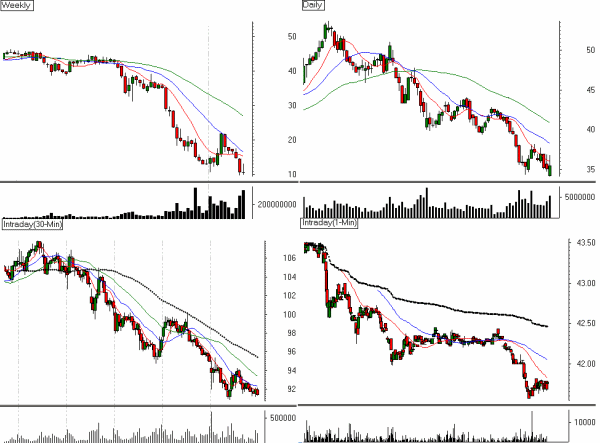
Note that trend reversals can occur early on. However, as more long participants are trapped with losses, fear-driven liquidation is more likely and typically will play out in multiple waves. Not only is there an absence of buyers; there is also an increasingly aggressive source of supply from who short sellers apply further pressure to the market. The obvious resulting technical signs of bearish enviornment take the stage -- lower lows which form below declining longer-term moving averages.

The stage four decline is market by lower lows and lower highs, regardless of time-frame. Notice the direction of the moving averages, they can be used to quickly identify "the path of least resistance."

It is easy and tempting to look at bounces in a primary downtrend and think there is an opportunity to make money form the long side, but simply math favors trading the short side. For example, when a stock drops three points, the only way it can remain in a downtrend is to rally less than three points as a counter trend rally ensues. On other words, the sum of the declines will always be greater than the sum of the rallies in a downtrend. Understanding the basis of trend trading (once a trend has been established, the more likely it is to continue than to reverse) increases the likelihood of further downside, and the declines will travel further than the corrective rallies within a downtrend. This creates a powerful reason to embrace short selling.

Picking bottoms is the hardest job on Wall Street, and frankly, nobody rings a bell at the market bottom. Yet for some reason there seems to be an attraction to declining prices among most participants. Natural human optimism and learned behavior of hunting for bargains in a retail environment provides a "slope of hope" along which stage four stocks, decline, crushing the dreams and finances of bewildered longs in its path.

We have all experienced the helpless feeling of searching every new source for a shred of bullishness to justify holding onto a stock in the face of declining prices. This fruitless action only delays the inevitable recognition of truth. It does not delay your losses. The is said that "it is better to be in cash wishing you were in a stock than it is be in a stock and wishing you were in cash." This is perhaps never truer than the point at which you are "foraging" for a reason to continue on a course that offers little promise.

For long participants, the stage four decline is market by two brands of fear:

  • Fear that the stock's descent will continue to wipe out their equity (a good fear to have as it may portend a proper action into cash).
  • Fear of feeling stupid for selling "the loser" at a point just before the stock turns higher (a bad fear to have). Do not fall prey to the short-term pauses in a primary downtrend; the short term action will typically be resolved in the direction of the larger, more powerful trend of the longer time-frame.

See the rest of this post by clicking HERE.

Non-Directional Option Techniques

Today I’d like to welcome Dave Rivera from DeltaNeutralTrading.com. Dave has been keeping me up to date on the latest options news and information. I can say that because of his emails and phone calls I’ve learned more about options trading then I ever thought I could. Enjoy his post below…and you’ll see what I mean

===============================================================

Please only use these examples for educational purposes.

Paper trade them.

I like to look at options in comparison to one another. I am looking at how much an option costs per day compared to an option from a different month in the same futures market. Let’s look at Gold.

October Gold futures contract closed at 953.60.

(September options follow the October futures contract)

September Gold options have 35 days left until expiration.

October Gold options have 65 days left until expiration.

Let’s look at the call side. If we thought the market was going to stay steady, we can look to put on some option spreads. We want to buy options that will lose less premium per day and per week than the options we will sell. We don’t know for sure what will happen but we can get an advantage by looking at the price per day of the options.

We will look at the money calls and the out of the money calls.

September Gold 950 Call options settled at 29.40.

October Gold 950 Call options settled at 41.20.

The October 950 Call is 1.4 times more expensive than

The September 950 Call, but it HAS 1.9 times more time left.

September Gold 1100 Call options settled at 1.90.

October Gold 1100 Call options settled at 7.70.

The October 1100 Call is 4.1 times more expensive than

The September 1100 Call, but it ONLY has 1.9 times more time left.

Normally traders will sell the front month and buy the further month. That is great with the at the money options but not true with the far out of the money options. When putting on any calendar spread, buy the cheaper cost per day options and sell the more expensive. Even if you are not putting on a spread, this is a great way to choose which option to buy or sell.

For more information on these non-directional option techniques, visit the link below:

Educational Non-Directional Option Techniques

take care,

dave

------------------------------------------------------------------------------------

If you’d like to learn more about Dave and his options insight check out his site DeltaNeutralTrading.com

The Dimensions of a Successful Trading Entity

In June I asked my friend Dean Whittingham from Traders Universe who wrote a GREAT post that got me, and our readers thinking. I asked Dean to see if he could write another piece that got us all thinking again...and I think the below article is exactly what we need!

================================================================

Many considerations go into creating and running a successful trading entity. We'll look at the most popular which get the most attention, right through to the most important, which usually get the least attention.

Here is the list:

1. Entry signals
2. Risk management
3. Exit signals

4. Reliability
5. Reward to Risk
6. Opportunity
7. Capital management

8. Objectives
9. Familiarity with Markets
10. Resources
11. Mindset
12. Style
13. Management

Most, and by most I mean probably close to 80-90% look at number 1 and that is it! That is a startling reality, but a reality nonetheless. But there is a reason this happens. Most new traders are unaware that such a large number of traders ultimately fail in this business, and more importantly, this fact is well known by the very people who market trading in this way.

But enough of that, let's look at some serious considerations you should make and the order in which you need to do it.

Objectives – Set a target, a goal, a reason. Without this, you can't create or find the right system for you. You won't know whether the system will work for you, or even if it is on track or not once you begin trading it.

Familiarity with the markets – Quite simply, markets move in similar patterns which is all good, but there are different costs, margins, hours of trade, laws etc associated with each market that need to be considered.

Resources – These are your physical and mental assets. Everything from your time, capital, computer, to your mental strengths forms your list of resources. Day traders need different resources to a long term trader, not only in hard assets but mentally too.

Mindset – This is part of your self-image. Your self-image influences your decision making process on a continual basis. It stands to reason a trader would only become successful if they were making the right decisions. You need to see yourself as a success first.

Style – This is something you'll need to work out way before you look at any system. Are you mechanical or discretionary, in other words, do you want a system to tell you what to do, or do you want to be analytical? Do you want to trade for growth or income (part of your objectives)? These sorts of styles all require different tools, and so it seems silly to purchase a system before you even know your preferred style.

Once you have these aspects thoroughly researched and sorted out, I can guarantee you that finding or creating the right system of entry and exit tools will become far easier and much more enjoyable too. You'll naturally be attracted to the type of market tools that suit you.

But even then, once you find the entry and exit tools that suit you, there is more work to do.

You need to back test and paper trade your entry and exit rules to determine the rest of the considerations mentioned above.

Reliability – How reliable is the system for producing winning trades compared to losing trades, and does this suit you? The latter part of this question is the most important part. The reliability of the system does not tell you its overall profitability. It tells you your ratio of winning trades to losing trades, and this is a psychological question. Do you need to be right more times than wrong? This is the simple question you need to answer.

Reward to Risk – What is the average profit per trade? This is your total net profits divided by your total number of trades (if your system has a net loss then it's no good - obviously). When you know the average profit per trade of your system over a decent sample, you can then determine the number of trades you need to make to reach your objectives.

Opportunity – Now that you know the number of trades you need to make over a time to reach your goals, you must determine whether or not your chosen markets will offer the opportunities you need. Will you need to trade in multiple markets, trade both long and short and so on?

Capital Management – If you do find that your chosen markets offer enough opportunities for you to reach your goals, you need to consider if your capital can handle it. Many systems will require multiple positions open at one time in order to reach goals in a specified time. This means your capital may be stretched, or may not even cope. The size of your positions in the market is a part of your capital management and is also determined by whether or not you have leverage and the margin required.

Risk Management – Risk is what you are willing to lose per trade. Your exit strategy aids in determining this factor, but it also needs to gel with you, because your risk per trade is a factor in your drawdown. The higher the risk, the higher the drawdowns and you need to know the maximum drawdown you're willing to tolerate.

Management – The final consideration we'll cover here is management. You are controlling an entity and so management of all key areas is important. If you log each trade, you can assess for human errors, bad habits, you can also assess costs associated with trading and whether or not they can be reduced. In fact management is the part of your trading that is always looking for ways to improve the running of the business.

If you look at the list above it can seem like a lot. If one was to think of what goes into creating the great business models like McDonald's, Starbucks and so on, then I don't think it even compares. But why should it be so daunting? Enjoy the process and it will be a lot easier than you think.

Happy Trading

Cheers,
Dean

A Traders Universe

Down Markets and the Fear of Shorting

Today's guest blog post couldn't come at a better time!! I asked Thierry Martin OnlineTradersForum.com.

==================================================================

Every time the market goes into a downtrend, I see many traders and
investors throw in the towel. They just can't keep their trading
skills working properly when the market goes into "reverse." This is
too bad, because these traders are losing out on trading opportunities
by getting out of the market when it is going down, or they trade
against the overall trend and lower their chances to make a profit.

One choice you have when you see a sustained downtrend, as we are
seeing currently, is to find a sector that is not following the
overall market. Even though most of the sectors or industries will
show the same down trend as the overall market there are always a
couple of sectors with rising trends. So if you really can't stomach
the idea of betting on a stock to go lower in value, then just find
the sector that is bucking the trend, scan for the best stocks in that
sector, do your research, whether it is fundamental, technical or
both, and trade in that area only. You won't have as big a palette to
choose stocks from, but at least you will be trading stocks that are
moving in the right direction if you insist on going long.

Another way to profit in a downtrend is to stop caring which way the
market is moving and make money by "shorting" stocks. For some reason,
many traders never get their minds around the concept of shorting and
so just stay away from it. If you are one of the traders who don't
understand shorting, here is a new way to look at it: When you short,
you are still buying low and selling high as you do when you are going
long. When you short a stock you are doing the selling high first, and
the buying low second. In other words, you are betting that the stock
is going down, so you sell it at the higher price first, then when it
(hopefully) drops in price, you buy it back to complete the trade. How
can you sell a stock before you buy it? Well, your broker will let you
borrow somebody else's stock to sell, with an obligation on your part
to replace it at whatever price it may cost you in the future to buy
it back. If you get to replace it at a lower price than you sold it
for, you get to keep the profits, and of course if you replace it a
higher price you lost on the trade.

So once you understand how shorting works, the only other skill you
need to develop is a way to overcome the psychological block you may
feel about betting on the negative. This is less of a problem with
Forex trading, because trades are always placed using pairs so when
one currency is going down the other one is going up, but with stocks
a lot of traders feel bad betting on a stock to fall. It is important
to overcome this resistance to betting on the negative because there
are huge profits to make by shorting stocks while the overall market
is collapsing.

A clever way to avoid the fear of shorting is to buy "puts" on stocks.
By buying an option to sell a stock at a future date, you get to bet
on the stock price dropping. When the option rises in value as the
stock drops in value, you can sell it just as you would sell a stock
that goes up in value. Since the leverage in options is quite
substantial, the profits you can make if the stock drops in value are
much higher than they are when you are just shorting. And you get to
make money by watching the instument you bought rise in value, instead
of hoping what you bought goes down in value as you do when you short
a stock outright.

Thierry Martin operates the popular stock trading forum
OnlineTradersForum.com & the new forex trading forum ForexSuperForum.com