Hedge Funds would kill for returns like these ...

Quarter 1 results are in... and we think you will be very impressed.

2008 has already been a roller-coaster ride. The after shock of record high oil prices, the sub-prime disaster and the credit crunch still have a profound impact on market direction. However the “Trade Triangle” technology once again prevailed in uneasy times.


Of course it would be easy to show you the results for a cherry picked group of great performers. However, to show consistency we have analyzed the same commodities, indexes and precious metals that we have used for our quarter results in 2007. We are using the same “Trade Triangle” method to show how you could have entered and exited the market with limited losses and plentiful profits.

The “Trade Triangle” technology can work for all types of trader. By working a filtering method into your trading plan, you are reducing risk and putting the odds in your favor that the market will move in the direction of a longer term trend.

So how did MarketClub do for Q1 of 2008, well watch and see...

Let us know what you think. You can email

su*****@in*.com


or call one of our support staff at 410.867-2100.

Cheers,

Adam Hewison
President, INO.com

Looking for pockets of dollar strength - Greenback's weakness is neither relentless nor without exceptions

SAN FRANCISCO (MarketWatch) -- One hears so much about the battered dollar lately that it's easy to forget the greenback is beating up a few of its major rivals, and will likely continue to do so this month -- and might even take a swing at some of the big bullies that have been knocking it down the most.

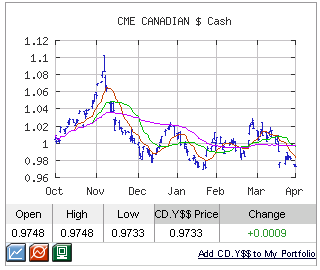
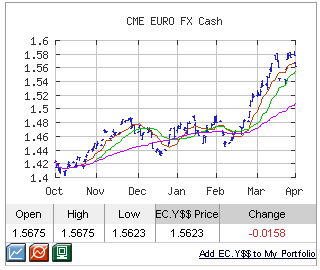
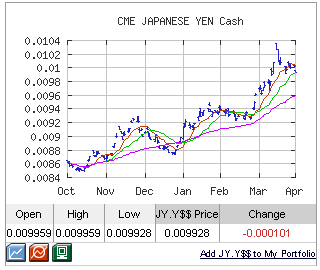
Investors betting on a further dollar fall against the euro and the yen should prepare for the possibility that the dollar could make up a bit of lost ground against either one - or possibly both. Moreover, the dollar is likely to keep gaining on its Canadian counterpart, which has been hurt by lower U.S. growth prospects.
"In April we are expecting to see further stabilization and a modest recovery in the U.S. dollar. This will create a foundation for a more sustained recovery later in the year," said Adam Hewison, president of MarketClub.com, an Annapolis, Maryland-based a technical analysis site.

"It would appear that U.S. interest rates are at or close to their lows for the year. We had been looking for the Fed funds rate to trade down to the 2 to 2 .5%-level. We feel the market has achieved that downside target zone," said Hewison.

'Poor ol' loonie'

The dollar has gained more than 3% against the Canadian dollar this year.
The loonie, as it is commonly called, is a commodity-linked currency, meaning it usually rises and falls in line with crude oil futures, which are priced in dollars. But this time, its fall coincided with a record rise in crude futures, with the front-month contract up more than 5% so far in the first three months of 2008.
The Canadian dollar "slumped despite rising oil price because of the bigger picture fact that 80% of exports go to the U.S. and that geographically its, well, right there on the doorstep," said Andrew Wilkinson, senior market analyst at Interactive Brokers.

This point was not lost on Canada's central bank, which cut its benchmark interest rate by a half-percentage point to 3.5% early last month and laid the blame south of the border.

"The deterioration in economic and financial conditions in the United States can be expected to have significant spillover effects on the global economy. These developments suggest that important downside risks to Canada's economic outlook that were identified are materializing and, in some respects, intensifying," the Bank of Canada said the day it cut rates.
And higher oil prices would make it worse, not better.

Rather than lift the Canadian dollar, as they often did in the past, high oil prices "could worsen the outlook for U.S. consumer spending and therefore Canadian output, exerting more pressure on the poor ol' loonie," said Wilkinson.

Euro, yen

Analysts are mixed when it comes to how the buck will fare in the coming weeks against the big two: the euro and the yen. So far, the euro has gained more than 8% this year against the dollar, while the latter shed about 11% against Japan's currency.

While many see pressure on the dollar continuing, some say there's a chance the dollar could regain lost ground by the end of April.
Last month, the Ides of March were literally a day late and a dollar short -- a dollar short-sell opportunity, that is.

On Sunday, March 16, the Federal Reserve took the extraordinary step of cutting its discount rate by a quarter percentage point to 3.25% and offered to lend money to an unprecedented list of firms. This, combined with news of J.P. Morgan's Fed-blessed firesale purchase of ailing brokerage Bear Stearns Cos., sent the greenback plunging in early trading Monday.
The euro topped at $1.5903, its highest level since it began trading in January 1999. Against Japan's currency, the dollar slid to a new 12-year low of 95.75 yen.
But even some analysts who think the euro still has upside potential don't expect April to end on a high note for the European unit.


"I think the market will take the euro through its record highs in the coming week and in April will probably come a bit lower," said Meg Browne, strategist at Brown Brothers Harriman. "April could see the euro come off its new high."

Part of this, she said, it due to low expectations for U.S. economic data, making market positions vulnerable to an upside surprise - or a downside surprise in the eurozone, where the effects of the strong currency could begin to show up.

"The market's priced in a lot of negative U.S. news," she said.

"If there is any sign of improvement in the next month's worth of housing or manufacturing data or some sign consumption's not so bad, and if we see signs of weakness in Europe -- maybe it becomes more apparent that non-German countries are deteriorating, or if German data somehow weakens -- sentiment is likely to shift in favor of the buck," said Browne.

Against the yen, the dollar is still trading significantly above its post-World War II low of 79.85, set in April 1995, and some analysts don't expect to see anything around that level anytime soon.

"The Japanese outlook is increasingly fraught with risk, and there is little to no expectation of confident leadership through any turmoil," wrote David Watt, senior currency strategist at RBC Capital Markets.

"Apart from carry trade unwinding and risk aversion, there is little to no reason to be bullish on Japanese yen. As a result, data releases will likely pose more upside risk to dollar/yen than downside risk, particularly those that suggest the Japanese economy is slowing," he said.


Lisa Twaronite reports for MarketWatch from San Francisco.
MarketWatch is a register trademark of Dow Jones News


Gold back above $950 on weak dollar, firm oil

Wednesday March 26 2008


By Frank Tang and Atul Prakash

NEW YORK/LONDON, March 26 (Reuters) - Gold ended higher and near a one-week high above $950 an ounce on Wednesday as a falling dollar and strong oil prices encouraged investors to shift money back into the market after last week's heavy sell-off.

However, gold could further consolidate before testing new highs after a tumultuous price drop last week had put a damper on the yellow metal's run, market watchers said.

Gold rose as high as $951.60 an ounce and was at $949.00/949.80 by New York's last quote at 2:15 p.m. EDT (1815 GMT), against $934.60/935.40 late in New York on Tuesday.

"We saw some pretty big falls last week and there has certainly been an increase in buying over the last day or so from investors who think those falls were overdone," said Daniel Hynes, metals strategist at Merrill Lynch.

Gold hit a record of $1,030.80 on March 17 before a broad sell-off in commodities dragged down prices to a one-month low of $904.65, briefly hurting investor confidence in the metal, seen as an alternative investment and a hedge against inflation.

The dollar slumped for a second straight session after an unexpected fall in U.S. durable goods orders bolstered worries about the economy's health, which could prompt further interest rate cuts.

Higher-than-expected U.S. new home sales numbers also failed to stop a slide in the dollar.

A weaker dollar makes gold cheaper for holders of other currencies and often lifts bullion demand. The metal is also generally seen as a hedge against oil-led inflation.

Soaring energy prices boosted gold's appeal as a hedge against inflation. U.S. crude futures ended up $4.68 at $105.90 a barrel.

"We are still going to have another leg up towards $1,000, but I think it might be slower than the run up we saw the last time," said Suki Cooper, metals analyst at Barclays Capital.

In other markets, the active U.S. gold contract for April delivery on the COMEX division of the New York Mercantile Exchange settled up $14.20, or 1.5 percent, at $949.20 an ounce.

OUTLOOK CAUTIOUS

However, dealers said that gold could run into strong resistance due to chart-based weakness and lost momentum among gold bulls.

"This rally that we are seeing (now) is just a corrective rally. I think it's going to have problems between $965 to $980, and you will see professional selling coming to the market at that point of time," said Adam Hewison, president of MarketClub.com, Annapolis, Maryland.

James Steel, metals analyst with HSBC in New York, told clients in a note that commodities prices, including gold and other precious metals, had ample opportunity to extend declines further during the recent correction because investors had reduced or eliminated their exposure to commodities.

Platinum was supported by supply fears due to the power crisis in top producer South Africa. Palladium and silver also firmed but remained below their recent highs.

Spot platinum rose 1.5 percent to $1,990/2,000 an ounce from $1,960/1,970 late in New York on Tuesday. It hit a record high of $2,290 on March 4.

South Africa's Public Enterprises Minister Alec Erwin said on Tuesday that power utility Eskom's ability to raise capital could be undermined if it was not allowed to raise tariffs.

Eskom has struggled to cope with rising demand due to years of underspending on generating capacity. The energy grid came close to collapse in January, forcing gold and platinum mines to shut down for five days and driving platinum to record peaks.

Silver rose to $18.38/18.43 from its Tuesday U.S. close of $17.78/17.83 an ounce, while palladium was up at $453/458 an ounce, versus $442/447 in the U.S. market late on Tuesday. (Editing by Christian Wiessner) (Additional reporting by Bate Felix in London)


Reuters is a registered trademark of Reuters