Check out Adam's interview on TraderInterviews.com . This is a re-cap of the SEC Rule Change from the post on August 3rd of 2007. This site has a large archive of interviews from various traders on numerous topics a great site for any style trader!
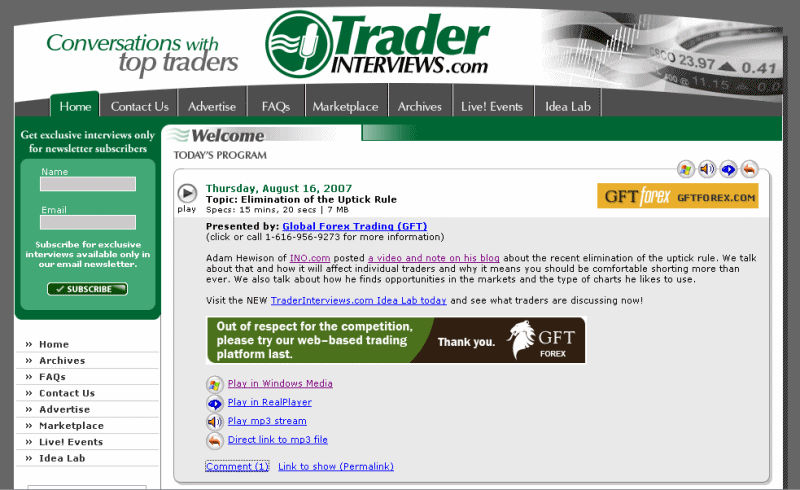
Check out Adam's interview on TraderInterviews.com . This is a re-cap of the SEC Rule Change from the post on August 3rd of 2007. This site has a large archive of interviews from various traders on numerous topics a great site for any style trader!

- Courtesy of Chuck from Rebel Traders -
Someone once asked me...
Well that is a question that any sane person would ask, and it makes perfect sense why someone would ask a question like that. Isn't the whole concept of buying stocks to buy low and sell high? The answer is that even though you may believe a stock (and the company behind the stock) is good we traders need to know how the market thinks of them. It does not matter what we think, but what does the people in the market with money think... that is the key!
Perhaps you have heard good things about a company and their products, maybe something about a good management team, or perhaps they have released some incredibly good sales data. Some nice starting points for any investment research. But what does the market think about them? I'm not talking about analysts at the big investment firms (who may have their own agenda) but what do the people with money in their pockets and big investors think of the company?
To answer that question we read the tape. Yep, reading the tape (technical analysis of the charts). Understanding the price movement of a stock is reading right into the minds of the investors putting their money into (or taking money out of) the stock. It is important to remember that any stock price moves up or down for only one reason. And that reason is people moving their money... in or out of the stock.
The science of technical analysis of stock charts is the study of human behavior. By interpreting the movements on the charts we are seeing the greed & fear behind the scenes of the people with the money. When we see a stock price begin to fall and the number of people selling is tiny compared to when the price was going up that tells us that as a collective the majority of the money is "sticking with it". Only a small amount of people are taking money out. On the other hand when we see a large number of people (volume) taking money out as compared to the volume when the price was going up then we have a big warning sign before us. It is telling us that the mass collective thinking on the stock is to "get out".

WHO ARE THEY?
HOW DO THESE FUNDS WORK?
Long-Only Commodity Funds (LOCF) and ETFs are the 800 pound gorilla in the room that can no longer be ignored. These funds are big, slow, and powerful. By understanding how they function an investor can profit from the inherent predictability of these funds.
Long-Only Commodity Funds invest in a variety of futures contracts, creating a basket of commodities. Energy related commodities comprise the largest percentage of the contracts held totaling 50-75% of the total portfolio. This is due to the significance of the products both domestically and globally. Energy contracts included in the “basket” are Crude oil, heating oil, and natural gas. Other commodities included in these funds are precious and base metals, grains, meats, sugar, and coffee. The largest of these Funds is the Goldman Sach’s Commodities Index (GSCI) with approximately $55 Bil dollars invested. Other notable LOCFs include the Dow Jones AIG Commodity Index, the Deutsche Bank Liquid Commodity Index (DBLCI) and the Rogers Commodity Index.
To understand how these funds operate, let’s look at the GSCI. This Fund holds long positions in the nearby futures contract for every commodity in it’s portfolio. As expiration of the futures contracts approaches, the fund will liquidate (sell) it’s entire position in the current month and establish a new position (buy) in the next active month. This action of selling the nearby futures contract and buying the next contract month is called “the Goldman Roll” and is done between the 5th and the 9th of every month.
CAN THE COMMODITY BULL MARKET CONTINUE?
CAN THESE FUND HOLDERS CONTINUE TO MAKE MONEY?
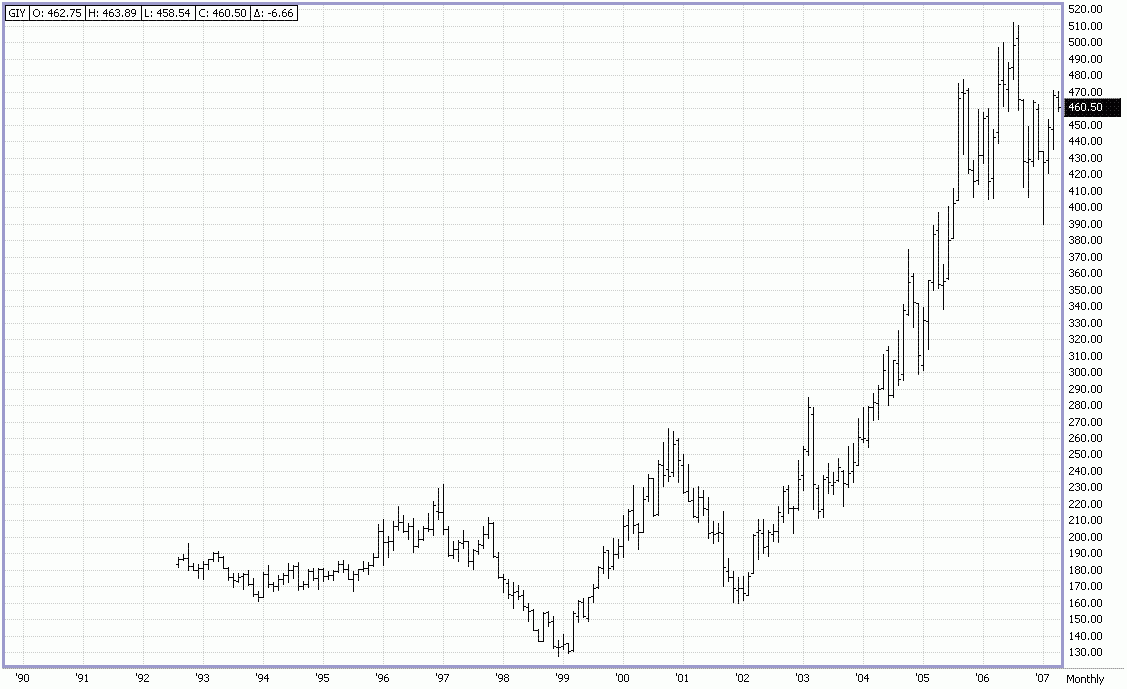
In the author’s opinion, these Funds are a terrible investment and you should stay away from them. Yes, commodity prices may continue their rise in the future. However, it’s inevitable that prices will get too high and the weight of higher production, will force prices back down. The commodity bull market is very much like the bull market in stocks in the late 1990s. During that time, money was pouring into Mutual Funds at an unprecedented rate. This caused stock markets to move higher and higher until they greatly exceeded any reasonable fundamental valuation. The same is true for commodity prices. Investor demand rather than true supply/demand fundamentals are constantly driving prices higher. Eventually, commodity producers will dramatically increase production to profit from higher prices and prices will violently correct downward.

THE GOLDMAN SACHS COMMODITY INDEX MONTHLY CHART: AS MONEY HAS FLOODED INTO THIS INDEX, PRICES HAVE CONTINUED HIGHER. HOW LONG CAN THIS TREND CONTINUE?
A better alternative is to stick to a profitable trading program, or a Commodity Trading Advisor (CTA) that can profit from large moves but will liquidate their position in the commodity before the price crashes back down. The best alternative is to find an experienced CTA that will go short the market and profit from a price crash.
HOW TO PROFIT FROM LOCF!
When trying to profit from LOCF, it is important to know the characteristics of these funds. First, these funds make up a large percentage of the open interest in many commodity futures contracts but they rarely adjust their position sizes. Therefore, during periods when investors holding short positions are likely to reduce their position size, these Funds will continue to hold their massive long positions. This can cause an explosion in prices to the upside. As buying pressure intensifies due to a lack of sellers, many participants holding short positions are forced to cover as the rally intensifies. During this period, very few participants (led by the LOCF) holding long positions are taking profits and are often increasing their long positions.
Example:
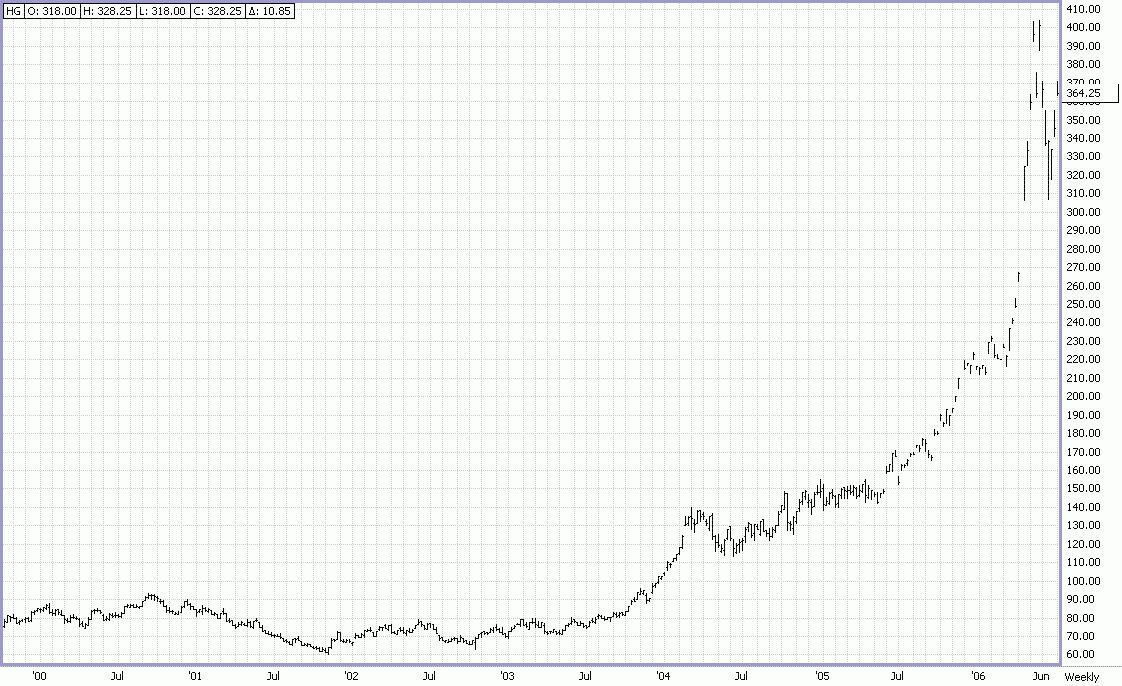
Copper: See weekly chart below.
For most of the last 30 years, copper has traded in a range between 60 cents and $1.60.
In 2003-2004, prices moved slowly but steadily higher, reflecting strong worldwide demand for copper and the emergence of LOCF which began accumulating long positions. However, in 2005 and 2006, LOCF grew by leaps and bounds. This resulted in large steady buying of copper futures, which sent prices rocketing higher. Compounding this was the fact that these funds never took profits and stayed with their positions no matter how high prices reached. Copper prices were forced to constantly move higher in an attempt to find new sellers to meet the demand. Eventually, prices will stay high enough for l ong enough to allow copper mining companies to dramatically raise production, which will eventually cause a total collapse of the price.

As LOCF continued to grow in size in 2005 and 2006, they bought large quantities of copper contracts. This mixed with positive fundamentals led to an unprecedented rally in copper prices.
PROFIT STRATEGY #1: Always buy upside breakouts in these commodities and exit quickly if the momentum ends.
PROFIT STRATEGY #2: Sell Short commodities under the following conditions 1) Prices have gone to an excessively high level and stayed there long enough for producers to increase production 2) Momentum is turning negative. 3) Exit short positions if momentum turns positive again.
PROFIT STRATEGY#3: Find a unique strategy for spread trading that is not well known and that can profit from the movement of money caused by LOCF.
The final and potentially most powerful strategy for profiting from LOCF is through spread trading. When these funds roll their long positions from the nearby futures contract to the next one (“the Goldman Roll”), the impact on the spreads between contract months is dramatic. Many professional traders have made fortunes over the years by trading in advance of the Goldman Roll. However, with so many traders aware of this opportunity, it is crucial for traders to find unique and creative ways to profit from this market moving event.
One unique and profitable spread trading program is the Platinum Commodity Spreads Program or PCSP offered by Platinum Trading Solutions and traded by VanKar Trading Corp. This program uses state of the art software that tracks the movement of money in and out of the spreads affected by the LOCF. In doing so, it is able to identify profitable spread trading opportunities. In 2007, this program has completed a total of 23 actual trades in customer accounts using a variety of commodity spreads with the following results.
2007 ACTUAL TRADES
Total Trades 23
Profitable Trades 17
Losing Trades 6
Total of Profitable Trades $14,863.90
Total of Losing Trades $ -2,252.95
Total Net Profit $12,610.95
Average Profit per Spread $ 548.30
These results are based on trading a single spread per trade. Because spreads typically have much lower margin rates than outright futures positions, traders are able to hold larger positions and therefore make substantial profits should the current winning ways continue.
CONCLUSION
The Long Only Commodity Funds are a powerful force that is likely to dominate the market for years to come. Like any major force in the markets, full understanding and creative thinking will allow you to profit handsomely from this market condition.
For more information, please visit:
http://www.ino.com/specials/platinum/spread4.html


[Courtesy of The Financial Whiz . com...]


One of the approaches that the Indiana University of Pennsylvania Student Managed Investment Portfolio utilizes to value companies is known as the Comparable Ratio Valuation. This method uses a spreadsheet that I developed last year in allowing a potential investment to be compared against its closet competitors to find a company’s “intrinsic value.” While this approach may ignore fundamental flaws in a company’s business model, it gives an investor a good base to start analyzing potential stocks to invest in.
To download a copy of the valuation spreadsheet model, please visit: http://www.iupsmip.com/component/
option,com_remository/Itemid,36/func,startdown/id,100/
In the above spreadsheet example, an analysis of Amgen (AMGN) was done and the spreadsheet ultimately found the company to be trading at a discount of about 19% to its peers.
This spreadsheet is not the only determining factor in an investment decision; the sheet is preliminary a tool to analyze and identify stocks that will require more detailed research before a final decision can be made. The twenty minutes that it takes to input the numbers into the spreadsheet will save you roughly two hours or more compiling due diligence. In a future post, I will present the SMIP’s fundamental analysis worksheet that must be completed prior to the company being presented to the team.
At first, the spreadsheet is somewhat difficult to maneuver, but I will guide you through the process.
The areas highlighted in green are areas that will require you to input information to be used in compiling the intrinsic value of the company.
Company Inputs Section:
The data to be used here can be found at the links provided, but when analyzing a different company, please replace the ticker symbol with that of your company.
|
Item |
Can Be Found at |
|
Price Per Share: |
|
|
EPS (Earnings Per Share): $4.41 |
http://finance.yahoo.com/q/ae?s= |
|
Growth Rate: |
the bottom of the page of the following link http://finance.yahoo.com/q/ae?s=
|
|
Market Cap: |
http://finance.yahoo.com/q?s= |
|
Sales: |
the Key Statistics in the Income Statement section at http://finance.yahoo.com/q/ |
|
Book Value |
the bottom of the page at http://finance.yahoo.com/q/ks?s= |
|
Cashflow per |
http://finapps.forbes.com/finapps/
|
|
Shares Outstanding (mil): 1,160.00 |
http://finance.yahoo.com/q/ks?s=
|
|
EBITDA (mil): |
http://finance.yahoo.com/q/ks?s=
|
|
Enterprise Value |
http://finance.yahoo.com/q/ks?s= |
|
PEG Ratio: 1.23 |
http://finance.yahoo.com/q/ks?s= |
AMGN Competitors Section:
To get a good start on which companies to use as your comparable analysis, you should visit http://finance.yahoo.com/q/co?s=AMGN and http://finance.google.com/finance?q=AMGN and look under the Related Companies section. You want to find a sample of 5-6 related companies to input their valuation ratios to value your company. When selecting companies to use as comparables, you should look for companies that have a market cap above $250 million.
I will give an example of how to collect the information for the first competitor on the list BAX, Baxter International. You will need to collect the following information:
|
Item |
Can Be Found at |
|
P/E Ratio: 24.8 |
http://finance.yahoo.com/q/ks?s=BAX as the Forward P/E under the Valuation Measures |
|
PEG Ratio: 1.72 |
http://finance.yahoo.com/q/ks?s=BAX as the PEG Ratio under Valuation Measures |
|
P/S Ratio (Price to Sales): 3.48 |
http://finance.yahoo.com/q/ks?s=BAX as the Price to Sales Ratio under Valuation Measures |
|
EV/EBITDA: 14.32 |
http://finance.yahoo.com/q/ks?s=BAX as the Enterprise Value/EBITDA under Valuation Measures |
|
Price/ |
http://finapps.forbes.com/finapps/jsp/ |
|
Price/Book: 5.6 |
http://finance.yahoo.com/q/ks?s=BAX as the Price/Book Ratio under Valuation Measures |
After this step, repeat the above processes for the other 4-5 competitors. If the ratio is not available for a company, just leave that section blank so it will not be used in the valuation calculation. If one company’s ratio is an outlier as compared to the other companies in the spreadsheet, consider leaving that section blank so it will not give an artificially high intrinsic value.
The Intrinsic Price Calculation:
The spreadsheet then takes the average of the 5-6 competitors’ ratios and then applies those ratios to the information provided about the main company under analysis. It then gives a price of the company for each of the valuation ratios: Price/Earnings, PEG, Price/Sales, EV/EBITDA, Price/Cashflow, and Price/Book. All of the prices that are given from those ratios are then averaged together to give the “Average Intrinsic Price”, which is then compared to the current stock price. Finally, a percentage drawn from these calculations shows if the company is overvalued or undervalued—and by how much it is. If the percentage is positive, then the company is undervalued as compared to its peers, and if the percentage is negative, then the company is overvalued.
I hope you enjoy as much as I did!


Email me with any ideas, questions, or comments.
Lindsay Bittinger
li*****@in*.com
Good Monday Morning,
Not covered much in the financial press in this country, but this week is a major holiday in China (May 1 to May 7)- the Labor Day holiday, which is one of the three 'Golden Weeks' that Chinese celebrate each year. The others are the Chinese Lunar New Year in February and the National Day holiday during the first week of October. On Tuesday, May 8, one day ahead of the FOMC announcement here in the U.S. the Shanghai market re-opens. In is my view that pent-up demand for stocks could make that one of the biggest up days in recent history. I am, of course, referring to the hot Shanghai Stock Index (herein recommended to our Platinum subscribers). That index after hitting a new low less than two years ago is now up over 270%. Since our markets are now following China, this information is vital to your trading and investing strategy. The play? Buy CAF!
I suspect that with all the talk of a 'Sell May and Go Away' strategy and with the technical tea leaves showing potential downside risk - even the best of us can get fooled as the market explodes yet higher and higher leaving the skeptics in the dust. Of course, this is not a market for the faint of heart and with all dramatic gains you have to be able to withstand the inevitable correction - so don't put all you eggs in one basket.
As you know, next Wednesday's FOMC meeting will be the focus of most analyst comments. It is clear Bernanke (with co-conspirator Paulsen) will do nothing to rock the boat. More than likely rates will remain unchanged. Behind the scenes, however, they have been busy as beavers driving the Dollar lower by opening the floodgates to liquidity and likely intervening with the Plunge Protection Team to give the Dow Industrials an added 'push' now and then to keep the momentum going. It is clear that housing weakness has been a financial and emotional drag on the individual investor and the economy. A balance has to be provided and that balance is the stock market surging to and staying at new highs! It's all very simple. It's called economic engineering!
My first Dow Industrial target of 13,300 has been more or less realized, but that still leaves open 13,600 and 13,800 over the near-term with higher measurements possible. For those watch my interview on PBS' 'The Nightly Business Report' last October (next interview coming up May 25, 2007), you know I predicted the Dow Industrials would see 13,600 in the months ahead. I don't believe anyone on the 'Street' made such a call.
---------------------------------------------
I've been invited back to appear on 'The Nightly Business Report' with my old friend, Paul Kangas, Friday evening, May 25. Unsure whether I will do it via satellite or in person in the Miami studios, but in either event I don't think it will be as exciting as my October appearance at the Nasdaq Market Site in Time Square where I predicted a move
Great Trading,
Mark Leibovit
http://www.vrtrader.com/vr_forecaster/index.asp
"TIMER DIGEST has named Mark Leibovit of VRTrader.com 'TIMER OF THE YEAR' for 2006 and he currently stands in the #2 Position for 2007!"
You are now leaving a Magnifi Communities’ website and are going to a website that is not operated by Magnifi Communities. This website is operated by Magnifi LLC, an SEC registered investment adviser affiliated with Magnifi Communities.
Magnifi Communities does not endorse this website, its sponsor, or any of the policies, activities, products, or services offered on the site. We are not responsible for the content or availability of linked site.