We knew this would happen!!!

First published March 16, 2008 under: Here’s why everything is hitting the fan at the same time.

Here's the original post.

After safely protecting investors for over six decades, a little known SEC rule was quietly removed on July 6, 2007.

With the removal of this rule all the rules of trading and investing in the market went out the window.

One of the reasons for the market's current volatility is a direct result of this rule change.

This major SEC rule was designed to protect investors.

With the removal of this rule, professional traders and hedge funds will be able to suck money out of the market and your portfolio in no time flat.

Why this rule that has stood the test of time since 1938 and was put in place to protect investors was removed is a big mystery.

Why now?

Here's what I suspect happened... some large hedge funds got together and lobbied to have this major trading rule removed.

It's just that simple. Why else would the SEC act out of the blue and remove this very important investor safe guard?

I suspect with this rule change the hedge funds have just been given the keys to Fort Knox.

I made this video last year but it details how this new ruling will effect you. The video explains in every day language what you can do to protect your capital from the hedge fund gunslingers and professional traders.

Watch the video as my guest. No registration required.

After you view the video you will have the knowledge on how to protect your portfolio, while at the same time reducing your risk exposure.


Adam Hewison
President INO.com

"Saturday Seminar" - A Game Plan For Investing In The 21st Century

The financial landscape has been changed forever by the widespread acceptance of the Internet. Understanding the driving principles for this new economy of the twenty-first century is a must. The invention and subsequent development of the Internet has brought new companies to trade, extended trading hours, introduced trading online, and made worldwide information instantly available. The one thing that hasn't changed is supply and demand. The same concepts that have affected the prices of produce in the supermarket for decades affect the change of stock prices on Wall Street as well.

Tom will help you develop a game plan for understanding the imbalances between supply and demand in stock prices. Tom will discuss market risk, sector rotation and individual stock selection, all using Point & Figure methodology. His straightforward, enthusiastic and always entertaining presentation will leave you with strategies for successfully managing risk in the stock market for the twenty-first century.

Tom DorseyTom Dorsey is well known in the financial community. Representing the major stock exchanges in the United States, conducting Risk Management seminars across the country for industry professionals as well as individual investors

Author of numerous articles on equity market and options analysis for such publications as; The Wall Street Journal, Barron's, Technical Analysis of Stocks and Commodities Magazine, and Futures Magazine.

---

Saturday Seminars are just a taste of the power of INO TV. The web's only online video and audio library for trading education. So watch four videos in our free version of INO TV click here.

INO TV

Traders Toolbox: Elliott Wave Theory

MarketClub is known for our "Trade Triangle" technology. However, if you have used other technical analysis indicators previously, you can use a combination of the studies and other techniques in conjunction with the "Trade Triangles" to further confirm trends.

Elliott Wave Theory categorizes price movement in terms of predictable waves. Beginning in the late 1980s, R.N. Elliott developed his own concept of price waves and their predictive qualities. In Elliott theory, waves moving with the trend are called impulse waves, while waves moving against it are called corrective waves.

Impulse waves are broken down into five primary price movements, while correction waves are broken down into three. An impulse wave is always followed by a correction wave, so any complete wave cycle will contain either distinct price movements. Breaking down the primary waves of the impulse, correction wave cycle into sub-waves produces a wave count of 34 (21 from the impulse wave plus 13 from the correction wave), producing more Fibonacci numbers. Elliott analysis can be applied to time frames as short as 15 minutes or as long as decades, with smaller waves functioning as subwaves of larger waves, which are in turn sub-waves of still larger formations. By analyzing price charts and maintaining wave counts, you can determine price objectives and reversal points.

A key element of Elliott analysis is defining the wave context you are in: Are you presently in an impulse wave uptrend, or is it just he correction wave of a larger downtrend? The larger the time frame you analyze, the larger the trend or wave you find yourself in. Because waves are almost never straightforward, but are instead composed of numerous sub-waves and minor aberrations, clearly defining waves (especially correction wave) is as much an art as any other kind of chart analysis.

Fibonacci ratios play a conspicuous role in establishing price objectives in Elliott theory. In an impulse wave, the three principal waves moving in the direction of the trend are separated by two smaller waves moving against the trend. Elliotticians often forecast the tops or bottoms of upcoming waves by multiplying precious waves by a Fibonacci ratio. For example, to estimate a price objective for wave III, multiply wave I by the Fibonacci ratio of 1.618 and add it to the bottom of wave II for a price target. Fibonacci numbers also are evident in the time it takes for price patterns to develop and cycles to complete.

---

You can learn more about the Elliott Wave Theory by visiting INO TV.

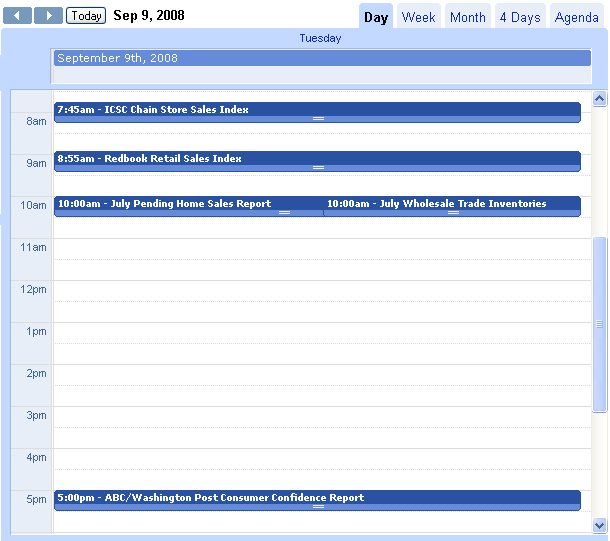
Report Calendar for September 9th, 2008

As I was walking out of the office today, I noticed on my calendar that tomorrow is the day for a few major reports to be issued in the housing and retail sectors. Just something to keep an eye on. Have a wonderful evening.

Best,

Lindsay Thompson
Director of New Business Development
INO.com & MarketClub.com

---

TRADERS CONTEST: Do you have a good trading story? First prize is an Apple iTouch! Enter your story here. There is no entry fee.

---

Traders Toolbox: How to use the Directional Movement Index

The Directional Movement Index, commonly called the DMI, is a powerful trend-following indicator. Many false signals generated by indicators such as the stochastics are filtered out by the DMI. Subsequently, this trading and analytical tool gives few signals, but, when generated, they tend to be very reliable.

Many, who at first glance are strangers to the DMI, find they are familiar with the prime component of the index: The ADX or average directional movement index. This discussion will center on the main use of the ADX, the turning point concept.

The DMI consists of three components: The + DI, which represents upward directional movement; the - DI, indicating downward movement; and the ADX, which signifies the average directional movement within a market.

In STRONG UPTRENDING moves, such as the late 1989 and early 1990 rally in the CRB, the + DI and the ADX turn up early in the move and move higher, with the + DI generally holding above the ADX. A high probability signal the uptrend has stalled or ended is generated when the ADX crosses above the +DI and turns down. This signal commonly occurs on the trading period of the trend change or slightly before. It rarely takes more than a few periods past a true trend shift to see the ADX turn down.

The rules for signalling a potential bottom are the same as for a top: Simply substitute the - DI for the + DI. There appears to be one slight difference between tops and bottoms: Generally, the ADX turns from a higher level when marking a top.

Several chart services plot only the ADX. In these instances, it can generally be assumed that a downturn in the ADX which occurs after crossing above 40 will have seen the ADX cross above the + DI if the market had been in an uptrend and above the -DI if in a downtrend. In simple terms, a move by the ADX above 40 followed by a downturn generally signals a probable trend change.

Signals such as those which occurred in May, 1990 and February, 1991 in the CRB index (arrows) can be very valuable in confirming a turn which had been projected by unrelated methods of technical analysis. ADX signals can help confirm the expected completion of a wave structure or to underscore a turn within a critical time period.

The DMI is based on a certain number of periods. I have had the most success with 14 days on daily charts. And with the exception of Treasury Bonds, for which I use 14 weeks, I prefer to use 9 periods on the weekly and monthly charts.

Editors note: While the examples shown are somewhat dated the concept and use of the ADX is not. The ADX indicator is available on MarketClub.