Tape Reading

For today's guest blog post, I've asked Kunal Vakil from MySMP.com to come back and teach us a bit about Tape Reading.

===================================================================

By Kunal Vakil, co-founder of http://www.mysmp.com/

08/12/2008

What is the Time and Sales Window?

From my experience in day trading over the last few years, my most valuable tool became the time and sales window, aka. the "Tape". The time and sales window basically shows the trader detailed information regarding the order flow for a particular security. The time and sales window provides details on each of the trades that have gone through for that security, such as: Time of Trade, Price, Size of order, and condition of order. Depending on the trading platform, you will have other data points available to you.
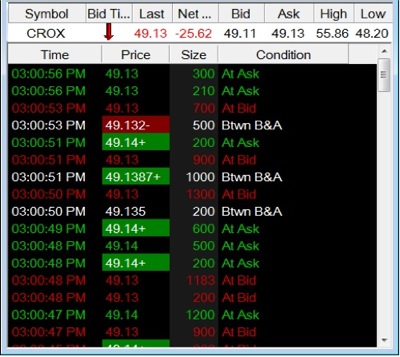
After mastering the message of the tape, you will be able to accurately decide when to enter and exit a trade.

How do I get access to the Time and Sales Window?

There are few brokers in the marketplace that offer the time and sales window to their customers. Typically, only trading platforms which are suited for day traders offer this option. I use Tradestation and as you can see in the image above, provides all the key elements that will allow one to effectively read the tape.

How to Use the Time and Sales Window

I am a very big believer that there are two truths in trading stocks. One is price and the other is volume. Tape reading involves both; and if used correctly, dramatically increases the odds of your trading working out. It does so due to the fact that your goal with tape reading is to follow the money.

While some professional traders may not like to admit it, trading stocks is an odds game. Your job as a trader is to put trades on with the highest odds of winning. Trading with the tape requires trading with patience. You cannot go out and buy or short a stock because you see the tape speeding up a bit. You need to be aware of support and resistance levels and also combine the message of the tape with price pattern formations.

Tape reading can be very fast and confusing at times and requires quite a bit of practice in order to get used to understanding the true meaning behind what you are seeing. Remember, every stock is a different story and tends to trade differently. It is wise to review the way in which the "tape" trades for a couple of minutes before entering a trade. Reading the tape requires you to train your eyes to scan for changes in character. I want to discuss a few of these key changes that you should take note of:

Size of Orders

Lets start with size. The size of the orders coming through will help you decide if there is conviction behind the price action you are seeing. When putting on a trade, you typically want to see a flurry of buy or sell orders which have greater than 300 to 400 shares in size. There is no hard and fast rule about this; it is more of a visual cue that your eye gets trained to recognize. Many times, I will see great technical setups in stocks that trade low volume. I stay away from these setups as the message of the tape is not as clear and this lowers my odds of a winning trade.

Order Speed

The speed of the orders is another key component to the message that the tape is giving you. Typically, when stocks breakout through support or resistance levels, not only will the size of the orders go higher but you will see the tape start to speed up. This gives you an indication that there is an interest in this stock at this level and that the interest is larger than a couple small traders buying or selling.

Order Condition

Order condition refers to which side of the bid/ask spread the trade was executed on. When we go long a stock, we want to see many orders being executed at ASK. Conversely, when we go short, we want to see orders being filled at BID. This gives us a clue as how desperate traders are to get into our out of this stock.

Speaking from Experience...

Above, I have reviewed a few basic principles of tape reading but I want to discuss some of lessons I have learned throughout my years of trading that I think you will find helpful when analyzing the tape.

Which stocks are best to trade?

I have received this question many times. The answer to this question for me is simple, I only trade the most volatile stocks of the day. These stocks are the ones which will provide you with strong volume and large interest from the public. They also provide strong and fast moves which you can make larger profits from. Remember, we need to see speed in the tape and that requires a stock with public interest.

Does the tape work better during specific times of the day?

In my experience, the answer to this question is YES. I typically only trade the first 2 hours of the day. This is when the most volatility is present in the market and also when most of the trending moves are made. Typically, lunchtime becomes very choppy and has a different group of traders who are buying or selling for different reasons than the first hour. I am not ruling out trading after lunchtime, however, my results have been less than stellar when I attempted to do so.

Tape Reading with Level 2

The level 2 window provides the trader with an edge. It will show you the sizes of the orders in the market makers book. While the market makers can play games with the level 2 in order to fool traders, in general you want to see high bid sizes and low ask sizes when you go long. On the flip side, you want to see low bid sizes and high ask sizes when you go short or sell out of a stock. Again, its not foolproof but it adds to the odds of your trading winning.

Exiting a trade

This is probably the most difficult part of the trade for most traders. Tape reading helps me get out of the trade by looking for imbalances. When I see a stock moving sharply in one direction, I will immediately look to the tape to offer clues as to when the brake pads will be applied. Again, this skill will take practice to develop. If your short a stock, keep an eye out for the bid side getting heavy and the bid/ask spread widening. This could be a tell tale sign that the juice has been used up.

Bid/Ask Spread at Key Levels

Make sure that stock does not have large bid/ask spreads as it approaches your entry points. You will not have much time to place you trade and if you are trading a volatile stock, you most likely will have to execute the orders at market. Large spreads tell me two things; first, your risk increases significantly when the spread increases. Why? Because most times you will have trouble getting out of a stock with a large spread using limit orders and this can turn a small loss into a big one quite quickly. Secondly, it tells me that there is not that much interest in the stock. If there was, the spreads would narrow and both sides would come as close as possible.

Extremely High Volume Stocks

There is trading high volume and then there is trading extremely high volume. I try and stay away from stocks that trade, for example, 30 or 40 million shares as the message of their tapes can be a bit confusing at times if your a beginner. You may see 14 orders come through at bid with large sizes but that may not mean as much as if the stock was trading less volume. Remember to always keep everything in context. If your stock trades gigantic volume, you should expect a different kind of tape action.

Make price prove the point

Up to this point, we have discussed order size, speed, and condition. While these are all key components of the tape, you must let price prove the point. For example, if you are looking to short a stock at $54 and there is strong order flow selling at bid at that level, my experience has shown me to wait for that level to break. If it does not, you may be involved in a trap that was made to get the weak traders out and then take the stock in the opposite direction.

Don't let your ego get in your way

One of the biggest mistakes that I see many traders making is that they get attached to their positions. In an effort to appease their ego's, they tend to take a trade and stick with it until they are right. Remember, day trading is an extremely fast game and if you do not react with speed, you will be left in the dust. When you make a decision based on that tape action and the stock does not go in your favor relatively quickly, odds are that you are in a bad trade.

Focus

It is extremely important to have utmost focus when you are trading and trying to listen to the message that tape is giving you. Try and stay in a zone and filter out the extra noise. If you are going to put a trade on, be in that trade and nothing else. This will help you feel when it is right to stay in the stock and when its time to get out.

Conclusion

Tape reading is a very important skill to have as a short term trader and can keep you out of many bad trades. Remember, don't be an action junkie, psyching yourself up for every trade. If you do this, you will find a reason to put on bad trades in the heat of the moment. Discipline is key and it takes time to develop. For any new traders looking to try this out, please practice, practice, practice before you put your hard earned money at work. Mastering the art of tape reading will take time, but when you do, you will be rewarded.

Traders Toolbox: Reversals

Reversals In my opinion, one of the most misused and abused terms in technical analysis is the reversal or key reversal. I often get calls from both new and experienced traders who are excited about a market because it has just posted a "key reversal." While the action these traders point to often marks a reversal day, such a day (week or month) by itself actually has little significance. There is research which indicates single period reversals mark a turn only about 50% of the time. Which gives about the same odds of indicating a turn using a coin flip.

In my studies, I use a set of rules which help me ferret out reversals which have a much higher probability of marking a turn. Before going any further, I want to clarify the term reversal when used in technical analysis. A reversal does not mean a market will necessarily reverse a trend. A reversal is a formation which may mark a top or a bottom. However, a top or bottom only signals the preceding trend has come to an end. In other words, a top will indicate an uptrend has come to an end. It does not indicate whether the new trend will be down or sideways.

Now, on to the rules. There are six rules which I use to identify a valid reversal. To clarify these rules, I have provided an example of the pattern which I watch for to mark a reversal in the circle on the weekly T- bond chart. I am listing the six rules to identify a reversal high; for a reversal low, simply reverse the parameters where warranted.

To mark a reversal high, first, the market must make a new high for the last six to eight weeks. Second, the market must close lower than the previous day's (or week's) close. Third, the market must reverse the previous day's (or week's) action. To clarify rule three, the day or week preceding the reversal must have posted a positive close. Fourth, the market must post follow through action the next day (or week). Again, to clarify, the market must close lower on the day (or week) following the reversal. Fifth, the reversal must be accompanied by moderate to high volume. And, finally, the reversal must occur in a terminal (critical) area.

Rules one through four deal with the pattern which the market must trace out and are basically self-explanatory. Rule five insures the reversal is not marked on a low-volume day (or week) such as is common in a holiday period. And rule six essentially means the market must be in an area of price or time where a turn could be expected to occur.

Notice the weekly T-bonds chart and the numerous turns which were marked by the valid reversal pattern. If you examine the chart closely, you will notice there are a number of reversal weeks which did not see followthrough action which failed to turn the market. However, it is rare to find a reversal which saw followthrough action that failed to mark a significant turn.

Traders Toolbox: Bottoming behavior

Markets which have been in a persistent downtrend often exhibit a common pattern as the end of the decline is approached. The pattern is to post a sharp rally followed by one final decline to new lows.

Sharp rallies formed recently in both pork bellies and gold. Following the rallies, both markets plummeted to new lows. However, once new lows were made, the declines stalled. The failure to sustain the break on the move to new lows indicated the selling was effectively exhausted and potential bottoms had formed. A similar pattern marked the low in soybeans prior to the 1983 bull market.

The logic behind this type of bottoming action is that the persistence of the downtrend has finally forced the bulls out of the market. As the last longs are liquidated, the burden of keeping the down-move going falls totally on the shoulders of the bears to keep pressure on. Any faltering of the bears to keep the pressure on can lead to a sharp short-covering rally as the sellers "all" turn buyers.

Any hint of bullish news accompanying the short covering rally will tend to entice the emotional bulls back into the market. Then, as the bullishness diminishes, the sellers try to reassert themselves. Often a push to new lows occurs and the stops of the early bulls are triggered. The stops provide additional short-term selling pressure. When this subsides and the bears find no more selling entering the market, they head for cover in a more orderly fashion.

A relatively gentle up-move starts as the market searches for the levels which will entice sellers back into the market. From there, the burden of proof falls on the market to determine if the bulls are now the strong hands or if the bears can regain their control.

"Saturday Seminars"- Simpler Is Simply Better — Getting Down and Dirty in the Real World - Part 1

Stewart shares his simple approach to finding a confluence of price, time and pattern that offers low-risk entries and solid stop placements. He shows how to extract the most meaningful portions from many of today’s leading technical disciplines. These techniques are applicable across a broad spectrum of time frames and markets, but this workshop concentrates on day- and swing-trading methods used in the financial and metal markets.

Stewart shows you how to identify Wyckoff price/volume patterns and behaviors and how to combine these patterns with simple Elliott patterns, Fibonacci objectives and retracements, and volume and open interest analysis to arrive at a solid and tradable market opinion.

Additionally, he shows how he combines basic oscillator patterns with daily/weekly range projections and support/resistance risk points to identify low-risk trading opportunities, placing special emphasis on Wyckoff analysis of accumulation and distribution.

Stewart Taylor began his trading career sixteen years ago by trading basic patterns and breakout strategies. These simple strategies evolved into complex day-trading strategies utilizing Elliott Wave and intraday cycles. Stewart’s trading style has come full circle, and he is now a leading proponent of the “simple is simply better” approach. Stewart developed his analytic abilities as an institutional broker serving the fixed income community with Brittenum & Associates, Refco, Vining Sparks Securities, Shearson Lehman, American Express, and Prudential Securities. In 1992, Stewart formed Taylor Consulting, Inc., and began publishing his market letter, The Taylor Fixed-Income Outlook.

---

Saturday Seminars are just a taste of the power of INO TV. The web's only online video and audio library for trading education. So watch four videos in our free version of INO TV click here.

INO TV

Traders Toolbox: Psychology of a bottom

As bull markets roar to a top, it is relatively easy to see the emotional or psychological signs of an impending top. Virtually every source of news will provide coverage of the seemingly endless climb towards higher levels. Greed infests the public as the inexperienced flock to get a piece of the action. Finally, when it is "impossible" for a market to decline and everyone who wants to buy is in, the top will be struck. Buyers become sellers and a downmove ensues.

To an extent, the same sort of pattern unfolds at major bottoms. However, since the events surrounding the decline are not as exciting or newsworthy as those in a bull market, the signs are harder to see. Instead of greed permeating the atmosphere, fear becomes the emotion of significance. As the news becomes per- ceived as increasingly bearish, traders who had been bullish give up. The emotional stress of margin calls and "bad" news finally forces long liquidation.

Despair, disgust and disillusionment abound among the public traders. Producers resign themselves to selling their production near current levels and, in fact, often sell future production as well. They become convinced the market is destined to move even lower. As the bearish attitude spreads, an important sign of a nearing bottom is declining open interest. This is especially true if this long liquidation of futures positions drops the open interest below recent low levels. In markets where individuals are the original holders of production, an additional sign is liquidation of cash positions.

Traders and marketers take any rally as a "gift" to sell on. Bullish fundamental conditions which may exist are discounted as the memory of the persistent downtrend remains entrenched. As a market starts up from the lows, the rallies are viewed with suspicion. Even the few who remained bullish don't trust the rebounds and often take advantage of early rallies to liquidate long positions. Setbacks from the early rallies are often sold as the participants don't want to miss the next washout to new lows. And, if enough gain this attitude, the break will not continue and traders then have to wonder why the markets won't go down on "bad" news. Eventually, their short covering triggers additional gains.

A final important component of an approaching bottom is the inability of a market to sustain a downmove on bearish news. The most common form of this action is seen when government reports are released. The bulls no longer rationalize a bearish report into a bullish one. Instead, the bulls resign themselves to additional declines. Bears move towards overconfidence and start selling the breaks as well as the rallies. Bearish reports often trigger downmovement, initially, but then additional declines fail to materialize. Moves to new lows are rejected as everyone who wants to be short already is and the longs have been liquidated, thereby leaving the markets with no one to initiate new selling. And, as at the top, but in reversed roles, the sellers become buyers.