Can the Bancroft family still kill News Corp's deal to buy Dow Jones?

Dow Jones + News Corp. = ?

A $5 billion history making takeover rests in the hands of the Bancroft family. The board of Dow Jones & Co. (DJ), publisher of the Wall Street Journal and Barron's, is prepared to approve a bid from Rupert Murdoch's News Corp. (NWS). The $60 a share offer was first publicly released April 30th, 2007. However, Bloomberg cites that in May of 2007, the Bancroft family was opposed to the deal and that the takeover bid would be pushed aside.

How does one family, the Bancroft family have so much clout? The family has been running Dow Jones & Co. for over 100 years and currently owns 64% of the company. The 35 voting Bancroft family members have also set demands that will be placed in the sales agreement if Murdoch gets his way.

One of the stipulations of the agreement will be a guaranteed protection of the Wall Street Journals editorial independence. The family is concerned that Murdoch will use the Wall Street Journal and Barron's as another instrument to spread his political and business agendas, says Bloomberg.

It will, given Murdoch's publishing history be interesting to see how long he can keep his hands off the Journal and Barrons. Remember this is the same gentleman who bought "The Times" of London. Many Londoners still haven't gotten over that one.

Since early July share prices for Dow Jones & Co have flattened. Speculators are unsure if the Bancroft family will approve the board's decision to accept the News Corp's bid. However the stock is 65% higher than the April 30th close, the day that the offer became public.

How will the share price of News Corp pan out? If the takeover is approved by the Bancroft family will we see a jump in price? The power is in the hands of the Bancrofts, it is just an interesting story to keep in mind.

This chart shows how MarketClub has performed since the the DOW deal became public in late April?


Monthly


Entry Date: May 1, 2007

Entry Price: $38.34/share

Weekly

Exit Date: July 12, 2007

Exit Price: $57.02/share


Gain/Loss: In about two month up $18.68/share. Up 48% since the public announcement.


Members Non-Members


-Trademarks shown above are held and owned by Dow Jones & Co. and News Corp., respectively-

Enjoy and if you have any questions please send make a comment and I will get back to you,


Alcoa lost... but MarketClub members won.

Canadian aluminum company, Alcan (AL), had some decisions to make. Who's offer to take... Alcoa (AA), one of the globe's leading suppliers of bauxite, alumina and aluminum, or Rio Tinto (RTP), a leading company in mining and mineral processing. After Rio Tinto offered $101 (USD) per all Alcan's outstanding common shares (a total equity consideration of $38.1 billion), Alcan rebuffed on previous offer by Alcoa for $28.7 billion. Bloomberg suggests that speculators feel that Rio Tinto's bid will spark more aluminum-industry takeovers.

What About ALCOA?

How did Alcoa make out after the rejection? Well, with an open (7/12) of over 5.3% increase from previous days close, and since had an additional 3.8% increase in after hours trading between the 7/12 and 7/13. If MarketClub members had been using the suggested technique they would have been in a position to gain off the rejection of the Alcoa bid.

Monthly Weekly

Alcoa - We were given a monthly green triangle on 11-22-06 @ 30.32. We could have taken this as in initial entry point, or we could have used it to signify that we should be taking long position on green weekly triangles. Let's say we used it to enter. We then use the weekly chart for exits and reentries. See table below for triangle signals loss and gains.

Entry Date Price Exit Date Price Loss/Gain
11-22-06 30.32 12-21-06 29.85 -.47/share
1-19-07 31.17 3-5-07 32.13 +.96/share
4-03-07 34.56 4-24-07 33.69 -.87/share
5-07-07 36.5 6-27-07 38.25 +1.75/share
7-12-07 42.9 Current 47.1 +4.2/share if sold off
Up $5.48 Per Share
Let's Hear It For ALCAN
How did Alcan do after the big news? Well, with an close of $89.6 on 7/11, after hours trading helped AL open at $98/share... an $8.4 per share increase... a whopping 9.4% gain overnight. If MarketClub members had been using the suggested technique they would have been in a position to earn big throughout the whole year with Alcan.


Monthly Weekly

Alcan - We were given a monthly green triangle on 11-21-06 @ 48.46, by the congruence with AA we can see that the industry trend had changed in late November. We could have taken this as in initial entry point, or we could have used it to signify that we should be taking long position on green weekly triangles. Let's say we used it to enter. We then use the weekly chart for exits and reentries. See table below for triangle signals loss and gains.
Entry Date Price Exit Date Price Loss/Gain
11-21-06 48.46 12-19-06 47.22 -1.24/share
1-12-07 49.78 3-1-07 50.11 +.33/share
4-09-07 53.78 6-26-07 81.5 +27.72/share
7-03-07
84.97
Current
97.67
+12.7/share
Up $38.85 Per Share
What's Next
Will Rio Tinto/Alcan try to bid on Alcoa? Does the removal of Alcoa's bid signify weakness... and if so, will they be the next company to be taken over? I think anything is still a possibility. The important lesson is to not follow the hype, but listen to the market. Our club members were guided to a $5.48/share profit with AA and $38.85/share profit with AL. No hype, just with triangles.

If you aren't a member...

-Sign Up For Our 30-Day Money Back Guarantee
-Paper trade these and other markets with our Trade The Triangle technology
-Send your questions and comments my way!

*Click Here To Get Started

Best Wishes,


Why Do We Wait For Prices To Go Up? - Chuck From www.rebeltraders.net

So how does this benefit us? In every way it benefits us. We use the charts to tell us what the market thinks of a stock. And we do this by applying technical analysis to the charts. Technical analysis on the surface may sound very geekish, nerdy, or downright complicated. But what it is at its core is the study of people. It is nothing more than that. We only want to buy stocks that people are putting money into. This way we have a better shot at the price going up. Even a great company with good sales figures and super products can be a loser on Wall Street. To know a winner from a loser we have to know where other people are placing their money. Because in the markets we really care only about one thing.. to have the stocks we are trading go up.

So getting back to the original question. Why do we wait for the price to go up before buying? The answer is that we want proof that people are buying a stock before we hop on also. When we look at a chart and if I put some notes on it that says "wait for a break above a certain price" that means that the stock is currently in a state of indecision perhaps, and that we want to see a continuation of more money flowing into a stock before we jump into it. If we were to use the buy it now premise without waiting for a clear sign then we could be jumping onto a train that is dead and is not going to go anywhere.. We could be sitting on that train waiting for a long time before, if ever it moves up. And even worse it could go down. That is why we wait for the train (stock) to kick up its engine and blow the whistle that it is going to start moving. That is when we get on board. The charts tell us where the money is, and we want to be on the same side of the trade as the rest of the money. Forget about how you feel about a company. What you always need to ask yourself is "What does the market (money) think about the company".

A passage from Jesse Livermore in the book "Reminiscences of a Stock Operator"... (by Edwin Lefevre)

Not so long ago I was with some friends. They got to talking wheat. Some of
them were bullish and others bearish. Finally they asked me what I thought.
Well, I had been studying the market for some time. I knew that they did not
want any statistics or analyses of conditions. So I said: "If you want to make
some money out of wheat I can tell you how to do it"
They all said they did and I told them, "If you are sure you wish to make
money in wheat just you watch it. Wait. The moment it crosses $1.20 buy it and
you will get a nice quick play in it!"
"Why not buy it now, at $1.14?", one of the party asked.
"Because I don't know yet that it is going up at all".
"Then why buy it at $1.20? It seems a mighty high price."
"Do you wish to gamble blindly in the hope of getting a great big profit or
do you wish to speculate intelligently and get a smaller but much more probable
profit?"

They all said they wanted the smaller but surer profit...

The New World Currency

Dear Trader,

You know, it's really hard to write this blog today, as everything that I planned to write about this new world currency is going to sound like hype.

But here goes anyway.

There's a new world currency and if you don't know about it yet, you are going to miss out on what I believe will be one of the major moments in world financial history.

If you don't know about the new world currency yet, you are putting yourself in a position that could cause you extreme financial pain in the very near future.

Hello, my name is Adam Hewison, I am the president of INO.com one of the oldest (we have been on the web since 1995) and most respected investor websites in the world.

Go ahead, Google me, or my company and see who we are. I recommend that you do, as it will give you even MORE confidence in what I am sharing with you today.

But, let's get back to the new world currency which is history in the making.

I have just finished a new video on the new world currency. I strongly suggest watching this six minute video as soon as possible. I believe it to be that important to your financial health.

Watch it on us, there's no registration required.

The new world currency video starts here

Thanks,

Adam Hewison
President INO.com

Long-Only Commodity Funds- Who Are They & How To Profit From Them?

A Lesson From...

WHO ARE THEY?
HOW DO THESE FUNDS WORK?

Long-Only Commodity Funds (LOCF) and ETFs are the 800 pound gorilla in the room that can no longer be ignored. These funds are big, slow, and powerful. By understanding how they function an investor can profit from the inherent predictability of these funds.

Long-Only Commodity Funds invest in a variety of futures contracts, creating a basket of commodities. Energy related commodities comprise the largest percentage of the contracts held totaling 50-75% of the total portfolio. This is due to the significance of the products both domestically and globally. Energy contracts included in the “basket” are Crude oil, heating oil, and natural gas. Other commodities included in these funds are precious and base metals, grains, meats, sugar, and coffee. The largest of these Funds is the Goldman Sach’s Commodities Index (GSCI) with approximately $55 Bil dollars invested. Other notable LOCFs include the Dow Jones AIG Commodity Index, the Deutsche Bank Liquid Commodity Index (DBLCI) and the Rogers Commodity Index.

To understand how these funds operate, let’s look at the GSCI. This Fund holds long positions in the nearby futures contract for every commodity in it’s portfolio. As expiration of the futures contracts approaches, the fund will liquidate (sell) it’s entire position in the current month and establish a new position (buy) in the next active month. This action of selling the nearby futures contract and buying the next contract month is called “the Goldman Roll” and is done between the 5th and the 9th of every month.

CAN THE COMMODITY BULL MARKET CONTINUE?
CAN THESE FUND HOLDERS CONTINUE TO MAKE MONEY?

In the author’s opinion, these Funds are a terrible investment and you should stay away from them. Yes, commodity prices may continue their rise in the future. However, it’s inevitable that prices will get too high and the weight of higher production, will force prices back down. The commodity bull market is very much like the bull market in stocks in the late 1990s. During that time, money was pouring into Mutual Funds at an unprecedented rate. This caused stock markets to move higher and higher until they greatly exceeded any reasonable fundamental valuation. The same is true for commodity prices. Investor demand rather than true supply/demand fundamentals are constantly driving prices higher. Eventually, commodity producers will dramatically increase production to profit from higher prices and prices will violently correct downward.


li*****@ma**.com


:143/fetch%3EUID%3E/INBOX%3E3002?part=1.1.2" border="0" alt="" width="372" height="231" align="middle" />

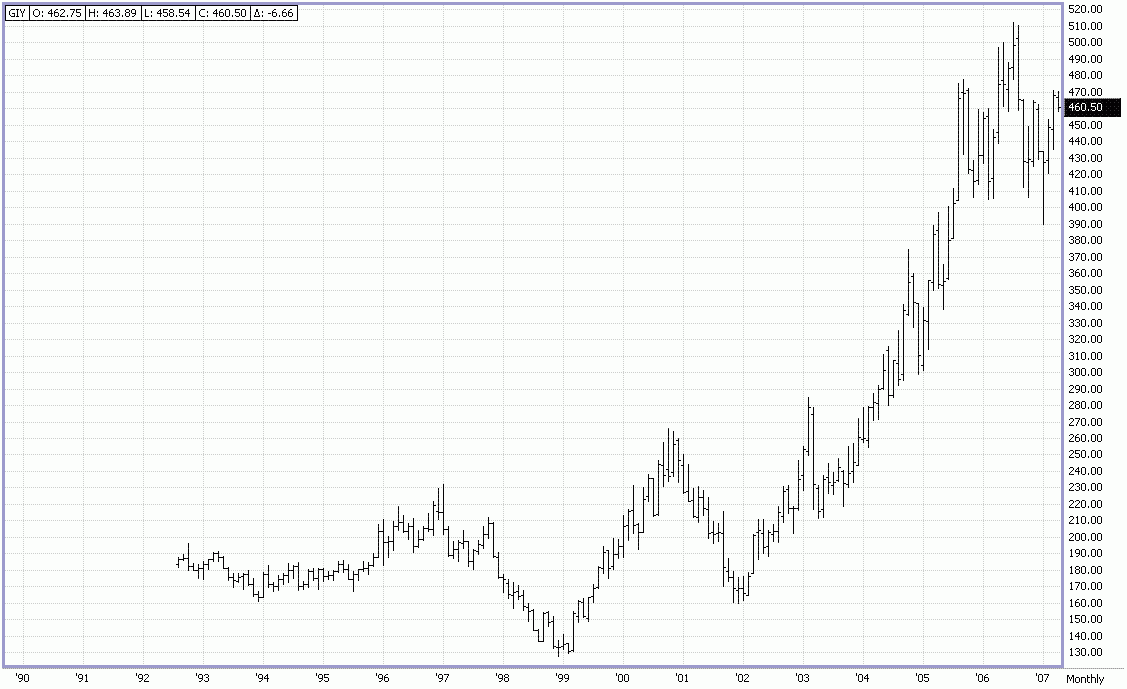
THE GOLDMAN SACHS COMMODITY INDEX MONTHLY CHART: AS MONEY HAS FLOODED INTO THIS INDEX, PRICES HAVE CONTINUED HIGHER. HOW LONG CAN THIS TREND CONTINUE?

A better alternative is to stick to a profitable trading program, or a Commodity Trading Advisor (CTA) that can profit from large moves but will liquidate their position in the commodity before the price crashes back down. The best alternative is to find an experienced CTA that will go short the market and profit from a price crash.

HOW TO PROFIT FROM LOCF!

When trying to profit from LOCF, it is important to know the characteristics of these funds. First, these funds make up a large percentage of the open interest in many commodity futures contracts but they rarely adjust their position sizes. Therefore, during periods when investors holding short positions are likely to reduce their position size, these Funds will continue to hold their massive long positions. This can cause an explosion in prices to the upside. As buying pressure intensifies due to a lack of sellers, many participants holding short positions are forced to cover as the rally intensifies. During this period, very few participants (led by the LOCF) holding long positions are taking profits and are often increasing their long positions.

Example:
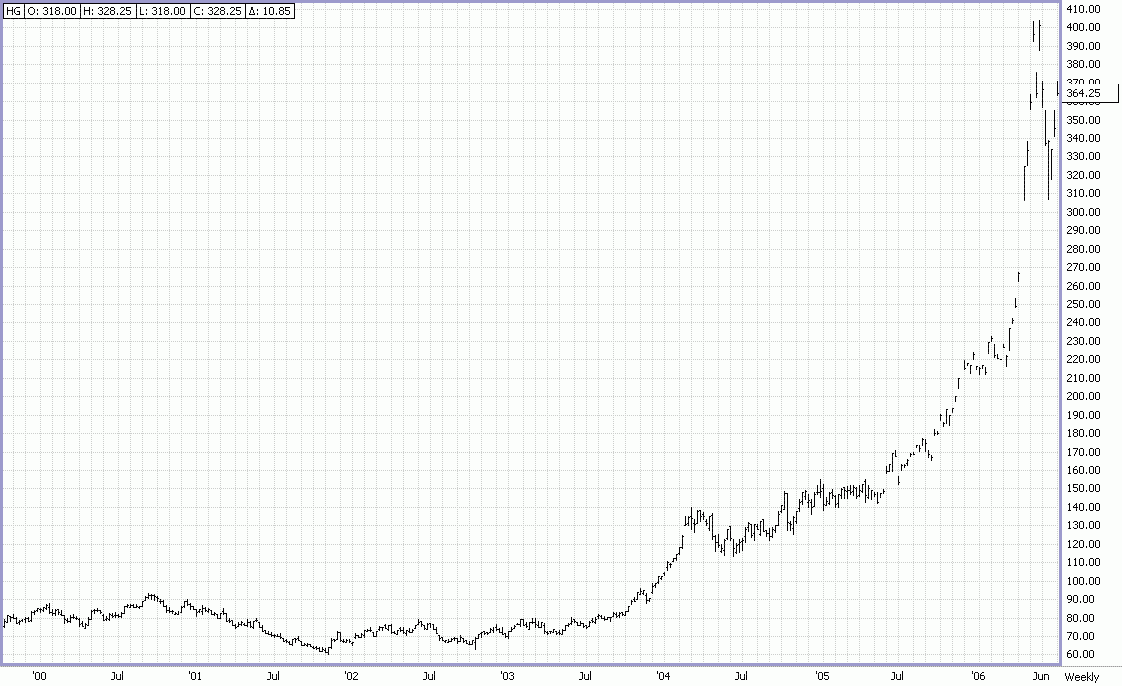
Copper: See weekly chart below.

For most of the last 30 years, copper has traded in a range between 60 cents and $1.60.

In 2003-2004, prices moved slowly but steadily higher, reflecting strong worldwide demand for copper and the emergence of LOCF which began accumulating long positions. However, in 2005 and 2006, LOCF grew by leaps and bounds. This resulted in large steady buying of copper futures, which sent prices rocketing higher. Compounding this was the fact that these funds never took profits and stayed with their positions no matter how high prices reached. Copper prices were forced to constantly move higher in an attempt to find new sellers to meet the demand. Eventually, prices will stay high enough for l ong enough to allow copper mining companies to dramatically raise production, which will eventually cause a total collapse of the price.


li*****@ma**.com


:143/fetch%3EUID%3E/INBOX%3E3002?part=1.1.3" border="0" alt="" width="370" height="226" align="middle" />

As LOCF continued to grow in size in 2005 and 2006, they bought large quantities of copper contracts. This mixed with positive fundamentals led to an unprecedented rally in copper prices.

PROFIT STRATEGY #1: Always buy upside breakouts in these commodities and exit quickly if the momentum ends.

PROFIT STRATEGY #2: Sell Short commodities under the following conditions 1) Prices have gone to an excessively high level and stayed there long enough for producers to increase production 2) Momentum is turning negative. 3) Exit short positions if momentum turns positive again.

PROFIT STRATEGY#3: Find a unique strategy for spread trading that is not well known and that can profit from the movement of money caused by LOCF.

The final and potentially most powerful strategy for profiting from LOCF is through spread trading. When these funds roll their long positions from the nearby futures contract to the next one (“the Goldman Roll”), the impact on the spreads between contract months is dramatic. Many professional traders have made fortunes over the years by trading in advance of the Goldman Roll. However, with so many traders aware of this opportunity, it is crucial for traders to find unique and creative ways to profit from this market moving event.

One unique and profitable spread trading program is the Platinum Commodity Spreads Program or PCSP offered by Platinum Trading Solutions and traded by VanKar Trading Corp. This program uses state of the art software that tracks the movement of money in and out of the spreads affected by the LOCF. In doing so, it is able to identify profitable spread trading opportunities. In 2007, this program has completed a total of 23 actual trades in customer accounts using a variety of commodity spreads with the following results.

2007 ACTUAL TRADES

Total Trades 23
Profitable Trades 17
Losing Trades 6

Total of Profitable Trades $14,863.90
Total of Losing Trades $ -2,252.95
Total Net Profit $12,610.95
Average Profit per Spread $ 548.30

These results are based on trading a single spread per trade. Because spreads typically have much lower margin rates than outright futures positions, traders are able to hold larger positions and therefore make substantial profits should the current winning ways continue.


CONCLUSION
The Long Only Commodity Funds are a powerful force that is likely to dominate the market for years to come. Like any major force in the markets, full understanding and creative thinking will allow you to profit handsomely from this market condition.

For more information, please visit:
http://www.ino.com/specials/platinum/spread4.html