Traders Toolbox: Reversals

Reversals In my opinion, one of the most misused and abused terms in technical analysis is the reversal or key reversal. I often get calls from both new and experienced traders who are excited about a market because it has just posted a "key reversal." While the action these traders point to often marks a reversal day, such a day (week or month) by itself actually has little significance. There is research which indicates single period reversals mark a turn only about 50% of the time. Which gives about the same odds of indicating a turn using a coin flip.

In my studies, I use a set of rules which help me ferret out reversals which have a much higher probability of marking a turn. Before going any further, I want to clarify the term reversal when used in technical analysis. A reversal does not mean a market will necessarily reverse a trend. A reversal is a formation which may mark a top or a bottom. However, a top or bottom only signals the preceding trend has come to an end. In other words, a top will indicate an uptrend has come to an end. It does not indicate whether the new trend will be down or sideways.

Now, on to the rules. There are six rules which I use to identify a valid reversal. To clarify these rules, I have provided an example of the pattern which I watch for to mark a reversal in the circle on the weekly T- bond chart. I am listing the six rules to identify a reversal high; for a reversal low, simply reverse the parameters where warranted.

To mark a reversal high, first, the market must make a new high for the last six to eight weeks. Second, the market must close lower than the previous day's (or week's) close. Third, the market must reverse the previous day's (or week's) action. To clarify rule three, the day or week preceding the reversal must have posted a positive close. Fourth, the market must post follow through action the next day (or week). Again, to clarify, the market must close lower on the day (or week) following the reversal. Fifth, the reversal must be accompanied by moderate to high volume. And, finally, the reversal must occur in a terminal (critical) area.

Rules one through four deal with the pattern which the market must trace out and are basically self-explanatory. Rule five insures the reversal is not marked on a low-volume day (or week) such as is common in a holiday period. And rule six essentially means the market must be in an area of price or time where a turn could be expected to occur.

Notice the weekly T-bonds chart and the numerous turns which were marked by the valid reversal pattern. If you examine the chart closely, you will notice there are a number of reversal weeks which did not see followthrough action which failed to turn the market. However, it is rare to find a reversal which saw followthrough action that failed to mark a significant turn.

Traders Toolbox: Bottoming behavior

Markets which have been in a persistent downtrend often exhibit a common pattern as the end of the decline is approached. The pattern is to post a sharp rally followed by one final decline to new lows.

Sharp rallies formed recently in both pork bellies and gold. Following the rallies, both markets plummeted to new lows. However, once new lows were made, the declines stalled. The failure to sustain the break on the move to new lows indicated the selling was effectively exhausted and potential bottoms had formed. A similar pattern marked the low in soybeans prior to the 1983 bull market.

The logic behind this type of bottoming action is that the persistence of the downtrend has finally forced the bulls out of the market. As the last longs are liquidated, the burden of keeping the down-move going falls totally on the shoulders of the bears to keep pressure on. Any faltering of the bears to keep the pressure on can lead to a sharp short-covering rally as the sellers "all" turn buyers.

Any hint of bullish news accompanying the short covering rally will tend to entice the emotional bulls back into the market. Then, as the bullishness diminishes, the sellers try to reassert themselves. Often a push to new lows occurs and the stops of the early bulls are triggered. The stops provide additional short-term selling pressure. When this subsides and the bears find no more selling entering the market, they head for cover in a more orderly fashion.

A relatively gentle up-move starts as the market searches for the levels which will entice sellers back into the market. From there, the burden of proof falls on the market to determine if the bulls are now the strong hands or if the bears can regain their control.

Traders Toolbox: Psychology of a bottom

As bull markets roar to a top, it is relatively easy to see the emotional or psychological signs of an impending top. Virtually every source of news will provide coverage of the seemingly endless climb towards higher levels. Greed infests the public as the inexperienced flock to get a piece of the action. Finally, when it is "impossible" for a market to decline and everyone who wants to buy is in, the top will be struck. Buyers become sellers and a downmove ensues.

To an extent, the same sort of pattern unfolds at major bottoms. However, since the events surrounding the decline are not as exciting or newsworthy as those in a bull market, the signs are harder to see. Instead of greed permeating the atmosphere, fear becomes the emotion of significance. As the news becomes per- ceived as increasingly bearish, traders who had been bullish give up. The emotional stress of margin calls and "bad" news finally forces long liquidation.

Despair, disgust and disillusionment abound among the public traders. Producers resign themselves to selling their production near current levels and, in fact, often sell future production as well. They become convinced the market is destined to move even lower. As the bearish attitude spreads, an important sign of a nearing bottom is declining open interest. This is especially true if this long liquidation of futures positions drops the open interest below recent low levels. In markets where individuals are the original holders of production, an additional sign is liquidation of cash positions.

Traders and marketers take any rally as a "gift" to sell on. Bullish fundamental conditions which may exist are discounted as the memory of the persistent downtrend remains entrenched. As a market starts up from the lows, the rallies are viewed with suspicion. Even the few who remained bullish don't trust the rebounds and often take advantage of early rallies to liquidate long positions. Setbacks from the early rallies are often sold as the participants don't want to miss the next washout to new lows. And, if enough gain this attitude, the break will not continue and traders then have to wonder why the markets won't go down on "bad" news. Eventually, their short covering triggers additional gains.

A final important component of an approaching bottom is the inability of a market to sustain a downmove on bearish news. The most common form of this action is seen when government reports are released. The bulls no longer rationalize a bearish report into a bullish one. Instead, the bulls resign themselves to additional declines. Bears move towards overconfidence and start selling the breaks as well as the rallies. Bearish reports often trigger downmovement, initially, but then additional declines fail to materialize. Moves to new lows are rejected as everyone who wants to be short already is and the longs have been liquidated, thereby leaving the markets with no one to initiate new selling. And, as at the top, but in reversed roles, the sellers become buyers.

Finding Your OWN Stocks

Today I'm pleased to introduce The Wild Investor from...The Wild Investor.com! I've had the chance over the past few weeks to spend some time at his site, seeing his methods, and really gleaning a lot of good info. His post today covers something we can ALL benefit from. Enjoy.

====================================================================

A couple years back, I got my first break into the world of trading stocks by listening to Jim Cramer of Mad Money. My first couple of trades came through his recommendations; however, that seemed to die out pretty quickly. He covers so many stocks at one time, that it seems he is proven wrong more often than right. If I was ever going to make some real money in the markets, I would have to branch out on my own.

Tons of people know how to buy, sell, see if a stock is worth acting on, and so on, but very few actually know how to find stocks.

Let me clarify. Perhaps some article talked about the 10 stocks you have to buy in 2008. Many can probably pick and choose the best ones out of those 10, but without that article they probably could have never come up with a list of 10 stocks.

So how do you go about finding stocks to invest in? You can't always rely on some third party.

Many people enjoy the ease of scans, but the tools and resources may not be available to everybody or they may just not understand enough to perform one.

Below are some steps that can help you create your own manual scan and perhaps help you run an automatic scan sometime in the future.

1. Reflect

Create a list of the past stocks you have either traded, watched, followed, or whatever. Try to get at least 50 stocks (100 if you are an overachiever). One by one, see which ones were successful, which failed, why they moved the way they did, and how you gained interest in that stock.

2. Breakdown

Try to group the stocks in the different ways your broke them down. For example, perhaps you have a few stocks that were successful on a cross of the 200 day moving average. Maybe some were oversold. Whatever it may be, just try and group some stocks together.

3. Classify Each Group

Out of the different categories you have created, come up with some sort of criteria that fits each stock in the group. For instance, say I have Stock A and Stock B in one group. Go back before those stocks experienced their gain and create some sort of pattern that could have been used to predict those gains.

4. Trial and Error

After you have gone through all your different groups, it is time to test. The more test you run, the better chance you have of creating a profitable search. Run your test on all the different stocks on your list, and see what results you get. Choose other random stocks that might match your criteria. Tweak it if you need to because the goal is to try and perfect your criteria, so that it should work more often than not.

5. Practice Run

Most likely you want to see if your system works before you throw real money at it, so find some stocks that fit your criteria. Use your finance site of choice and find top movers, similar stocks to the ones that were already successful, or look in the sector you are comfortable in and just let your system run. Follow the stocks until your system said it should have worked and look at the results.

Did it work? Keep trying and editing until you are comfortable throwing real money at it. It may seem tedious and cumbersome, but hopefully you will be able to move out of the realm of Jim Cramer and into your own world.

For those that still may be confused, here is a simplified version of my criteria:

  • Consistency to perform within 6 months or less

  • Ability to diversify and maintain some form of global exposure

  • Companies that have been oversold or beaten down

  • Buy and sell signals according to technical analysis

  • Best of breeds that continually produce and post solid numbers

  • Capability to shine in any type of market condition (recession proof)

In the end, the goal is to create a simplified way to complete a somewhat complicated task. If you can ease your tasks and rest your mind, then it only betters your trading, which increases your profits.

The Wild Investor

The 4 Characteristics of Strong Breakouts

For today's Guest Blog post, I've asked Harry Boxer to come and teach us a little bit about what makes a breakout a STRONG breakout...and MUCH more! Harry's been a contributor on CNBC, CBSMarketWatch, WinningonWallStreet, Stockhouse, DecisionPoint and more. If you're eager to learn more about Harry Boxer and his methods, check out TheTechTrader. Enjoy the post.

===================================================================

Breakouts of long bases on strong volume are frequent harbingers of continued price appreciation. Another harbinger, after the initial up-leg, is a low-volume, orderly pullback towards support.

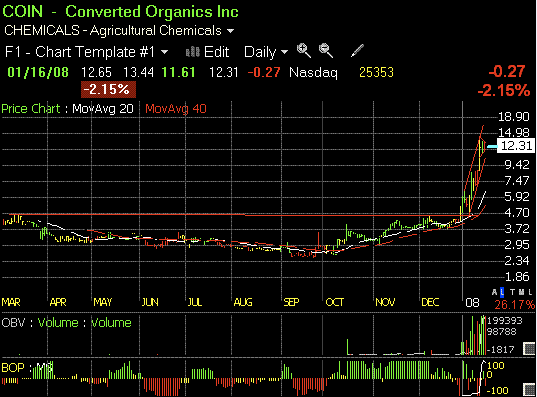
An analysis of the Converted Organics (COIN) chart illustrates this strategy. As the daily chart indicates, COIN in October 2007 broke out of a base pattern that extended back since its IPO in late February. Some traders who missed entering early may have given up on the stock when it rose 50% from around 2 1/2 to 3 3/4, but a closer look at the chart shows why it had more room to move.

COIN's pullbacks were orderly, coming on lower volume and holding near its moving averages, a key sign of more upside to come. Not once did its pullback break beneath the 40-day moving average, and most pullbacks hugged the 21-day moving average.

The pattern was breakout (mid-October), flag, breakout (early November), flag, breakout (late December), flag, and then breakout in mid-January, where it closed on January 15 at 12.58, more than 5 times its pre-October breakout price. Volume on each pullback was a small fraction of the level of the breakout, and a shallow decline just grazing the moving averages suggested a continuation of the uptrend.

As a stock in a rising pattern pulls back, look for several factors to portend the continuation of the pattern.

1. First, look for very low volume on the pullback between 10% and 25% of the average volume of the last 90 days. Second, watch for the decline to flatten near the 21- or 40-day moving average on the hourly charts in a quiet, narrow flag-type formation.

2. When the breakout comes, buy on the initial thrust out of this flag pattern. This means a sudden dramatic change in price accompanied by heavy volume. The price doesn't necessarily have to rise above the top of the flagpole (i.e., the previous rally high prior to the consolidation), but only needs to be a price bar that is at least several times the size of the previous several bars on the chart.

3. Wait to add to the position until the stock takes out the top of the flagpole, which is key short-term resistance. This will protect against a head fake, which is a move that starts out dramatically but quickly fizzles price- and volume-wise after just a bar or two and has no follow-through and, in particular, does not make it through the top of the flagpole.

4. Set a stop below the bottom of the lowest level reached during formation of the consolidation or flag pattern out of which it has broken. When COIN, for example, in its November upmove exceeded the top of its October flagpole around 3.75, that was one signal to get in or add to the position. Another signal came in the second week of January at around the 8 level, when we first highlighted it for our subscribers.

We saw COIN having consolidated and tested its 8.70 triple-top resistance over the previous 3-4 sessions, and noted that if it broke through that level it could initially head to 10 1/2-11, and then beyond that to our next target of 12 1/2-13, where it last resided, as mentioned, on January 15. The COIN example illustrates the potential that chart patterns like high-volume breakouts from long bases and low-volume flags can have in predicting price appreciation.

Harry Boxer is an award-winning, widely syndicated technical analyst and author of The Technical Trader, which features a real-time diary of Harry's minute-by-minute trades and market insights, plus annotated technical charts & stock picks, based on Harry's 35 years experience as a Wall Street technical analyst. You can find out more about Harry's work at TheTechTrader.com.