Bitcoin's Performance Amid ETF Flux – a Closer Look at Fidelity and BlackRock

On January 10, 2024, the Securities and Exchange Commission (SEC) authorized 11 U.S.-listed exchange-traded funds (ETFs) focused on Bitcoin investments, subsequently unlocking a new asset class for a broad spectrum of investors and simplifying the path to gaining direct exposure to the digital currency.

This highly anticipated decision garnered significant participation from institutional and retail investors in the cryptocurrency market, spurring substantial inflows. Notably, new U.S. spot Bitcoin ETFs witnessed $4.6 billion in volume on their inaugural trading day, as per data from the London Stock Exchange Group.

A week after the launch of these ETFs, intriguing patterns began to materialize. Spot Bitcoin ETFs currently command more than 100,000 Bitcoin, which implies an Asset Under Management (AUM) estimated at approximately $4 billion. This important revelation signifies the escalating amalgamation of Bitcoin into traditional financial systems and underlines the amplified role of cryptocurrency within the investment community.

Grayscale, leading the pack as the largest Bitcoin holder in the ETF segment, remains at the cutting edge of this Bitcoin acquisition drive. Its holdings reached an impressive tally of 552,681.2268 BTC. This substantial investment further solidifies Grayscale's standing as a major contributor in the crypto sphere and hoists Bitcoin ETFs above Silver to rank them as the second-largest commodity ETF based on holding size.

Following Grayscale's lead, BlackRock’s ishares Bitcoin Trust (IBIT) secures its position as the runner-up in terms of Bitcoin holdings with an impressive 39,925 BTC in its vault. Fidelity Wise Origin Bitcoin Fund (FBTC) continues to hold robust with 34,126 BTC. These figures exhibit significant engagement from leading financial institutions in the expanding cryptocurrency market, marking a considerable shift toward digital assets in investment strategies.

Upon winning ETF approval, Bitcoin's price momentarily soared to $48,000, only to face a subsequent downturn. This volatility alludes to an unpredictable market where current selling pressures seem to outweigh buying activities.

Adding to the uncertainty is BitMEX founder Arthur Hayes foreseeing a further dip in Bitcoin's value below the $40,000 mark, a prediction affirmed by acquiring 29Mar $35k strike puts. Hayes' cautious approach mirrors his acquisition, amounting to 5 BTC, revealing a reserved perspective for the immediate future of this cryptocurrency.

The existing market landscape, combined with expert evaluations and forecasts, hints at a potential slump for Bitcoin in the near term. While the approval of spot Bitcoin ETFs stands as a critical step in Bitcoin's mainstream acceptance, the path ahead presents an element of vagueness.

U.S. Spot Bitcoin ETF fluctuations could be rooted in various factors apart from Bitcoin's price oscillations. The spot Bitcoin ETFs depend on Authorized Participants (APs) to create and redeem ETF shares in return for Bitcoin. These APs procure Bitcoin from varied platforms, which might differ in liquidity levels, fees, and risks; these variations can impact the price of the ETF and the NAV of funds. Furthermore, management fees could also have an impact on the returns on ETFs.

Of the 11 freshly introduced spot ETFs, two funds particularly stood out in terms of net inflows: BlackRock’s ishares Bitcoin Trust (IBIT) and Fidelity Wise Origin Bitcoin Fund (FBTC).

BlackRock and Fidelity commanded the investors' attention, jointly netting 68% of all inflows during the first week (IBIT accounting for 37% and FBTC for 31%). IBIT swiftly amassed $1 billion in assets within four days of trading, while FBTC achieved the same feat on the fifth trading day. The two funds have each generated over $2 billion in trading volumes since inception.

The regulatory nod sparked intense competition for market share among the issuers. The issuers have deployed strategies to cut expense ratios and offer fee waivers. For instance, the FBTC underwent an initial proposal of a 0.39% fee, which was later reduced to 0.25%, coupled with a fee waiver effective until July 2024. Meanwhile, IBIT charges a 0.12% fee for the first 12 months for assets up to $5 billion. Both IBIT and FBTC charge 25 basis points in fees.

Investors considering a Bitcoin ETF should bear in mind that although these ETFs generally operate in a similar fashion with minor disparities, the expense ratio remains a pivotal factor in the decision-making process.

Let's delve deeper into the Bitcoin ETFs leading the pack now.

ishares Bitcoin Trust (IBIT)

IBIT, the BlackRock-owned Bitcoin ETF, emerges as a leading choice for retail investors due to its superior liquidity and affordable expense ratio. As a titan in the financial world, BlackRock remains unparalleled in its position as the most extensive ETF manager globally, with an AUM of $3.5 trillion across its portfolio of global ETF investment vehicles as of December 31, 2023. This powerhouse backing makes IBIT an assured choice for those seeking Bitcoin offerings buttressed by a sophisticated and large-scale financial structure.

The planning is such that IBIT vows an accessible expense ratio of 0.12% for the fund's initial $5 billion in assets over the ensuing year. An annual expense ratio of 0.25% is projected to kick in from January 2025.

Standing true to its promise of liquidity, IBIT has already amassed over $1 billion worth of Bitcoin in its reserves, a feat rivaled only by the SPDR Gold Trust (GLD), which impressed the markets by garnering $1 billion in assets within three days of its inauguration in 2004.

As of January 22, IBIT had $1.34 billion in AUM and an impressive NAV of $22.86. It registered net inflows of $1.12 billion over the past five days. IBIT holds about 39,925 BTC, valued at roughly $1.62 billion.

Despite experiencing a dip of 7.2% over the last five days, closing the last trading session at $22.95, IBIT maintains its allure among investors. Its swift popularity underscores it as an ideal option for those looking to diversify their portfolio with cryptocurrency and cultivate growth over time.

Fidelity Wise Origin Bitcoin Fund (FBTC)

FBTC, another notable name in Bitcoin ETFs, boasts a low expense ratio. However, investors with significant capital ready for deployment into Bitcoin ETFs are in luck, as FBTC has decided to waive even these modest fees until August 1, 2024. After this date, it will implement an expense ratio of 25 basis points.

Notably, Fidelity serves as the largest 401(k) plan and service provider in the nation. This development positions both individual investors and asset managers to seamlessly incorporate Bitcoin into comprehensive retirement strategies.

Crypto bears might argue against such a move, but it's worth considering: Would a competent asset manager willingly forsake prospective gains by excluding a Bitcoin ETF from their client portfolio? Allocating even a small portion toward this asset could potentially yield substantial returns in relation to the total investment, given Bitcoin's impressive performance trajectory over the past decade. Concurrently, with individuals reevaluating their 401(k) strategies leading up to 2024, a surge of capital directed toward FBTC is predictable.

As of January 22, FBTC had $1.21 billion in AUM and an NAV of $35.08. Its net inflows were $1.07 billion over the past five days. FBTC holds about 34,126 BTC, valued at roughly $1.37 billion.

Despite these positive indicators, FBTC plunged 7.3% over the past five days, closing its last trading session at $35.18.

Bottom Line

With the advent of Bitcoin ETFs, investing in this unique asset class has become less complex, potentially elevating its position within the financial industry. These recently launched ETFs provide a broad spectrum of investors with a simpler approach to gaining exposure to the crypto asset.

Shortly before the SEC approved the ETFs, it re-emphasized its previous "no FOMO" cautionary message to investors. Aimed at highlighting the volatility of digital assets, the warning underlines how investments tied to current popular trends like cryptocurrencies can experience periods of severe fluctuations, translating into drastic changes in value both positively and negatively.

The SEC's approval brings much-needed standardization and regulatory supervision to digital asset investment. However, experts are advising mainstream investors to proceed with caution, pointing out that Bitcoin still distinguishes itself as a speculative asset.

News of Bitcoin ETFs has made headlines, even though their trading results may not meet the initial hopes of crypto bulls. Nevertheless, many see brighter days closing in. Potential future record cash inflows into these funds might be on the horizon as financial advisors and wealth managers consider incorporating them into their clients' diversified portfolios.

Bitcoin's primary utility arises from its function as a form of value storage akin to gold. The day that central banks initiate the acquisition and storage of Bitcoin will signify its arrival at the forefront of the financial world. The price is now around $39,000, and it appears to be headed lower. After the establishment of a true base, a progressive increase in its price over time could be projected as governments devalue their fiat currencies.

With the introduction of spot ETFs, we're starting to see the beginnings of real price discovery. This process could further develop in a couple of months.

Prestigious investment managers such as Fidelity and BlackRock’s iShares should not be overlooked in this space. Their competitive edge in the traditional ETF fees arena may eventually give them an advantage over smaller rivals. Considering the slight disparity in fees between these funds and market leaders, long-term Bitcoin ETF investors might consider opting for these established alternatives.

Although the issuer’s role is arguably minor, ETFs governed by larger asset managers could be more resistant to liquidity issues arising from insufficient demand.

As an example, the IBIT ETF concluded January 22 trading at a 0.41% premium to its net asset value, indicating high demand. On the other hand, the FBTC traded at a 0.30% discount relative to its net asset value, suggesting weaker demand.

In view of the overall market situation, adopting a strategic position in IBIT and FBTC once the price stabilizes would be prudent.
Breakout for Stocks or Fake Out?

Please enjoy this updated version of weekly commentary from the Reitmeister Total Return newsletter. Steve Reitmeister is the CEO of StockNews.com and Editor of the Reitmeister Total Return.Click Here to learn more about Reitmeister Total Return


SPY – Once again stocks flirted with the all time highs for the S&P 500 (SPY). This has happened 2 times recent both leading to failure and this 3rd time doesn’t seem to be the charm either. What is holding stocks back from making new highs? And what should an investor do to find better performance? 43 year investment veteran Steve Reitmeister shares his view including a preview of his 11 favorite stock picks now. Read on below for the answers…


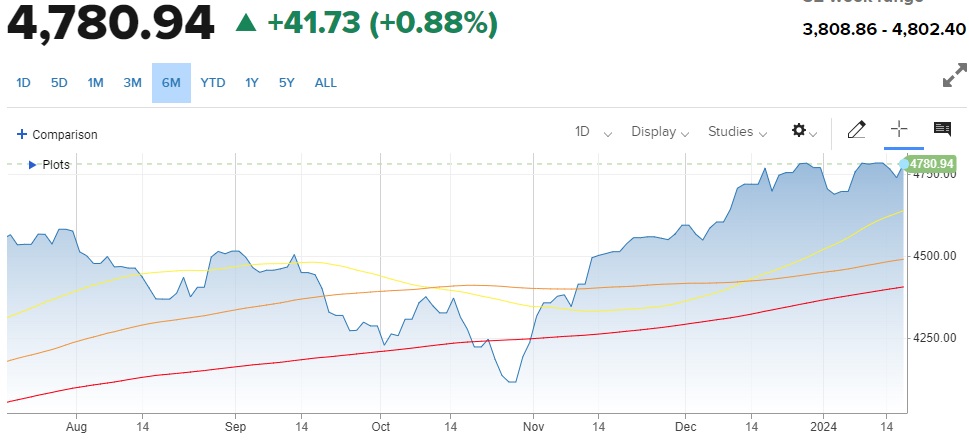
In my recent commentaries I have speculated that we were due for a trading range to digest some of the rampant gains at the end of 2023. However, so far it has been more of a consolidation under the all time highs at 4,796 for the S&P 500 (SPY).

Consolidations are simply much tighter trading ranges. That investors refuse to have a serious sell off while also not being ready to climb higher. Kind of feels like cars revving up at the starting line of a race…lots of noise, but going nowhere.

We will discuss more of the reasons behind this consolidation and when stocks should be ready to race ahead.

Market Commentary

Stocks have tried twice over to make new all time highs above 4,800 for the S&P 500. And twice thwarted at that level followed by share pullbacks.

Yes it looks like Thursday’s action signals a 3rd such attempt. Yet that was a very hollow rally with the usual suspects in the S&P 500 doing well with small caps and other riskier stocks lagging. That is not the sign of a healthy bull. And give very low odds of breaking to new highs.

(1/20/24 update: Yes, the S&P 500 officially made new highs above 4,800 on Friday. I honestly thought it was a fairly hollow rally mostly led by the usual mega cap tech stocks and not such a broad rally. Meaning I do not believe this rally has staying power and likely will fall back below 4,800 this coming week. And at best we consolidate just above 4,800 with little true upside coming in the days ahead).

Some are pointing to economic data being too weak as the problem. Such as the horrific -43 showing for the Empire State Manufacturing Index on Tuesday.

While others are pointing to economic data being too strong like Retail Sales being above expectations on Thursday. This had 10 Year Treasury rates breaking further above 4% and also lowered the odds of the first rate cut coming at the March Fed meeting.

Sorry folks…you can’t have it both ways. And perhaps the answer is that neither of these theses are correct.

Meaning I don’t believe that investors are truly worried about a looming recession. Nor are they fearful of rates spiking again as they did in the Fall of 2023.

Simply, the market has come a long way from bear market bottom in October 2022. A total gain of 37% from that valley to now is a lot of profit in a short time when the long term average annual gain for the S&P 500 is only 8%.

So now is a healthy time for an extended pause. The same way you would take a long break after running a marathon.

Rest is what is needed. And then gaining the strength for the next run higher.

In the stock market world that typically comes hand in hand with a pullback in price leading to a trading range. Along with that you will see these investment terms show up more often:

  • Profit taking
  • Sector rotation
  • Change of leadership
  • Buy the Dip
  • The Pause that Refreshes
  • And so on…

Yet right now the most apt term is consolidation. As shared up top, that is simply a very tight trading range right under a point of resistance. Currently that resistance corresponds with the all time closing highs at 4,796…but for simplicity easier to think of it as 4,800.

The point is at this stage it is healthy and normal for stocks to relax after such a long run higher. Don’t be surprised if the consolidation does turn into a wider trading range with a subsequent test of the 50 day moving average at 4,628 being a likely downside target.

Moving Averages: 50 Day (yellow), 100 Day (orange), 200 Day (red)

A break below 4,600 is unlikely without some greater fundamental concerns arising. But let’s do appreciate the 2 next levels of price support rest at 4,488 for 100 day moving average and about 4,400 for the 200 day moving average.

Your trading plan should be to stay bullish. Use any subsequent pullback as a buy the dip opportunity. NOT for the stocks that led the charge in 2023. That game plan is played out.

Instead valuation and quality will be held in higher regard this year as the overall PE of the market is not cheap. GAARP is fine (Growth At A Reasonable Price)…but not growth at ANY price like last year.

If you want my favorite stock ideas for 2024, then read on below…

What To Do Next?

Discover my current portfolio of 11 stocks packed to the brim with the outperforming benefits found in our exclusive POWR Ratings model.

Yes, that same POWR Ratings model generating nearly 4X better than the S&P 500 going back to 1999.

Plus I have selected 2 special ETFs that are all in sectors well positioned to outpace the market in the weeks and months ahead.

These 13 top trades are based on my 43 years of investing experience seeing bull markets…bear markets…and everything between.

If you are curious to learn more, and want to see these lucky 13 hand selected trades, then please click the link below to get started now.

Steve Reitmeister’s Trading Plan & Top Picks >

Wishing you a world of investment success!


Steve Reitmeister…but everyone calls me Reity (pronounced “Righty”)
CEO, StockNews.com and Editor, Reitmeister Total Return


About the Author

Steve is better known to the StockNews audience as “Reity”. Not only is he the CEO of the firm, but he also shares his 40 years of investment experience in the Reitmeister Total Return portfolio. Learn more about Reity’s background, along with links to his most recent articles and stock picks.

Will Google's UPI Expansion Make GOOGL a Must-Have Tech Stock?

Alphabet Inc. (GOOGL) has decided to help globalize India’s home-grown payments service, Unified Payments Interface (UPI). This instant real-time payment system was developed by the National Payments Corporation of India (NPCI) in 2016 and allows individuals to use a single app to make peer-to-peer payments to or from multiple bank accounts.

Third parties can include UPI in their payment systems or apps, with payments flowing smoothly between all participants. The interface has more than 300 million active users and manages around 10 billion transactions per month. The traffic is not far behind Mastercard Inc. (MA) and nearly half the volume that Visa Inc. (V) handles.

UPI is ubiquitous in India and is one of the largest retail payment systems in terms of transaction value and volume. The payment service has already been made available in other nations, partly to assist Indian tourists as they travel and to facilitate cross-border transactions.

Now, Google has decided to spread these use cases around the globe. On January 18, 2024, Google Pay India and NPCI International Payments Ltd (NIPL), a wholly owned subsidiary of NPCI, signed a Memorandum of Understanding (MoU) to broaden the transformative impact of UPI to nations beyond India.

The MoU has three key objectives. Firstly, it seeks to expand the use of UPI payments for travelers out of India, allowing them to make transactions abroad seamlessly and conveniently. Secondly, it will help establish UPI-like digital payment systems in other countries, offering a model for seamless financial transactions.

Lastly, the MoU intends to ease the process of remittances between countries by utilizing the UPI infrastructure, thereby simplifying cross-border financial exchanges. These listed objectives are expected to accelerate UPI’s global acceptance, providing foreign merchants easy access to Indian customers who will no longer have to depend only on foreign currency and credit or forex cards to make payments.

“We are delighted to support NIPL towards expanding the reach of UPI to international markets. Google Pay has been a proud and willing collaborator to NPCI and the financial ecosystem, under the regulator’s guidance, and this collaboration is another step towards our commitment to making payments simple, safe and convenient,” said Deeksha Kaushal, Director, Partnerships, Google Pay India.

With this strategic collaboration, Google will not only create new digital finance opportunities for itself but also support the Indian government’s initiative to take UPI global.

India’s Digital Diplomacy Strategy

The recently signed MoU aligns with NPCI’s endeavor to boost India’s position in the global digital payment landscape. India’s Prime Minister Narendra Modi has been vocal on the government’s ambitions to take UPI global. At the BRICS summit in August last year, Modi noted that UPI had expanded to other nations, including the UAE, Singapore, and France.

“There are many possibilities of working on this with BRICS countries as well,” he stated.

Further, in an exclusive interview with Business Today, Modi highlighted the fact that 46% of global digital payment transactions today are in India, which he described as “one shining example of the success of our policies,” adding that “the world today sees India as the incubator of innovation.”

Last year, India also topped the global remittance charts. According to a recent report, the World Bank noted that India’s remittance inflows totaled $125 billion in 2023, the highest in the world and well ahead of Mexico ($67 billion) and China ($50 billion). Annual growth was a brisk 12.4%.

GOOGL’s stock has advanced more than 19% over the past six months and nearly 57% over the past year.

Here are other factors that could impact GOOGL’s performance in the near term:

Google’s Remarkable AI Progress

2023 has been a year of significant progress for GOOGL in the field of Artificial Intelligence (AI) research and its practical applications. With generative AI, the company is reimagining its products and services. In February 2023, Google launched Bard, its conversational AI service powered by LaMDA. This tool can generate text, translate languages, write different kinds of creative content, and more.

In May, the tech giant reviewed the results of months and years of its foundational and applied work announced on stage at Google I/O. This included its next-generation large language model (LLM), PaLM 2, which is built on advanced compute-optimal scaling, scaled instruction-fine tuning, and enhanced dataset mixture.

By fine-tuning and instruction-tuning PaLM 2 for multiple purposes, the company was able to integrate it into more than 25 Google products and features, including an update to Bard, which enabled multilingual capabilities.

In addition, Search Generative Experience (SDE) uses LLMs to reimagine how to organize information and help people navigate through, creating a more fluid, conversational interaction model for its core Search product, MakerSuite, an easy-to-use prototyping environment for the PaLM API powered by PaLM 2, and many more developments.

The company also introduced DuetAI, its AI-powered collaborator that offers users assistance when they use Google Workspace and Google Cloud.

In June, Google unveiled Imagen Editor, which offers the ability to use region masks and natural language prompts to edit generative images. Later last year, Imagen 2 was released, which improved outputs through a specialized image aesthetics model based on human preferences for qualities like lighting, exposure, and framing.

Further, on November 22, in collaboration with YouTube, the company announced a new DeepMind model, Lyria. It is the most advanced AI music generative model to date that will create vocals, lyrics, and background tracks mimicking the style of popular artists. This model is available on YouTube through two distinct AI experiments – DreamTrack for Shorts and Music AI tools.

Then, in December, GOOGL launched Gemini. Gemini will include a suite of three different sizes: Gemini Ultra, its largest, most capable category; Gemini Pro, which scales across a wide range of tasks; and Gemini Nano, which will be used for specific tasks and mobile devices.

Robust Last Reported Financials

For the third quarter that ended September 30, 2023, Google parent Alphabet’s revenue came in at $76.69 billion, beating analysts’ estimate of $75.73 billion. This compared to revenue of $69.09 billion in the same quarter of 2022.

The company’s Google advertising revenues were $59.65 billion, an increase of 9.5% year-over-year, and its Google Cloud revenues grew 22.5% from the year-ago value to $8.41 billion. Its income from operations came in at $21.34 billion, up 24.6% from the prior year’s quarter.

GOOGL’s income before income taxes rose 30.6% year-over-year to $21.20 billion. The company’s net income rose 41.5% year-over-year to $19.69 billion. It posted net income per share of Class A, Class B, and Class C stock of $1.55, compared to the consensus estimate of $1.45, and up 46.2% year-over-year.

Furthermore, as of September 30, 2023, the company’s cash and cash equivalents stood at $30.70 billion, compared to $21.88 billion as of December 31, 2022. Its current assets were $176.31 billion versus $164.80 billion as of December 31, 2022.

Sundar Pichai, Alphabet’s CEO, said, “I’m pleased with our financial results and our product momentum this quarter, with AIdriven innovations across Search, YouTube, Cloud, our Pixel devices and more. We’re continuing to focus on making AI more helpful for everyone; there’s exciting progress and lots more to come.”

Solid Historical Growth

GOOGL’s revenue grew at a 20.1% CAGR over the past three years. Over the same period, the company’s EBITDA and operation income (EBIT) improved at CAGRs of 26% and 32.7%, respectively. Further, its net income and EPS grew at respective CAGRs of 23.2% and 26.3% over the same timeframe.

Additionally, the company’s total assets grew at a CAGR of 9.9% over the past three years, and its levered free cash flow improved at a 36% CAGR.

Optimistic Analyst Estimates

Analysts expect GOOGL’s revenue for the fourth quarter (ended December 2023) to increase 12% year-over-year to $85.20 billion. The consensus EPS estimate of $1.60 for the current quarter indicates a 52.21% year-over-year improvement. Moreover, the company surpassed consensus revenue and EPS estimates in three of the trailing four quarters, which is impressive.

In addition, Street expects GOOGL’s revenue and EPS for the fiscal year (ended December 2023) to increase 8.1% and 26% year-over-year to $305.77 billion and $5.74, respectively. For the fiscal year 2024, the company’s revenue and EPS are expected to grow 11.3% and 15.9% year-over-year to $340.26 billion and $6.66, respectively.

High Profitability

GOOGL’s trailing-12-month gross profit margin of 56.12% is 14.1% higher than the 49.18% industry average. Also, the stock’s trailing-12-month EBIT margin and net income margin of 27.42% and 22.46% are considerably higher than the industry averages of 8.56% and 3.27%, respectively.

Moreover, the stock’s trailing-12-month ROCE, ROTC, and ROTA of 25.33%, 17.36%, and 16.82% are favorably compared to the respective industry averages of 3.53%, 3.48%, and 1.38%. Its trailing-12-month levered FCF margin of 23.81% is 200.2% higher than the industry average of 7.93%.

Bottom Line

Alphabet’s shares climbed nearly 58% last year as tech stocks rallied after a disastrous 2022, driven partly by excitement about AI. The company reported an impressive revenue growth of 11%, returning to double digits for the first time in more than a year alongside a recovery in the digital ad market. Sales and profit both surpassed analysts’ expectations.

Moreover, for GOOGL, 2023 was a remarkable year of groundbreaking advances in AI and computing. Last week, in a memo titled “2024 priorities and the year ahead” that staffers received, Google CEO Sundar Pichai stated that the company has ambitious goals and will be investing in its big priorities this year. This includes AI and spans Google’s consumer to enterprise platforms.

Analysts at JP Morgan named GOOGL as one of their top picks for 2024, with AI primarily assisting in the stock’s significant growth.

GOOGL's partnership with the National Payment Corporation of India (NPCI) is geared toward extending India's UPI's reach globally, which is expected to yield advantages for the company.

This partnership seems like a suitable strategic move that would support a vital policy objective of the Indian government to broaden the digital payments landscape and provide Google Pay with new growth opportunities.

Considering these factors, GOOGL seems to be a must-have stock for any investment portfolio.

Is BlackRock's $12 Billion GIP Deal a Golden Buying Opportunity?

Giant private asset manager BlackRock, Inc.’s (BLK) CEO, Mr. Larry Fink, made a modest prediction recently that the global economy might be on the brink of an “infrastructure revolution.” This forecast was made in the wake of BLK’s largest acquisition announcement in over 15 years.

With an initiative to invest in and own infrastructure, BLK is seeking to accelerate growth by announcing its plan to purchase Global Infrastructure Partners for $12.5 billion.

New York-based GIP owns and controls companies in sectors like energy, transport, water, and waste. If the acquisition goes ahead, it will be BLK's largest since it procured Barclays’s asset management business in 2009.

GIP, led by Adebayo Ogunlesi, is considered the third-largest infrastructure investor worldwide, falling behind Macquarie in Australia and Brookfield in Canada. Its assets are quite diverse, ranging from Gatwick Airport to Melbourne’s Port.

The cash and stock transaction between these two investment manager titans is slated for completion in this year’s third quarter, pending federal antitrust approval in the U.S.

This assertive acquisition represents a significant strategic push by BLK into the alternative investment sector, further securing its position as a dominant player in global finance.

Most of GIP's ownership resides with its six founding partners, five of which, including Bayo Ogunlesi (the CEO), will be joining BLK. Consequently, Ogunlesi will be tasked with leading BLK’s forthcoming infrastructure group while also becoming a board member and resigning from his position as the key director at Goldman Sachs.

BLK is strategizing to develop its private market operations, which suggests faster growth and higher possible returns when compared to its core business of trading down-priced passive investment products like exchange-traded funds. This deal will likely augment BLK’s private assets by roughly 30% and double the baseline management fees for its private markets.

With GIP, BLK is purchasing an infrastructure fund manager that manages around $100 billion, with a combined revenue of $80 billion from its portfolio companies.

After finalizing this acquisition, BLK aims to establish a separate Global Infrastructure Partners entity that melds the newly acquired firm with current BLK infrastructure teams.

The newly formed entity is projected to rank as the second-largest private infrastructure manager on a global scale, boasting over $150 billion worth of assets under its management – Brookfield Asset Management being the only firm outpacing this figure.

With government deficits on the rise, the demand for private financing for large-scale infrastructure projects has grown, and attractive investment subsidies may be key to meeting this need.

BLK's CFO, Martin Small, expressed that BLK's preference for acquiring GIP over opting for a traditional private equity buyout firm stems partially from the perception that the era of peak returns from private equity, facilitated by zero interest rates, might be on the decline.

BLK holds investments in several GIP funds, and there has been considerable competition for deals between the two entities. As Larry Fink propelled BLK to prominence in the field of traditional asset management, Adebayo Ogunlesi rose to head Credit Suisse's investment banking and fostered GIP in 2006 with his pool of fellow alumni from the now-defunct bank, who will also join BLK.

Acquiring GIP will promptly double BLK's management fees from private markets, highlighting that Fink appears to have found the prominent deal he has been seeking.

Nevertheless, BLK, as a publicly traded asset manager, faces the necessity to delicately balance the retention and motivation of GIP's top talent with the interests of its shareholders.

As part of striking a balance, it was decided that BLK would receive all the management fees on GIP funds in addition to 40% of the performance fees accruing from all future funds. GIP employees would retain all the carried interest in its existing funds and those slated for future raising.

To acquire GIP, BLK agreed to an amount of $3 billion in cash and 12 million of its shares, approximately equating to around $9.5 billion.

GIP is predominantly owned by its six founding partners, who will collectively ascend to become some of BLK's most significant shareholders, possessing about 8% of its outstanding shares.

BLK intends to distribute 7 million shares to the six GIP founders immediately and will add 5 million more in five years. A portion of this equity will be allocated to employees as a part of a retention strategy. As a result, the collective GIP team will ascend as the second-largest shareholder in BLK, binding them to the ongoing fortunes of their new proprietor.

But why is BLK pouring billions on infrastructure?

The evolution of the intervention of private investors in infrastructure began during the 1990s and early 2000s. Western governments burdened with mounting debts sought private investors to purchase and overhaul outdated infrastructure, from airports to water pipelines. Subsequently, numerous companies across industries, from energy providers to telecom operators, started selling assets such as pipelines and cell towers to these investors.

Presently, the demand for infrastructure investment is escalating, fueled by three significant trends:

  1. Decarbonization: In order to achieve global climate objectives, approximately $8 trillion is required to be spent on developing renewable energy infrastructure, storage batteries and transmission lines within this decade. Significant investments are also needed in hydrogen facilities to manufacture carbon-free fuel for aviation and maritime transport and in carbon capture technology.
  2. Digitization: While the software is increasingly dominating the world, it relies heavily on tangible assets, including fiber-optic cables, 5G networks, and data centers.
  3. Deglobalization: A shift in supply chains away from China has spurred demand for capital-intensive factories and new transport infrastructure to facilitate overland and sea freight movement. This trend has been further galvanized by increased calls for energy security in Europe following Russia's incursion into Ukraine, stimulating the construction of liquefied natural gas terminals to import fuel from less aggressive nations.

This skyrocketing demand for investment coincides with an era where government and corporate balance sheets are under significant stress. America's federal debt, nearing $34 trillion, is projected to continue snowballing throughout the following years. Additionally, several European governments face daunting debt burdens.

Rising interest rates have made these liabilities more burdensome to service and pose challenges to corporations that have capitalized on inexpensive debt to boost shareholder yields. Consequently, their capacity to finance substantial investments will be curtailed in the ensuing years. As a result, infrastructure investors are set to bridge this gap, having expressed their readiness and willingness to invest heavily.

Private equity groups anticipate growing their footprints in sectors like debt or infrastructure investment – sectors that are expected to profit from higher interest rates – either by incorporating public shareholders or merging with larger organizations. This approach extends beyond merely corporate buyouts, an area experiencing deceleration due to soaring financing costs.

The swift surge in interest rates has instilled caution among many investors, tempering commitment to fresh funds and stunting the utilization of existing ones. These prevailing circumstances present compelling reasons for independent firms to contemplate seeking out more substantial partners.

Fund managers hoping to benefit from the predicted influx of wealth from affluent individuals into private markets must heavily invest in novel products and distribution networks. Additionally, significant financial input into technology is essential to adapt to the advances in artificial intelligence.

The acquisition potentially furnishes BLK with a strategy to broaden its investment portfolio, thereby decreasing its vulnerability to market volatility. This is mainly due to the generally lower correlation that infrastructure investments bear with divergent asset classes and their reduced sensitivity to economic fluctuations.

Moreover, availing BLK of a comprehensive array of infrastructure assets could confer it with significant advantages. These mostly stem from those assets' capacity for long-term growth potential coupled with steady cash flows.

Following the acquisition, BLK is poised to emerge as a global leader, offering eminent infrastructure capabilities to its clientele. Clients who are persistently scouting for assets to counterbalance their extensive liabilities and diversify their portfolios may find solace in BLK's offerings.

Especially factoring in the prevailing economic conditions, this acquisition could prove to be a significant milestone for BLK. It would empower the company to effectively utilize its combined platform to capture a larger slice of the market share, churn superior returns, and seamlessly address the growing challenges and demands of its clients amidst the swiftly transforming infrastructure landscape.

Bottom Line

Throughout 2023 and well into 2024, two key trends have emerged within the financial sector: the escalating importance of private capital for infrastructure projects and the growing appeal of infrastructure assets amid economic uncertainty.

The recent landmark deal acts as a quintessential example of the consolidation trend that industry insiders have been forecasting. BLK has strategically secured a robust position in a market valued at $1 trillion today. Moreover, infrastructure is projected to be one of the most rapidly expanding segments of private markets in the foreseeable future.

While some caution against possible cultural discrepancies and potential conflicts of interest, the early market response to the deal appears stable. Shares of BLK surged by 1.3% immediately after the announcement.

Mr. Fink maintains his belief that the driving force behind their acquisition strategy has always been growth. With the acquisition of GIP, he firmly believes a similar scenario will likely play out. The efficacy of Mr. Fink’s belief is pertinent not just for BLK's shareholders but also for the entire industry that has billions invested in this premise.

The main query for BLK is whether this deal will finally serve as the key to unlocking a sector where it has previously found it challenging to gain substantial traction.

Besides the acquisition, there are numerous factors investors should consider during their assessment of the company. However, it might be prudent for them to wait and assess how this deal plays out.

Therefore, keeping BLK on the watchlist might be prudent at this juncture.

Joann Stores on the Brink: Is it Time to Unload JOAN Stock?

Over the past years, the retail sector has been shaken by renowned names going under and a couple of others just barely surviving. In most cases, the financial damage was caused by the COVID-19 pandemic, which forced many retail businesses to shut down for months due to mandated stay-at-home orders.

Due to these closures, online retailers received a boost in sales as customers looked for alternative ways to shop.

JOANN, Inc. (JOAN), a specialty retailer of crafts and fabrics, should have been a pandemic winner, but it stands on the verge of collapse, and the company prospects appear weak, as per Creditsafe Head of Brand Ragini Bhalla.

In theory, JOAN should have benefitted from people staying at home during the pandemic, as sewing enthusiasts and other hobbyists make up the retailer’s customer base. Even when Joann stores were opened, customers could’ve opted to purchase their supplies online.

The ease of shopping online has changed customer behavior drastically, and that could have shifted some of Joann’s regular customers to e-commerce giant Amazon.com, Inc. (AMZN). Another possibility could be that some of the company’s fanbase died or changed their hobbies during the pandemic.

No matter what the reason is, Ragini Bhalla thinks that JOAN’s situation is critical.

“Given the struggles JoAnn has had with cash flow, its inability to stay current with many of its bills, its declining sales in FY 2023, and its $1 billion debt load, our Creditsafe algorithm has classified the company as a high risk of becoming seriously delinquent on payments and could be headed for bankruptcy very soon. Without strong leadership (still no permanent CEO), it could be hard to right the ship,” he told TheStreet via email.

Bhalla further stated that JOAN has been lagging in paying its bills, something which often foreshadows a bankruptcy filing.

“Creditsafe data shows that Joann struggled to make on-time payments in the second half of 2023. For most of that time, about 20% to 31% of its bills were paid late (1-30 days), while about 1% to 8% of its bills were paid late (31-60 days),” he added.

Despite management’s positive comments during the third-quarter 2024 earnings call, Bhalla sees the company’s risk of bankruptcy rising.

“Joann is rated as a high risk: Based on Creditsafe’s risk algorithm which takes into account both trade payment data and financial results, JoAnn is deemed to be a high risk (D), meaning it could be at risk of bankruptcy. Its risk score dropped from C to D in July 2023 and has stayed there since,” he added. 

Now, let’s discuss some of the factors that contribute to Joann’s precarious financial situation and could impact the stock’s performance in the near term:

Broader Challenges Faced by the Retail Industry

Over the past few years, several retailers have been grappling with struggling physical storefronts, massive debt, and inefficient operations, among other challenges. The COVID-19 pandemic initially compounded these issues and advanced the downfall of various retailers, which had faced declining sales and increasing debt in the years prior as consumer preferences changed.

Shopping centers witnessed decreasing foot traffic even before the pandemic, but stay-at-home orders further shifted consumers to online shopping and spending cash on essential goods instead.

After 2020, the retail industry experienced a major rebound as consumers returned to physical stores. While there were 52 retail bankruptcies in 2020, 2021 witnessed just 21, a decline of 60% year-over-year, according to the report by Axios, citing research by S&P Global Market Intelligence. In 2022, only a few retail companies went under.

However, last year, retail bankruptcies flared up again due to persistently high inflation and a significant pullback in consumer spending. According to Axios, there were about 82 bankruptcies filed by consumer discretionary companies amid a tighter financing market and higher borrowing costs.

Home goods and furniture retailer Bed Bath & Beyond filed for bankruptcy in April 2023. During the pandemic, the retailer’s merchandise was non-essential. A failure to take online shopping seriously harmed the company, and then product missteps and misguided financial maneuvers fastened its decline.

A popular Ohio-based fabric and craft retailer, JOAN, has been recently identified as having an elevated risk of filing for bankruptcy. It faces enhanced financial uncertainty after dwindling sales and massive debt. Also, the company seems to miss out on the e-commerce boom.

During the third quarter of 2023, the share of e-commerce in total U.S. sales amounted to 15.6%, an increase from the prior quarter. From July to September last year, retail e-commerce sales in the U.S. reached nearly $284 billion, the highest quarterly revenue in history.

Deteriorating Last Reported Financials

For the fiscal 2024 third quarter that ended October 28, 2023, JOAN reported net sales of $539.80 million, beating analysts’ estimate of $547.20 million. That compared to the revenue of $562.80 million in the same quarter of 2022. Its net interest expense increased 56.9% from the year-ago value to $28.40 million. Its adjusted gross profit was $282.10 million, down 5.8% year-over-year.

The company’s operating loss widened by 24.4% from the prior year’s quarter to $15.40 million. Its adjusted EBITDA declined 6.7% year-over-year to $37.50 million. Its adjusted net loss came in at $8.80 million, compared to an adjusted net income of $2.30 million in the previous year’s period.

Joann posted third-quarter adjusted loss per share of $0.21, compared to adjusted income per share of $0.06 in the same quarter of 2022.

Furthermore, for the nine months ended October 28, 2023, the company’s free cash flow decreased 26.4% year-over-year to $187 million. JOAN’s current assets were $790.30 million as of October 28, 2023, compared to $854.10 million as of October 29, 2022. Its net long-term debt stood at $1.15 billion versus $1.06 billion as of October 29, 2022.

Full Year 2024 Outlook

Despite deteriorating financial health, Joann’s interim leaders tried to paint a positive picture.

Commenting on the third-quarter performance, Scott Sekella, JOANN’s Chief Financial Officer and co-lead of the Interim Office of the CEO, said, “During the quarter, we continued to execute against our Focus, Simplify and Grow cost reduction initiative in which we had previously identified $200 million of targeted annual cost savings across supply chain, product, and SG&A expenses. As we implement these cost savings initiatives, we are driving meaningful cash flow improvements that we expect will continue for the remainder of this fiscal year and beyond.”

“With the strategic shifts we have implemented this year, combined with our ongoing cost reduction strategies, we are pleased to increase the top-line and reaffirm the bottom line full-year outlook,” Sekella added.

These management’s comments sound nice, but with only $28.30 million in cash and cash equivalents as of October 28, 2023, and its net long-term debt standing at $1.15 billion, the company has to make choices more carefully moving forward.

Unfavorable Consensus Earnings Expectations

Street expects JOAN’s revenue for the fiscal year (ending January 2024) to decrease 1.7% year-over-year to $2.18 billion. The company’s loss per share for the ongoing year is expected to widen by 149.4% year-over-year to $2.12. In addition, the company has missed the consensus EPS estimates in three of the trailing four quarters.

For the fiscal year 2025, the retailer’s revenue is estimated to decline 1.4% year-over-year to $2.15 billion. Analysts expect Joann to report a loss per share of $1.39 for the following year.

Declining Profitability

JOAN’s trailing-12-month EBITDA margin and net income margin of negative 1.51% and negative 11.10% compared to the respective industry averages of 11.04% and 4.56%. The stock’s trailing-12-month levered FCF margin of negative 1.68% compared to the 5.40% industry average.

In addition, the stock’s trailing-12-month ROTC and ROTA of negative 3.52% and negative 10.64% compared unfavorably to industry averages of 6.17% and 4.01%, respectively. Its trailing-12-month CAPEX/Sales of 2.43% is 19.6% lower than the 3.02% industry average.

JOAN’s FRISK Rating Lowered

Joann has been identified as at an increased risk of bankruptcy within the next 12 months by a retail industry analysis reported by RetailDive. In October 2023, JOAN got its CreditRiskMonitor FRISK Score updated, which generally has a 96% accuracy in predicting bankruptcies for public U.S. companies.

 In the report, Joann has been given a score of 1, which is the worst possible score. This indicates a probability between 9.99% and 50% of bankruptcy within the next 12 months.

Experts Hinting at Significant Bankruptcy Risk

“Joann is in a financial mess. Not only does it have a huge debt pile and associated interest, it is not profitable at operating level,” GlobalData Managing Director Neil Saunders posted on Retailwire.

According to Aptos’ Vice President, JOAN needs to make changes quickly to save itself and can look at a key competitor for ideas.

“Michael’s recently invested in revamping stores, streamlining checkout, upping their loyalty game,” she stated. “Joann would definitely benefit, and potentially quickly, by taking a look at their promotional strategy. It’s very confusing and there is a lot of over-promoting and overlapping promotions. Barring anything else, getting smart and streamlined and simple about the offer to customers could help both top and bottom line – at the same time.”

Further, CEO of Vector Textiles, Mark Self, said, “A specialty store specializing in crafts and sewing whose customer base is dwindling, no CEO and $1B in debt...sounds like liquidation time to me.”

Bottom Line

JOAN’s financial struggles continue as the retailer reported a sales decline and mounting losses in the third quarter of the fiscal year 2024. Stubborn inflation, continued supply chain disruption, a pullback in consumer spending, and macroeconomic uncertainty have impacted the company’s financial performance over the past year. Also, Joann has been slow to adopt e-commerce.

The craft and fabric company, which is still operating without a permanent CEO, tried to paint a positive picture about its growth prospects; however, Joann’s growing losses, massive debt and limited available cash tell a different story.

Companies rarely come out and tell investors that they are teetering on the edge of disaster until they are left with no choice. For instance, J.C. Penney, which spiraled toward bankruptcy, a fall that took years, the company’s earnings call mainly focused on positive aspects.

Given its deteriorating financials and other challenges, JOAN has its CreditRiskMonitor FRISK Score lowered to 1. Based on the history, companies that receive a 1 have between a 9.99% and 50% chance of filing for bankruptcy. Several experts further hinted that the company was facing significant bankruptcy risk.

With these factors in mind, it could be wise for investors to avoid JOAN’s shares now.