2 Strong Stocks to Add to Your Watchlist in Q4

Influenced by hotter-than-expected inflation and employment data for September, the Fed will most likely announce another aggressive rate hike in its meeting next week, raising recession odds. Goldman Sachs believes there is a 35% chance of a recession in the next 12 months.

However, despite lingering macro headwinds, the stock market witnessed a relief rally since mid-October, with initial corporate earnings beats boosting investor sentiment. The S&P 500 gained close to 7% over this period.

Earlier this week, Morgan Stanley's equity strategist Mike Wilson said that the stock market could see a 13% rally in the near term. However, we believe the S&P 500 needs to trade above its 200-day moving average to find strong support.

Are you optimistic about the S&P 500 trading above its 200-day moving average by the end of the year?

View Results

Loading ... Loading ...

Investors doubt the market's continued rally following disappointing big tech earnings, but one could take advantage of the strong uptrend in O'Reilly Automotive, Inc. (ORLY) and Poshmark, Inc. (POSH) by watching them closely.

O'Reilly Automotive, Inc. (ORLY)

ORLY and its subsidiaries operate as a retailer and supplier of automotive aftermarket parts, tools, supplies, equipment, and accessories in the United States. It has a market capitalization of $49.12 billion.

Over the last three years, ORLY has grown its revenue at an 11.9% CAGR, while the company's EBITDA has grown at a 15.2% CAGR.

For the second quarter ended June 30, 2022, ORLY’s sales came in at $3.67 billion, up 5.9% year-over-year. Its gross profit increased 3.2% year-over-year to $1.88 billion. In addition, its operating income increased marginally year-over-year to $798.55 million. Continue reading "2 Strong Stocks to Add to Your Watchlist in Q4"
Don't Let This Stock's Reputation Discourage You

Shares of investing app operator Robinhood Markets, Inc. (HOOD) have declined more than 70% since its blockbuster IPO in July 2021. Moreover, the stock has declined 42.5% year-to-date.

Pioneering zero-commission trading, Robinhood's mobile app garnered huge popularity among beginners during the height of the COVID-19 pandemic. The company was at the center of the never-seen-before frenzied trading activity in meme stocks.

However, the retail brokerage controversially restricted trading in GameStop (GME) early last year, allowing investors to only sell their positions and not open new ones. This led to significant outrage among its users.

Since the Fed’s aggressive interest rate hikes have kept the market under pressure this year, most retail investors have stayed away from trading, leading to revenue loss for HOOD.

However, this rise in interest rates is turning out to be beneficial for brokerage firms like HOOD as customers tend to be more moderate in seeking out yield from their brokers when compared to banks.

Although cash sorting is one of the reasons banks have not risen in tandem with the rise in treasury yields, brokerages, on the other hand, are relatively in a better place as the request for cash sweeps among their customers is comparatively lower.

According to Curinos’s CDA Wealth data, during the previous cycle of rising interest rates between late 2015 and mid-2019, yields on wealth accounts under $250,000 subject to cash sweeps rose only 10% as much as the Federal funds rate. On the other hand, online savings accounts and one-year certificate-of-deposit rates rose 58% and 80%, respectively.

In addition, as brokers do not indulge in longer-term lending like banks, their assets tend to be shorter-term. This is beneficial, especially in a rising interest rate environment when cash can be redeployed at higher yields. Continue reading "Don't Let This Stock's Reputation Discourage You"

Trade Like a Hedge Fund - 1 Stock They're All Buying

The much-talked-about acquisition saga of Twitter, Inc. (TWTR) is finally drawing to a close.

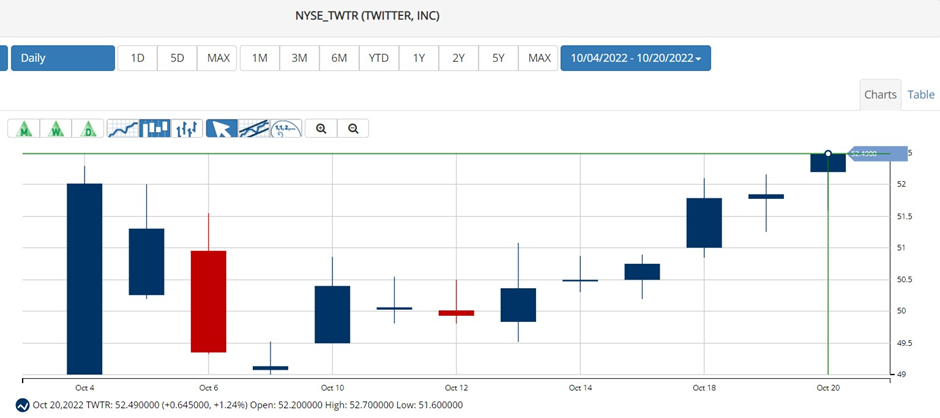
SpaceX founder Elon Musk finally agreed to buy the company for $54.20 a share. In a regulatory filing on October 4, Musk notified TWTR of his intent to go ahead with the initial agreed-upon deal to acquire the company and take it private. The stock jumped more than 22% on October 4, 2022, and has been on an uptrend since then.

TWTR Chart

Source: MarketClub

There has been no shortage of controversy as the two parties were scheduled to go to trial on October 17. TWTR had dragged the Tesla CEO to court after he informed the company of his intention to terminate the agreement in July.

Musk had backed out of the deal, stating that TWTR had failed to disclose the number of bots and spam accounts on its platform. He claimed that the company was misleading investors by misstating the number of bots on its platform by providing false numbers in its corporate filings with the SEC.

On July 12, 2022, TWTR filed a lawsuit against Musk, as his decision to back out of the deal had led to its investor sentiment tumbling. In the lawsuit, TWTR argued that having signed a binding agreement, he could not abandon it.

Just after Musk officially tried to terminate the deal in July, hedge funds Pentwater Capital and Greenlight Capital sensed an opportunity. They went long on the stock as there was a signed contract, and Musk could only pull out of the deal if there were fraud in TWTR’s financial statements or any material event that could change the company’s value. So, in the absence of these issues, Musk had no option but to honor the contract.

Greenlight Capital founder David Einhorn said, “Investing in something like Twitter, which I think will resolve this year, is good because I should get the cash out to redeploy into the next thing.” Continue reading "Trade Like a Hedge Fund - 1 Stock They're All Buying"

One Penny Stock Posting Extraordinary Gains

The Fed’s persistent hawkish stance to tame the stubborn inflation and the consequent increase in recession fears have led the widely-followed stock indices to witness massive sell-offs this year.

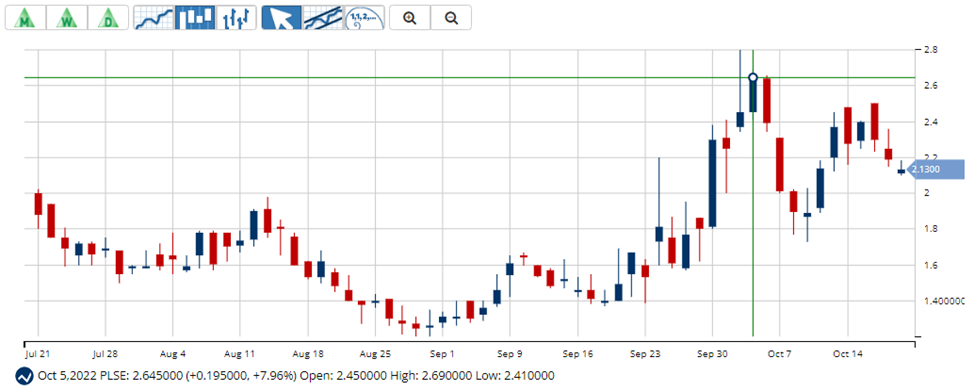
While most well-known names in the market got caught in the brutal sell-off, penny stock Pulse Biosciences (PLSE) witnessed a solid uptrend, gaining 54.3% over the past month and 11.9% over the past three months.

PLSE Chart

Source: MarketClub

PLSE operates as a novel bioelectric medicine company. It provides CellFX System, a tunable, software-enabled, and console-based platform used to treat various medical conditions using its Nano Pulse Stimulation technology.

The medical therapy company delivered impressive results for the second quarter that ended June 30, 2022. During the quarter, the company transitioned its commercial focus toward utilizing CellFX Systems in a select group of dermatology clinics. In addition, the company completed two commercial sales of CellFX Systems.

Furthermore, PLSE is expanding strategic opportunities within healthcare and anticipates a concentrated focus on the oncology, gastroenterology, and cardiac sectors.

PLSE is trading above its 50-day moving average of $1.73, indicating an uptrend. While the company is yet to turn profitable, Wall Street expects its loss to decline in the upcoming quarters, which could help the stock grab some more investor attention and maintain its momentum.

In terms of its forward EV/Sales, PLSE is trading at 73.74x compared to the industry average of 3.81x. The stock’s forward Price/Sales of 72.31x compares to the industry average of 4.25x.

Is it a good idea to buy shares of a loss-making company if it trades at a high premium to its peers but is trending upward?

View Results

Loading ... Loading ...

Here is what could influence PLSE’s performance in the upcoming months: Continue reading "One Penny Stock Posting Extraordinary Gains"

Health Care Stocks You'll Wish You Bought Sooner

The latest inflation data has further aggravated recession worries. With inflation still hovering near its multi-decade high, the odds of the Fed proceeding with its fourth consecutive 75-bps interest rate hike are pretty high. The consequent increase in recession fears has dampened the market sentiment significantly.

However, healthcare companies enjoy demand and margins resistant to inflation and recession. The inelastic demand for healthcare products helps these companies generate stable revenues regardless of inflationary pressures and consumers’ spending cuts amid a recession.

Moreover, the demand for healthcare products and services could rise further due to the increased need to serve aging Baby Boomers and the increasing frequency and severity of chronic conditions.

According to a report published by Health Affairs, national health spending is expected to reach $6.8 trillion by 2030.

Hence, given ongoing macroeconomic turbulence and uncertain outlook, one could make the most of the strong uptrend in healthcare stocks Eli Lilly and Company (LLY), Merck & Co., Inc. (MRK), and Biogen Inc. (BIIB) by investing in them.

Eli Lilly and Company (LLY)

LLY discovers, develops, and markets human pharmaceuticals worldwide. With a market capitalization of $314.88 billion, the company provides diabetes, oncology, neuroscience, and other products.

Over the last three years, LLY has grown its revenue at a 10.3% CAGR, while the company’s EBITDA has grown at a 13.3% CAGR.

For the second quarter of the fiscal year 2022 ended June 30, 2022, LLY’s worldwide revenue stood at $6.49 billion. Excluding revenue from Alimta, the sale of the company's rights to Cialis in China in Q2 2021, and COVID-19 antibodies, the company’s revenue grew 6% year-over-year. LLY’s operating income and net income came in at $1.21 billion and $952.50 million, respectively. Its non-GAAP EPS came in at $1.25.

The consensus revenue estimate of $30.30 billion for fiscal 2023, ending September 2023, represents a 5.2% improvement year-over-year. Also, Street expects LLY’s EPS to grow 16.3% year-over-year to $9.28 during the same period.

LLY’s stock is trading at a premium, indicating high expectations regarding the company’s performance in the upcoming quarters. Regarding forward P/E, LLY is trading at 41.69x, 122.7% higher than the industry average of 18.7x. Also, it is trading at a forward Price/Sales multiple of 10.98 compares to the industry average of 4.25. Continue reading "Health Care Stocks You'll Wish You Bought Sooner"