ETF Talk: Is China's Great Wall of Growth Showing Cracks?

As many of us know China is becoming a bigger shareholder in the US then our citizens, which scares some and for good reason! But what does the long term look like for China? Whatever it is, it now directly impacts the US, so I've asked Doug Fabian to come and give us his thoughts on the ETF's that track China and the indexes. If you are interested in ETF's of ANY type, then I HIGHLY recommend you read the article below and check out Doug's newsletter HERE. I'm a member of his Mutual Fund Lemon List as I was a big believe in mutual funds. So enjoy the article and learn more about Doug HERE.

====================================================================

For the last 30 years, the economy that has achieved the fastest and most consistent growth in the world may well be China’s. Despite the current global recession, the Chinese economy still grew 9.8% in 2008. It marked the first year of single-digit percentage growth for the country since 2003, after notching double-digit percentage growth between 2003 and 2007.

Chinese government officials claim that their nation contributed more than 20% to the world’s economic growth last year. They also optimistically forecast economic growth of at least 8% for this year. However, a number of independent private sector estimates, including those from Economist magazine and the International Monetary Fund, estimate China’s economic growth will fall below 7% and possibly slip to 6%. A fear exists that civil unrest may occur if the growth rate dips below 8%, since economic weakness typically boosts unemployment. With relatively high growth rates, compared to other countries, investors may wonder if China could offer a hedge against recessionary conditions elsewhere.

If 2008 is any indication, investors should tread cautiously before going either long or short in the Chinese market. Despite the country’s growing economy, history shows that the correlation between global stock markets increases during times of recession. As the Dow fell 33% last year, the Shanghai Composite Index plunged 65%. The iShares FTSE/Xinhua China 25 (FXI), an exchange-traded fund (ETF) that follows 25 companies on the Shanghai stock exchange, fell 47.76% last year. If you were shorting the Shanghai stock exchange through UltraShort FTSE/Xinhua China 25 (FXP), you would have lost 53.61%. You might expect a short ETF to turn a profit if the stock index that it tracks plummets but China certainly did not follow that pattern last year.
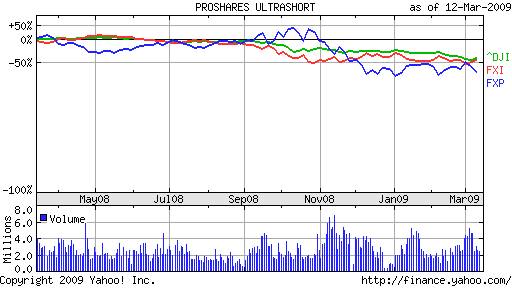
Despite the positive spin that Chinese government officials are giving to the country’s economic outlook, it is hard for me to belief that its stock market is ready to rebound. But that hasn’t stopped its leaders from expressing renewed confidence in its economy. The Chinese government reported last week that its industrial output last year rose by 5.7%, while its retail industry grew by 17.4%, year-on-year. In addition, China has nearly $2 trillion in reserves and a low debt-to-GDP ratio of 18%, compared to 80% in the United States and 160% in Japan.

On the other hand, other economic signs indicate a significantly slowing economy in China. Its exports fell in February by a whopping 25.7%. Millions of people have been left jobless and thousands of export firms have closed shop. With consumer prices falling, some analysts are discussing the possibility of deflation in China.

Since investors hate uncertainty, China is not looking very enticing right now. Of course, if investors decide stock markets around the world have been pounded enough and the current bear market rally may be a sign that the worst is behind us, China’s beaten down stock market could rally as strongly as any around the globe.

Personally, I am not yet ready to move into China either long or short. If you, however, think that the Chinese market has bottomed out and that its government stimulus spending will give the Chinese economy a boost, you may want to consider going long. For those who expect more fallout in the Chinese market this year, you may be tempted to put a little money into a short ETF. But if you’re like me and you dislike losing money and investing without a clear market direction in sight, you can monitor these ETFs from the sidelines along with the Fabian team.

LONG: iShares FTSE/Xinhua China 25 Index (FXI)

PowerShare Gldn Dragon Halter USX China (PGJ)

SPDR S&P China ETF (GXC)

SHORT: Ultrashort FTSE/Xinhua China 25 Index (FXP)

Doug Fabian

If you want guidance about which ETFs to trade and when, check out my ETF Trader service by clicking here.

Inflation/Deflation Uncertainty

Our government continues to CRUSH the value of the dollar so I asked Adam Katz from PlusEV.ca to break down the current situation. I've read the article and it provides a great view of what's going on, how we got here, and the nuts and blots (his words not mine). So please enjoy the article and COMMENT as Adam Katz and I are looking forward to your thoughts!

==================================================================

I have received many emails over the past few months proclaiming that inflation is an obvious result of the current government intervention and that the dollar's days are numbered. As a nuts and bolts kinda guy, I like to step back and analyze the situation from point A to B, instead of staring at fancy charts which can usually be used to prove just about anything.

Before I get into the discussion, let me say that the focus of this article is timing more so than theory. To argue that we will never see inflation after the tricks central bankers have been pulling would simply make no sense. Yet, I was surprised last year to see some really good traders position themselves for an inflation trade in the middle of serious disinflation. After all, what the Fed was doing MUST have been inflationary! Right?

Firstly, what are the ingredients for credit expansion?

1)    Central banks expanding the money supply
2)    Banks lending that money out
3)    Credit worthy borrowers

Now we all know that we can place a big fat check mark next to (1), but what about the other ingredients? Putting money into the banks is easy; getting it into circulation is hard in a ‘fairly’ transparent system. Consider for a moment Zimbabwe, a country that has suffered unimaginable inflation. Do you think Robert Mugabe is subtle about expanding the money supply? He has the luxury of simply handing out money to his cronies and directly flooding the money supply. In countries like the U.S., such actions would be very difficult. China on the other hand can simply make large loans to government held businesses and thus expand the money supply.

The U.S. has been creative. For example, the AIG bailout after the Lehman collapse resulted in a transfer of government funds from AIG to large investment banks in the form of margin calls. When AIG’s credit rating was downgraded, they were forced to post margin with their counterparties. Yes this saved AIG, but it also saved those banks that were using AIG to hedge their risky trades with CDS contracts. The capital found its way into the banks, but never made it any further.

Now people are complaining. The stupid banks that made stupid loans have been bailed out. So why aren’t they lending? Why aren’t they making loans to borrowers who are not credit worthy? I hope my sarcasm wasn’t missed. To encourage banks to make bad loans is the most irresponsible thing that we can do. The point of the bailouts was to prevent financial collapse, not to continue the fundamentally flawed system.

Now we are seeing the economic follow through effects of both a credit and a housing bubble bursting. What is likely is that the credit worthiness of borrowers decreases and so will the banks willingness to make loans. Money won’t flood the markets – in the developed countries.
In the emerging markets, currency devaluation and sovereign defaults are alive and well. In fact, even Switzerland, the icon of monetary responsibility has engaged in devaluing their currency. If that’s not symbolic of the end of an era then I don’t know what is. My point is that the U.S. will continue to be a safe haven. As long as threats of further economic downside looms, the U.S. will continue to be perceived as the safest option – on a relative scale. Inflation will strike emerging markets long before it hits the U.S.

And when that happens, the U.S will be able to afford to allow their currency to weaken on an absolute basis because on a relative basis it will appear stronger than many of it’s peers. When risk appetite picks up, as it has done the past few days, the dollar will weaken. In the future, that pattern will coincide with the banks making more loans, and inflation will become a threat. However, that’s unlikely to happen any time soon, at least according to Meredith Whitney. She estimates that banks will cut $2.0 trillion of credit-card lines in 2009 and a total of $2.7 trillion will be cut by the end of 2010. That doesn’t bode well for inflation advocates, at least in the short term. This gives the Fed more than enough time to shrink the amount of funds that they have made available to banks and calls into question further asset price deflation over the coming 18 months.

I will leave you with the following basic economic concept: It is unexpected inflation, not expected inflation that causes havoc in the economy. With the current outlook of low or negative inflation for years to come, a sudden shift to high inflation would be devastating for the economy.

Adam Katz
www.PlusEV.ca

Jon Stewart puts spotlight on CNBC and meltdown

From our Business Partner Associated Press
Jon Stewart puts spotlight on CNBC and meltdown

NEW YORK (AP) — The feud between Jon Stewart and CNBC's Jim Cramer has been good for laughs — and ratings — but has also raised the serious question of whether the experts at TV's No. 1 financial news network should have seen the meltdown coming and warned the public.

Over the past two weeks, Stewart's "Daily Show" on Comedy Central has ridiculed CNBC personalities, including Cramer, the manic host of "Mad Money," by airing video clips of them making exuberantly bullish statements about the market and various investment banks shortly before they collapsed.

Courtesy of Comedy Central


Stewart has charged that people at CNBC knew what was going on behind the scenes on Wall Street but didn't tell the public. He has accused CNBC anchors and pundits of abandoning their journalistic duties and acting like cheerleaders for the market.

"In a tremendous boom period, they covered the boom and people wanted to believe in the boom," said Andrew Leckey, a former CNBC anchor and now president of the Donald W. Reynolds National Center for Business Journalism at Arizona State University. "They didn't uncover the lies that were told to them. Nobody did. But they should be held to a higher responsibility."

But Don Hodges, chairman of Hodges Capital Management in Dallas, said he doesn't fault CNBC for not seeing the bust coming.

"I'm not sure that anybody had seen it coming," he said. "I've listened to all of the so-called experts, and it's obvious that everybody is very confused."

Cramer, for his part, appeared on "The Daily Show" on Thursday and was interrogated Mike Wallace-style by Stewart. Cramer acknowledged that he made mistakes but said that he and CNBC weren't alone.

Like other Wall Street professionals, Joe Saluzzi, co-head of equity trading at Themis Trading LLC, said it was plain CNBC was bullish during the run-up in the economy over the past few years. But he said his job was to do his homework and not to make decisions based strictly on what he heard on TV.

The questions raised about CNBC are similar to those journalists faced about what was reported during the months before the Iraq War.

CNBC spokesman Brian Steel noted that the network "produces more than 150 hours of live television a week that includes more than 850 interviews in the service of exposing all sides of every critical financial and economic issue." He added: "We are proud of our record."

All of the cable news networks recognize the growing popularity of shows with a strong point of view. But is there too much talking and not enough reporting?

"They need some adult supervision about what people get to pop off about over there, even if it is opinion," said Dean Starkman, managing editor of Columbia Journalism Review's The Audit, which focuses on the business press. "They need to look into the mirror and see how close they are intellectually and emotionally with the people they cover. They need to sit back and get some critical distance."

Some CNBC defenders have accused Stewart of taking some of the video clips out of context, or blowing them out of proportion.

"A politician stumbles over himself," MSNBC "Morning Joe" host Joe Scarborough said on his own program. "Then they pick it out. They edit it. He runs the clip, and then he makes a funny face, and the whole audience has a Pavlovian response. And you know what? It's really easy to be a comedian and take those cheap shots."

Some at CNBC believed, at least prior to Cramer's appearance on Thursday, that the controversy was ultimately good for the network because of the attention it drew. Some questioned whether the business professionals who make up the bulk of CNBC's daytime audience would be affected by Stewart's criticisms.

From Feb. 19 through March 9, CNBC averaged 361,000 viewers during the business day, compared with 328,000 the three weeks before, according to Nielsen Media Research. During the same period, the page views on CNBC's Web site went up 22 percent from 13.1 million to 15.9 million.

Similarly, a video clip of Stewart's original criticism of CNBC last week has been seen more than anything else the show has put online this year.

"Stewart's a comedian and Cramer is a showman," said Robert Howell, professor at Dartmouth University's Tuck School of Business. "If anybody takes seriously anything that (Cramer) says, they're stupid."

How to tell or refer a friend (short video)

Why the market rebound may be slower than the pros think.

One thing that I've been paying attention to more and more is the Forex markets. Honestly, over the past few months my attention has landed pretty squarely on Forex and how Forex reacts with the ebb and flow of the general stock and futures markets. Now one guy that I've been paying a ton of attention to (other then Adam as he's the published author and successful Forex trader) is Bill Poulos from ProfitsRun. I've been following him for a while personally and professionally, and can say without a doubt that he is the second best resource I have for Forex related questions! Yes SECOND best!

Regardless of that, I asked him to do two things for me today. First I wanted him to give away (for free) the Forex kit I paid for a while back. I was able to glean a TON out of information and again I paid for the "Forex 4-Pack" pack that he's agreed to give away for free.

Second I wanted him to explain why Forex is so hot and how we can benefit from the huge flow of liquidity thats moving into Forex. Check out the article below and get the Forex 4-Pack.

Please feel free to comment as Bill will be responding to ALL questions and comments!

==================================================================

If you've followed the stock markets (and really, who hasn't?), you've likely wondered where the buyers are when stocks are now at their lowest levels in decades.

One place money has been flowing to has been the Foreign Exchange (or Forex) -- which has grown rapidly in the last several years and is fast gaining wide popularity among traders.

Forex alone now accounts for more than $3 TRILLION in average daily turnover and shows little sign of slowing down.

What does this mean to you, the trader?

It spells opportunity. This is one of the best times I can recall to learn to trade and to start trading the enormously popular and potentially profitable Forex markets.

Why?

Because with the world's financial markets in turmoil, mega trends in the Forex markets have seldom been better. The pressures causing disruption in the stock markets around the world are also causing awesome trading opportunities in the Forex markets.

Keep in mind that with Forex, you don't need to wonder when the market will stop going down or when it will recover, or how long it will take. With Forex, the six major pairs are almost always up or down in what I call mega-trends, providing trading opportunities right here, right now.

The problem I see is that too many traders aren't sure how to take advantage of those opportunities, or how to spot those trades they could be making. Or, if you have never traded the Forex markets, people are wonder how they can participate? Still others worry about controlling risk or being able to capture a 'free' trade situation when trading these markets.

As of this writing, the U.S. Dollar has rallied against most major currencies. The continued economic fallout from the housing, banking and credit crises, major unemployment explosion and the ongoing recession have forced the U.S. government into unprecedented spending. That spending creates incredible inflation risk for the dollar, and could well send the dollar into a significant reversal. Regardless, the Dollar will continue to provide great trading opportunities versus the other major currencies time and time again.

Simply put -- as governments across the globe scramble to provide liquidity to credit markets and inject cash into their money supplies to refloat their economies, they will directly impact the value of their respective currencies as they relate to one another. This then acts to drive the six major currency pairs up or down, in very recognizable and tradable trends.

At the end of the day, economists and media gurus are all predicting what will happen to the economy, when the recession will end, when the stock market will "bottom" and recover -- but here's the thing: Forex traders don't have to wait for a recovery. Nor do they care, necessarily, when a recovery will come.

And because of that, I believe we are seeing more capital flight to Forex, which in turn is creating longer, stronger trends and better trading opportunities.

So, if you're already a Forex trader, you should recognize the impact all of this has had on trading currencies and focus on key trading elements:

- Risk Management
- Trend Identification (beginning and ending)
- Optimal Profit Strategies

If you're interested in Forex, but not yet trading it, or, not yet succeeding in it, you should take this time to LEARN to trade Forex with a solid trading method that teaches you:

- Why Forex is different
- How to trade
- Entry and Exit rules
- Risk Management and Capital Preservation

I think right now is one of the best times to begin trading or to learn to trade in the Forex markets because of the trends being driven by the economic turmoil around the world.

And that turmoil creates trading opportunities every day. If you've been missing those market-moving opportunities, don't miss another one!

Bill Poulos

Get the FOREX 4 PACK as I told Adam I'd give it away!

Can the U.S. survive $80 crude oil?

Can the U.S. survive $80 crude oil?

For the first time since September of 2007, the crude oil (NYME_CL) market has flashed a positive signal that it is headed higher. This is the first buy signal that we have seen in over 18 months in the energy markets.

The big question is, if crude oil is headed higher, how much of a price increase can the US economy afford and withstand?

Here is a raw commodity that is used by everyone and the US has no control over it. This key commodity to commerce just happens to be in areas that are normally hostile to the US. If we see a hiccup in the supply chain that changes this market dynamic, even for a short time period, we could see oil move back to the $80/barrel range in a heart beat.

So how will this affect the US equity markets? If crude oil heads back to the $75-$80 range, I expect that the major indices will head south. I call it the 551 syndrome. 5000 on the Dow, 500 on the S&P 500, and finally 1000 on the NASDAQ.

In this short video I will share with you the potential target zones we could see in the next 6 to 12 months in crude oil.

So with the trend in crude oil in a positive trajectory and the trend in the US equity markets in a negative trajectory, I think the two will feed off themselves. Look for traders and hedge funds to move aggressively in both these areas with abandon.

Lastly with no reinstatement of the up-tick rule, expect stocks to once again get pummeled to oblivion.

Enjoy the video and all the best in trading,

Adam Hewison
President, INO.com
Co-founder, MarketClub

P.S. We welcome your comments and feedback on this and all the posts we make on this blog.

How to tell or refer a friend (short video)