A Trading Pattern For The Impatient Or Time Sensitive Trader

I'm pretty sure many of us fall into the category of impatient trader. I am guilty as charged! I'll spare you the details of the trade but put it this way if I would have held I would have made 15 times my money. Hey I did make 2 times my money so I can't complain...but my impatience got the best of me.

I've asked Dean from ATradersUniverse.com to give us his insight on how to deal with being impatient. ENJOY!

=====================================================================

Your major focus in trading should the softer side of trading, the business and psychological side of it; the harder side which relates more to the technical side is a secondary thought, however in this article I am combining the two because one of my favourite patterns is an ideal pattern for the impatient trader who does not like to hold on to trades for too long.

Impatience is not a good trait to have in the markets when trading or investing. It breeds laziness when it comes to research, planning and analysis, it causes some to exit trades too early, and it causes other’s to constantly monitor their positions. To add to this, trades that linger on can incur costs such as time premium erosion for options traders, and interest costs for CFD traders or stock traders using margin, to name a couple.

Weaknesses are a part of human nature; your job is to ‘manage’ them, not to try and eliminate them or even turn them into strengths. We were brought up to take our weaknesses and try and turn them into strengths which I believe is the wrong approach. Build on your strengths and manage your weaknesses is the best motto I ever heard.

Some traders who don’t like to be in trades for too long will use an exit strategy that will force them out of the trade if the particular stock or market consolidates and moves sideways for a few days, which is a good strategy. Let’s look at an entry technique which is the trading pattern for the impatient trader.

This pattern signals a turning of the market. It does not necessarily signal a top or bottom, it will sometimes just signal a correction, either way; it tells you that a swift and sharp move the other way is imminent, and usually enough to give a good reward to risk. The emphasis here is ‘swift and sharp’, because this is what the impatient trader is looking for.

The pattern unfolds in 5 waves with the highs and lows of the waves overlapping each other to the point where the 5th wave ends in a spike. Here is a diagram showing what to expect at the end of a run up, and the end of a run down.
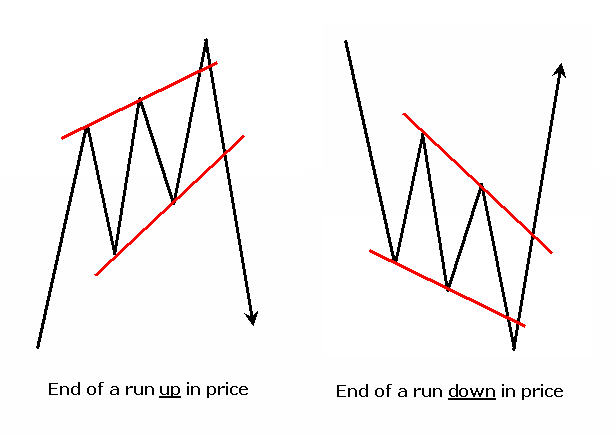
This is what you need to see and how to trade it:

1. You join the highs of wave 1 and 3 together, and the lows of wave 2 and 4 together if in an up market, and these lines need to converge [or lows of waves 1 and 3, and highs of waves 2 and 4 if in a down market].
2. You want the high of wave 5 to break the upper line and spike [low of wave 5 to break lower line and spike].
3. The break of the lower line is your entry [the break of upper line is your entry].
4. Your stop goes on the other side of the 5th wave.
5. You want your exit or your first profit target to be within the range between the low of wave 1 and wave 2.
6. You shouldn’t take the trade if this range does not offer you at least a reward to risk ratio of 1:1, however this is obviously a personal choice

This is an example that occurred on the SP500 index in July 2008 on a 30 minute chart.
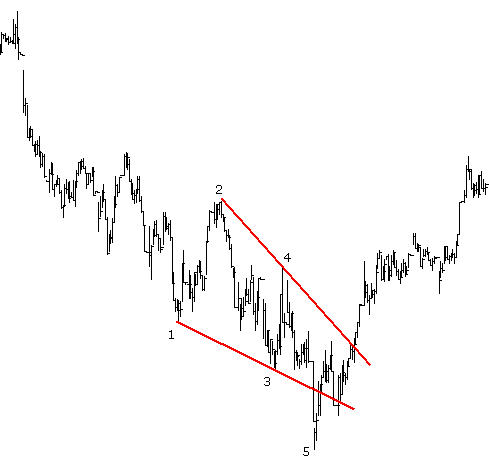
Elliott Wave users will be familiar with this pattern, known as an ending, leading and 5th wave diagonal; others may know it as three drives pattern, and others may just say it’s a wedge pattern.

The point I wanted to make in this article, so as to benefit you is that when these patterns occur they produce swift and sharp moves and this is an obvious benefit to those who don’t like spending too much time in the markets, whether it’s due to being impatient or because of trading instruments that are time sensitive.

Here's a challenge
Who can tell me a currency (or forex pair) where this pattern has occurred very recently?
Here's a clue; the pattern took months to form and only weeks to retrace.

Dean is the owner of ATradersUniverse.com , a resource and education site for traders. He also has a trading system development program which you can find here PentagonalTrading.com.

Dean has also been researching the mind and why traders self sabotage after seeing his parents win the lotto only to lose it all and more. He is giving away a free portion of his ebook discussing the science behind why we fail to succeed, which you can download here:

http://www.atradersuniverse.com/RMFSGiftMC.pdf

==============================================

5 Traits of a Highly Successful Investor

With all the recent action I think we all need a reminder of what makes a successful trader. Above is the post from Adam on the Traders Whiteboard series and those videos are a GREAT place to start. But Blain from StockTradingToGo.com has also given us a list and what you need to do. Enjoy!

===============================================================

With the bear market in full force and volatility at record highs every investor needs to be trading
at their best. For the active investor there is no room for error when the market is swinging 10%+ in
single day sessions.

Here are five traits of a highly successful investor (in no particular order):

1. Discipline - Every investor has to be disciplined in the market. If you can’t follow your own rules and stick to a strategy, you may find yourself laying dead in the battlefield faster than you know. Discipline is the most important trait of a successful investor because the market is full of temptation to make dumb mistakes day in day out.

2. Patience - Act too quickly and you may just get burned. Some traders will step back and wait months before making a trade, why? Because they are patient hunters looking for the right moment to strike. Right now one fact is certain, cash is king.

3. Dedication - Invesors that are not dedicated to the market will get punished. Some of the best managers are up at 4:30 AM if not earlier to start their day and map out potential plays. It doesn't matter how late it is at night, preping for each and every day is critical.

4. Guts - When you bet nine months in advance that Apple is going to take off and you place $100 million on the table, you have guts. Some of the best traders in the world have taken bets that no one else saw or agreed with, but had the last laugh in the end.

5. Perseverance - Probably the X factor of successful trading, perseverance is critical to success because let’s face it, not everything is going to go your way. No one cares that you have thirty years experience behind you, without a solid track record you are a nobody. The best part of the stock market is that history has shown the game repeats itself. Investors may loose their rear today, but in three months when the same trade comes around they will know what to do.

Please take time and visit StockTradingToGo.com and work with the network of smart investors spending time there!

It takes a long time for a market recovery

This from our media partner Associated Press.
Monday, October 13, 2008

NEW YORK: It has taken Wall Street considerable time to recover from crashes and for investors to regain their confidence and decide it was safe to put their money into stocks again. A look at how the market recovered from its two best-known crashes, and how much it needs to recover from its latest plunge.

When the market crashed Oct. 19, 1987, sending the Dow Jones industrial average down 508 points to 1,738.34, the blue chips had lost 938 points, or 36.1 percent, since reaching a then-record close of 2,722.42 on Aug. 25, 1987. It took just over 15 months for the Dow to get back to its pre-crash level, and almost two years to the day — Aug. 24, 1989 — to reach a new closing high, 2,734.64.

_The recovery from the 1929 crash was more difficult — and spanned a quarter century. The Dow had reached a high of 381.17 on Sept. 1 and then began drifting downward. Although the date of Oct. 29, 1929, Black Tuesday, is probably best-known by the public, many market historians say the crash began on Thursday, Oct. 24, and accelerated the following Monday and Tuesday.

From its close of 305.85 on Oct. 23, the Dow tumbled 75.78, or 24.8 percent, by the time it ended at 230.07 on Black Tuesday. It continued its decline to a low of 198.69 on Nov. 13, giving it a drop of 107.16, or 35 percent.

That also made for a drop of 182.48, or 47.9 percent from the September high. But stocks kept on falling as the Great Depression wore on, and the Dow fell to 41.22 on July 8, 1932, giving it a loss of 339.95, or 89.2 percent from the September 1929 high.

The Dow did not close above 305.85 again until April 1, 1954, more than 24 years after the crash, and it didn't return to 381.17 until Nov. 23, 1954, a quarter century after Black Monday and Tuesday.

The Dow has a large percentage drop to regain this time. By Friday's close, the average had fallen 5,713 points, or 40.3 percent, from its record finish of 14,165.43 a year earlier, on Oct. 9, 2007. More recently, it fell 2,970, or 26 percent, from its close before the Sept. 15 collapse of Lehman Brothers Holdings Inc., the event that triggered the freeze-up in the credit markets and that sent stocks plunging.

With Monday's advance of 936.42, the Dow is still nearly 4,778, or 33.7 percent, below its record close.

A Word of Encouragement for the 'Average Trader'

I'm going to cut right to the chase...READ THIS!! Our good friend Norman Hallett from DirectYourMind.com has been an expert in the psychology of trading for years! He's helped, and helping, thousands of traders a day to get their minds right. So read this article and check out Normans site.

=================================================================

"Deep recession!"

"Depression!"

"End of the world as we know it!"

Anyone who's tuned into CNBC or CNN has heard these statements of doom and gloom.

They may or may not be true.

We are not in control of what happens to the economies of the world.

We ARE in control of how we handle our personal finances in light of these possibilities and, as traders, how we choose to TAKE ADVANTAGE of all situations... including this one.  No, ESPECIALLY this one.

We know that price action is a reflection of what is perceived "to be", not what is.  We know if we take a position and employ money management techniques, then
if we are wrong in our position, we will get pinched and not punched... and we'll re-analyze and go again.

It's the way of the trader.

For the trader, the greater the economic challenge, the greater the opportunity to better ourselves and our family... through our trading.

When most individuals are hiding behind excuses, the trader steps up to the plate.

We are lucky, indeed.

But don't fool yourself. Being a trader, is not easy.

I look at markets in turmoil and I "feel" for the average trader.

The average trader has every good intention, but lacks the two basic elements to consistent trading success...

A formulated trading plan, whose elements are the components of a good trading system or systems, is the first element. And having the mental and emotional discipline to run that plan is the second element.

The GREAT NEWS for the 'average trader' is that it doesn't take years to elevate your level of trading... months, yes, but not years.

The further GREAT NEWS is that we are in historic times.

The opportunities that will unfold over the coming weeks, months and years could result in windfall profits for those traders who choose to master the two elements mentioned above.

Shake-outs like we are experiencing now in the marketplace yield new super-trends that may be followed.. and ridden... by those who are prepared.

So should you "drop back and punt", and stand aside while the market displays its current violent ways?

Only you know the answer to that.

Are your two basic elements solid?

Is your trading plan MEANT to handle extremely high volatility?

For any average trader... these are the type of markets that exploit your weaknesses.

FOR YOU, it's time to re-group and prepare yourself for the opportunities that are about to present themselves as the smoke starts clearing.

Adopt a solid trading plan, based on a solid trading system. AND

Start now to make the development of your trading discipline a PRIORITY.

Without COMMITMENT to these two elements, you will not succeed on a consistent basis and will not be able to take advantage of the opportunities to come.

This is NOT the time for excuses.

It's your time for admission... recognizing that you do, in fact, possess these two elements, or admit that you don't and work NOW on shoring them up.

I've been trading for 25 years I can say with confidence that the opportunities that are about to unfold will be historic.

Fortunes will be made.

The Disciplined Trader with a tested trading plan and possesses solid trading disciplined will gather the money of The Average Trader who continues to downplay both.

It's time to prepare.

Norman Hallett

DirectYourMind.com

Fed, central banks cut rates to aid world economy

By JEANNINE AVERSA

Associated Press Economic Writer (AP:WASHINGTON) The Federal Reserve and six other major central banks from around the world slashed interest rates Wednesday in an attempt to prevent a mushrooming financial crisis from becoming a global economic meltdown.

The Fed reduced its key rate from 2 percent to 1.5 percent. In Europe, which also has been hard hit by the financial crisis, the Bank of England cut its rate by half a point to 4.5 percent and the European Central Bank sliced its rate by half a point to 3.75 percent.

Also cutting rates were the central banks of China, Canada, Sweden, and Switzerland. The Bank of Japan said it strongly supported the actions.

"The recent intensification of the financial crisis has augmented the downside risks to growth," the Fed said in explaining the coordinated action.

The Fed action will reduce borrowing costs almost immediately for U.S. bank customers whose home equity and other floating-rate loans are tied to the prime interest rate. Bank of America, Wells Fargo and other banks cut their prime rate by half a point to 4.5 percent after the Fed announcement.

White House spokesman Tony Fratto welcomed the cooperation among the Fed and other countries' central banks to battle the crisis. "It's important and helpful that central banks are working in a coordinated way to deal with stress in the financial system," Fratto said.

But analysts were cautious about the impact of the central banks' coordinated action.

"At first blush, while this is a big step, it is unlikely to prove sufficient to stem the rot. Additional rate cuts are likely and further measures to inject liquidity and re-capitalize banks are needed," said Marc Chandler, global head of currency strategy at the investment firm Brown Brothers Harriman.

The rate cuts came against a backdrop of increasing anxiety in global financial markets. Investors have been fleeing shares on worries that neither the Fed, nor other central banks, could move fast enough to stop the rising turmoil.

To read the rest of this story click here: http://club.ino.com/trading/fed-central-banks-cut-rates-to-aid-world-economy-cont/