What Is A Buyback? 1 Company Buying Back Its Stock in 2023

A business with excess cash on its books can return value to shareholders in various ways. One of them is distributing the surplus among shareholders as dividends. However, they are more tax-efficient ways to reward existing shareholders with delayed gratification.

A business can choose to reinvest its earnings into its own business or acquire other businesses to upgrade or expand its operations organically or inorganically to increase its future earnings and consequentially increase the intrinsic value of each of its outstanding shares.

Alternatively, the business may choose to decrease the number of outstanding shares, making each share worth a greater percentage of the corporation. All else being equal, this increases the earnings attributable to each share almost immediately. This method of allocating excess capital is called a buyback.

Buybacks are initiated through tender offers or open market transactions when the management of an organization feels that its shares are undervalued. In addition to signaling financial health and increased confidence in their own prospects, businesses also repurchase their own shares to reduce supply and dilution by shrinking the float to prevent other shareholders from taking a controlling stake.

In a nutshell, a buyback is a way for a business to get its skin deeper in the game with the hope of rewarding investors who choose to keep supporting it.

Can Meta Platforms Be a Good Investment Given Its Buyback Program?

On February 1, Meta Platforms, Inc. (META) announced that it had repurchased $6.91 billion and $27.93 billion of its Class A common stock in the fourth quarter and full year of 2022, respectively.

It also announced a $40 billion increase in its share repurchase authorization, in addition to the $10.87 billion available and authorized for repurchases as of December 31, 2022.

As the parent company of world-renowned social networking platforms, such as Facebook and Instagram, META builds technologies that help people find communities and grow businesses through mobile devices, personal computers, virtual reality (VR) headsets, wearables, and in-home devices. The company operates through two segments: Family of Apps (FoA) and Reality Labs (RL). Continue reading "What Is A Buyback? 1 Company Buying Back Its Stock in 2023"
Are Stock Investors "Dazed & Confused"?

Please enjoy this updated version of weekly commentary from the Reitmeister Total Return newsletter. Steve Reitmeister is the CEO of StockNews.com and Editor of the Reitmeister Total Return.

Click Here to learn more about Reitmeister Total Return


The stock market (SPY) has been up, down and all around since last week’s commentary. That’s because bulls and bears are slugging it out for dominance during this “Dazed & Confused” phase for the market.

What does that mean?

What happens next?

What should an investor do about it?

We will explore the answers for each of these pressing questions in this week’s Reitmeister Total Return commentary.

Market Commentary

Now let’s a step back to last week’s commentary where I outlined 4 possible outcomes for the market after the very important Fed rate announcement on Wednesday 2/1. Indeed, we landed on the least of attractive of which. That being…

Scenario 4: Dazed & Confused

"This is where the Fed gives mixed signals. Still hawkish for a long time to save face given previous statements. And yet do tip their hat a little to moderating inflation.

This gray area leads to a trading range until investors have more facts in hand. I suspect that 4,000 is the low end with 4,200 at the high end. This comes hand in hand with a ton of volatility as each new headline has investors recalibrate the bull/bear odds."

The market since then has lived up to ever single syllable of the above expectations. Especially the part about the volatility that comes after every key headline. Continue reading "Are Stock Investors "Dazed & Confused"?"

Bullish or Bearish or BOTH???

Please enjoy this updated version of weekly commentary from the Reitmeister Total Return newsletter. Steve Reitmeister is the CEO of StockNews.com and Editor of the Reitmeister Total Return.

Click Here to learn more about Reitmeister Total Return


Why are so many investment experts still calling for a bear market?

And just as interesting…why are so many equally talented investors saying the new bull market is already here?

Because investing is an inexact science leading some to rely on economic data…while others prefer to read the charts…or the expression on Powell’s face… or astrology signs or….(fill in the blank with the nuttiest thing you can think of).

So what is an investor to do when there are so many well-reasoned opinions that are giving such contradictory conclusions?

That will be the focus of this week’s commentary.

Market Commentary

I believe the best way to tell this story is from a very personal place. That being where I have an Economics degree and most certainly diagnose the market from a fundamental point of view.

Early on in my career I used to make fun of chartist for playing the market like a video game instead of taking it more seriously with fundamentals. Yet that was quite foolish on my part as I have come to greatly respect many of the leading chartist like Kevin Matras of Zacks and JC Parets of AllStarCharts.com. There is simply no denying their keen insights on market direction.

Now let’s move the conversation forward to Wednesday’s Fed meeting. I was already bearish beforehand…as are the majority of market commentators at this time. And I became even more bearish after the announcement. Amazingly, others saw it differently as stocks 3% from the time of the speech into Thursday’s close.

I went to bad Wednesday night angry, confused, dejected, perplexed, and downright flummoxed.

But then something dawned on me in the early hours and could not get back to sleep. This led to the following trade alert that I sent out to Reitmeister Total Return members on Thursday morning. Continue reading "Bullish or Bearish or BOTH???"

1 Tech Stock To Count On In 2023

Software giant Oracle Corporation’s (ORCL) second-quarter revenue and EPS exceeded Wall Street’s estimates. The company’s EPS was 3.2% above the consensus estimate, while its revenue beat analyst estimates by 2.1%.

The strength in cloud infrastructure and cloud-based applications drove a solid topline performance.

Its total cloud revenue, including infrastructure-as-a-service (IaaS) and software-as-a-service (SaaS), rose 48% year-over-year in constant currency to $3.80 billion.

IaaS revenue increased 59% year-over-year in constant currency to $1 billion.

Without the impact of the foreign-exchange rates, ORCL’s adjusted EPS would have been 9 cents higher.

ORCL’s CEO, Safra Catz, said, “In Q2, Oracle’s total revenue grew 25% in constant currency-exceeding the high end of our guidance by more than $200 million. That strong overall revenue growth was powered by our infrastructure and applications cloud businesses that grew 59% and 45%, respectively, in constant currency.”

“Fusion Cloud ERP grew 28% in constant currency, NetSuite Cloud ERP grew 29% in constant currency- each and every one of our strategic businesses delivered solid revenue growth in the quarter,” she added.

For fiscal 2023, the company expects its cloud revenue to grow more than 30% in constant currency compared to the 22% growth in fiscal 2022.

ORCL expects its revenue to rise 17% to 19% on a reported basis and 21% and 23% on a constant currency basis in the third quarter. Also, it expects adjusted EPS for the third quarter to be between $1.17 and $1.21, lower than the consensus estimate of $1.24.

ORCL’s stock has gained 13.3% in price over the past three months and 13.6% over the past six months to close the last trading session at $88.46.

The company paid a quarterly dividend of $0.32 on January 24, 2023. Its annual dividend of $1.28 yields 1.45% on the current share price. It has a four-year average yield of 1.59%.

Its dividend payouts have increased at a 10.1% CAGR over the past three years and an 11% CAGR over the past five years. The company has grown its dividend payments for eight consecutive years.

Here’s what could influence ORCL’s performance in the upcoming months:

Steady Topline Growth

ORCL’s total revenues increased 18.5% year-over-year to $12.27 billion for the second quarter that ended November 30, 2022.

The company’s non-GAAP operating income increased 4.8% year-over-year to $5.08 billion. Its non-GAAP net income declined 2% year-over-year to $3.31 billion. Continue reading "1 Tech Stock To Count On In 2023"

2 FAANG Stocks Staging A Comeback

The fabled group of five large-cap tech businesses, so-called FAANG — Facebook (currently Meta Platforms), Amazon, Apple, Netflix, and Google (currently Alphabet) — dominated the stock market through late 2021.

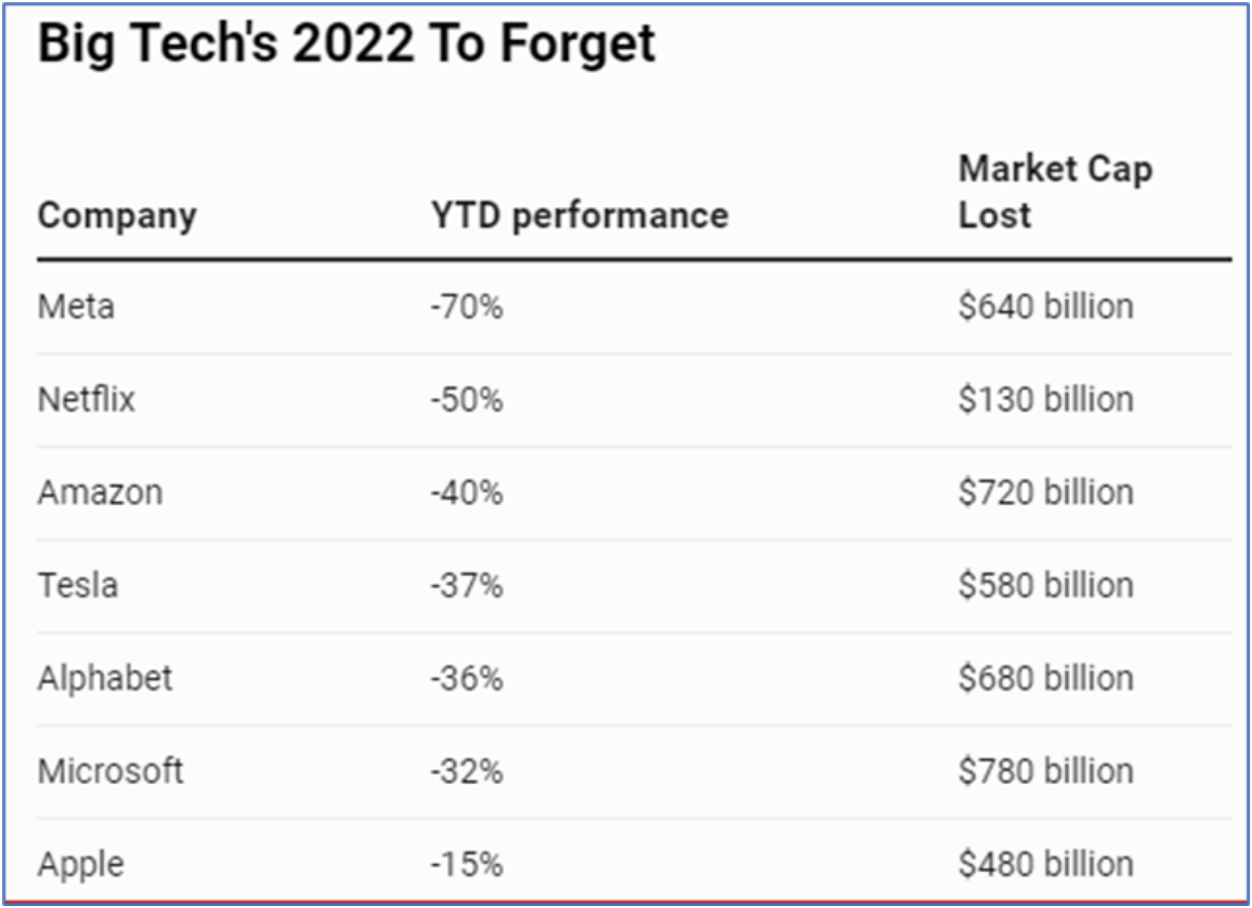
However, a challenging macroeconomic environment in 2022, characterized by stubborn inflation and removal of Covid restrictions, saw big tech struggling to meet and exceed the high expectations of growth in subscribers/users and advertisement revenues set at the height of the pandemic.

The slump in the performance of these tech businesses was soon reflected in the price action of their stocks. Their dismal year can be summarized by the below snapshot at the end of October 2022.

Big Tech

Source: Forbes

However, the drawdown brought the valuations of these compounders to a more comfortable buying point while they did the needful to recapture lost demand and improve the efficiency of their businesses.

In your opinion, which of the below factors is driving the recent string of layoffs in the technology sector the most?

View Results

Loading ... Loading ...

Continue reading "2 FAANG Stocks Staging A Comeback"