General Motors Rick Wagoner finally admits his biggest mistake

It takes a big man to admit a mistake, especially when the mistake almost crippled an industry giant. Rick Wagoner, former GM CEO, came clean this week admitting his mistakes. Now, no one likes to see anyone lose a job, but this mistake placed General Motors (NYSE_GM) in jeopardy years ago.

So what was Rick Wagoner's big mistake?

Continue reading "General Motors Rick Wagoner finally admits his biggest mistake"

Using Volatility in Your Market Analysis

The longer I'm here at INO I find myself in contact with some of the most knowledgeable, yet unheralded, trading minds. John Foreman is one of those trading minds. He will be a speaker at the LA Traders Expo in June, he's written books, and he focuses on teaching all levels of traders! I've been a fan for a while and I will be at the Traders Expo to hear him speak. Oh yeah his site is TheEssentialsofTrading.com.

All that being said, I invited John to teach on something that's been on my mind...and the mind of EVERY trader out there, volatility. So read the article, post comments and questions for John, and then check out his site...in that order!

====================================================================

As a market observer I have to say its kind of funny that a year ago after the Bear Stearns meltdown the question on everyone’s lips was whether that was the bottom in the stock market and now, as so many folks have thrown their hands up in disgust, we just might have seen it. There are several different things which lead me to think the bottom has either been put in or will be soon. In this article I’m going to outline one of them - one that helped me stay bullish into 2007, but warned me that things were changing midway through the year – and show you how you can use it.

Reading the Volatility
Volatility is one of the most useful metrics for any trader. Many have learned to use it to help in money management – to help size their positions, set their stops, or to just plain stay out of the market when it’s getting hairy. Volatility can also let us know when the market is getting ready to change states. There are two readings I look for that purpose, closing price volatility and ranges.

Closing price volatility is simply looking at how widely dispersed period closes are over a given period of time. It’s going to be high when the market is trading across a wide range or when it’s moving quickly in one direction. It will be low when the market is in a tight range or trending slowly. In my experience, this type of volatility is most interesting when at extreme readings.

Ranges are exactly that – looking at the high to low spacing. More volatile markets produce wider period ranges. Less volatile markets have narrow period ranges. Where I find this volatility most useful is when it’s transitioning from declining to rising or vice versa.

Measuring the Volatility
Each type of volatility noted above can be pretty easily tracked. Closing volatility is the subject of the extremely popular Bollinger Bands. Similarly, Average True Range (ATR) is the metric which measures period ranges. Both can be found included in many technical analysis charting packages.

Now, having said that, I need to insert an additional layer over the top of the normal studies. Recall that I said that closing price volatility is most interesting at extremes. How do we see an extreme reading for the Bollinger Bands? We look at how wide or narrow they are, then we look for extremely tight or extremely wide Bands. In terms of ATR, remember that I said turning points were important, which means looking for those times when the study is turning up from a low reading for turning down from a high one.

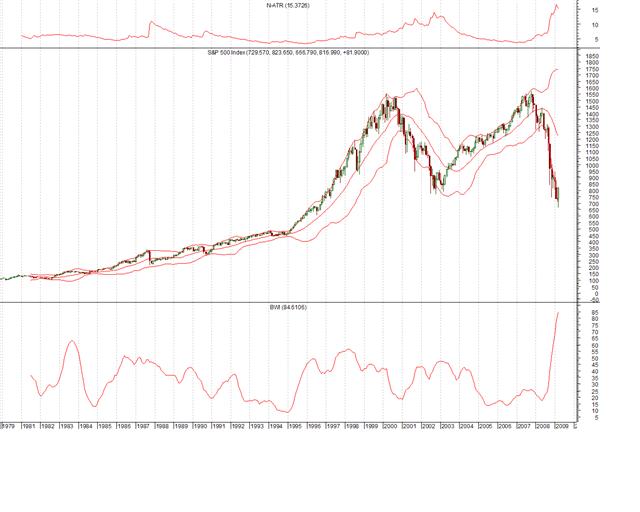
Take a look at this chart of the monthly S&P 500 to see the volatility in action.

Let me break down the different plots here.

The top line is a normalized version of ATR (N-ATR). That means I’ve taken the base ATR reading and divided it by the 14-period moving average to express it as a percentage. That way I can compare it historically. If I didn’t do that, we wouldn’t be able to look at it with any kind of perspective. Notice the sharp rise in N-ATR from 1987 at the point of the Crash. If I didn’t normalize the study that would only be a little bump in the line because the S&P was only in the 200s-300s at that point.

In the middle of the graph above is the monthly S&P 500 candlestick chart with Bollingers Bands overlaid.

On the bottom of the graph is the Bollinger Band Width Indicator (BWI) which does something similar to N-ATR in that it normalizes the width of the Bands so they can be viewed in a historical context. BWI is the distance between the upper and lower bands divided by the 20 period moving average (or whichever one is being used to plot the Bands). That gives us the Band width expressed as a percentage, just like the N-ATR. It lets us look for those extreme readings mentioned previously which can tell us that something very interesting is probably coming.

CONTINUE ARTICLE HERE

So You Want to be a Trader...

Today's guest is Chuck Young from Rebel Traders. Chuck is going to give us his insight into what it takes to become a successful and disciplined trader. I have to say that I think he nailed it...what do you think? Check it out then leave a comment, let Chuck know what you think makes a successful trader. Enjoy!

===================================================================

Ask anyone who has been holding stocks for many years what the previous two years has done to their portfolios; I’m sure you will get some nasty comments. For many years everyone from professional financial advisors to our parents told us that the “buy and hold” strategy was the only real way to make money in the long term. Well I’m sure those who have been doing just that are not very happy now that nearly 50% of their portfolio has evaporated.

In the span of 9 years the U.S. markets have gone through two very ugly bear markets, and the current bear market is not yet over. So the ‘buy and hold’ people have taking a real beating in the past decade.

If you told someone 10 years ago that you were a ‘stock trader’ you might have received a strange look or perhaps a lecture about how dangerous trading stocks would be. “Listen young man… the only way to save for your retirement is to put your money into stocks and ignore it… you will have a lot of money when you retire”.  How many times have we heard something like that during our lifetime?

Today if you told someone that you traded stocks you might get an evil look because the media has painted traders as a group of people who have contributed to the massive stock market declines experienced during the current bear market. There are numerous types of traders; currency traders, hedge fund traders, and commodities traders (recall last summer the media blamed traders for the rapid rise in oil prices) just to name a few.

But actually individual traders who trade from their own homes are nothing at all like those portrayed by the mainstream media. We are market participants who look to capitalize on short term price movements, take our gains, and then move on to another trade when one presents itself.

The ‘buy and hold’ strategy has been proven to be flawed for guaranteeing that you will have enough money to retire with. The nature of the markets now requires an active involvement on your part if you are to preserve and grow your capital. And how do you actively manage your holdings? You become a stock trader.

As a stock trader you are simply managing your holdings actively. It does not mean you are buying and selling every day (that is for highly experienced day traders). It means that you use various charting tools, your understanding of chart reading, and by keeping track of trends to know what and when to buy. And by keeping a close watch on your holdings you know when the time comes to sell them and take your profits.

This is referred to as “swing trading”, or sometimes referred to as “position trading”. It means you initiate a position in a certain stock based on your analysis of the charts using healthy risk management, and then when the charts communicate that the time to sell is upon you then you exit the position. That is ‘swing trading’.

Swing trading can mean you hold a stock for a few days or a few months, regardless of the time frame the goal is the same; to capitalize on short term price movements and then get out before there is a significant change in the trend of the stock. This is an active involvement in your portfolio that helps you prevent the types of losses experienced by those who ‘buy and hold’ and walk away hoping their money will be there when they need it. And ‘hope’ is not an investment strategy; if a person relies on hope then they are prone to fail.

So now your interest is peaked, and you want to get started right away at becoming an active manager of your stock holdings, a trader. Your next step is to learn how to read charts, understanding the fundamentals of technical analysis, and get setup with the electronic broker of your choice. Now you think you have everything ready and you take your first plunge into trading. You have studied the charts, you keep an eye on the broad market trends, and then you identify the best risk to reward entry price and you ‘hit the button’, now you’re in! So you begin to watch your trade by keeping a close watch on the performance of your trade, you know where your exit price is based on your understanding of the chart, and you have a ‘stop loss’ set to protect your capital in case the stock goes against your analysis.

Things are humming along great and you spot another chart that is providing you with a great entry price and you want to take a position in that stock now. But now you have to decide if you should sell your first trade in order to move your money into the new one...   STOP.

If you ever find yourself needing to sell your stock in order to buy another then you have to stop right away. A smart trader never puts all of his or her capital into one trade at once. Placing all of your trading capital into one trade puts you on a direct course to failure.

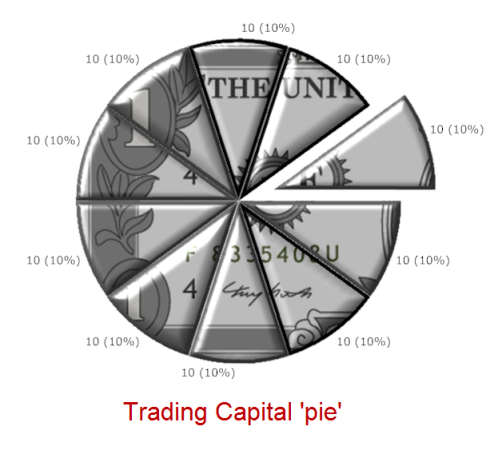
As a trader you have to manage your trading capital by dividing it up into pieces. And only one piece can be allocated to any one trade. In this manner you reduce the risk to your overall capital. But wait you say, how can I make any decent money if I don’t go ‘all in’. You do it slowly, that’s how. If you want to be a successful trader with growing funds that enables you to trade another day, then you must absolutely practice good trading capital management.

For example, let’s say you have $20,000 set aside to begin your trading career with. You put all $20,000 into one trade and unfortunately the trade does not work as you expected and you end up taking a 4% loss on the trade. Now you are left with an $800 hole in your account. But, had you divided up your trading capital into 10 pieces now that same trade would result in a loss of only $80 because you only had $2,000 on the trade.
But you say this will take forever for me to make any money. You say that I want it faster. If you become impatient then you will fall into the trap of letting greed dictate your trading system, and once you cross the line to greed then your trading plan will be prone to fail. Patience and self discipline are very important in trading; you must keep reminding yourself of that.

Getting back to your statement that ‘it will take forever’ to make any money this way. It may appear to be slow at first but following healthy capital management techniques ensures you are able to stay in the game. Remember, your gains may be small at first but for every profitable trade you add that money back into your capital pool of funds. So your next trade instead of being $2,000 now you might be able to put $2,500 into each trade. It is only a matter of time before your portfolio begins to increase rapidly, so long as you always stick to your trading rules, your capital management techniques, and your discipline.

As you expand your trading capital over time you can increase the number of slices you make in your trading capital pie. But, I never recommend anyone just starting out to try and keep track of more than 10 trades at any one time. For me I have made good money over the years using the 10% rule, occasionally I will go upwards to 20 trades at one time, but I always come back to my average of 10.

Also keep in mind that you do not have to have all 10 slices of your trading capital in the market all the time. If you only have 3 or 4 trades that is fine, remember that the smart trader waits for the best trades to come to him or her, never go chasing trades for the sake of just being ‘in the market’.

Trading can be a very rewarding endeavor, it can be fun, and it can also be dangerous if you don’t practice proper trading disciplines. And one of the most important disciplines is to manage your trading capital properly.

There are two very important rules that traders must follow:
1.    Practice capital preservation
2.    Make money

You cannot perform rule #2 if you don’t learn how to do rule #1!

Best of luck,

Charles Young

Rebel Traders

===================================================================

For more on Chuck and Rebel Traders be sure to check out RebelTraders.net

Why Patience and Rules are necessary in forex trading

Today I'd like everyone to welcome back Bill Poulos from ProfitsRun. Bill is launching a new forex product, Forex Profit Accelerator, and to put him to the test I wanted him to come and teach us a little more about the necessary patience needed to be a successful, yes SUCCESSFUL, forex trader. Your comments are ALWAYS welcome and needed as you help us learn more about our guest bloggers. So take a look at the article below, let the comments fly, and check out this video by Bill and let him know what you think in the comment section! See streaming video.

====================================================================

Today I want to talk about the necessity of both patience and rules when trading the forex. Trading without rules (or without a trading method) is frequently a key factor in the failure of many forex traders. Without rules, a trader has no boundaries, and while at first glance the idea of ‘freedom’ from boundaries may seem a good thing, I believe that it is not.

Here are a few examples why I say that.

Without a clear set of rules to follow, the forex trader must make every ‘call’ or every decision throughout the trading process. This creates an immense amount of pressure on the trader to get every decision correct – whether it’s identifying a trade opportunity, getting in on the trade, protecting a trade position or exiting a trade.

In addition, a forex trader may find themselves frustrated or angered by a market that moves against him, or by the lack of perceived opportunities in the market, or by a trade which, once exited, runs on to create ‘lost’ profit.

The heart of the problem for the trader like this is not having a clear set of rules to help guide their trading. And the mistakes that most often occur out of this occur from a lack of patience and failing to follow their rules (one leads to the other) are:

-    Traders whose trading rules do not yield ‘daily’ trading opportunities
-    Traders without patience who rush to enter or exit a trade

I believe most traders overtrade the Forex market. They need the action – it’s almost like a drug – and without a daily trade to be taken, they seem to suffer withdrawal.  But to capture longer term moves in the forex market requires patience and timing (not timing the market, mind you, rather, timing in terms of when to enter a move). Without that patience to wait for a trend to develop, traders are rushed to find ‘any’ position – this frequently leads to breaking the rules of their trading method and bad trades.

Similarly, many traders, relieved to have a trade turn ‘profitable’ will rush to the exit doors with their small gain – only to watch the market continue in an uptrend. Although I will never tell a trader they’ve made a mistake taking a profit, I will always point out the better ways under which they can take profit and potentially profit even more. But in this case, the lack of patience to draw maximum pips from the market is frequently caused by not having a set of rules to follow when exiting the market to maximize profit potential.

Let me share a recent trade experience, and show how having patience and following the rules of your trading method can help you to defeat the emotional side of trading and grab the most potential profit from the market.

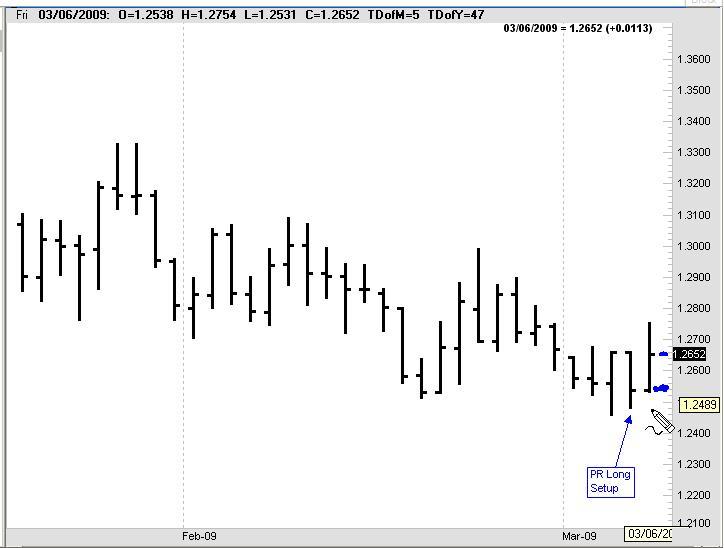
Recently a trade developed in the EUR/USD pair, which was picked up by one of my own trading methods called the Pip Reversal method. The trade would have triggered a buy position on this currency pair on March 6th at approximately the 1.2575 mark.

On March 6th, that trade would have turned profitable by nearly 200 pips – in just one day – but the trading rules of this method are what I want to focus on for you today.

In most cases, what I would see are traders exiting their position completely and taking their profit – and that’s certainly not a bad thing. But what many traders miss would be what I call “mega-moves” in the forex markets – and when traders don’t adhere to the rules of their trading programs, they typically will miss these moves.

An Exit Strategy that I use calls for exiting ½ of the position at a pre-determined price level equal to 1 ATR. On March 6th, that would have yielded 179 pips. But my strategy then calls for letting the second ½ of the position run, in the event the market is involved in a major move, and then capitalizing on the move with trailing stops. Keep in mind, many different exit strategies exist, and it’s very important that you find one that works best for your style of trading. In my case, I prefer to let a part of my position run as long as possible once I’ve been able to take some profit out of the market. What happens, however, is most traders would exit their ENTIRE position at this point – and that’s ok – but as we’ll come to see, these traders can often times miss out on substantial moves because they don’t have the patience to let the market run, or they fear giving back a strong gain for an even stronger gain.

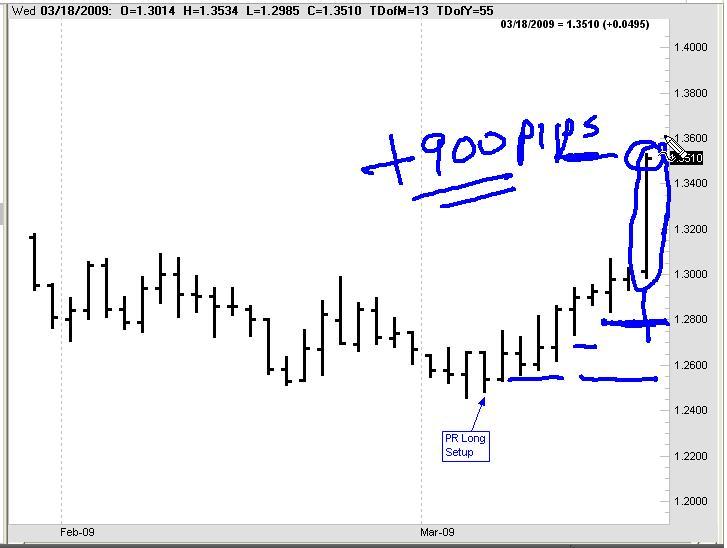
By running an increasing level of trailing stop losses, however, this particular trade, which took nearly two weeks to complete, would have culminated in an unusual, but substantial move on March 18th, amounting to nearly 900 total pips.

At this point in the trade, I have a whole new set of exit options: I can take complete profit or, I can set a new level of trailing stops.

Either way, the potential gain in this trade for any trader was substantial – but many would have missed it because on previous days, when the markets had smaller moves, or backtracked, here’s what I see most traders doing:

-    They panic and exit the trade too early
-    They set their stop losses so tight, they virtually guarantee they’ll be stopped out

This is why the rules of any trading method are so important. Traders make such mistakes because they allow their emotions to get the better of them, rather than letting the ‘rules’ of their method define their trades.

So stick to the rules of your trading method – whether it’s how to identify a trade opportunity, when to get in on a trade, when to get out, or how to protect your trade – your method should guide you in all aspects of your trading opportunities and instill the patience and discipline that you undoubtedly need to succeed in the markets today.

Bill Poulos

Forex Profit Accelerator

Senator Dodd, Why Don't You Be A Man, Admit Your Mistake And Resign

Senator Dodd you accepted $223,000 from AIG in campaign contributions, you changed the language in the bill to provide a loophole for AIG and then say some mysterious White House administration official told you to do it. Then you try and back pedal and squirm out of what you did. How dumb do you think the American people are?

Senator Dodd, why don't you be a man, admit your mistake and resign. You have been at your post long enough, its time to move on.

Read the whole sordid, sickening story here.

Please fell free to comment.