Finding A Good REIT For Today's Market

Editor’s Note: Our experts here at INO.com cover a lot of investing topics and great stocks every week. To help you make sense of it all, every Wednesday we’re going to pick one of those stocks and use Magnifi Personal to compare it with its peers or competitors. Here we go…


Real estate investment trusts, or REITs, have existed here in the U.S. since the 1960s. The mature American market means there are some interesting subsectors where investors can gain exposure.

One such asset class is infrastructure. American Tower (AMT), Crown Castle (CCI), and SBA Communications (SBAC) are the second-, fourth- and 11th-largest U.S. REITs. All three own communication towers across the country, which are leased out to mobile phone services providers, radio and TV broadcasters, government bodies, and other companies.

The other type of infrastructure popular in the REIT space is data centers. The third- and 10th-largest REITs, Equinix (EQIX) and Digital Realty (DLR), both own and lease data centers to technology companies requiring immense amounts of digital storage space.

However, the data center REITs have come under criticism. In 2022, well-known short seller Jim Chanos said he was raising money to bet against such companies, predicting that the tech giants currently renting the space would look to develop their own data centers going forward.

As Chanos put it, “…although the cloud is growing, the cloud is their enemy, not their business. Value is accruing to the cloud companies, not the bricks-and-mortar legacy data centers.”

Chanos also pointed to a wider issue in the REIT space: the risk that many are overvalued.

According to numbers compiled by FactSet, the average S&P 1500 REIT is priced at 2.39 times net asset value (NAV) and 40.2 times earnings. Also, the average S&P 1500 REIT’s net debt is 1.36 times its NAV.

However, the high multiples on REIT shares come from the fact that they have lots of exposure to high-growth sub-sectors, such as self-storage, healthcare, student accommodation, and the aforementioned infrastructure.

What we want to do this week is to compare a REIT in the sub-sector that Chanos doesn’t like — Digital Realty — and the largest of the communications tower REITs, American Tower.

The easiest way to do that is to ask Magnifi Personal to do it for us. It’s as simple as asking this investing AI to “Compare AMT to DLR.” Continue reading "Finding A Good REIT For Today's Market"
The WORST Stock Market Ever!

Please enjoy this updated version of weekly commentary from the Reitmeister Total Return newsletter. Steve Reitmeister is the CEO of StockNews.com and Editor of the Reitmeister Total Return.

Click Here to learn more about Reitmeister Total Return


I woke up 2 days ago already knowing the theme for this article:

The WORST Stock Market Ever!

That’s because this ride is more Tilt-A-Whirl than Merry-Go-Round thanks to all the volatility. Pretty soon the corn dogs, cotton candy and elephant ears are coming up. (sorry for the visuals…but needed to drive home the point

Gladly if we pull back to the big picture, we can make sense of it all to chart our way to calmer shores. That is what is in store in today’s commentary.

Market Commentary

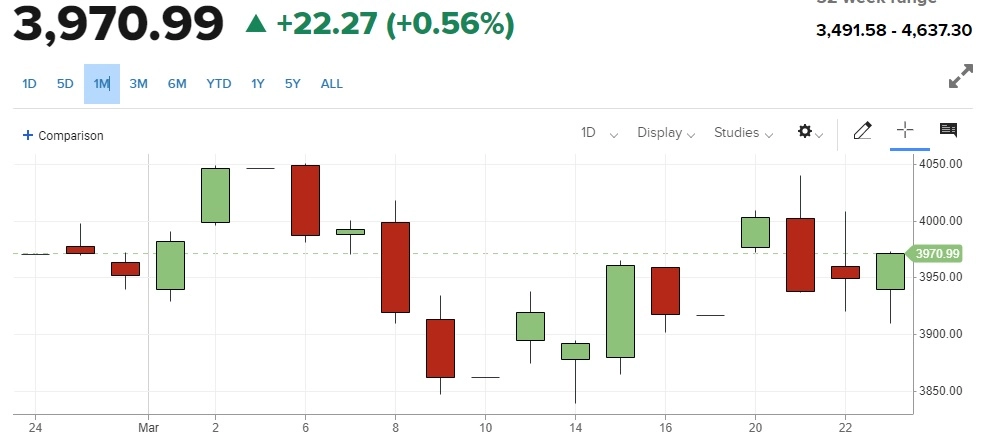
OK…I might be kidding about this being the worst stock market ever…but it’s certainly not fun. That’s because most people are rational and want things to move ahead in a more orderly fashion. This stock market of late has been anything but that.

Up, down and all around. Not just across weeks and months…but INSIDE of a single session. This candlestick chart of the past month tells that story in spades:

SP500 Chart

So much to point out on this chart starting with us being absolutely flat month over month. This would seem to indicate that nothing of significance happened. Continue reading "The WORST Stock Market Ever!"

Why Banks Fail

A lot, if not everything, in the world of finance, is based on trust: trust that the future would be better than the present; trust that a dollar bill would guarantee an equivalent worth of goods and services at a given point in time; and trust that wealth created would be safe, accessible, and transferable at all times.

So, when events like those unfolding over the past fortnight undermine one or more of the aforementioned collective beliefs, the ensuing risks can quickly become systemic and existential.

On February 24, KPMG signed an audit report giving SVB Financial, Silicon Valley Bank’s parent company, a clean bill of health for 2022.

On March 10, federal regulators announced that they had taken control of the bank, which reopened the following Monday as Deposit Insurance National Bank of Santa Clara.

This was the second-biggest bank failure since Washington Mutual’s collapse during the height of the 2008 financial crisis. It was soon followed by the third-biggest, with Signature Bank shuttered by the regulators to stem the fallout from Silicon Valley Bank’s failure.

The resulting crisis of confidence has somehow been contained with an assurance that all insured and uninsured depositors would get their money back, the announcement of a new lending program for banks, and 11 banks depositing $30 billion in the First Republic bank.

However, the contagion risk subsided only after claiming an illustrious victim from the other side of the Atlantic, with UBS agreeing to take over its troubled rival Credit Suisse for more than $3 billion in a deal engineered by Swiss regulators.

Since we are more or less up to speed, let’s look deeper into what can make banks seem unbankable in a little over two weeks. Continue reading "Why Banks Fail"

2 Tech Stocks For The Long-Term

High-growth tech stocks have had to bear the consequences of the Federal Reserve’s aggressive rate hikes since last year. Amid concerns of a recession, most tech stocks have suffered a correction in their share prices due to fears of softening demand.

However, with continued digital transformation and the growing interest in AI, the tech industry is well-positioned to grow.

Earlier this year, Fed Chair Jerome Powell said the “disinflationary process” had begun. However, inflation still remains above the central bank’s comfort level, as evidenced by February’s CPI report.

The Fed has indicated that it intends to hike rates higher than previously predicted.

Although the recent bank failures are likely to stop the Fed from undertaking a bigger rate hike at the policy meeting, it is expected to return to its hiking spree once the banking crisis eases.

However, that should not make investors stay away from quality tech stocks.

Wedbush analyst Dan Ives believes that cost-cutting by major tech giants will likely show improved profits this year. The recent banking crisis made investors count on reliable tech stocks, as is evident from the tech-heavy Nasdaq Composite’s 13.3% increase year-to-date and 3.2% gain over the past month. According to Gartner, worldwide IT spending is expected to rise 2.4% year-over-year to $4.50 trillion in 2023.

Several technical indicators look positive for Microsoft Corporation (MSFT) and Salesforce, Inc. (CRM), so it may be worth investing in these stocks now.

Microsoft Corporation (MSFT)

MSFT develops, licenses, and supports software, services, devices, and solutions worldwide. The company operates in three segments: Productivity and Business Processes, Intelligent Cloud, and More Personal Computing. It has a market capitalization of $2.03 trillion. Continue reading "2 Tech Stocks For The Long-Term"

The Port We Need In This Market Storm

Editor’s Note: Our experts here at INO.com cover a lot of investing topics and great stocks every week. To help you make sense of it all, every Wednesday we’re going to pick one of those stocks and use Magnifi Personal to compare it with its peers or competitors. Here we go…


When markets turn as volatile and uncertain as they’ve been this week, it’s a good idea to look for sectors you’d want to be invested in no matter where the markets go.

Healthcare is one such sector.

It encompasses two contrasting types of businesses. The first is boring, large-cap stocks in the pharmaceutical and healthcare services sectors. These traditionally provide some defensive qualities if the economy starts to slow. That’s true because a lot of healthcare spending is not dependent on cycles in the economy. People get sick no matter the economy.

The more exciting part of the healthcare sector is very growth-oriented, with high valuation multiples. This is the biotechnology sector, with exciting fields like genomics, CRSPR gene-editing machines, and cures for cancer.

And even beyond biotech, there are also other growth segments in this healthcare sector, including medical data businesses and medical equipment suppliers. All of these are riding long-term trends such as aging and increased healthcare spending, along with big data and AI.

The safer pharma sector looks especially enticing for more conservative investors. Vincent Deluard, strategist at StoneX, has run numbers showing pharmaceuticals have maintained 15% to 20% margins over the past 40 years. He told the Financial Times: “They have almost no exposure to energy and basic material costs: their main expenses are research and development, marketing and lobbying… Inflation in drugs prices and medical services has been twice that of the broad consumer price index in the past 40 years.”

But for the adventurous among you, putting money into the more exciting biotech small caps may be the way to go. Valuations are cheap, with a substantial upside.

So, I asked Magnifi Personal to compare an ETF from each healthcare segment - pharma and biotech. I didn’t even have to find the right ETFs. Continue reading "The Port We Need In This Market Storm"