"Saturday Seminars" - Determining Trends in the Foreign Exchange Markets

J. Adam Hewison, the founder and president of INO.com, will share with you the technical tools he uses every day to determine trends in the foreign exchange markets. He will also discuss the outlook for the U.S. dollar and major cross-rates and show you a very simple technique to determine the major trend in the currency markets.

Adam will explain negative and positive forces in the marketplace and how the big moves are often set up years in advance. As a former floor trader, Adam will discuss the difference between trading on the floor of an exchange and trading from an office thousands of miles away.

Adam HewisonBefore starting INO in March 1995, Hewison was a foreign exchange trader and advisor. He was one of the first currency traders when the International Monetary Market (IMM) of the Chicago Mercantile Exchange pioneered financial futures in the 1970s, and in the 1980s he introduced a very popular daily fax advisory service, FXPro. He is also the author of two highly-acclaimed guides to the foreign exchange markets: "International Monetary Report" and "Right on the Money, the Definitive Guide to Forecasting Foreign Exchange Rates".

In addition to an IMM membership, Hewison held seats on the CME's Index and Options Market (IOM), and was a charter member of the New York Futures Exchange (NYFE) and the London International Financial Futures and Options Exchange (LIFFE). Also during his trading career, he managed the currency and risk exposure of a large multinational corporation, based in Geneva, Switzerland.

---

Saturday Seminars are just a taste of the power of INO TV. The web's only online video and audio library for trading education. So watch four videos in our free version of INO TV click here.

INO TV

Traders Toolbox: Stochastics (K%D)

MarketClub is known for our "Trade Triangle" technology. However, if you have used other technical analysis indicators previously, you can use a combination of the studies and other techniques in conjunction with the "Trade Triangles" to further confirm trends.

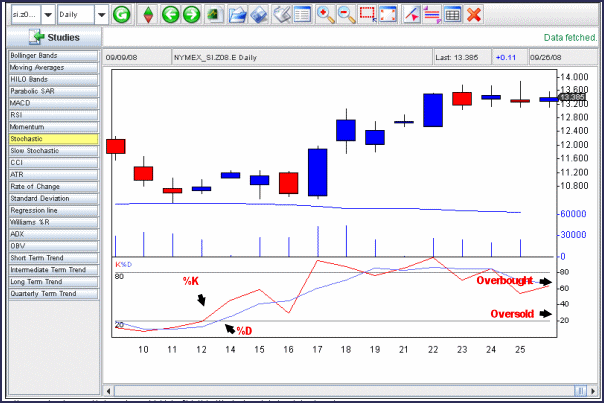
The stochastics indicator created by George Lane measures the relative position of the closing price within a given time interval. This indicator is based upon the premise that prices tend to close near the upper portion of a trading range during uptrends and near the lower portion of a trading range during downtrends. When prices close in the middle of a range, this suggests a sideways market. There are two components to this calculation, the %K value and the %D value. The %K is calculated as follows: %K= (C-Ln / Hn – Ln) x 100 where C = closing price of current period, Ln = lowest low during n time periods. Hn = highest high during n time periods and n = number of periods.

The %D value is the moving average of the %K value. The simple moving average calculation is: %D = 100 (Hn / Ln) also in the %K formula.

These formulas produce two lines that oscillate between a scale of 0 and 100. As with the other oscillators, a stochastic value below 30% suggest an oversold condition, while a value greater than 70% suggests an overbought condition.

Some simple trading rules apply in the use of the stochastics indicator. A sell rule would be to sell when the fast (%K) crosses over the slow (%D) and both are pointing down, but are still above the 70% level. A buy signal would be triggered when the fast crosses the slow, and both point up, but are below the 30% level.

Another type of signal occurs when the stochastics indicator diverges from a price move similar to momentum and RSI.

---

You can learn more about the Stochastics and George Lane by visiting INO TV.

Just because it looks cheap doesn't mean it can't go lower.

Just because it looks cheap doesn't mean it can't go lower.

With General Electric (NYSE_GE) trading around 22 1/4 today it looks cheap, but can it go even lower? The answer is yes. The last time General Electric traded at current levels was back in October of 2002. Now add in inflation and General Electric is even lower today than it was 6 years ago!

Despite the fact that Warren Buffet invested 3 billion dollars in GE preferred stock giving him a 10% yield, I see no reason to buy GE. The deal Mr. Buffet received was a deal that every investor would love to have in their portfolio. The bottom line is the trend for General Electric which is on the downside and it shows no signs of turning around at this point in time. I would rather buy General Electric at let's say 30, knowing that it's going higher than trying to pick a "value bottom."

Watching CNBC this morning, Mark Haines who has been around for a long time in the financial world made a statement that the buy and hold strategy is no longer a successful strategy in the stock market. I have long held the belief that the world has changed and you can no longer just buy a stock and hold it forever hoping that in long-run it will go higher. We only have to look back at a recent blog commentary on General Motors (NYSE_GM) to see that this is a flawed strategy. Looking at General Electric today proves once again that we are in a trading world and not an investment world.

I understand many of you will disagree with that statement but the truth is the markets have changed, not just domestically here in the US, but globally. Now, the US has to contend in a competitive way with China, India and Russia. The US is in a much more competitive world, where fortunes will be made and fortunes will be lost.

At MarketClub, our mission is to help you make money in this ever-changing market. We are still waiting to see what the outcome will be from the rescue package, bailout package, save America package, any name you want on it package.

No one is going to be able to predict what will happen to the market, except the market itself. We've talked about this in the past. The market is the ultimate mechanism for price discovery.

I do not believe that the current global economic slowdown is going to turn around any time soon. I don't expect to see a "V bottom" in the stock market and that "demand destruction" will force a retracement in many markets that were very much in demand just a few months ago.
So here's my advice... the one thing we do know about the markets is that they a reflection of human nature. Having said that we would want to pay attention to our "Trade Triangle" technology. Those of you who are MarketClub members, follow the "Trade Triangles" because they will keep your emotion out of the market and show you which way the market is headed. For those of you who are not MarketClub members, you should be looking at some sort of technical analysis to help you avoid stock meltdowns.

It doesn't matter what markets you trade because there are always opportunities to make money in the trading game. Our mission is to present those opportunities to you in a very easy way to understand.

Every success in what can only be described as an interesting, turbulent and opportunistic time.

Adam Hewison
President, INO.com
Co-creator, MarketClub

Bailout or bust... for the USA

Bailout or bust... for the USA.

Congress, can't live with them and we can't sue them. How about putting a few of them in jail, is that possible given the mess they have put us in?

Let's think about what can happen if they pass the bill for the "rescue" package. The first thing that will happen is that they will come up with a softer name that will not scare the general public. After that, confidence and fear will push and pull the markets.

Let's look at the market in the belief that they pass the bill. What will happen the next trading day? What happens is going to be very important as to which direction the market heads. If the market opens lower after they pass the bill, watch out. It won't be a pretty day and panic will be sure to set in. If the market opens sharply higher and sells off later in the day, it's not going to instill confidence in the system.
What I'm looking at is how the market closes this Friday. Does it close higher for the week, or does it close lower for the week? Another key will be what are traders comfortable going home with this weekend. You may want to watch the dollar index and gold and see where they are closing for the week as they typically foreshadow things to come for the economy as a whole.

If Congress and the Senate continues to play politics and do not pass this bill for the markets, we are going to see a pullback and a retest of the lows. Again, I can not stress enough the importance of how the indexes close this weekend. I doubt I am the only one who thinks that these guys are incapable of cleaning up this issue given that they made the mess to start with.

Our "Trade Triangle" technology continues to remain in a negative position and we see nothing in the short term that's going to change the trend of the US economy and the stock indexes that we are following.

For your information the Dow closed at 11,143.13 last week. NASDAQ closed at 2183.34 and the S&P closed at 1213.01.

Again, I stress that I want to see how these markets close for the week and not only how they close the day after the announcement is made.
Our blog poll for traders has always been very accurate over time. Many traders, in this case 67%, are negative on the stock market for the balance of the year. I would not dismiss this poll as it has been extremely accurate in the past in predicting gold, crude oil, and other markets.
We are living in tumultuous times and these times demand strict discipline in the one's trading.

Round three begins Thursday morning.

Good luck to everyone,

Adam Hewison
President, INO.com
Co-creator, MarketClub.com

The rules have changed again!!!! Only this time it may be a good thing.

This from our business partner AP News

Government to clarify accounting rules for banks

AP Business Writer (AP:WASHINGTON) Federal regulators on Tuesday clarified accounting rules for banks in a way immediately embraced by the industry, which has been seeking relief that could boost its balance sheets in the financial crisis.46 minutes ago

By MARCY GORDON

The Securities and Exchange Commission and the Financial Accounting Standards Board issued clarifications to the current rules, and said more detailed guidance is coming later this week from the standard-setting FASB.

The banking industry, which has seen its mortgage-backed assets plummet in value, has been pressing the SEC to suspend the so-called "mark-to-market" accounting rules that require banks to value their holdings at current market prices, even if they plan to hold the assets for years. A possible addition to the $700 billion bailout bill being considered by Congress would reaffirm the authority of the SEC to suspend them.

But the head of a policy group backed by the biggest accounting firms warned lawmakers against such a suspension, saying it would hurt the interests of investors and the capital markets.

The principles of mark-to-market accounting "are rooted in the fundamental virtue of transparency and are central to informed market decisions and efficient allocation of capital," Cynthia Fornelli, executive director of the Center for Audit Quality, wrote in a letter to members of Congress.

The clarification issued Tuesday says that when an active market for a security doesn't exist, "the use of management estimates that incorporate current market participant expectations of future cash flows, and include appropriate risk premiums, is acceptable."

The guidance will apply to companies' financial statements for the just-completed third quarter. It is "intended to provide increased clarity related to the practices that may be used to determine an appropriate fair value in the light of current market conditions," said James Kroeker, the SEC's deputy chief accountant.

The arcane accounting rules even intruded into the battle for the White House, with Republican presidential contender John McCain's campaign lauding the SEC's release. Democrat Barack Obama's campaign did not immediately return requests for comment Tuesday evening.

The American Bankers Association also applauded the action, saying the new guidance "will help auditors more accurately price assets that are difficult to value under current market conditions."

McCain's campaign said he "is pleased to see that the SEC has finally decided to permit alternative accounting methods to mark-to-market accounting for securities where no active market exists. There is serious concern that these accounting rules are worsening the credit crunch, making it difficult for small businesses to stay afloat and squeezing family budgets."