ETF Talk: Is China's Great Wall of Growth Showing Cracks?

As many of us know China is becoming a bigger shareholder in the US then our citizens, which scares some and for good reason! But what does the long term look like for China? Whatever it is, it now directly impacts the US, so I've asked Doug Fabian to come and give us his thoughts on the ETF's that track China and the indexes. If you are interested in ETF's of ANY type, then I HIGHLY recommend you read the article below and check out Doug's newsletter HERE. I'm a member of his Mutual Fund Lemon List as I was a big believe in mutual funds. So enjoy the article and learn more about Doug HERE.

====================================================================

For the last 30 years, the economy that has achieved the fastest and most consistent growth in the world may well be China’s. Despite the current global recession, the Chinese economy still grew 9.8% in 2008. It marked the first year of single-digit percentage growth for the country since 2003, after notching double-digit percentage growth between 2003 and 2007.

Chinese government officials claim that their nation contributed more than 20% to the world’s economic growth last year. They also optimistically forecast economic growth of at least 8% for this year. However, a number of independent private sector estimates, including those from Economist magazine and the International Monetary Fund, estimate China’s economic growth will fall below 7% and possibly slip to 6%. A fear exists that civil unrest may occur if the growth rate dips below 8%, since economic weakness typically boosts unemployment. With relatively high growth rates, compared to other countries, investors may wonder if China could offer a hedge against recessionary conditions elsewhere.

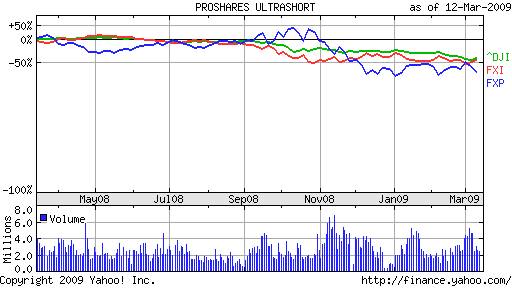
If 2008 is any indication, investors should tread cautiously before going either long or short in the Chinese market. Despite the country’s growing economy, history shows that the correlation between global stock markets increases during times of recession. As the Dow fell 33% last year, the Shanghai Composite Index plunged 65%. The iShares FTSE/Xinhua China 25 (FXI), an exchange-traded fund (ETF) that follows 25 companies on the Shanghai stock exchange, fell 47.76% last year. If you were shorting the Shanghai stock exchange through UltraShort FTSE/Xinhua China 25 (FXP), you would have lost 53.61%. You might expect a short ETF to turn a profit if the stock index that it tracks plummets but China certainly did not follow that pattern last year.
Despite the positive spin that Chinese government officials are giving to the country’s economic outlook, it is hard for me to belief that its stock market is ready to rebound. But that hasn’t stopped its leaders from expressing renewed confidence in its economy. The Chinese government reported last week that its industrial output last year rose by 5.7%, while its retail industry grew by 17.4%, year-on-year. In addition, China has nearly $2 trillion in reserves and a low debt-to-GDP ratio of 18%, compared to 80% in the United States and 160% in Japan.

On the other hand, other economic signs indicate a significantly slowing economy in China. Its exports fell in February by a whopping 25.7%. Millions of people have been left jobless and thousands of export firms have closed shop. With consumer prices falling, some analysts are discussing the possibility of deflation in China.

Since investors hate uncertainty, China is not looking very enticing right now. Of course, if investors decide stock markets around the world have been pounded enough and the current bear market rally may be a sign that the worst is behind us, China’s beaten down stock market could rally as strongly as any around the globe.

Personally, I am not yet ready to move into China either long or short. If you, however, think that the Chinese market has bottomed out and that its government stimulus spending will give the Chinese economy a boost, you may want to consider going long. For those who expect more fallout in the Chinese market this year, you may be tempted to put a little money into a short ETF. But if you’re like me and you dislike losing money and investing without a clear market direction in sight, you can monitor these ETFs from the sidelines along with the Fabian team.

LONG: iShares FTSE/Xinhua China 25 Index (FXI)

PowerShare Gldn Dragon Halter USX China (PGJ)

SPDR S&P China ETF (GXC)

SHORT: Ultrashort FTSE/Xinhua China 25 Index (FXP)

Doug Fabian

If you want guidance about which ETFs to trade and when, check out my ETF Trader service by clicking here.

Inflation/Deflation Uncertainty

Our government continues to CRUSH the value of the dollar so I asked Adam Katz from PlusEV.ca to break down the current situation. I've read the article and it provides a great view of what's going on, how we got here, and the nuts and blots (his words not mine). So please enjoy the article and COMMENT as Adam Katz and I are looking forward to your thoughts!

==================================================================

I have received many emails over the past few months proclaiming that inflation is an obvious result of the current government intervention and that the dollar's days are numbered. As a nuts and bolts kinda guy, I like to step back and analyze the situation from point A to B, instead of staring at fancy charts which can usually be used to prove just about anything.

Before I get into the discussion, let me say that the focus of this article is timing more so than theory. To argue that we will never see inflation after the tricks central bankers have been pulling would simply make no sense. Yet, I was surprised last year to see some really good traders position themselves for an inflation trade in the middle of serious disinflation. After all, what the Fed was doing MUST have been inflationary! Right?

Firstly, what are the ingredients for credit expansion?

1)    Central banks expanding the money supply
2)    Banks lending that money out
3)    Credit worthy borrowers

Now we all know that we can place a big fat check mark next to (1), but what about the other ingredients? Putting money into the banks is easy; getting it into circulation is hard in a ‘fairly’ transparent system. Consider for a moment Zimbabwe, a country that has suffered unimaginable inflation. Do you think Robert Mugabe is subtle about expanding the money supply? He has the luxury of simply handing out money to his cronies and directly flooding the money supply. In countries like the U.S., such actions would be very difficult. China on the other hand can simply make large loans to government held businesses and thus expand the money supply.

The U.S. has been creative. For example, the AIG bailout after the Lehman collapse resulted in a transfer of government funds from AIG to large investment banks in the form of margin calls. When AIG’s credit rating was downgraded, they were forced to post margin with their counterparties. Yes this saved AIG, but it also saved those banks that were using AIG to hedge their risky trades with CDS contracts. The capital found its way into the banks, but never made it any further.

Now people are complaining. The stupid banks that made stupid loans have been bailed out. So why aren’t they lending? Why aren’t they making loans to borrowers who are not credit worthy? I hope my sarcasm wasn’t missed. To encourage banks to make bad loans is the most irresponsible thing that we can do. The point of the bailouts was to prevent financial collapse, not to continue the fundamentally flawed system.

Now we are seeing the economic follow through effects of both a credit and a housing bubble bursting. What is likely is that the credit worthiness of borrowers decreases and so will the banks willingness to make loans. Money won’t flood the markets – in the developed countries.
In the emerging markets, currency devaluation and sovereign defaults are alive and well. In fact, even Switzerland, the icon of monetary responsibility has engaged in devaluing their currency. If that’s not symbolic of the end of an era then I don’t know what is. My point is that the U.S. will continue to be a safe haven. As long as threats of further economic downside looms, the U.S. will continue to be perceived as the safest option – on a relative scale. Inflation will strike emerging markets long before it hits the U.S.

And when that happens, the U.S will be able to afford to allow their currency to weaken on an absolute basis because on a relative basis it will appear stronger than many of it’s peers. When risk appetite picks up, as it has done the past few days, the dollar will weaken. In the future, that pattern will coincide with the banks making more loans, and inflation will become a threat. However, that’s unlikely to happen any time soon, at least according to Meredith Whitney. She estimates that banks will cut $2.0 trillion of credit-card lines in 2009 and a total of $2.7 trillion will be cut by the end of 2010. That doesn’t bode well for inflation advocates, at least in the short term. This gives the Fed more than enough time to shrink the amount of funds that they have made available to banks and calls into question further asset price deflation over the coming 18 months.

I will leave you with the following basic economic concept: It is unexpected inflation, not expected inflation that causes havoc in the economy. With the current outlook of low or negative inflation for years to come, a sudden shift to high inflation would be devastating for the economy.

Adam Katz
www.PlusEV.ca

We got our bailout money ... did you get yours!!

I was lucky enough to convince Bob, who heads up advertising, and Lindsay who is our director of new business to join me as we head to Washington to pick up our bailout checks. Enjoy.

Try JibJab Sendables® eCards today!

From all the staff at MarketClub and INO.com who bolted when I asked them to volunteer for this video spoof on Washington.

Happy St. Patrick's day.

It looks like we are going to need the luck of the Irish to get out of this recession.

Enjoy, reflect and laugh out loud ... It's good for you.

All the best,

Adam Hewison

President, INO.com

Co-creator, MarketClub

How my worst trade turned out to be my best trade ever!

Today I'd like to share with you my worst trade ever. In retrospect it turned out to be my best trade.

Here's why...

I started in the commodities business as a broker for a company called Conti Commodity Services. Conti was a division of Continental Grain Co. one of the largest and oldest grain companies in the world. Back in the 70s, Conti was just starting a new division to handle customers in the brokerage business. I was lucky enough to have them hire me as I had no experience and very little education. But, I was enthusiastic and willing to learn.

So there I was at Conti Commodity Services dialing and smiling and looking to get business for myself and the company. All this was back in the 70s when grain prices were skyrocketing. After a brief time on the job I guess I thought I knew better than everybody else.

So here’s my worst trade...

I was following the wheat market, just like everyone else because markets were hot. All of a sudden a slumbering December wheat market shot up dramatically on no news. I thought to myself that wheat had gone up too far and too fast, so I went short (that is I sold something that I didn’t own). It had to come down, right? That alone shows you how naïve I was back then. Well, for 20 minutes I looked like a hero. Rather than take a small profit when I had it, I decided I’d sit and wait for a bigger profit (call that greed). Well, you probably know what happened next, wheat closed up the limit and I was unable to get out of my short position and finished the day with a loss. Well I said to myself that wheat has got to pull back tomorrow, right? In the commodity markets, things only go from bad to worse when you're on the wrong side of a trade and that's what happened to me and my wheat position. I am not going to bore you with the gory details or the pain I went through, but the bottom line was I lost $10,000 on that trade. It doesn't seem like a lot of money now, but back then when I was just starting up my career it seemed like an insurmountable fortune.

To be truthful it was the best thing that could ever happen to me and here's why...

I learned a very tough lesson in that wheat trade, one that I've never forgotten. I've learned that there are two sides to every coin, two sides to every sword and two sides to every trade. For every profit opportunity you see in the marketplace there is an associated risk that comes along with that profit. I learned the value of risk management and why there is no free lunch when it comes to the markets.

Later in my trading career I’ve lost much more than $10,000 in other trades, but it never bothered me because I was managing my risk. A friend of mine lost over a million dollars on one trade. To many, this would seem like an insurmountable amount of money to lose on one trade. But my friend is trading with $50 million, so a $1 million loss is only 2% of his risk capital which is certainly very manageable. It is when you lose 40%, 50% or 60% of your capital on a single trade that it becomes very difficult, if not impossible to come back from.

So when I say my worst trade happened to be my best trade; I mean it. In my mind that early loss in December wheat was a priceless education in risk management that I still use to this day.

I cannot say enough about risk management and how you should manage your risk, but here are some trading tips that will help you avoid disasters like mine..

You must use stops. You must be disciplined. You must be diversified. If you have those three core trading items in your portfolio, you can survive and thrive no matter what the market throws your way.

I hope that like me, your worst trade turns into your best trade in the long run.

Every success in trading and in life,

Adam Hewison
Co-founder, MarketClub

PS Do you have a worst or best trade that you would like to share on this blog?

You may think this is shameless promotion, but it's not meant be. It's meant to help you succeed in the markets you trade.

Learning by experience can be costly, especially in the financial markets. Fortunately, there are shortcuts. “I’ve changed from losing money to consistently making a profit,” says Paul, a trader from Illinois. “I’ve learned techniques that really have made a big difference in my trading.” He credits INO TV’s streaming educational videos and audios for his success. INO TV is a division of INO.com, a pioneer in the web-based delivery of financial information since 1995.

Traders of all levels will appreciate INO TV’s online digital library of video and audio seminars, the largest and most comprehensive collection of trader and investor seminars available anywhere today. INO TV’s seminars - currently numbered a 547 with more being added all the time - present time-tested theories, techniques, and strategies from over 150 master traders. INO TV offers traders an easy and convenient way to improve their skills, confidence, and profits.

Enroll Today

Traders say online seminars are more convenient, less costly Compared to the high price tag of live seminars, INO TV’s annual membership fee of $99.95 (or $49.95 for three months) is a bargain. While many traders find the live atmosphere of seminars enjoyable, others find that the registration fees, travel expenses, and hotel charges are cost prohibitive. Dean, a trader in the UK, is one of the latter. The live seminar he attended, which coast him $7,500, failed to meet his expectations. “I should have avoided going to the actual seminars,” he says. “What I learned through the online videos was more than what they were giving me at the seminars.” Dean says that they knowledge he acquired in a signal month would have cost him about $24,000 in seminar fees.

It’s not just the cost that makes INO TV so attractive to traders. It’s also the convenience. Dirk, a financial writer and seminar instructor in the Netherlands who has been an active trader for over a decade, elaborates. “I was invested by my broker to attend a seminar on futures. For me, coming from a small village near Amsterdam, that would be a time consuming and high-priced event,” he explains. “It is far more convenient to watch a video online. Watching them at any convenient time and seeing them again and again brings a trader far more value while being very time efficient.”

Anyone with a computer and a high-speed internet connection can take advantage of INO TV’s digital seminar collection. The on-demand streaming seminars feature some of the world’s top experts, whose ranks include trading system pioneers, trading contest champions, authors, trading coaches, and real floor traders. Many of the seminars come with free downloadable workbooks. INO TV’s digital library of trading seminars is the most extensive collection available online, and these seminars are not available anywhere else. Members are free to watch and listen to as many seminars as they want, as often as they want, for one low membership fee. A 3-month membership is just $49.95, and an annual membership just $99.95.

Enroll Today

Even though I caught some lucky breaks early in my financial career and went on to become a successful forex trader, I still look back with 20/20 hindsight and realize that I could have been more successful, sooner, if I had been a more educated trader. That’s why I’m so excited about what we have to offer at INO TV: proven trading techniques… practical tools for consistent success… step by step trading methods that will empower you to build wealth and create the life you want. And all straight from the lips of the masters themselves. If you do nothing else today, visit INO TV and find out if the service is right for you.