Today's guest blogger is Craig Pritchard author of Trader Craig's Market Edge. Craig wrote about what drives him to enter and exit a trade. So without further delay, here's what really matters to Craig
===================================================================
Prior to reading the little book titled The Adam Theory of Markets or What Matters is Profit by Welles Wilder, I had been consistently losing money trading. Most of my efforts had been expended in trying to find the perfect method for predicting market movements. I had spent a considerable sum on subscription services to a variety of well known trading gurus that claimed to have solved the riddle of the markets only to be disappointed time and again. While I do not use the method described in the book, a story in the book helped changed my perspective on the markets.
In the beginning of the book, Mr. Wilder tells a tale about an aspiring trader who is attempting to explain to his young daughter what he is doing. As he shows her his trading screen he tells her that he is buying because the market is going to go up. He is certain of this because special numbers called the Azerhoff numbers are signaling that the market is going to go up. After listening to his explanation, the young daughter replies, “but daddy, it looks like it’s going down to me." Frustrated, the aspiring trader tries to reassure his daughter that the Azerhoff numbers mean that the market will go up. Again she responds, “It still looks like it’s going down to me." Eventually, the frustrated trader exits the trade for a loss.
The point of the story, of course, is that all market indicators and theories are secondary to price and even a young child can look at the chart and see which way the price is going. If we are long a market, we profit when we sell at a higher price than we bought, regardless of what the indicators or prognosticators say. Ultimately, it is always price that determines our actions in one way or another. Certainly, we can use indicators to help us anticipate, i.e. be prepared for, changes in trend, but the movement of price alone determines the trend. By learning to see and follow the trend in price, we can come to accept what the market gives us without being overcome by the emotions of fear and greed. Trading can then become an enjoyable and profitable experience.
The question arises as to what trend to trade. The trend can be different on different time frames. The approach that I have found that works the best is to look at three different time frames. Two examples are Monthly and Weekly, Daily and Weekly, and Daily and Hourly. The smallest time frame is the trading time frame. When the higher two time frames are in agreement, we enter trades in the same direction on the smallest time frame.
Marketclub’s "Trade Triangle " Technology is a good example of a method that employs the above approach. The Monthly trend is up when the market makes a 3 month high. The Weekly trend is up when the market makes a 3 week high. We enter long on the Daily time frame, i.e. on a specific day, when today’s price exceeds the high of the prior 3 weeks.
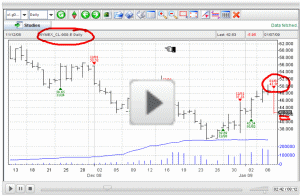
This same approach can be generalized to any number of trend following methods. For example, moving averages, macd, swing points and volatility breakouts can all be used to identify the trend. On Friday January 2, 2009, the major indexes closed above their 20 day 2.0 SD Bollinger bands giving an exit signal for short positions using a volatility system.
Currently, there is a great deal of speculation about the current Elliott wave count for the markets. Many traders are increasing short positions in expectation of a final fifth wave down to new lows, but that may be a dangerous and costly position to take. The Monthly trend is still down, but the Weekly and the Daily trends are up. At the same time many market commentators have already declared an end to the bear market. This, too, may be a dangerous and costly position to take given the direction of the Monthly trend.
Even though the market stance is neutral using the Monthly, Weekly, Daily time frames, we can still profit from a potential rally in January. Since the Weekly and Daily time frames are now up as long as the market does not make a 3 week low and trades above the prior week’s low, the hourly time frame can now be used for entries and exits with a long bias. Ideally, we should wait for a pullback that does not break the prior week’s low, and then enter long on the hourly chart on a breakout above the prior day’s high. Trail a stop using a 3 hour low or a break of the prior day’s low with a view to exit at predetermined targets. Remember to adjust your risk on the trade accordingly, and do not trade this method if you cannot watch the markets intraday.
In conclusion, speculation about potential market movements can help us realize possible outcomes and manage expectations, but we should only trade the price for profit and not opinions and expectations. Short opportunities may come again soon if the Weekly trend turns down, but don’t bet on it just yet.
Best,
Craig Pritchard
www.tradercraig.blogspot.com
===================================================================
The ideas and opinions expressed above are those of Criag Pritchard of "Tradercraig.blogspot.com" and do not necessarily reflect those of INO.com, MarketClub or staff members.

 Emotions are probably the biggest obstacle any trader has to overcome. Many traders become losers because they can't follow a plan. They see a couple of losses, get excited, abandoned the plan and start to take wild shots at the market.
 Adam Hewison
 PDF Workbook
 Hank Pruden is a professor in the School of Business at Golden Gate University in San Francisco, where he has been teaching for twenty years. He is also the executive director of the Institute of Technical Market Analysis (ITMA). At Golden Gate, he developed the first accredited courses in technical market analysis in 1976. Since then, the curriculum has expanded to include advanced topics in technical analysis and trading. In his courses, Hank emphasizes the psychology of trading as well as the use of technical analysis methods, and he has published extensively in both areas. Hank is more than a theoretician. He has actively traded his own account for the past twenty years. His personal involvement in the market ensures that what he teaches is practical for the trader and not just abstract academic theory. Hank has coached institutional traders in the field of technical analysis for many years. He is presently on the board of directors of the Technical Securities Analysts Association of San Francisco and was formerly president of that association. Hank also sits on the board of directors of the Market Technicians Association (MTA). The MTA is the world’s leading association for the dissemination of technical analysis information. The MTA’s sister organization, the IFTA (International Federation of Technical Analysts), certifies analysts worldwide. Hank edits The Market Technicians Association Journal, the premier publication of technical analysts. From 1982 until 1993, he was a member of the board of trustees of Golden Gate University.