We knew this would happen!!!

First published March 16, 2008 under: Here’s why everything is hitting the fan at the same time.

Here's the original post.

After safely protecting investors for over six decades, a little known SEC rule was quietly removed on July 6, 2007.

With the removal of this rule all the rules of trading and investing in the market went out the window.

One of the reasons for the market's current volatility is a direct result of this rule change.

This major SEC rule was designed to protect investors.

With the removal of this rule, professional traders and hedge funds will be able to suck money out of the market and your portfolio in no time flat.

Why this rule that has stood the test of time since 1938 and was put in place to protect investors was removed is a big mystery.

Why now?

Here's what I suspect happened... some large hedge funds got together and lobbied to have this major trading rule removed.

It's just that simple. Why else would the SEC act out of the blue and remove this very important investor safe guard?

I suspect with this rule change the hedge funds have just been given the keys to Fort Knox.

I made this video last year but it details how this new ruling will effect you. The video explains in every day language what you can do to protect your capital from the hedge fund gunslingers and professional traders.

Watch the video as my guest. No registration required.

After you view the video you will have the knowledge on how to protect your portfolio, while at the same time reducing your risk exposure.


Adam Hewison
President INO.com

"Saturday Seminar" - A Game Plan For Investing In The 21st Century

The financial landscape has been changed forever by the widespread acceptance of the Internet. Understanding the driving principles for this new economy of the twenty-first century is a must. The invention and subsequent development of the Internet has brought new companies to trade, extended trading hours, introduced trading online, and made worldwide information instantly available. The one thing that hasn't changed is supply and demand. The same concepts that have affected the prices of produce in the supermarket for decades affect the change of stock prices on Wall Street as well.

Tom will help you develop a game plan for understanding the imbalances between supply and demand in stock prices. Tom will discuss market risk, sector rotation and individual stock selection, all using Point & Figure methodology. His straightforward, enthusiastic and always entertaining presentation will leave you with strategies for successfully managing risk in the stock market for the twenty-first century.

Tom DorseyTom Dorsey is well known in the financial community. Representing the major stock exchanges in the United States, conducting Risk Management seminars across the country for industry professionals as well as individual investors

Author of numerous articles on equity market and options analysis for such publications as; The Wall Street Journal, Barron's, Technical Analysis of Stocks and Commodities Magazine, and Futures Magazine.

---

Saturday Seminars are just a taste of the power of INO TV. The web's only online video and audio library for trading education. So watch four videos in our free version of INO TV click here.

INO TV

Wasn't gold supposed to hit $2,000 an ounce?

To many it is quite surprising that gold is getting closer to $700 an ounce rather than the $2,000 many were calling for. When gold was trading at the $1,000 level many people were expecting this market to zoom to $2,000 an ounce.

When we first suggested that gold had actually given us a sell signal we received numerous e-mails, many of which were not flattering and some were just downright ugly. "How could you short gold are you an imbecile" and that was one of the nicer emails.

Emails aside, to trade successfully in any market you must listen to the market. This is the one true voice that tells you what is going on.

During my career in the commodity markets, I have heard many stories, some of which were fabricated and some of which are true, but either have little or no bearing on the market itself. The very best indicator of all is to follow the price action which tells you when the insiders are selling or buying. In the commodity markets you have insiders who actually produce a commodity or the actual end-user of that commodity. Everything else is speculation. These insiders have extensive networks of global information that they plug-in to their hedging models. They also have extensive experiences and know what it's like to be in the trading trenches of any market.

Take a few minutes and look at the short video I just produced to show you exactly what I mean and how the patterns are different this time in gold and why it may have still further to fall.

Every success in the markets and in life,

Adam Hewison
President, INO.com
Co-Creator of MarketClub.com

Adam's Bio

TRADERS CONTEST: Do you have a good trading story? First prize is an Apple iTouch! Enter your story here. There is no entry fee.

Wasn't crude oil supposed to go to $200 a barrel?

It's true, the rumors were circulating heavily when crude oil was trading at $145 a barrel that it was going to be hitting $200 a barrel in a matter of days or weeks at the very latest. Well, that never happened. Crude oil learned that gravity plays a part in every commodity market's life.

The pullback in crude oil, given the fact that a major hurricane named Ike is shooting for the gulf, is not so surprising given the history of the commodity markets. Often times we see pressure coming into a market months ahead of the actual news that either production has been increased or demand fluctuation has changed the dynamics of the marketplace.

Take a few minutes and watch this short video and see how we have been looking at crude oil. Afterwards, check out our track record in this market for the past 12 months.

I hope you find time to quickly browse through this video as it will certainly give you some good trading tips on how to improve your own trading.

Every success trading and every success in life.

Adam Hewison
President, INO.com
Co-Creator of MarketClub.com

Adam's Bio

TRADERS CONTEST: Do you have a good trading story? First prize is an Apple iTouch! Enter your story here. There is no entry fee.

A Different Type of Moving Average Cross

I've been trying to convince our next guest blogger to write for us since we first started these...but he's been way too busy. Well I FINALLY caught him and I think you'll agree that it was worth the wait. I'd like to introduce Mark McRae from Traders Secret Code. Mark has been a friend to INO and MarketClub since 2001 and I can personally say that his insights and knowledge have become a crucial point in my trading. His focus has been the same as Adam...teach a man to fish (trade) he'll eat (profit) for a lifetime. Now please enjoy Mark's lesson on "A Different Type of Moving Average Cross".

====================================================================

Virtually every trader has dabbled with or experimented with some sort of moving average. What I want to introduce you to in this lesson is a different sort of moving average cross method, which I have found to be very good at identifying short term trend changes.

As we know a moving average is normally plotted using the close of a bar e.g. if you were plotting a 3 period moving average, then you would add the last three closes and divide the total by three to get a simple moving average.

This is where I want you to think a little differently. I have always been an advocate of taking traditional thinking and changing it around. What if you used the open instead of the close? What if you used the close of one period of a moving average and the open of another?

First, most charting packages will allow you to use the open, high, low or close to plot a moving average.
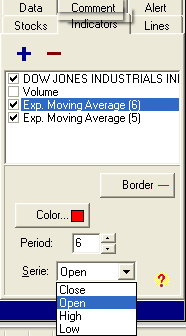
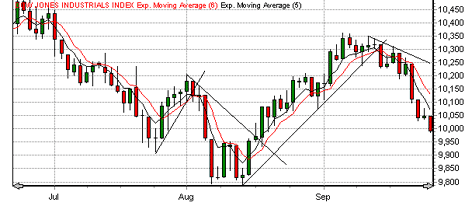
In the example below of the daily Dow Jones, I have used a 5 period exponential moving average of the close and a 6 period exponential moving average of the open. As you can see it catches the short term trend changes really nicely.
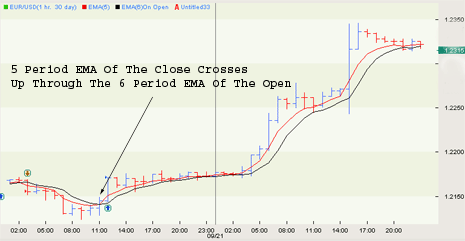
In the next example of the 1 hour EUR/USD, you can see that the close/open combination worked really well. Of course you will go through periods of consolidation with any market and any moving average method you use will be whipsawed. To get around this you need some sort of filter or approach that helps you keep out of the low probability trades.

You could use ADX, Stochastic or MACD to help filter the noise but I also like to add a time frame.
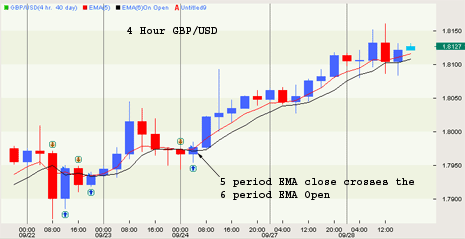
In the next example of the 4 hour GBP/USD you can see that on the 24th September 04 at 4:00 there was a cross of the 5 period exponential moving average of the close above the 6 period exponential moving average of the open. This signal has remained in place until today as I write on the 27th September.
Although there was a signal on the 4 hour, to help identify even better entry points you can drop down a few time frames to the 30 minute chart. As you can see from the 30 minute chart there have been quite a few crosses of the 5 period exponential moving of the close above or below the 6 period exponential moving average of the open.
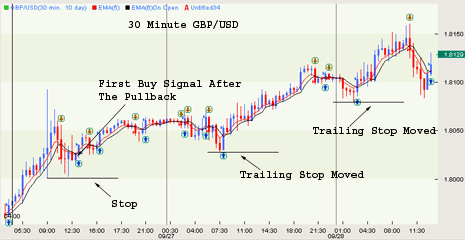
There are lots of ways to trade this but a neat little trick is to wait for the signal on a higher time frame and then drop down a few time frames and wait for a pullback. The first signal after the pullback on the lower time frame is normally a pretty good entry point e.g. If there were a cross up on the large time frame then drop down to a lower time frame and wait for the market to retrace and then give another buy signal (cross up). The opposite is true for short signals.

Once you get the signal on the shorter time frame depending on where support is you can usually place your first stop loss under the nearest support area (valley). If the market begins to make progress you can move your stop so that it trails the market by moving your stop to just under the most recent support area.

In this lesson I have use an exponential moving average but experiment with different types of average such as weighted, smoothed or simple. You can also experiment with different lengths of moving average.

Good Trading.

Best Regards
Mark McRae

Traders Secret Code

=================================================================

Please take time today and visit Mark's site Traders Secret Code as I believe the information there would be of good use to you!