Finding Your OWN Stocks

Today I'm pleased to introduce The Wild Investor from...The Wild Investor.com! I've had the chance over the past few weeks to spend some time at his site, seeing his methods, and really gleaning a lot of good info. His post today covers something we can ALL benefit from. Enjoy.

====================================================================

A couple years back, I got my first break into the world of trading stocks by listening to Jim Cramer of Mad Money. My first couple of trades came through his recommendations; however, that seemed to die out pretty quickly. He covers so many stocks at one time, that it seems he is proven wrong more often than right. If I was ever going to make some real money in the markets, I would have to branch out on my own.

Tons of people know how to buy, sell, see if a stock is worth acting on, and so on, but very few actually know how to find stocks.

Let me clarify. Perhaps some article talked about the 10 stocks you have to buy in 2008. Many can probably pick and choose the best ones out of those 10, but without that article they probably could have never come up with a list of 10 stocks.

So how do you go about finding stocks to invest in? You can't always rely on some third party.

Many people enjoy the ease of scans, but the tools and resources may not be available to everybody or they may just not understand enough to perform one.

Below are some steps that can help you create your own manual scan and perhaps help you run an automatic scan sometime in the future.

1. Reflect

Create a list of the past stocks you have either traded, watched, followed, or whatever. Try to get at least 50 stocks (100 if you are an overachiever). One by one, see which ones were successful, which failed, why they moved the way they did, and how you gained interest in that stock.

2. Breakdown

Try to group the stocks in the different ways your broke them down. For example, perhaps you have a few stocks that were successful on a cross of the 200 day moving average. Maybe some were oversold. Whatever it may be, just try and group some stocks together.

3. Classify Each Group

Out of the different categories you have created, come up with some sort of criteria that fits each stock in the group. For instance, say I have Stock A and Stock B in one group. Go back before those stocks experienced their gain and create some sort of pattern that could have been used to predict those gains.

4. Trial and Error

After you have gone through all your different groups, it is time to test. The more test you run, the better chance you have of creating a profitable search. Run your test on all the different stocks on your list, and see what results you get. Choose other random stocks that might match your criteria. Tweak it if you need to because the goal is to try and perfect your criteria, so that it should work more often than not.

5. Practice Run

Most likely you want to see if your system works before you throw real money at it, so find some stocks that fit your criteria. Use your finance site of choice and find top movers, similar stocks to the ones that were already successful, or look in the sector you are comfortable in and just let your system run. Follow the stocks until your system said it should have worked and look at the results.

Did it work? Keep trying and editing until you are comfortable throwing real money at it. It may seem tedious and cumbersome, but hopefully you will be able to move out of the realm of Jim Cramer and into your own world.

For those that still may be confused, here is a simplified version of my criteria:

  • Consistency to perform within 6 months or less

  • Ability to diversify and maintain some form of global exposure

  • Companies that have been oversold or beaten down

  • Buy and sell signals according to technical analysis

  • Best of breeds that continually produce and post solid numbers

  • Capability to shine in any type of market condition (recession proof)

In the end, the goal is to create a simplified way to complete a somewhat complicated task. If you can ease your tasks and rest your mind, then it only betters your trading, which increases your profits.
The Wild Investor

The 4 Characteristics of Strong Breakouts

For today's Guest Blog post, I've asked Harry Boxer to come and teach us a little bit about what makes a breakout a STRONG breakout...and MUCH more! Harry's been a contributor on CNBC, CBSMarketWatch, WinningonWallStreet, Stockhouse, DecisionPoint and more. If you're eager to learn more about Harry Boxer and his methods, check out TheTechTrader. Enjoy the post.

===================================================================

Breakouts of long bases on strong volume are frequent harbingers of continued price appreciation. Another harbinger, after the initial up-leg, is a low-volume, orderly pullback towards support.

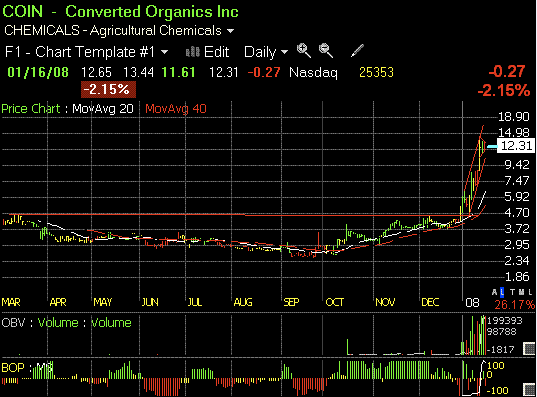
An analysis of the Converted Organics (COIN) chart illustrates this strategy. As the daily chart indicates, COIN in October 2007 broke out of a base pattern that extended back since its IPO in late February. Some traders who missed entering early may have given up on the stock when it rose 50% from around 2 1/2 to 3 3/4, but a closer look at the chart shows why it had more room to move.

COIN's pullbacks were orderly, coming on lower volume and holding near its moving averages, a key sign of more upside to come. Not once did its pullback break beneath the 40-day moving average, and most pullbacks hugged the 21-day moving average.

The pattern was breakout (mid-October), flag, breakout (early November), flag, breakout (late December), flag, and then breakout in mid-January, where it closed on January 15 at 12.58, more than 5 times its pre-October breakout price. Volume on each pullback was a small fraction of the level of the breakout, and a shallow decline just grazing the moving averages suggested a continuation of the uptrend.

As a stock in a rising pattern pulls back, look for several factors to portend the continuation of the pattern.

1. First, look for very low volume on the pullback between 10% and 25% of the average volume of the last 90 days. Second, watch for the decline to flatten near the 21- or 40-day moving average on the hourly charts in a quiet, narrow flag-type formation.

2. When the breakout comes, buy on the initial thrust out of this flag pattern. This means a sudden dramatic change in price accompanied by heavy volume. The price doesn't necessarily have to rise above the top of the flagpole (i.e., the previous rally high prior to the consolidation), but only needs to be a price bar that is at least several times the size of the previous several bars on the chart.

3. Wait to add to the position until the stock takes out the top of the flagpole, which is key short-term resistance. This will protect against a head fake, which is a move that starts out dramatically but quickly fizzles price- and volume-wise after just a bar or two and has no follow-through and, in particular, does not make it through the top of the flagpole.

4. Set a stop below the bottom of the lowest level reached during formation of the consolidation or flag pattern out of which it has broken. When COIN, for example, in its November upmove exceeded the top of its October flagpole around 3.75, that was one signal to get in or add to the position. Another signal came in the second week of January at around the 8 level, when we first highlighted it for our subscribers.

We saw COIN having consolidated and tested its 8.70 triple-top resistance over the previous 3-4 sessions, and noted that if it broke through that level it could initially head to 10 1/2-11, and then beyond that to our next target of 12 1/2-13, where it last resided, as mentioned, on January 15. The COIN example illustrates the potential that chart patterns like high-volume breakouts from long bases and low-volume flags can have in predicting price appreciation.

Harry Boxer is an award-winning, widely syndicated technical analyst and author of The Technical Trader, which features a real-time diary of Harry's minute-by-minute trades and market insights, plus annotated technical charts & stock picks, based on Harry's 35 years experience as a Wall Street technical analyst. You can find out more about Harry's work at TheTechTrader.com.

We revisit a crude oil posting

(First published on 7/21)

How many times have you heard that it's going to be different this time?

Do you remember the dot com bust? Well, that was supposed to be different and look what happened. Same with the housing bubble, that was supposed to be different and look how that's turning out. Both events created the illusion of madness that made everyone rich on paper for at least 20 seconds.

The fact is, it's always different "this time", that's what makes it different.

But it's different this time in crude oil, right?

Okay, I know, I have heard all the reasons why oil is up, we are running out of energy, India and China are buying, the turmoil in the Middle East, etc, etc. Let's face it the energy market is the market du jour.

But it's different this time in crude oil, right?

I have to say that it's always different and at the same time it is always the same, only the names of the players in the markets change. It's all speculation (ooh, dirty word) but the reality of the situation someone is always left holding the bag.

The irrefutable laws of the market never change:

Check out my new crude oil video after you have read the six steps.

Read on and understand why.

SIX STEPS and the IRREFUTABLE LAWS of the MARKET
What Every Investor and Trader needs to know to Succeed in the Markets.

Step 1: A move begins with the sponsors (smart traders) who have insider knowledge as it relates to a particular stock or market. This information will move a market up or down depending on the insiders' information. These buyers are smart, very smart, and recognize trading/investment opportunities very early in the markup cycle.

Step 2: Days, weeks, or sometimes months after a move has started, there is a brief mention in the electronic media (radio, cable, TV) or on one of the internet chat boards that a market has moved. The public hears for the first time and begins to get interested, but does not buy.

Step 3: A blurb of information appears in print media. The move also begins getting more exposure on blogs and internet message boards. The public starts paying a little more attention, and will buy a little bit.

Step 4: Wall Street and LaSalle Street brokers go into full hype mode and hawk the market to their customers. The public begins buying in greater volume.

Step 5: A full-blown front-page article appears about the particular stock or market in one of the major financial newspapers, magazines, or financial websites. This is often six months after the fact and after a market has shown its greatest appreciation. There is often heavy public buying, even a possible frenzy, as all media, brokers, and so-called "gurus" start to tout the market.

Step 6: As step 5 gets underway, the sponsors or smart traders begin to move out of the market and take their profits off the table.

The finale Step: The move ends, the market falls, and investors lose money.

Does any of this sound familiar to you? If it does then you know the key rules of engagement in the market. If none of this is familiar to you then learn to recognize these six step asap. Your financial life depends on it!!

Think about it.

Adam Hewison

President INO.com

Traders Toolbox: Reactions within a downtrend

Many traders, especially those who have not traded very long, find trending declines very difficult to trade. Many trad- ing and analytical tools which perform well in uptrends, or even in sideways pat- terns, often perform differently in down- trends. This is not to say such tools will not work well in a downtrend, but, real- istically, many perform differently.

Many traders (once again, especially those with little experience) tend to be biased to the long, or buy, side of the market. Such traders often have difficulty adapting to the changes which may occur in the performance of their favorite tools in declining markets. Thus, many tend to shy away from the short side of markets. This is unfortunate as markets often fall more quickly than they go up. As a result, profits can be potentially harvested faster in a down move than in an uptrend.

While some traders tend to avoid the short side of markets altogether, others would be interested in selling short if only they could find a way to get on board trending declines. As mentioned earlier, while many tools don't appear to work as well in a down- trend, there is a pattern which occurs often enough to be helpful in analyzing and trading.

The reliable pattern which often develops within down trending moves is a consistency of the upward reactions. The consistency within upward reactions can be in terms of time or price or both. However, most patterns tend to involve time, either alone or in combination with price.

Generally speaking, upward reactions in true downtrends tend to last from 1 to 3 days. The reactions are not limited to 3 days; however, many declines will follow this pattern.

To be more specific, individual markets often mark the maximum time span of most upward reactions with the first rebound in a downtrending pattern. For example, if the first upward reaction lasts two days, many of the subsequent rebounds within the downtrend will last two days or less. A good example of this phenomenon occurred in the February/March, 1991 collapse in the currency markets.

The first rebound in the Swiss franc, following the posting of the February high, lasted for about a day and a half. From that point forward until the primary downtrend came to an end in late March, no upward reaction (arrows) lasted much more than a day and a half. And, when the Swiss franc rebounded for more than a day and a half, (circle) it proved to be a signal the clean portion of the downtrend had come to an end.

The trading strategy is quite simple. In general, traders may look to sell 1- to 3-day rebounds in downtrending markets. If a reaction lasts longer than the longest previous reaction, the strategy then moves to either being stopped out or to look for a gracious way to move to the sidelines on the next break. This is done because, even if the market eventually moves lower, what remain, compared to the previous trending portion or "meat" of the move, often prove to be the "crumbs." Obviously, the strategy is adjusted when a specific market has marked its reaction time.

The spring, 1991 situation in the new-crop corn market pres- ents an example of a time span longer than three days being marked as the primary reaction time. After collapsing from the March high, December corn marked its key reaction time with the sharp rebound into early April. This 4-day bounce set the stage for subsequent reactions to last from 1 day to 4 days. In addition, December corn has marked the likely size, in terms of price, of most subsequent reactions.

The rebound posted in December corn into early April was 13.25(E. This is likely to be the approximate size of the largest subsequent rebound which occurs within the downtrending move. A rebound which is substantially larger than 13.25 cents is likely to signal an end of the primary decline. However, on a daily degree, it is rather obvious that a 13.25C rebound in corn is a large reaction. While a 4-day reaction time is realistic, most reactions in price are likely to be smaller than 13.25 cents.

Notice the 4-day rebound which followed the posting of the April high. This upward reaction was 5cents. From this point on, it was/is reasonable to expect most reactions to be in the neighborhood of 5(t or Go; and to last from 1 to 4 days. However, it would be wise to allow for at least one larger-degree rebound of about 13 cents.

In the spring, 1991 situation in the December corn market, a possible trading approach would be to sell rebounds from a new low of 5cents to 6cents. Risk could be limited to a point which is 14cents or 15cents above a new low. Thus, the effective risk should be about 8cents to l0cents. Once a new low is posted, if one were using "tight" stops, the risk could be limited to about 7cents to 8cents above each new low. Otherwise, a 14cent or 15cent trailing stop above each new low should keep one in position for the bulk of a move. While this is a possible approach, it is not necessarily a specific or the only approach to trading a short position.

As always, knowing the personality of a market can prove beneficial. In the spring, 1991 corn market, it was wise to allow for one rebound in time of up to ten days. This is due to the presence of such rebounds in time in potentially similar previous downtrends in the corn market.

The tendency for consistent reactions in a downtrend should be an attractive addition to one's technical "toolbox". This pattern offers a low-risk method to reap potentially substantial rewards.

BARRON'S numbers confirm our "Trade Triangle" technology" outperformed 200 CTA and 1000 Hedge fund managers in the past 4 quarters.

The results are in and we have to say that we impressed ourselves at how well we are doing. But we wanted to measure our success against some of the best in the industry.We picked 1000 hedge funds and 200 of the top commodity trading advisers in the world. We took the 12 month returns of the top 1000 hedge funds and 200 CTA's out of BARRON'S as we consider this publication to be world class.

We wanted to compare our results (plus 300%) to the best of the best. After we had checked through all 1000 Hedge fund results and the results of 200 CTAs that BARRON'S tracks, we were shocked, surprised and a little giddy to see that our simple little approach had outperformed every one of the top hedge and CTA funds.

How is that possible? How can a simple mechanical program that we have shared in detail with all our members outperform many of the best Hedge and CTA managers in the world? These are the same funds you read and hear about in the financial press who charge a 2% management fee and take a whopping 20% of any profits they make for you.

Now thanks to MarketClub's "Trade Triangle" technology, you never have to pay another nickel to anyone to manage your money. Plus you get superior results. You have the power to create your own great returns no matter what happens to the economy.

Why pay management and incentive fees when you can do this yourself and get better results than all of the top hedge and CTA funds. We have been publishing our results for the past four quarters and we are proud to say that we have been positive in all the markets we've reported on in the last year.

We track and report on the same six markets each quarter, they are: corn, wheat, soybeans, crude oil, gold and the dollar index.

Some might argue that we were lucky, but in the futures market there is no such thing as luck. I do not believe that you can be consistently lucky for 12 months in a row. You can only see these types of returns by staying disciplined and trading a diverse portfolio.

All the trading signals were taken using MarketClub's "Trade Triangle" approach which we firmly believe is the best approach for the majority of all investors.

Check out this short video and see exactly what we did in the markets we described above. You will also see how we did against the best funds in the world.

I think you will agree the results have been outstanding.

The choice is yours, you can go it alone using "Trade Triangles" and outperform most hedge and CTA funds, or you can give your money to a hedge fund and have them manage it for you. I am not saying that there are no extremely profitable hedge funds or CTAs, in fact there are several. However, many of the best CTAs and hedge fund managers really aren't taking any new funds.

So take the time, watch the video, and see how we tackled these markets over a 1 year period. Then compare the results of the CTAs and see where you'd rather put your money.

"Trade Triangles" give you the power to make the right decisions at the right time. They are easy to use and understand. There is no mumbo-jumbo in the equation or a black box that spits out numbers for you to follow.

You don't need a degree in physics or a Ph.D. in math to follow MarketClub's "Trade Triangles." You simply need to use common sense and discipline, and if you have read this far you already possess those qualities.

Now go watch the video.

Adam Hewison
President, INO.com

Be Our Guest
We welcome syndication of our content in your blog or on your trading website. Please feel free to use our content with attribution - more details here to syndicate our content