Will United Parcel Service (UPS) Soar Despite Ongoing Controversy?

 The past few weeks have been challenging for logistics giant United Parcel Service, Inc. (UPS) as it faced the prospect of a crippling labor strike if the company did not agree to a new contract containing the demands put forward by the International Brotherhood of Teamsters, the labor union representing the nearly 330,000 workers of UPS.

 The Teamsters have been demanding better pay, especially for part-time employees, and improved working conditions. The workers were scheduled to go on strike from August 1, 2023, without an agreement. However, UPS and Teamsters reached an agreement on July 25, 2023, potentially avoiding the strike, which could have crippled U.S. supply chains and impacted the economy.

 Earlier in June, UPS announced its agreement with Teamsters on new heat safety measures, which build upon the company's important actions in February. The company has agreed to equip newly purchased U.S. small package delivery vehicles with air conditioning starting January 1, 2024. After equipping over 95,000 package cars with a cooling fan, UPS will install a second fan in vehicles without air conditioning by June 1, 2024.

 It also agreed that exhaust heat shields will be included in the production of new package cars and will be retrofitted into existing package cars within 18 months of contract ratification. Despite these agreements, UPS and Teamsters remained at odds over pay and benefits for part-time workers that comprise a significant part of UPS’ workforce.

 The deadlock was finally broken a few days before the potential strike as UPS and Teamsters reached a preliminary labor deal that included raises for full- and part-time workers. Under the tentative agreement, all UPS union employees would receive a $2.75-an-hour raise this year and a $7.50-an-hour pay increase over the next five years. Its part-time workers’ pay would start at $21 an hour, up from the $16.20 per hour currently.

 Teamsters General President Sean O’Brien said the agreement was worth $30 billion. In a statement, O'Brien said, “We’ve changed the game, battling it out day and night to ensure our members won an agreement that pays strong wages, rewards their labor, and doesn’t require a single concession. This contract sets a new standard in the labor movement and raises the bar for all workers.”

 UPS CEO Carol Tomé said, “Together, we reached a win-win-win agreement on the issues that are important to Teamsters leadership, our employees, and to UPS and our customers. This agreement continues to reward UPS’s full- and part-time employees with industry-leading pay and benefits while retaining the flexibility we need to stay competitive, serve our customers and keep our business strong.”

 The five-year agreement is subject to union members' voting and ratification from August 3 till August 22. UPS released its second-quarter earnings with its EPS coming 4 cents above the consensus estimate, while its revenue missed the Street estimates by $1.06 billion.

 After its second-quarter earnings report, UPS lowered its revenue estimate by $4 billion. It now expects its fiscal 2023 revenue to be $93 billion, and the company also lowered its adjusted operating margin to 11.8%, down from the previous estimate of 12.8%. It expects a capital expenditure of $5.3 billion.

 UPS’ stock has gained 4.8% in price year-to-date. However, it has declined by 7.4% over the past year.

 Here’s what could influence UPS’ performance in the upcoming months:

Disappointing Financials

 UPS’ total revenue for the second quarter ended June 30, 2023, declined 10.9% year-over-year to $22.06 billion. Its adjusted operating profit decreased 18.4% over the prior-year quarter to $2.92 billion. The company’s adjusted operating margin came in at 13.2%, compared to 14.4% in the prior-year quarter.

 Its adjusted net income declined 24.1% year-over-year to $2.19 billion. In addition, its adjusted EPS came in at $2.54, representing a decline of 22.8% year-over-year.

Mixed Analyst Estimates

 Analysts expect UPS’ EPS and revenue for fiscal 2023 to decline 17.9% and 3.7% year-over-year to $10.63 and $96.59 billion, respectively. Its EPS and revenue for fiscal 2024 are expected to increase 9.9% and 4.3% year-over-year to $11.68 and $100.77 billion, respectively.

Mixed Valuation

 In terms of forward non-GAAP P/E, UPS’ 17.14x is 4.3% lower than the 17.90x industry average. Its 11.20x forward EV/EBITDA is 0.4% lower than the 11.25x industry average. Likewise, its 14.33x forward EV/EBIT is 8.5% lower than the 15.66x industry average.

 On the other hand, in terms of forward Price/Book, UPS’ 7.19x is 175.6% higher than the 2.61x industry average.

High Profitability

 In terms of the trailing-12-month net income margin, UPS’ 10.90% is 74.9% higher than the 6.23% industry average. Likewise, its 16.23% trailing-12-month EBITDA margin is 20% higher than the industry average of 13.53%. Furthermore, the stock’s 4.88% trailing-12-month Capex/Sales is 67% higher than the industry average of 2.93%.

Solid Historical Growth

 UPS’ revenue grew at a CAGR of 9.7% over the past three years. Its EBITDA grew at a CAGR of 16.7% over the past three years. Moreover, its EPS grew at a CAGR of 35.8% over the past three years.

Bottom Line

 The agreement UPS reached with Teamsters will cost it $30 billion in additional spending over the five-year contract period, increasing its costs significantly.

 Additionally, the threat of the strike still lingers as many union members could vote against the ratification as they were not pleased with the $21 per hour pay for part-time workers. They were expecting a wage of around $25 per hour.

 Furthermore, UPS faces stiff competition from FedEx Corporation (FDX). Given the mixed analyst estimates and valuation, waiting for a better entry point in UPS shares could be wise.
NVIDIA (NVDA) vs. Advanced Micro Devices (AMD): Which Stock Is Proving to Be the Better Long-Term AI Buy

After its earnings release on May 24, the Santa Clara-based graphics chip maker NVIDIA Corporation (NVDA) stole the thunder by becoming the first semiconductor company to hit a valuation of $1 trillion.

NVDA has also blown away Street expectations ahead of its quarterly earnings release on August 23, with profits for the current quarter expected to be at least 50% higher than analyst estimates and the momentum expected to continue in the foreseeable future.

On the other hand, since its humble beginnings as a supplier for Intel Corporation (INTC), Advanced Micro Devices, Inc. (AMD) has come a long way. During its earnings release for the second quarter, despite persistent weakness in the PC market, the company’s result topped analyst estimates.

While NVDA has carved its niche and cornered a significant share of the GPU domain through advancements in parallel (and consequently accelerated) computing which began back in 2006 with the release of a software toolkit called CUDA, Chair and CEO Dr. Lisa Su is widely credited with AMD’s turnaround and transition from being widely dismissed due to performance issues and delayed releases to being the only company in the world to design both CPUs and GPUs at scale.

The New (Perhaps Only) Game in Town

As a general-purpose technology, such as the steam engine and electricity, Artificial Intelligence (AI) that has already been touching and influencing all facets of our life, including how we shop, drive, date, entertain ourselves, manage our finances, take care of our health, and much more.

However, late in November of last year, when OpenAI opened its artificial intelligence chatbot, ChatGPT, to the general public, all hell broke loose. The application took the world by storm. It amassed 1 million users in five days and 100 million monthly active users only two months into its launch to become the fastest-growing application in history.

The generative AI-powered application’s capability to provide (surprisingly) human-like responses to user requests equally fascinated and concerned individuals, businesses, and institutions with the possibilities of the technology. A large language model or LLM powers ChatGPT. This gives the application the ability to understand human language and provide responses based on the large body of information on which the model has been trained.

NVDA is reaping the rewards for all that invisible work done in the field of parallel computing. Parallel computing was ideal for artificial neural networks' deep (machine) learning. As a result of that head start in the AI tech race, its A100 chips, which are powering LLMs like ChatGPT, have become indispensable for Silicon Valley tech giants.

To put things into context, the supercomputer behind OpenAI’s ChatGPT needed 10,000 of NVDA’s famous chips. With each chip costing $10,000, a single algorithm that’s fast becoming ubiquitous is powered by semiconductors worth $100 million.

However, AMD isn’t too far behind either. According to Dr. Su, Data Center is the most strategic piece of business as far as high-performance computing is concerned. AMD underscored this commitment with the recent acquisition of data center optimization startup Pensando for $1.9 billion.

At the premiere, AMD’s ambitions to capitalize on the AI boom were loud and clear, with the launch of MI300X (a GPU-only chip) as a direct competitor to NVDA’s H100. The chip includes 8 GPUs (5nm GPUs with 6nm I/O) with 192GB of HBM3 and 5.2TB/s of memory bandwidth.

AMD believes this will allow LLMs’ inference workloads that require substantial memory to be run using fewer GPUs, which could improve the TCO (Total Cost of Ownership) compared to the H100.

The Road Ahead

The optimism surrounding both companies is justified.

With NVDA’s presence in data centers, cloud computing, and AI, its chips are making their way into self-driving cars, engines that enable the creation of digital twins with omniverse that could be used to run simulations and train AI algorithms for various applications.

On the other hand, AMD has also been training its guns to exploit the burgeoning AI accelerator market, projected to be over $30 billion in 2023 and potentially exceed $150 billion in 2027.

AMD is one of the few companies making high-end GPUs needed for artificial intelligence. With AI being seen as a tailwind that could drive PC sales, the company announced plans to launch new Radeon 7000 desktop GPUs at its quarterly earnings release. It is being speculated that the GPU will come with two 8-pin PCIe power connectors and four video out ports, including three DisplayPort 2.1 and one HDMI 2.1.

Caveats

AMD existed as both a chip designer and manufacturer, at least until 2009. However,  significant capex requirements associated with manufacturing, amid financial troubles in the wake of the Great Recession, compelled the company to demerge and spin off its fab to form GlobalFoundries Inc. (GFS), which has been focused on manufacturing low-end chips ever since.

Today, both NVDA and AMD operate as fabless chip companies. Hence, both companies face risks of backward integration by companies such as Apple Inc. (AAPL), Amazon.com, Inc. (AMZN), and Tesla Inc. (TSLA) with the wherewithal to develop the intellectual capital to design their own chips.

Moreover, almost all of the manufacturing has been outsourced to Taiwan Semiconductor Manufacturing Company Ltd. (TSM), which has yet to diversify significantly outside Taiwan and has become the bone of contention between the two leading superpowers.

With geopolitical risk being the potential Achilles heel for both companies, their efforts toward geographical diversification also receive much-needed political encouragement through the Chips and Science Act.

Dr. Su, who also serves on President Biden’s council of advisors on science and technology, pushed hard for the passage of the Act. It is aimed at on-shoring and de-risking semiconductor manufacturing in the interest of national security by setting aside $52 billion to incentivize companies to manufacture semiconductors domestically.

Bottom Line

Given its massive importance and cornucopia of applications, it’s hardly surprising that Zion Market Research forecasts the global AI industry to grow to $422.37 billion by 2028. Hence, this field has understandably garnered massive attention from investors who are reluctant to miss the bus on such a watershed development in the history of humankind.

Hence, in view of product diversification, increasing traction in the GPU segment, and relatively higher valuation comfort, investors in AMD could benefit from more sustained upside potential compared to NVDA.

Intel Corporation (INTC) Races to Dominate the AI Market – Will It Succeed?

In our June 3 post, we concluded that the resurgent Intel Corporation (INTC), which had weathered back-to-back quarterly losses amid softening PC demand, consequent surplus inventory, and realignment toward GPU-heavy and AI-centered enterprise demand, could be worth more than what was being suggested by its market price at that time.

By announcing its return to profitability during last week’s earnings release, the pioneer of modern computing lived up to our expectations while exceeding the ones on the Street. INTC posted a net income of $1.5 billion, compared to a net loss of $454 million during the previous-year quarter. Its adjusted EPS came in at $0.13 compared to an adjusted loss of $0.3 per share expected by Wall Street.

While the Market greeted the news with a 7% surge in the stock price in extended trading and a further 5% gain the following morning, INTC’s revenue, despite exceeding low expectations, declined 15.7% year-over-year to $12.9 billion, marking the sixth consecutive quarter of sales decline.
In view of a subdued topline, much of the outperformance in the quarterly results can be attributed to the progress INTC had made in cutting $3 billion in costs this year.

In addition to exiting nine lines of business since CEO Pat Gelsinger rejoined INTC to achieve a combined annual savings of more than $1.7 billion, the company slashed its dividend and announced plans to save $10 billion per year by 2025, including through layoffs.

With INTC’s cloud computing group, which includes the company’s laptop and desktop processor shipments, and server chip division, which is reported as Data Center and AI, reporting year-over-year declines of 12% and 15%, respectively, Pat Gelsinger forecasted “persistent weakness” in all segments of its business through year-end, and that server chip sales won’t recover until the fourth quarter.

With upside through cost optimization capped and customers prioritizing GPUs over CPUs to handle ever-increasing AI/ML workloads, INTC is eager to join the race currently being led by NVIDIA Corporation (NVDA) and Advanced Micro Devices, Inc. (AMD). The company is working on the manufacturing front, for which it significantly depends on Taiwan Semiconductor Manufacturing Company Ltd. (TSM).

By doubling down on the fab business, INTC aims to match TSM’s chip-manufacturing capabilities by 2026, enabling it to bid to make the most advanced mobile processors for other companies, a strategy the company calls “five nodes in four years.”

To that end, INTC is pursuing an aggressive IDM 2.0 road map with new manufacturing facilities in Oregon, New Mexico, Arizona, Ireland, and Israel in the pipeline to augment the capabilities of 15 fabs worldwide and facilities to assemble and test the manufactured chips in Vietnam, Malaysia, Costa Rica, China, and the U.S.

Among those, Arizona's new facilities would be manufacturing chips for the company and customers such as Amazon, Qualcomm, and others as part of Intel Foundry Services. While the company still depends on TSMC for 5nm chips used for AI applications, it aims to take a quantum leap in that direction with even smaller 18 A chips.

While companies such as Amazon.com, Inc. (AMZN) are resorting to chips designed in-house to support their cloud infrastructure, INTC, in addition to being the manufacturer of both wafers and packaging of AI accelerators, is also present with its Gaudi chips.

The company’s efforts are also receiving much-needed political encouragement in the form of the Chips and Science Act, which is aimed at on-shoring and de-risking semiconductor manufacturing in the interest of national security.

Recently, Pat and his team at INTC upped the ante by unveiling its new ambitious plans to incorporate AI into every product it creates. This announcement comes as the company’s upcoming Meteor Lake chips are rumored to feature a built-in neural processor specifically designed for handling machine learning tasks.

With an objective to “democratize AI,” Pat was loud and clear about INTC’s plans to make it a ubiquitous and integral feature of its products designed to cater to all segments of the computing ecosystem, including “at the edge in the Client, in the enterprise, as well as in the cloud.”
The upbeat CEO forecasted that AI would permeate all business domains, including the client-facing consumer electronics market, enterprise data centers, and even manufacturing, and make its way into personal devices, such as hearing aids and personal computers. AI is already present as a co-pilot for Windows 11, allowing users to type questions and perform specific actions, and it could play a significant role in the next iteration of Windows.

Bottom Line

For the third quarter of the fiscal, INTC expects adjusted earnings of 20 cents per share on $13.4 billion revenue at the midpoint.
Whether or not INTC manages to meet or exceed the above target could go a long way in helping investors determine if its ambitious turnaround is on track to restore the company to its former glory.

Will Twilio (NYSE: TWLO) and Amazon (NASDAQ: AMZN) Redefine AI Potential with Their Unstoppable Alliance?

Last week, at the Amazon Web Services (AWS) Summit in New York, San Francisco-based cloud communication and customer engagement platform Twilio Inc. (TWLO) announced its strategic partnership with technology giant Amazon.com, Inc. (AMZN). Right on cue, the market welcomed the announcement with more than a 5% intraday gain in the former’s share price while surging by as much as 11.7% during the trading session.

The Partner

As a dominant player in the CPaaS (Communications-Platform-as-a-Service) market, TWLO provides businesses with the tools to integrate voice calls, text messages, and security verification tools into their software and apps to drive customer engagement by facilitating seamless and personalized interactions on demand. This empowers businesses to expand their customer base and communicate with clients across the globe.

While potential growth avenues for TWLO include expanding its CPaaS offerings and forging partnerships with other major tech companies, competition from established tech giants could impact the company’s operations and revenue generation. However, that concern seems to have been mitigated by TWLO’s artificial intelligence (AI)-fueled strategic partnership with AMZN.

The Partnership

The renewal of vows and strengthening of ties, which seeks to enhance the company’s predictive AI proficiency, has closely followed a vote of confidence from the tech giant in which AMZN announced that it has acquired 1% stake in TWLO earlier in the week with its ownership of 1.77 million shares worth more than $108 million.

The association between the two businesses started back in 2016 when TWLO began serving as a Marketplace partner for AWS, which had become the world's largest cloud infrastructure platform. It signed two deals with AMZN to directly integrate its communication tools into AWS, which enabled developers to easily add TWLO's voice calls, text messages, audio clips, and other features to their mobile apps.

Fast forward to June 2022, and TWLO revealed its CustomerAI, which adds a technology layer that integrates generative AI and predictive AI tools into the company's customer engagement platform.

According to Twilio CEO Jeff Lawson, who was employed with AMZN between 2004 and 2005, “With generative and predictive intelligence, Twilio’s high-quality interaction data, and Segment profiles working together, every experience can be highly personalized and tuned with a level of sophistication that was previously only attainable by the tech giants. With Twilio CustomerAI, brands can transform their customer relationships and unlock their full potential.”

The Heavyweight

Coincidentally, also in June 2023, AWS, in response to the recent noise around AI being made by frontrunner Microsoft Corporation (MSFT) and challenger Alphabet Inc. - Class A (GOOGL), announced an allocation of $100 million for a center to help companies use generative AI. This technology has captivated the public imagination and shaped the business narrative since OpenAI unleashed ChatGPT.

While $100 million might be an apparent drop in the bucket for a company with $64 billion in cash and half a trillion dollars a year in operating expenses, the investment acknowledges the significance of generative AI and the importance of being a part of the conversation.
AWS CEO Adam Selipsky insists that the AI trend is real. For AMZN, that momentum applies to its Bedrock generative AI service and its Titan models, as well as the new innovation center.

While it might seem that the company, which got a head start of no less than seven years over MSFT and GOOGL in the business of renting out servers and data storage to companies and other organizations, might be late to the generative AI game, Selipsky, echoing Amazon founder and longtime CEO Jeff Bezos, said the company has succeeded by listening to customers.

In fact, AMZN’s leadership in the cloud infrastructure market could give the company heft and mileage in the generative AI race. “AI is going to be this next wave of innovation in the cloud,” Selipsky said. “It’s going to be the next big thing that pushes even more customers to want to be in the cloud. Really, you need the cloud for generative AI.”

Moreover, according to Selipsky, AWS provides a measure of credibility in offering generative AI that eludes others in the space. He emphasized, “I can’t tell you how many Fortune 500 companies I’ve talked to who banned ChatGPT in the enterprise. Because at least the initial versions of it just didn’t have that concept of enterprise security.”

Bottom line

TWLO Senior Director of Product Alex Millet expressed his optimism around the company’s partnership with AMZN, “With AWS’ predictive AI technologies, we are rapidly developing AI-native features and APIs.” He further added, “We believe our tools will change the way marketers, contact centers, developers, and data teams deliver these world-class customer experiences.”

Hence, while the OpenAI-MSFT alliance is garnering attention and reaping the first-mover advantage with GOOGL scrambling to play catchup, the coalition of AMZN and TWLO has the potential to emerge as the dark horse in what AWS CEO has termed as a “10K race.”

August Stock Market vs. Big 3 Economic Reports

Please enjoy this updated version of weekly commentary from the Reitmeister Total Return newsletter. Steve Reitmeister is the CEO of StockNews.com and Editor of the Reitmeister Total Return.Click Here to learn more about Reitmeister Total Return


SPY – The new bull market is hand as the S&P 500 (SPY) moves ever closer to the all time highs. However, that doesn’t mean we can fall asleep at the wheel as the health of the economy is always part of the stock investment equation. As such let’s review the Big 3 economic reports on the menu in early August and what that tells us about the market outlook and adjustments to our trading plan. Read on for the full story below…

This week we get served up the Big 3 economic reports to give us a wide ranging view on the health of the economy.

Typically, these are market moving events. However, with stocks on such a tremendous bull run, then the good news is likely priced in and the risk remains to the downside.

The first of those reports came in today, ISM Manufacturing. So let’s discuss the results along with a preview of the other 2 to shape our market outlook and trading plan.

Last week the key event was the Fed announcement on Wednesday 7/26. I gave a pretty thorough analysis of the event in this commentary.

The summarized version is that there is good reason to believe the Fed has made their last rate hike. Further, they have improved their future economic outlook to where they believe inflation can be tamed without creating a recession.

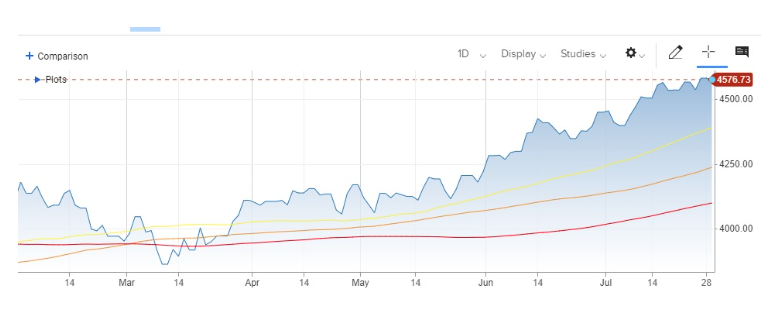
Investors already assumed that to be the case which was the catalyst behind the nearly non-stop rally we have enjoyed since mid March. That is when fears of the banking concerns started to go away allowing the S&P 500 (SPY) to bounce from 3,855 to the present level that is getting ever closer to the all time highs.

With the Fed announcement by the way side, plus Q2 earnings season in line with modest expectations, now attention turns to the Big 3 economic reports that kick off each new month.

ISM Manufacturing got things started on Tuesday morning. It is hard to say with a straight face that the 46.4 reading is good when everything below 50 is a sign of economic contraction. However, it is a step up from the even weaker 46.0 last month. More importantly, the New Orders component rose from recent weakness which generally means future readings will be higher as well.

However, given the importance of full disclosure I will admit that the Employment component falling to 44.4 could be a sign that the jobs market is finally about to weaken. However, that would not necessarily lead to a sell off as that was expected at some point during this aggressive rate hike cycle.

More likely investors will see that as a sign that wage pressure will abate…which leads to a lower overall inflation picture…which means the Fed will start lowering rates soon rather than later making the future economic and stock market outlook that much brighter.

The next of these Big 3 reports is ISM Services which taps into a much larger swatch of the economy. Previously that spiked from 50.3 to 53.9 in the July reading. This time around investors are expecting a more modest 52.0 reading.

Not great. But not terrible for an economy where the Fed is still slamming on the brakes with the highest rates in over 20 years.

Honestly, anything north of 50 for this report would be a green light for bullish investors. Below that would strike a note of caution. But likely nothing more than a very small sell off.

Coming down the homestretch, on Friday investors will digest the monthly Government Employment Situation report. Remember that the jobs market has been surprisingly resilient over the past 17 months as the Fed has been raising rates. That is why once again the market is expecting healthy job adds in the neighborhood of 190,000.

Equally important to the number of job ads is the reading for wage inflation. That was a bit too hot at 4.4% year over year according to the July reading. That is expected to keep moderating at this meeting which will only further embolden the Fed to prepare for an end to the rate hikes and future decreases. That more accommodative stance will be better for the economy…and better for stock prices as they will look more attractive as interest rates decline.

Price Action & Trading Plan

Now let’s check in with the following S&P 500 price chart to see what it is tell us:

 S&P 500 price chart Continue reading "August Stock Market vs. Big 3 Economic Reports"