Growing Dividends is the Secret to Wealth

For the dividend-focused investor, nothing is better than one of your stocks announcing a dividend increase. So you can be assured that this Seeking Alpha headline caught my eye: 100 REIT Dividend Hikes.

Investing for dividend growth is a sure-fire way to build your wealth over the long term. The article explained that 100 real estate investment trusts (REITs) had increased their dividend rates so far in 2022. Last year there were 120 rate increases in the REIT sector.

This many increases bodes very well for one of my favorite investment strategies…

REITs own commercial properties or invest in real estate-related debt securities. The Nareit includes 213 publicly-traded REITs in its All REITs Index. These companies operate as pass-through businesses, which means they don’t pay corporate income taxes as long as they pay out at least 90% of net income as dividends to investors. The REIT dividend rules make the sector a good place to look for attractive dividend-paying stocks.

A few years ago, I researched the returns from growing dividend stocks. I found that investors earn an average annual compound total return that, over the long term, will be very close to the average dividend yield plus the average dividend growth rate.

For example, if an REIT (or shares of any stock with growing dividends) has an average yield of 4% and the dividends grew by an average of 10%, investors in that stock will have seen a 14% compound annual total return.

While the shorter-term market cycles will pull returns above and below the expected results, owning a dividend growth stock for ten years or more will push the returns very close to mathematical expectations.

When researching dividend growth stocks, look first at the historical dividend growth rate. You want to see the average growth rate and how many years the company has been increasing its dividend. For example, industrial property REIT Prologis, Inc. (PLD) has increased its dividend for eight consecutive years with an average of 10.5% dividend growth. Add in the current 2.5% yield, and you have a low-teens return potential. Continue reading "Growing Dividends is the Secret to Wealth"
3 Well-Positioned Momentum Stocks

The stock market has witnessed significant volatility due to several macroeconomic and geopolitical headwinds this year. With inflation remaining elevated and the possibility of the Fed raising interest rates aggressively, the market is expected to remain volatile.

Amid this uncertain environment, a good strategy could be buying stocks that have gained momentum recently and are well-positioned to maintain the same based on their strong fundamentals and growth prospects, irrespective of the market movements. Investors’ interest in momentum stocks is evident from the Invesco DWA Momentum ETF’s (PDP) 8.2% returns over the past month.

PBF Energy Inc. (PBF), Global Partners LP (GLP), and GeoPark Limited (GPRK) have shown no signs of slowing down and are currently trading at discounts to their peers.

Strong fundamentals should help these stocks maintain their momentum in the upcoming months. So, it could be wise to invest in these stocks.

PBF Energy Inc. (PBF)

PBF is a petroleum refiner and supplier of gasoline, diesel fuel, jet fuel, unbranded transportation fuels, heating oil, petrochemical feedstocks, lubricants, and other petroleum products. The company operates through two segments: Refining; and Logistics.

On July 28, 2022, PBF announced the acquisition of the remaining public stake in PBF Logistics LP. As of July 22, 2022, it owned approximately 47.7% of the outstanding common units of PBF Logistics.

Tom Nimbley, PBF Energy’s and PBF Logistics’ Chairman and CEO, said, “This transaction will ultimately allow us to simplify our corporate structure and eliminate administrative, compliance, and cost burdens of running a separate public company. Following consummation of the merger, we believe that the combined company will have a significantly enhanced financial profile.”

For the second quarter, which ended June 30, 2022, PBF’s revenues increased 104.1% year-over-year to $14.08 billion. Its income from operations rose 1,057% from its year-ago value to $1.71 billion.

The company’s adjusted net income increased 2,416% year-over-year to $1.21 billion, while its EPS grew 2,374.3% from the prior-year quarter to $9.65. Also, its adjusted EBITDA grew substantially from the year-ago value to $1.91 billion.

In terms of forward non-GAAP P/E, PBF is currently trading at 1.95x, 74.9% lower than the industry average of 7.76x. Its forward EV/S multiple of 0.16x is 91.9% lower than the industry average of 1.95x. In addition, the stock’s forward EV/EBITDA and EV/EBIT ratios came in at 1.85x and 2.21x, compared to the industry averages of 5.67x and 8.64x, respectively. Continue reading "3 Well-Positioned Momentum Stocks"

Dollar Strength VS Gold Weakness

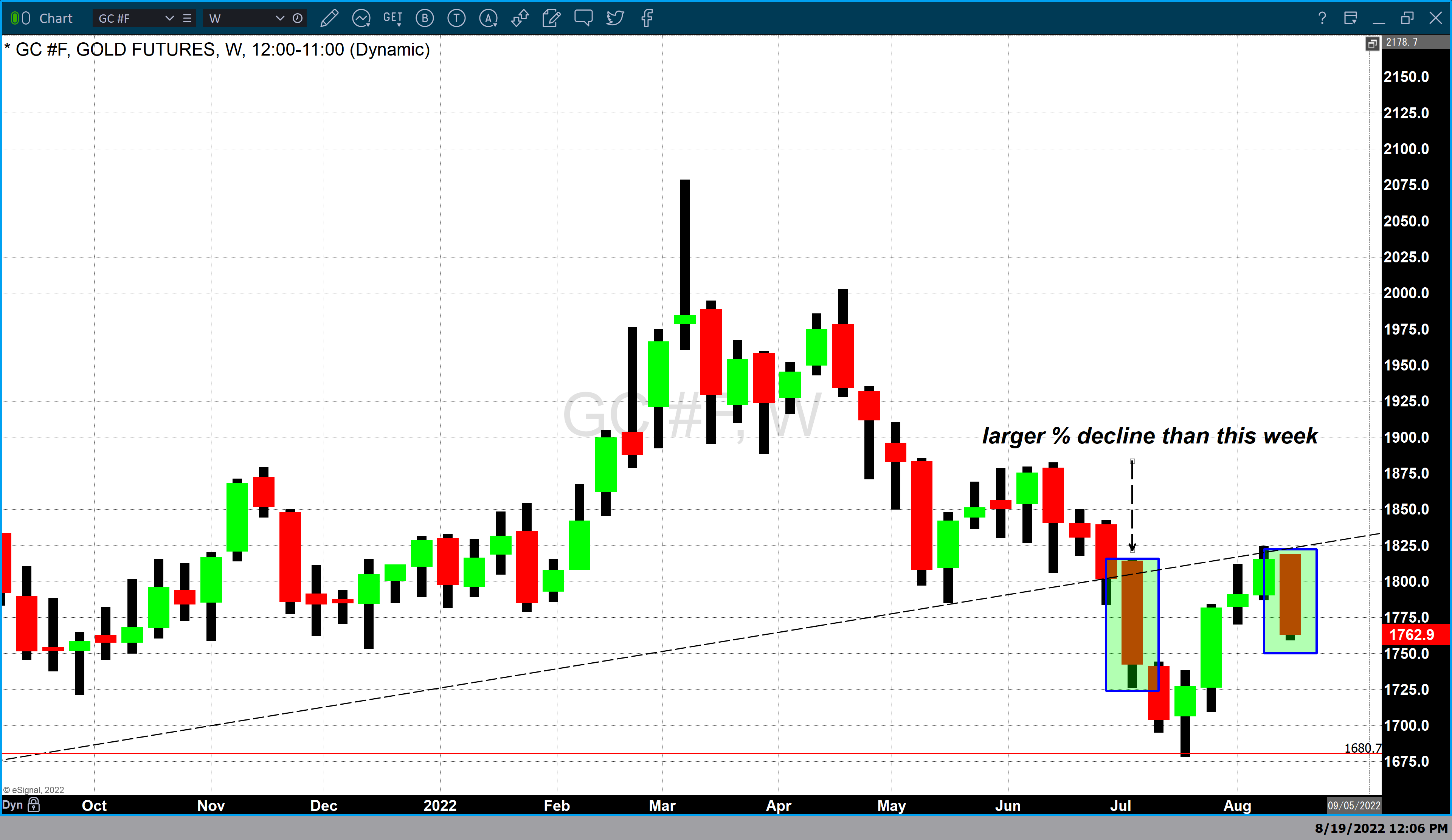
Last Monday, August 15 gold opened at approximately $1816 per ounce and scored strong price declines over the last five consecutive days, characterized by four lower highs, and four lower lows taking the most active December contract of gold futures to $1760 with under a half hour of trading before closing for the weekend.

In a single week, gold lost $56 in value. Gold sustained a price decline of approximately 3.083% over the last five trading days.

Weekly Gold Futures Chart

This is significant but certainly not extremely rare. Historically speaking we can easily identify weeks in which gold had a significant drawdown greater than this week’s price decline. Only five weeks ago, during the week of July 4 gold sustained a weekly drawdown of $71. This represents a weekly price decline of 3.861%.

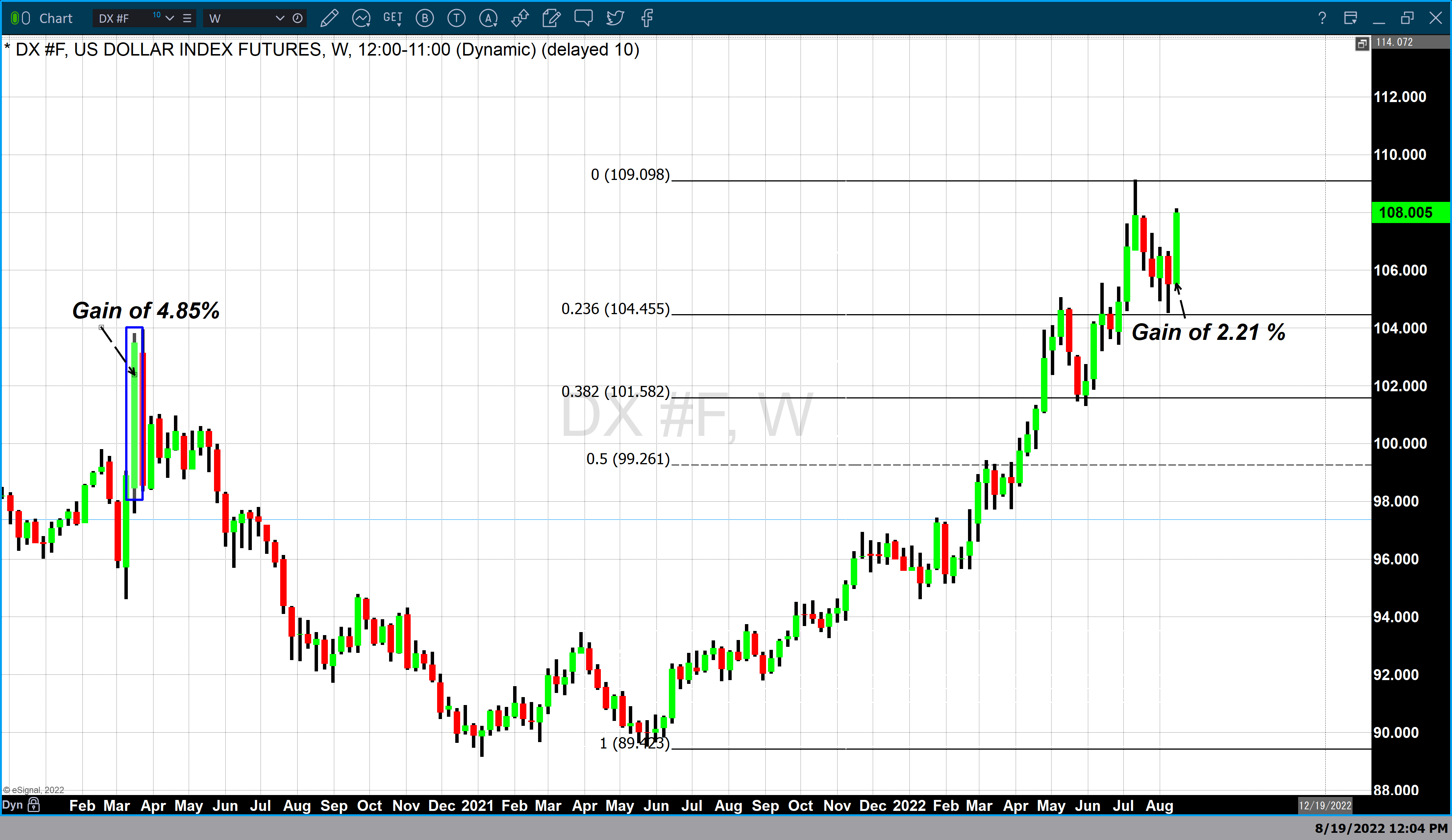
On the other hand, the gains last week in the dollar index are rare and I believe extremely significant.

Weekly DX Chart

In terms of percentage advance, gold did experience a larger percentage drop than the dollar gained. The weekly advance for the dollar index is 2.217%.

However, to identify the last instance the dollar declined this deep in a single week occurred during the week of March 16, 2020, well over two years ago. In a single week, the dollar index opened at 98.46 and closed at 103.48, a strong price advance of 502 points which is a weekly gain of 4.851% more than double last week’s gain. Continue reading "Dollar Strength VS Gold Weakness"

5 Reasons To Still Be Bearish

Please enjoy this updated version of weekly commentary from the Reitmeister Total Return newsletter. Steve Reitmeister is the CEO of StockNews.com and Editor of the Reitmeister Total Return.

Click Here to learn more about Reitmeister Total Return


The recent rally in stocks (SPY) has been impressive. But it is still officially a bear market and there are 5 reasons that bears will not be waving a white flag soon. Lets review why stocks rallied… why they are likely to stall at this level… and the 5 reasons why the bearish argument will likely win the day.

Stocks have been rising nearly unabated for 2 months. A lot of that was because it was easy for stocks to “climb the wall of worry” created by the initial decline into bear market territory.

Meaning that it was fairly easy to find just enough silver linings or things not going as bad as advertised for stocks to bounce from that recent bottom. However, as we are finding out now… all good things must end.

Meaning that investors finally found resistance at the 200 day moving average of the S&P 500 (SPY) at 4,326 and retreated quickly from that mark into the finish line on Tuesday. Expect this level to denote the near term highs for the market as we likely enter a consolidation period with trading range to follow.

Why? And what is the parameters of this trading range? And what will cause us to break out of the range?

Market Commentary

Technically speaking… we are still in a bear market. That certainly is confusing to many investors given several weeks of upward price action. So let me spell it out for y’all.

The definition of a bull market is when you come out of a bear market and have risen 20% from the bottom. Well the recent bottom for the S&P 500 (SPY) is 3,636.87 and yet yesterday we closed at 4,305.20 which is 18.38% above the lows. Continue reading "5 Reasons To Still Be Bearish"

Chesapeake Energy All in on Natural Gas

Forget oil—the real money is in natural gas.

Or at least that’s the message coming from a pioneer of the U.S. shale revolution, Chesapeake Energy (CHK).

From Prince to Pauper to Prince Again?

Once upon a time—when its stock was valued at more than $35 billion and its CEO, Aubrey McClendon, had the biggest pay package of any CEO of a listed firm—Chesapeake Energy was America’s best-known fracker.

But those glory days disappeared quickly, and Chesapeake became the poster child for the shale sector’s excesses.

About a year and a half ago, in the autumn of 2020, Chesapeake was in the midst of bankruptcy proceedings after the coronavirus pandemic-led crash in energy demand proved to be the final straw in the company’s fall from grace.

And for the industry more broadly, the prospects for liquefied natural gas (LNG) exports were looking bleak after a $7 billion contract to supply the French utility Engie went down the tubes on concerns over the emissions profile of U.S. natural gas.

Fast forward to 2022 and the picture has changed dramatically. Natural gas exports are booming!

Thanks to the Russian invasion of Ukraine and subsequent sanctions, Europe is in the middle of an energy crisis. It is buying up as much American LNG as it can. Those concerns about emissions are long forgotten.

In the first four months of the year, the U.S. exported 11.5 billion cubic feet a day of gas in the form of LNG, an 18% increase from 2021. Three-quarters of those exports went to Europe. And European leaders have pledged to ratchet up their imports by the end of the decade. There is also a massive opportunity in Asia, where LNG demand is set to quadruple to 44 billion cubic feet a day by 2050, according to a recent report released by think-tank, the Progressive Policy Institute.

And even here in the U.S., natural gas supplies look set to be tight this winter. Hot summer weather and high demands for power generation are sucking up supplies and leaving storage precariously low. Continue reading "Chesapeake Energy All in on Natural Gas"