Two ETFs Set To Gain The Most In May

Editor’s Note: Our experts here at INO.com cover a lot of investing topics and great stocks every week. To help you make sense of it all, every Wednesday we’re going to pick one of those stocks and use Magnifi Personal to compare it with its peers or competitors. Here we go…


It was an outstanding month for inflows into exchange traded funds (ETFs) in March.

Flows into ETFs almost tripled to $62.1 billion last month—with the bulk of the money heading into safe assets like government debt—as investors sought shelter from the recent banking crisis.

Developed market government bond ETFs soaked up a record $33.2 billion of the money, eclipsing the previous monthly peak of $27.4 billion set in May 2022, according to data from BlackRock.

Todd Rosenbluth, head of research at consultancy VettaFi, told the Financial Times, “In March, while net inflows to ETFs were strong, nearly all of the money U.S. ETFs gathered was in fixed income ETFs, led by Treasury products, as investors sought safety amid the banking crisis and the uncertainty of the Federal Reserve’s next move.”

It was interesting to note how expectations of two interest rate cuts by the Federal Reserve that might come later in 2023 affected the ETF flows. Investors betting on this would gravitate toward longer-term Treasuries versus those (like me) that prefer the safety of shorter-term Treasuries.

The $28.6 billion of net inflows into U.S. Treasury bond ETFs was divided almost equally between those focused on the short end, middle, and long end of the yield curve.

This divergence in views was visible in iShares 7-10 Year Treasury ETF (IEF), which gathered $6.1 billion in March. Meanwhile, at the other end of the maturity scale the SPDR Bloomberg 1-3 Month T-Bill ETF (BIL) pulled in $3.8 billion according to VettaFi data. And the iShares US Treasury Bond ETF (GOVT), with an effective duration of 6.3 years, was just behind at $3.7 billion.

Let's do a comparison of the two ETFs on the two duration ends of the yield curve - BIL and GOVT - over the past very volatile year. The quick and easy way to do this to ask Magnifi Personal to run the comparison for us. It’s as simple as asking this investing AI to “Compare BIL to GOVT.”

Not surprisingly, BIL is vastly superior. Not only is it less volatile, but the return was superior. Continue reading "Two ETFs Set To Gain The Most In May"
Bull or Bear or Neither?

Please enjoy this updated version of weekly commentary from the Reitmeister Total Return newsletter. Steve Reitmeister is the CEO of StockNews.com and Editor of the Reitmeister Total Return.

Click Here to learn more about Reitmeister Total Return


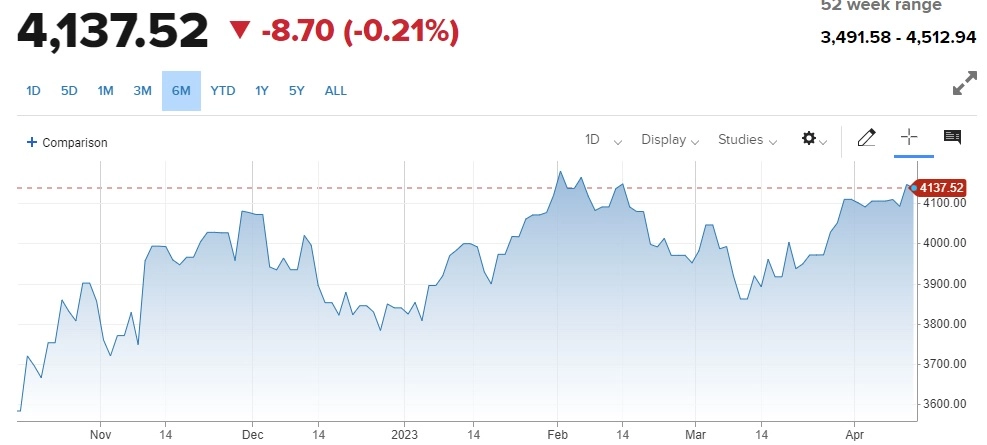
Six months ago, stocks made fresh lows of 3,491. Since then, we have seen a hefty bounce to our current `perch at 4,137.

So are we in still in a bear market…or has the new bull emerged?

That vital discussion, along with our trading plan with top picks, will be at the heart today’s commentary.

Market Commentary

Technically speaking we are still in a bear market. That is because the definition of a new bull market is when the S&P 500 (SPY) rises 20% from the lows. Here is that math:

3,491 October Lows x 20% = 4,189

However, some will say that was only an intraday low and more appropriate to measure based upon the closing low of 3,577 set on October 12. That would mean stocks would need to break above 4,292 to be considered in bullish territory.

The point is that we are getting closer to a bullish breakout. Yet where we stand at this precise moment is a state of limbo which is what creates a trading range.

One could say it’s as wide as the recent lows of 3,855 up to 4,200. But I think most of the near future will be spent in a tighter range of 4,000 to 4,200.

SP500 Continue reading "Bull or Bear or Neither?"

How To Profit Now That Gold Is Back

Editor’s Note: Our experts here at INO.com cover a lot of investing topics and great stocks every week. To help you make sense of it all, every Wednesday we’re going to pick one of those stocks and use Magnifi Personal to compare it with its peers or competitors. Here we go…


Investors are betting on further increases in the price of gold after it touched a 12-month high in late March.

The reasons are twofold: first, the Federal Reserve’s cycle of interest rate rises appears to be over (despite oil rising again), and second, gold makes for a safe haven during banking sector turmoil.

Aakash Doshi, head of commodities for North America at Citigroup, told the Financial Times there had been a surge in investor activity in recent weeks. “The big catalyst has been the stress in the regional banking system in the U.S.… [and] it has been pretty much one-directional buying,” he said.

March was set to be the first month of net inflows into gold ETFs for 10 months. In addition, the volume of bullish options bets tied to gold funds has approached record levels.

Call options are a bullish bet that give investors the right to buy assets at a set price at a later date. By late March, the five-day rolling volume of call options on the SPDR Gold Trust ETF (GLD) had surged more than five-fold since the start of the month.

There was a similar increase in interest in CME’s gold futures and options tied to them, including deep “out-of-the-money” options, which would only pay out if the gold price hits new all-time highs.

And it’s not smaller investors or speculators jumping onto the gold bandwagon. Over the past few years, a key source of demand has been central bank buying. Between 2020 and 2022, central bank purchases went up 4.5 times!

Financial advisors sometimes recommend having some gold as an insurance policy against financial markets calamities.

So, let’s say you do want to add some gold to your portfolio. Then you face the choice between whether to go with a physical gold ETF or with an ETF that focuses on gold stocks.

Our colleague Serge Berger discussed this recently — is physical gold better, or gold stocks? Continue reading "How To Profit Now That Gold Is Back"

Weighing Two Drug Titans Against Each Other

Editor’s Note: Our experts here at INO.com cover a lot of investing topics and great stocks every week. To help you make sense of it all, every Wednesday we’re going to pick one of those stocks and use Magnifi Personal to compare it with its peers or competitors. Here we go…


According to recent reports, the World Health Organization (WHO) may for the first time include drugs that combat obesity on its “essential medicines list,” which is used to guide government purchasing decisions in low- and middle-income countries.

This will only add to the buzz around these drugs, which is approaching the levels surrounding artificial intelligence (AI) and chatbots like GPT-4.

Despite the hype, we believe investors are right to be excited about the drugs.

These drugs will find a quickly growing market from expanding waistlines. That’s because obesity is growing in tandem with rising global prosperity. A bad side effect of prosperity is that consumption of not-so-healthy foods rises a lot, as does the prevalence of occupations requiring less physical work.

Obesity already affects about 650 million people around the world. America’s waistline is among those rapidly expanding—almost half of Americans will be obese by 2030, a Harvard study found. It also estimated that about 18% of healthcare spending would then go to related conditions of obesity.

No wonder, then, that Morgan Stanley thinks the market for weight-management medicines could reach $54 billion in just seven years—with $31.5 billion of this from the U.S. alone.

Companies behind the new obesity drug treatments are flying high:

Novo Nordisk (NVO) — the dominant player in diabetes treatments — generated $2.4 billion in sales from obesity treatments last year. And it has barely started to widely distribute its new obesity drug, Wegovy. Its shares are up 43% over the past year, and 15% year-to-date.

Eli Lilly (LLY), whose diabetes drug, tirzepatide, should get regulatory approval to treat weight loss this year, has seen its stock price rise 17.5% over the last year, although it is down 7% year-to-date.

So, we thought we’d do a comparison of the companies. The easiest way to do that is to ask Magnifi Personal to do it for us. It’s as simple as asking this investing AI to “Compare NVO to LLY” and selecting a three-year timeframe. Continue reading "Weighing Two Drug Titans Against Each Other"

When Will The Balloon Pop Again?

Please enjoy this updated version of weekly commentary from the Reitmeister Total Return newsletter. Steve Reitmeister is the CEO of StockNews.com and Editor of the Reitmeister Total Return.

Click Here to learn more about Reitmeister Total Return


By far the most popular article I have written in years was from last week because it crystalized what so many of us are feeling. Here it is again:

The WORST Stock Market Ever!

Unfortunately, everything said then is just as true now. That being that the only trend is NO trend. And that is true even after a few solid days in the plus column.

Gladly, we can add a few key updates to help us plot our trading plan for the days ahead. That is what is in store in this week’s commentary below…

Market Commentary

Let’s start with a helpful analogy that will frame our discussion today. And that is to appreciate that the stock market is quite similar to a helium balloon.

Meaning that its natural state is to float higher unless it is being held down by a stronger, negative force that pushes it lower.

Please read that again so it sinks in.

Now if we pull back to the big picture, we can easily appreciate that state of floating higher is true because 85-90% of investment history is framed by bullish conditions where going up is more likely than going down. However, we find this picture to also to be the case during bear markets when negative events are removed.

Consider the start of the year…how the market climbed day by day in January. Perhaps it was because there was really nothing negative to hold stocks down. Continue reading "When Will The Balloon Pop Again?"