Forex Currency Pairs: How to Choose the Right One Right From the Start

As many countries there are that have their own currency, there are currency pairs to trade. This does not mean you should start off studying the movements of the Guatemalan Quetzal. New traders need to stick to those currencies whose indicators and movements have been well documented.

The three major currency pairs are the EUR/USD, GBP/USD and USD/JPY. If you didn’t already notice, the US dollar is listed in each one. That’s because this it the most traded currency in the market, and the one that has been studied at length.

There are three very good reasons why you should stick with these three currency pairs:
• All of them are well established currency pairs that are traded widely. This type of liquidity guarantees that you are going to profit from price changes.
• They all have the US dollar, which means that the most amount of activity will be during the New York trading hours. This adds to the liquidity as this is typically when the highest amount of Forex trading is taking place.
• Since they are so popular, a new trader is going to find a wealth of Forex trading systems online that can help them in trading these pairs successfully.

Which Ones Should You Avoid?

Any currency that is considered to be exotic or uncommon should be avoided by new traders. In some instances the financial state of the country is too unstable to be able to read the charts properly. For others, there just is not enough information available to you. A new trader needs to use as many resources as possible before placing a trade. Unless you have some first hand knowledge of Guatemala and its future financial state, you should stay far away from trading the uncommon currencies.

Focus your attention instead on the: Continue reading "Forex Currency Pairs: How to Choose the Right One Right From the Start"
Forex Trading: Perspective, Trends & Finding New Opportunities

Jim Martens shares key insights into trading currencies with the Wave Principle

By Elliott Wave International

In this brand-new video interview, EWI Senior Currency Strategist Jim Martens shows you his approach to the forex markets -- and how the "simplicity" of Elliott wave analysis has guided him through 23 years of forecasting.

Watch this new interview -- and follow the link below the video to learn how to get a full week of his currency forecasts - FREE - during Forex FreeWeek (Nov 4-11).

EWI's World-Famous Forex FreeWeek, Nov. 4-11

Join thousands of your fellow Elliott wave fans from around the globe during EWI's Forex FreeWeek.

Forex FreeWeek is a 7-day event where you get unrestricted, 24/7 access to intraday, daily, weekly and monthly forecasts -- including charts and videos from our premium-grade Currency Pro Service.

Currency Pro Service's team of four currency experts brings you forecasts for these popular FX pairs:

  • EUR/USD
  • USD/JPY
  • GBP/USD
  • USDX, the Dollar Index
  • More...

Get your free password for Forex FreeWeek now >>


This article was syndicated by Elliott Wave International and was originally published under the headline Forex Trading: Perspective, Trends & Finding New Opportunities. EWI is the world's largest market forecasting firm. Its staff of full-time analysts led by Chartered Market Technician Robert Prechter provides 24-hour-a-day market analysis to institutional and private investors around the world.

Let's Take A Look At The Currency Markets

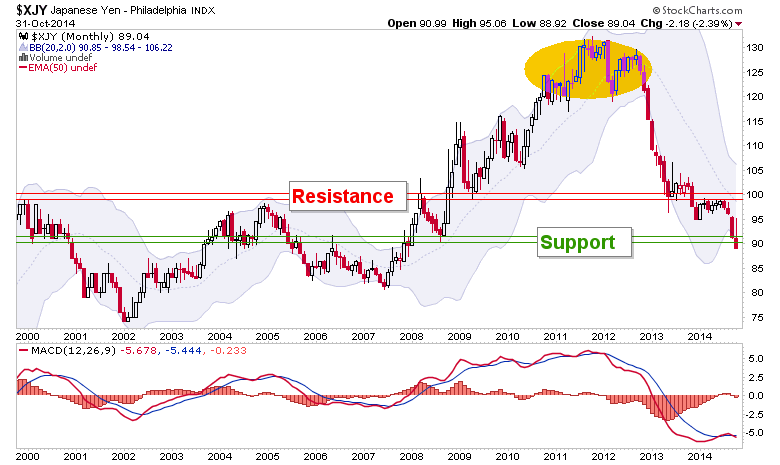
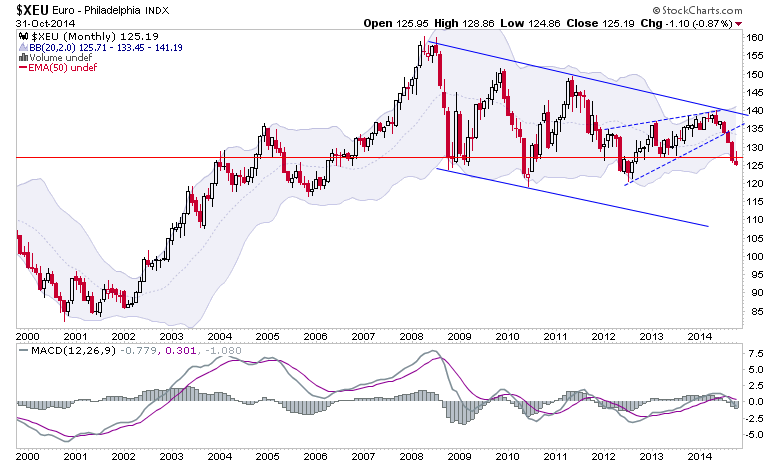
In light of the news from the land of the rising sun and the sinking currency, let’s reserve NFTRH 315’s only real charting for a big picture monthly view of currencies, to which we usually give just a brief update, and then some misc. big picture monthly charts [not included in this excerpt] as we try to gain perspective on things that may seem illogical to our rational minds.

xjy

Yen is losing the next level of support.  BoJ saw that support too. I’ll bet they also took note of the big October bounce and found it unacceptable.

xeu

The Euro is losing the support zone after bouncing above it in-month. Continue reading "Let's Take A Look At The Currency Markets"

In the Week Ahead: Is A Market Bottom Finally In Place?

By: John Kosar of Street Authority

All major U.S. stock indices finished in positive territory last week, for only the second time since Aug. 29, led by the Russell 2000, which gained 4.9%. This is good news for the market as small-cap stocks have lagged in a big way all year. The Russell 2000 is up just 0.9% year to date compared with 15.8% for the tech-heavy Nasdaq 100 and 9.2% for the broad market SP 500.

Another good sign is that, despite the Federal Open Market Committee (FOMC) announcing the end of its bond-buying program on Wednesday, the SP 500 rose by an additional 1.7% into Friday's close. This suggests that, despite a lot of investor apprehension beforehand, the market ultimately interpreted the Federal Reserve's action as evidence that it believes the U.S. economy is finally strong enough to stand on its own two feet.

From a sector standpoint, last week's rally was led by technology, up 3.3%, and financials, up 3.2%. This is another good sign for the overall market between now and year end as these sectors typically outperform amid expectations for a strengthening U.S. economy.

Technology Stocks at a Key Inflection Point

In the Aug. 25 Market Outlook, I discussed an important overhead resistance level at 4,147 in the Nasdaq 100. I said, "Major benchmark highs like this one are seldom meaningfully and sustainably broken without at least a multi-week corrective decline first."

The index peaked three and a half weeks later, at 4,119 on Sept. 19, and then subsequently declined by 10.2% into the Oct. 15 low. The SP 500 declined by 9.8% during the same period.

The Nasdaq 100 managed to edge slightly above 4,147 last week, which represents the September 2000 benchmark high, closing at 4,158 on Friday.

The more time this market-leading index spends above 4,147, the more likely that a major breakout is emerging that would clear the way for a continued rise into year end.

Investors Breathing a Sigh of Relief Continue reading "In the Week Ahead: Is A Market Bottom Finally In Place?"

Don't Get Ruined by These 10 Popular Investment Myths (Part VI)

Interest rates, oil prices, earnings, GDP, wars, peace, terrorism, inflation, monetary policy, etc. -- NONE have a reliable effect on the stock market

By Elliott Wave International

You may remember that after the 2008-2009 crash, many called into question traditional economic models. Why  did they fail?

And more importantly, will they warn us of a new approaching doomsday, should there be one?

This series gives you a well-researched answer. Here is Part VI; come back soon for Part VII.

Myth #6: "Wars are bullish/bearish for stocks."

By Robert Prechter (excerpted from the monthly Elliott Wave Theorist; published since 1979)

... If the stock market is not reflecting macroeconomic realities, what else could it possibly be doing? Well, how about political news? Maybe political events trump macroeconomic events.

It is common for economists to offer a forecast for the stock market yet add a caveat to the effect that "If a war shock or terrorist attack occurs, then I would have to modify my outlook."

For such statements to have any validity, there must be a relationship between war, peace and terrorist attacks on the one hand and the stock market on the other. Surely, since economists say these things, we can assume that they must have access to a study showing that such events affect the stock market, right? Continue reading "Don't Get Ruined by These 10 Popular Investment Myths (Part VI)"