Allow me to share with you this free mini-email trading course

Hello,

My name is Adam Hewison. You might want to Google Me to confirm what I am about to share with you.

There are plenty of people out there that create "exclusive email courses" with little or no credentials to actually backup their teachings. So, I think it's right that I share a little bit about myself with you before we even start.

I was a former floor trader on the IMM, IOM, NYFE and LIFFE as well as a risk manager of a large, multinational corporation in Geneva, Switzerland. I also have written books on forex trading and trend following. In 1995, I founded INO.com and later co-founded MarketClub. I've been in the trading biz for over three decades and have seen it all. I created this course as a way to give back and share trading tips and techniques that I still use in my trading today.

In my Free Mini Email Course, I will show and explain the tools and strategies you need to increase your success rate in the marketplace.

Here's just a small sampling of what you'll learn in this course:
Get the <a href="http://www.widgetbox.com/widget/adam-hewisons-mini-email-course" mce_href="http://www.widgetbox.com/widget/adam-hewisons-mini-email-course">Adam Hewison's Mini Email Course</a> widget and many other <a href="http://www.widgetbox.com/" mce_href="http://www.widgetbox.com/">great free widgets</a> at <a href="http://www.widgetbox.com" mce_href="http://www.widgetbox.com">Widgetbox</a>!

(1) The importance of psychology in price movement (2) How to spot mega trends (3) Understanding of technical price objectives (4) How to picture price objectives (5) How to trade with moving averages (6) How to use point and figure trading techniques (7) How to use the RSI indicator (8) How to correctly use stochastics in your trading (9) How to use the ADX indicator to capture trends (10) How to capitalize on natural market cycles.

Plus, you will you will learn all about fibonacci retracements, MACD, Bollinger Bands and much more. Just fill out the form and we'll get you started right away.

Every success,

Adam Hewison

President, INO.com & Co-Creator, MarketClub

The biggest secret to successful trading

The biggest secret to successful trading is ...

Trading Discipline

Emotions are probably the biggest obstacle any trader has to overcome. Many traders become losers because they can't follow a plan. They see a couple of losses, get excited, abandoned the plan and start to take wild shots at the market.

Traders who develop a sound set of trading rules that match their financial situation with their objectives, and then stick with those rules, increase their chances of becoming big winners. Trading discipline can be more important than your trading system.

Discipline means you must become mechanical in making trades when certain price actions occur. You must shut off your emotions, and not accept one trading signal over another. Disciplined traders let profits run and keep losses short by following rigid guidelines.

Again, discipline does not mean you will have perfect results. If you've select a diversified portfolio, you know that you can expect losses in some markets. Yet, discipline forces you to trade the whole portfolio and keep you from second guessing your system. If you have a training system that's proven successful, discipline may be the only thing you need to get profitable returns.

Note these concepts all work together - you can't have the right trading system and no discipline, you can't select the right trade without the right system, you can't diversify without having adequate capital, etc. If you adhere strictly to all of these rules of money management, trading may not be as glamorous as you probably thought it would be.

However, by using sound money management techniques, you spread out your risk and take a conservative approach aimed at getting 25-50% returns on your investments, year in and year out. That's a good return on investment in anybody's book, and that's the approach any new trader should take towards markets.

Adam Hewison

President, INO.com

Co-creator, MarketClub

“Saturday Seminars” - The Wycoff Method

In this session, you will gain a comprehension of how mass psychology in action creates the shape of a conceptual framework for technical market analysis. Hank emphasizes an appreciation for the cause and effect linkages among price, volume, time, and sentiment and explains how these factors combine to form stages of accumulation, markup, distribution and markdown. You will have a further sensitivity to the value of trading ranges and divergence and develop an understanding of the critical need for selecting between a trend-following system and a trend-fading system.

This workshop provides you with a unique opportunity to learn the principles of the Wyckoff Method of technical analysis and trading. You will learn to combine the technical tools you already use with an entirely new perspective on market behavior, enhancing both your technical trading skills and your ability to judge critical trading situations. You will learn to concentrate your analysis on three essential factors: tick-volume or volume (the intensity of trading), the relationship between price movement and volume, and the time required for all the movements to run their respective courses. The information derived by using a volume or tick-volume approach can directly influence your day-to-day decision making process. It will enhance your awareness of the market’s real strengths or weaknesses.

Hank Pruden is a professor in the School of Business at Golden Gate University in San Francisco, where he has been teaching for twenty years. He is also the executive director of the Institute of Technical Market Analysis (ITMA). At Golden Gate, he developed the first accredited courses in technical market analysis in 1976. Since then, the curriculum has expanded to include advanced topics in technical analysis and trading. In his courses, Hank emphasizes the psychology of trading as well as the use of technical analysis methods, and he has published extensively in both areas. Hank is more than a theoretician. He has actively traded his own account for the past twenty years. His personal involvement in the market ensures that what he teaches is practical for the trader and not just abstract academic theory. Hank has coached institutional traders in the field of technical analysis for many years. He is presently on the board of directors of the Technical Securities Analysts Association of San Francisco and was formerly president of that association. Hank also sits on the board of directors of the Market Technicians Association (MTA). The MTA is the world’s leading association for the dissemination of technical analysis information. The MTA’s sister organization, the IFTA (International Federation of Technical Analysts), certifies analysts worldwide. Hank edits The Market Technicians Association Journal, the premier publication of technical analysts. From 1982 until 1993, he was a member of the board of trustees of Golden Gate University.

Saturday Seminars are just a taste of the power of INO TV. The web’s only online video and audio library for trading education. So watch four videos in our free version of INO TV click here.

INO TV

Trade the market and not the economy.

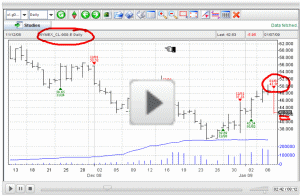
What do I mean when I say... trade the market and not the economy? It may sound like I'm saying to trade the same thing... but in many cases they're different. The difference is that the market is driven by fear and greed, while the economy is driven by fundamentals. Our "Trade Triangle" technology allows us to analyze the market... leaving the fundamentals and our own emotions at the door. Let's look at some of the major markets and see which direction the trend is headed:Crude Video

* The equity markets are still in a negative trend.

* Crude oil is still in a negative trend.

* Gold is in an erratic upward trend.

* The dollar is also in an erratic upward trend.

All of these markets are still in entrenched trends and there is no reason to suggest that they will be reversing anytime soon.

I have just finished a short video on crude oil (NYMEX:CL). This market is making moves, which I will tell you all about using the "Trade Triangle" technology which I helped to create.

We recently received a trading signal in this market which I think is an important one. You will also get a chance to see several of the previous signals that were issued. The video is definitely worth watching for that benefit alone.

Watch Video Here

The silly season which we talked about in December is rapidly coming to a close. I would expect that the volume and liquidity will return to the markets by the 15th of January. So get ready... cause there is money to be made.

Enjoy the video and by all means, give us a call at 1-800-538-7424 if you have any questions about the video.

Many thanks,

Adam Hewison

Adam Hewison
President, INO.com
Co-creator, MarketClub

The secret to trading success in 2009

This little trading tip can and will make a difference in your trading results in 2009.

Stops are enormously important part of a traders arsenal of trading tools. Some traders confirm that stops are the most important part of their trading armour.

So here are three ways to use stops to protect your capital and lock in profits from a trade. These three money management techniques can be used in stock, futures and forex trading.

The important rule is that you do use a real stop in the marketplace. A friend of mine joked with me that that he had never seen a "mental stop" filled in the pits.

If the market is good your stop will not be hit. If the market is bad or changing direction then you'll want to be out of it anyway. That is why stops are so crucial to trading success.

Here are the three most commonly used types of stops. Which one do you use?

(1) Dollar stop.
(2) Percentage stop.
(3) Chart stop.

If you chose (1) you'd be correct, but, you would also be correct if you had chosen 2 or 3. All three are money management stops and are used to either lock in profits or protect capital.

--------------------------------------------------

1) A dollar stop, is when you set a predetermined dollar amount to a trade. Let's say you want to risk $500 on a grain trade or $750 on a stock trade. Once you get your fill back from your broker or electronically online you simply figure from your fill price where to put your stop.

Pros: Easy to implement and use.
Cons: Can place stops too close in a volatile market

--------------------------------------------------

2) Percentage stop, is a very simple way for you to place a stop on a position. Here's how it works. Let's say your trading account is 100,000 dollars and let's say you only want to risk 1% of your total portfolio on any one trade. You simply take a $1,000 risk which represents 1% of your over all portfolio. This can help enormously in avoiding taking BIG LOSSES. A 1% loss is easy to absorb. A 30% or 40% loss in a trade is an account killer, and should be avoided at all costs.

Pros: Easy to implement and use.
Cons: Can place stops too close.

--------------------------------------------------

3) Chart stop, a chart stop is where you place a stop that is either above or below a crucial chart level. The good thing about a chart stop is that this level is often used by other traders. That can both be a good thing and a bad thing, here's why. Using either one of our first two examples only you know where the stop is. With a chart stop, a great many traders/brokers know that is where the stops are. In an illiquid market this type of stop should not be used, as many times brokers gun for the stops. In a highly liquid and active market this is a good stop to use.

Pros: Very easy to implement and use.
Cons: Can't be used in thinly traded markets.

--------------------------------------------------

So there you have it. Now you have all three ways to manage your money and protect your profits in 2009.

Use stops…let them work for you.

Have a great 2009.

Adam Hewison