Don't Let Fear of a 'Grexit' Keep You Out of European Stocks

By: Joseph Hogue of Street Authority

After nearly three years of extremely weak economic growth, the European Central Bank is finally delivering on Mario Draghi's pledge to do "whatever it takes" to get the region back on track.

The central bank is set to pump $64 billion into the economy through monthly bond purchases through September 2016. The quantitative easing program, alluded to in September, formally announced in January and started on March 9, may already be having an effect on the economy in terms of sentiment.

Q4 GDP growth of 0.3% beat expectations, and manufacturing data showed signs of life in March. Exports to the United States could get a big boost this year on a massive depreciation in the euro versus the U.S. dollar.

All things considered, I would say it could be a very good year for European stocks, and possibly most of 2016 as well.

There is one fly in the ointment. Greece is back in the headlines as officials were said to have informally approached the IMF to delay repayment on the country's debt but were denied. Thanos Vamvakidis, head of European G10 FX strategy at BofA Merrill Lynch Global Research, said the country may run out of money if a reprieve is not granted at the meeting of eurozone finance ministers on April 24.

How do we act on what could be a great opportunity in European stocks without running the risk that a "Grexit" wipes out returns? Continue reading "Don't Let Fear of a 'Grexit' Keep You Out of European Stocks"

6 Lessons To Conquer Any Market

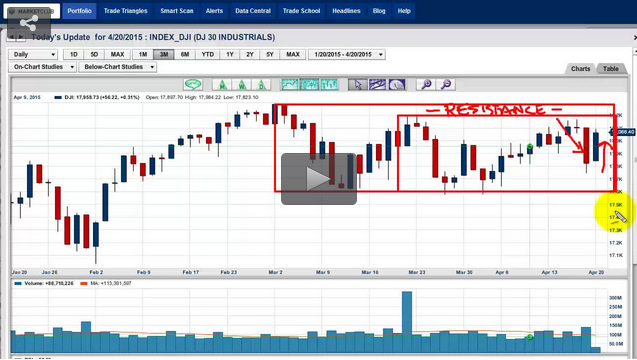
Hello traders and MarketClub members everywhere. Today, I would like to do something a little bit different and welcome all of our new members. We have had a tremendous influx in the last few months and we want to get you started on the right foot with these 6 lessons.

So on behalf of our company INO.com, the parent of MarketClub, welcome. We want you to get the very most out of MarketClub in the future. Our mission is to help coach, guide and share with you a successful pathway to profits. With that goal in mind, we have 6 lessons for you that will help you conquer any market.

The lessons are the real deal and they were learned the hard way in the trading pits of Chicago, many years ago when I was a floor trader. These are the universal truths of the marketplace and have not changed, nor will they change, as they reflect human nature and how we act as individuals. So let's get started, our first lesson has to do with drawing a simple, straight line.

LESSON 1: Trend Lines
In this lesson, I will show you the correct way to draw trend lines and how to use them successfully in any market.

Continue reading "6 Lessons To Conquer Any Market"

The Brazilian Real: From Bad To Ugly

Lior Alkalay - INO.com Contributor - Forex


Over the past two years, it seems, Brazil has remained in the headlines for the very worst of reasons – corruption. In fact, the very latest scandal at Petrobras, the state owned petroleum giant, reached all the way to its upper echelon. Long gone are the days when the Brazilian government was praised for its fiscal discipline; the situation there has become so notorious that the name Brazil, it seems, has become synonymous with corruption. And as if this were not bad enough the country's main exports, which range from iron ore to agricultural goods, have tumbled in crisis. Yet, as investors, we always seem to intuitively look at the bright side of even the worst situation; in this case, we have thoughts of buying because when the situation is as bad as it is, we think, from here on out, that the situation can only get better. The Brazilian economy is basically at a standstill with a weak government at the helm, and there is one corruption scandal seemingly after another, and given the softness in commodities' prices the question that investors want an answer to is this: is the collapse in the Brazilian Real over?

A Broken Banking System

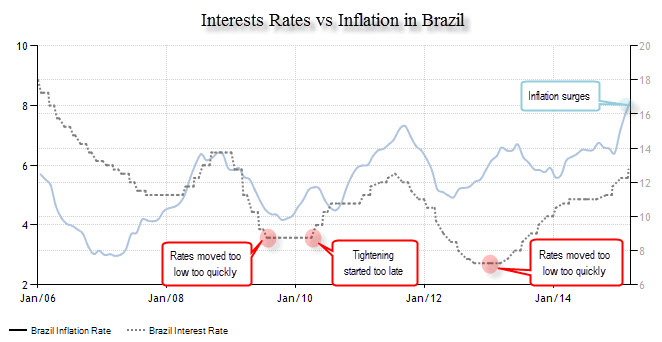
While many see corruption as the core problem in Brazil, this writer thinks the true core and the basis of the problem is, in fact, rooted in the country's banking system and at its heart, with Brazil's central bank, the Banco Central do Brasil. While reforms in the country are key for future growth it is the credibility of its central bank that is key for the Real, and as the chart below reveals, credibility is sorely lacking.


Chart courtesy of Tradingeconomics.com

The central bank has marked the 4.5% as the desired target for inflation. Yet the Brazilian central bank, generally amid political pressure to spur growth, has always eased policy prematurely and too aggressively. However, when it comes to tightening, the fact is the central bank doesn't apply those same standards. When in 2009 inflation peaked, rates were cut quickly, to as low as 8.75%, and left unchanged for several months. Soon after, though, inflation spiraled out of control once again, above 7%. And yet again, the Brazilian central bank was behind the curve, tightening too slowly and allowing inflation to move outside its targeted range. Once inflation slowed to 4.91% the central bank once again cut rates, this time even more aggressively than before, and the results were not pretty. As seen in the chart, inflation was soon out of control, to the extent that the latest reading on inflation hit 8.13%, once again spurred on by a central bank that hands out rate cuts much too easily. Continue reading "The Brazilian Real: From Bad To Ugly"

How I See The Week Ahead

Last Friday's 1.5% drop in the major indices certainly was a surprise to a lot of people, but was it predictable? The answer has to be yes and no, here's what I mean.

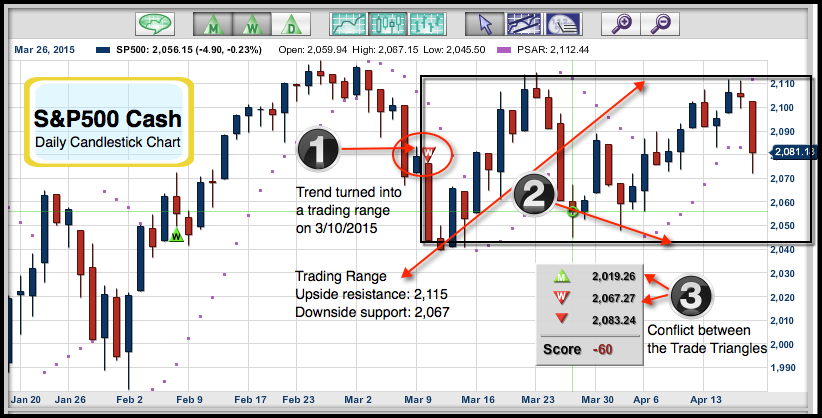
For some time now, the major indices have been moving sideways based on the Trade Triangle technology. What that means is that the monthly Trade Triangles are indicating that the long-term trend remains positive, while the weekly Trade Triangles are negative indicating the intermediate-term trend is down. That tells you there is a conflict between the Trade Triangles and that the market is in a broad trading range.

As with any trading range, you're going to see sharp upward and downward moves. So did Friday's move to the downside do anything to really change the general market? The answer has to be no because the general market is still contained within its broad trading range which I have illustrated on the chart below and in my recent videos.

Don't forget to watch today's video (that will be added later) as I will be giving you an up-to-date analysis of what is going on in the markets right now. Continue reading "How I See The Week Ahead"

Three Currencies To Watch Versus The U.S. Dollar

By: Cory Mitchell, CMT VantagePointTrading.com

In forex trading, trade with the trend. Trends last a long time and tend to go further than people expect. Those who bought the EURUSD above 1.39 less than a year ago can attest to that, with the pair having traded as low as 1.0462 in March.

The U.S. Dollar (USD) isn't just strong against the Euro; it's strong against nearly all currencies, major and minor. For trades lasing longer than a few weeks, trading on USD strength--in alignment with the trend--is still the main play.

The USDCAD, NZDUSD and USDCHF are in a slightly different position though. Trading in the direction of USD strength is still a possibility, yet it's wise to have a few pairs to trade if the USD reverses. If the USD reverses, or even sees a deeper pullback, it is likely to be showcased in these pairs first. In fact, it has already begun.

USDCAD

The USDCAD hasn't given up much ground this year (relative to many other pairs), as it channeled between resistance just below 1.2840 and support just above 1.2350. Continue reading "Three Currencies To Watch Versus The U.S. Dollar"