Breaking News: US Relaxes Crude Export Restrictions

Adam Feik - INO.com Contributor - Energies


The US Commerce Department on Tuesday announced it started on December 8th approving a backlog of requests to export certain, specific forms of processed light oil. Crude exports have been banned since 1975. Tuesday’s announcement doesn’t end the crude oil export ban entirely, but the department on Tuesday did also issue long-awaited guidelines “outlining exactly what kinds of oil other would-be exporters can ship.” (Reuters)

Reuters reported this new action “effectively clears the way for the shipment of as much as a million barrels per day of ultra-light U.S. crude to the rest of the world.” Ed Morse, global head of commodities research at Citigroup, was quoted as saying US condensate exports could rise from 200,000 bpd to as much as 1 million bpd by the end of 2015, thanks to this new regulatory change.

For now, exports of untreated crude remain banned. Refined fuels such as gasoline and diesel, though, have not been banned from selling abroad. The question has been at what point crude becomes “refined,” and thus eligible to be exported. “Processed condensate,” a semi-refined form of the product, has been a gray area. Continue reading "Breaking News: US Relaxes Crude Export Restrictions"

Is The Ruble Meltdown Over?

Lior Alkalay - INO.com Contributor - Forex


The 16th of December will be remembered by investors across the globe, and Russia specifically, as “Black Tuesday;” a day when investors got a quick and unwelcome reminder of the 1998 crisis during which Russia was bankrupted. On Black Tuesday, the Ruble tumbled by 21.1% in less than a day and hit 78.51; Credit Default Swaps (CDS) for 5 years have priced in a 8.8% chance for a Russian bankruptcy. Black Tuesday was, simply put, an utter meltdown; investors were in a panic, Russians were running to the banks and the risk of a total collapse of the Russian economy hung in the air. Yet two weeks later, as some of the chaos from that Black Tuesday began to dissipate, some stability has emerged and with it the Ruble has regained some lost ground. The two questions which beg to be asked and answered; Is it the calm before the storm or perhaps a step toward stability? As we attempt to answer these questions we will also, hopefully, shed some light on the Ruble’s possible trajectory as a consequence.

What Ignited the Chaos?

Although it is still debatable as to what exactly was the last straw, there are clearly two very big contenders. The first was Rosneft, the Russian oil giant, was effectively bailed out by the Russian State through the tapping of the country’s emergency reserves. Continue reading "Is The Ruble Meltdown Over?"

Understanding the Basics of Technical Analysis

Whether you are trading stocks or currency, technical analysis is an advanced tool used to try and predict changes in your market and trade accordingly.

At the base of technical analysis is price history. You are studying the price of a currency, it’s up and downs, and looking for an obvious indicator that will tell you when another up or down is coming up. Think of it like trying to learn to read tea leaves to see the future – except there is real science behind it.

Using Charts For Technical Analysis

The most basic tool for technical analysis is your chart or graph. Whether you are looking at a line graph or candlesticks, the Forex trading chart is giving you a wealth of information. First, you can check the support and resistance. These are the points where it seems that the currency pair won’t cross. Is there a certain range in which the currency is moving? When you see a price making sudden movements in that range you can use the support and resistance to predict when it is going to change its direction again.

Trend lines can be used when there is a definitive pattern that you can follow. You can chart the trend line if it is moving in one direction to predict where the price is going to go using indicators.

For example, let’s say you are studying a candlestick chart -which you should as they give you more indicators in one convenient place. This type of chart can help you to find trends that indicate a major reversal is about to take place. One indicator you can look for is what traders refer to as “three white soldiers” which indicate a bullish reversal is pending. Continue reading "Understanding the Basics of Technical Analysis"

Semiconductor Equipment Sector Update

By: Gary Tanashian of Biiwii.com

NFTRH 322 covered the usual range of markets, from US to global stocks to precious metals and commodities to currencies and indicators.  It also included an extended economic discussion about the realities of the strong US economy and its dangerous underpinnings.

The economic segment began with this look at the Semiconductor Equipment sector, which was our first indicator on economic strength exactly 2 years ago and will be an initial indicator on economic deceleration when the time is right.

Excerpted from the December 21 edition of Notes From the Rabbit Hole, NFTRH 322:

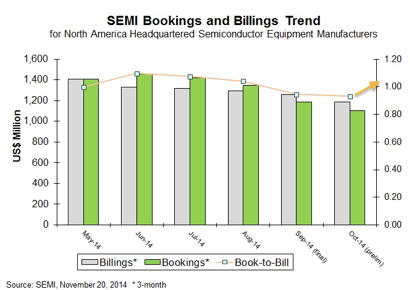
Checking the Semiconductor Book-to-Bill ratio (b2b), this all-important forward looker came in pretty decent for November.  Per the data we reviewed in an update last week, the bookings, which is the most important component, was pretty good at $1.22 Billion compared to October’s $1.1 Billion.

The graph from SEMI does not include the November data.  I added an arrow showing the current level of the b2b.

semi.b2b

Our original graph is marked up as well to show the longer trend.  There is a spike up happening and this may or may not be related to an overall year-end sales spike in some high end capital equipment that happens like clockwork at the end of each year in Machine Tools (ref. sales graph below).  I do not have the level of knowledge about the Semiconductor Equipment industry to speak authoritatively about its more structural capital spending cycles.  So this is just a possibility to consider. Continue reading "Semiconductor Equipment Sector Update"

Natural Gas Takes Its Turn At The Puke Bowl

Adam Feik - INO.com Contributor - Energies


Natural gas futures on Friday dropped below $3 for the first time since September 2012, on an intraday basis. December is now on track for the dubious distinction of producing natty’s largest one-month drop since 2008 – currently about a 26% month-to-date (MTD) decline – as producers continue churning out the commodity even while mild weather has resulted in below-normal consumption.

Crude oil, by comparison, has declined about 17% in December (MTD).

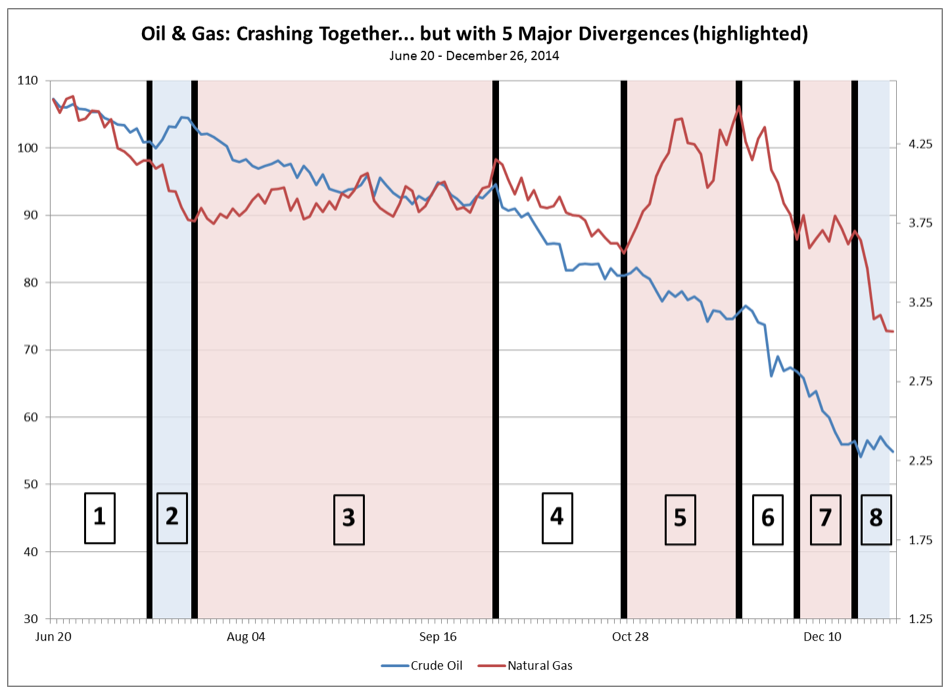
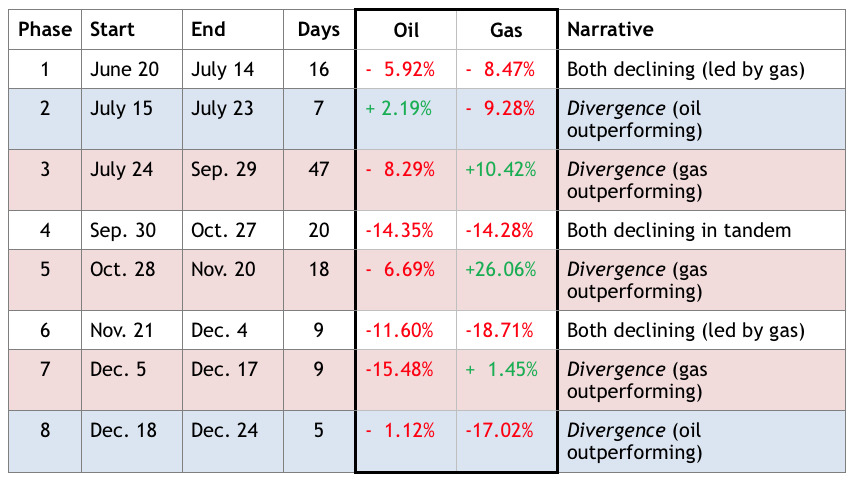
Natural gas and crude oil prices have taken turns out-dropping each other over the past 6 months. This simple graph (and accompanying chart) shows how oil and gas have crashed both together and separately for the last 6 months. What do I mean by that? Both have nosedived, but with 5 distinct periods of divergence (highlighted in blue when oil is outperforming, and highlighted in red when gas is outperforming). See for yourself:

In total:

  • Oil & gas have crashed “together” for 3 of the 8 periods, for a total of 45 trading days in which gas has generally declined more than oil.
  • Oil has “diverged” to the upside in 2 periods (highlighted in blue), for a total of 12 trading days.
  • Gas has “diverged” to the upside in 3 periods (highlighted in red), for a total of 74 trading days.

Actually, at its recent peak on Nov. 20th, natural gas prices were only a few pennies below their June 20th level; so effectively all of natty’s 2014 crash has occurred in just over 23 trading days since just before Thanksgiving.

What happened to natural gas from Oct. 28th through Nov. 20th, when it rose about 26%? Continue reading "Natural Gas Takes Its Turn At The Puke Bowl"