3 Tech Stocks Turning Negative Sentiment Into Positive Returns

With the U.S. Treasury set to exhaust its workarounds and run out of options to manage the national debt until the self-imposed debt ceiling is raised or suspended, the world’s richest economy, which also issues the global reserve currency, is projected to run out of cash and fail to meet its obligations as early as June 1.

While Treasury Secretary Janet Yellen has deemed it ‘unthinkable’ to let the U.S. default on its debt and has urged lawmakers to set their differences aside to ensure that “America should never default.”

However, with Republicans such as Donald Trump playing hardball and endorsing the notion of letting the nation default if Democrats don’t agree to spending cuts, it’s probably fair to say that Ms. Yellen’s words are going largely unheeded.

Given that the alternatives to raising or suspending the debt ceiling, like the U.S. has done almost 80 times since the 1960s, seem either unviable or unattractive, the extent to which the U.S. and global economy could be undermined if the default comes to pass would, in the words of Yellen, be an “economic catastrophe.”

With business leaders such as Jamie Dimon convening a ‘war room’ over the debt ceiling standoff, even the markets have begun pricing in the worst. The S&P 500’s net loss since the beginning of the month could only worsen further the longer the crisis drags on.

Do you see the U.S. defaulting on its debt this time?

  • Yes
  • No
  • Can’t Say

However, the sliver of silver lining that could encourage investors alarmed by the looming cloud of fat tails is that if the worst comes to pass, it would also mean a potential devaluation of the U.S. dollar.

This could be a significant tailwind for the export prospects of technology stocks, which have been under pressure due to 10 interest-rate hikes over the past year and are witnessing a watershed due to the advent of generative artificial intelligence. Continue reading "3 Tech Stocks Turning Negative Sentiment Into Positive Returns"
The Role of China in the Global Stock Market and Its Impact on Investors

Towards the end of last year, China surprised the world with an abrupt pivot away from the strict restrictions of its long-espoused “Zero-Covid” policy., including quarantine requirements for inbound visitors. Despite an initial surge in infections, global businesses rushed in, hoping to cash in on the economic recovery.

Sentiments were further boosted by steps to stimulate economic growth and domestic consumption, mapped during and around the annual Central Economic Work Conference. These steps also helped ailing Chinese developers ease their liquidity strains and revive home purchases.

These measures seem to be working. According to the data released by China’s National Bureau of Statistics on April 18, the country’s GDP grew by 4.5% in the first quarter of the fiscal year. This was better than the forecast of 4% and the highest growth since the first quarter of last year.

Six months on, while the country is still open for business, the momentum has visibly slowed. While China’s exports in April grew by 8.5%, the country’s imports declined by 7.9% year-over-year as growth in the service sector softened, and manufacturing contracted again in three months.

With the 50-mark separating growth and contraction, the Caixin/S&P Global services purchasing managers’ index fell to 56.4 in April from 57.8 in the previous month, and the Caixin China general manufacturing purchasing managers’ index fell to 49.5 in April.

China’s top leaders have also taken note. A translated state media readout of the Plitburo meeting said, “At present the positive turn in China’s economy is primarily one of a recovery. Internal drivers still aren’t strong, and demand is still insufficient.”

As a result of this patchy growth, analysts at Morgan Stanley foresee a significant dip in demand and output of Chinese steel that could result in a 28% decline in iron ore prices by the end of 2023.

With markets mirroring this moderation, Citi has pushed back its stock rebound forecasts, and its analysts expect Hang Seng to take until the end of September to reach 24,000. Continue reading "The Role of China in the Global Stock Market and Its Impact on Investors"

Cathie Woods: Bold Prediction for Tesla

Recently the renowned stock picker and Tesla (TSLA) bull made a new price prediction on the automaker, which sounds just as crazy as the last time she made a wild prediction, but the first prediction has come true, and then some.

Cathie Woods is the Founder and lead stock picker for the Ark Invest family of exchange-traded funds. Woods initially started Ark Invest in 2014 and made heavy bets on technology companies.

She became a household name when her original $2,000 price target on Tesla, when the stock was trading for around $300 per share, came true on a split-adjusted basis.

When Cathie initially made her case for Tesla at $2,000, people thought she had lost her mind. They couldn't understand how she arrived at that valuation and why she was so confident in that prediction.

Which, by the way, she was, considering she invested millions in Tesla before it went on its run higher.

Those investments in several different Ark Invest ETFs helped propel several Ark ETFs into the top ten best-performing ETFs for several years in a row.

Cathie is at it again, possibly giving investors a second chance to catch lightning in a bottle.

Cathie Woods Ark Invest owns a little more than $850 million worth of Tesla stock (stock price is currently around $170 per share). She believes the stock price can go to at least $1,400 per share by 2027.

That price is her bear case scenario, with a bull case scenario of $2,500 and a base case price of $2,000 per share. Those figures would represent an eight, eleven, and fourteen-fold return from today's price.

Furthermore, the base-case price of $2,000 per share would give Tesla a market capitalization of $6.3 trillion. For context, two of the largest companies in the world Apple (AAPL) and Microsoft (MSFT), have market caps of $2.7 trillion and $2.2 billion. At $6.3 trillion, Tesla would be worth more than both of them combined. Continue reading "Cathie Woods: Bold Prediction for Tesla"

Natural Gas: Opportunity of the Year?

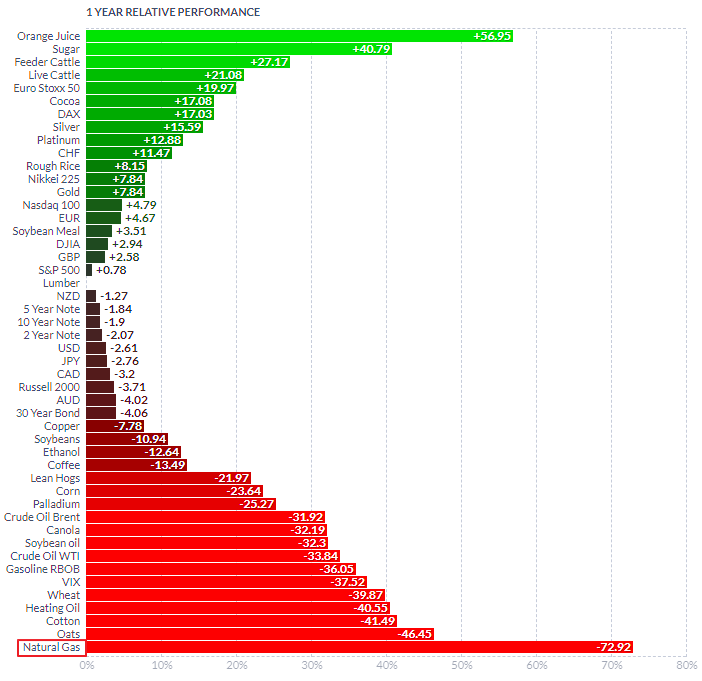
It's difficult to imagine that this energy commodity could offer a promising opportunity for profit when you observe its performance across different timeframes, including yearly, half-yearly, and even year-to-date. Below is a chart displaying its performance over the course of one year.

NG Futures 1Y Performance

Source: finviz.com

Natural gas futures have performed the worst among all commodities on the mentioned timeframes, losing 73% of their price in one year. They are almost double the percentage loss of the next worst-performing commodity, oats futures.

The chart below sheds light on the poor performance of natural gas futures. Continue reading "Natural Gas: Opportunity of the Year?"

Countdown To Catastrophe

If you believe Treasury Secretary Janet Yellen, the U.S. is headed to “an economic and financial catastrophe” if Congress doesn’t agree to increase the federal debt ceiling.

Even worse, she warned in an interview with ABC News, we are headed to a “constitutional crisis.”

You know something is purely political and not to be taken too seriously when a prominent official in Washington warns that something is a “constitutional crisis,” as if that is the absolute worst thing that can possibly happen, short of war or some other real calamity.

According to Yellen, doomsday will occur around June 1, at which time the government will purportedly be unable to pay its bills, unless the Republicans in the House knuckle under and agree to increase the debt limit.

For good measure, she wrote in a letter to Congress that “we have learned from past debt limit impasses that waiting until the last minute to suspend or increase the debt limit can cause serious harm to business and consumer confidence, raise short-term borrowing costs for taxpayers, and negatively impact the credit rating of the United States.”

All of which has never happened.

When the government “defaulted” back in 2011 I seem to remember that the biggest imposition was that the national parks were closed for a few days. Anyone who was owed money, such as federal employees who had their paychecks delayed, soon got all the money that was coming to them.

Yes, Standard & Poor’s lowered the U.S. government’s credit rating to AA-plus from triple A - where it still stands - but did anyone really care? (Moody’s, Fitch and DBRS all still rate the government’s credit rating at triple-A).

If you were wondering, other countries with AA-plus ratings from S&P include Austria, Finland, New Zealand, and Taiwan. Canada, Germany and the Netherlands, among others, sport AAA ratings. With all due respect to those countries, does anyone seriously believe that you run a greater a risk lending money to Uncle Sam than you do to those nations? Continue reading "Countdown To Catastrophe"