The Middle Third

By: Bill Poulos of Profits Run

Today, I'm going to share one of the best 'mind shifts' I've ever discovered when it comes to trading the markets.

Now, let’s look at going after profits in the middle one-third of a trend. So take a look at this chart where I’ve zoomed in on a nice uptrend.
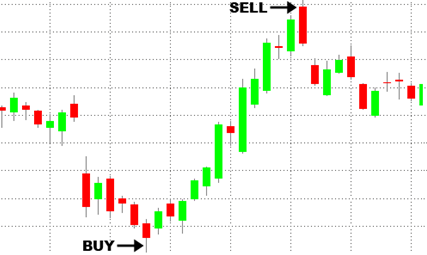
Now here’s what most people think you have to do to create wealth trading the markets. They think you have to buy at the very bottom of a trend as seen here, and then sell at the very top. Anything less than that is perceived as a failure.

Well, one of the greatest traders of the 20th Century, Bernard Baruch, who was a multi-millionaire and who also went on to become a presidential advisor, had this to say about trying to capture the entire trend. He said:

"Don’t try to buy at the bottom and sell at the top. It can’t be done, except by liars. I can’t help making money. I just wait for the market to bottom. Then I buy on the way up, and then I sell before the top. I'm satisfied with the middle one-third of the move."

Now this is a very, very profound concept, and I want to emphasize this again. Baruch said, "I just wait for the market to bottom, and buy on the way up. Then I sell before the top. I’m satisfied with the middle one-third of the move."

That’s the secret: the middle one-third. If that doesn’t make sense to you, here’s another way to look at it. Babe Ruth, Hank Aaron, and Barry Bonds are all masters of the middle one-third. They understood that all you need to do to hit the most homeruns, over time, is to hit the ball one out of every three times you step up to the plate.

What do you think would have happened if Babe Ruth had given up early in his career because he didn’t hit the ball 100% of the time? Of course, we wouldn’t be talking about him right now.

Just like Bernard Baruch and just like many of the rich, all three of these homerun kings were satisfied with the middle one-third. So let's look at what Baruch was talking about in a little more detail, so you can implement this concept yourself.
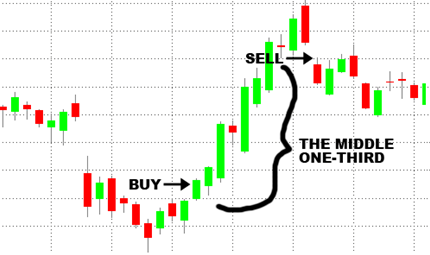
This is the same chart we just saw, but applying Baruch’s philosophy to it. This is what the middle one-third looks like. Now, you might be thinking: "Well, what about the rest of the move? I'd be paying too much if I miss the bottom or I'd be selling too low if I miss the top."

Well, that’s how the middle class thinks. They think you need to capture it all, but some of the wealthiest people on the planet, like Baruch, figured out long ago that the middle one-third of a trend is much easier to take advantage of.

All you need to do is wait for a trend to develop, hop on board, and then sell before it ends. Now, in practice, what we actually end up doing is selling a few days after a trend peaks, and that’s why the sell arrow points to the spot on the other side of the trend.

Do you see how that works? It's easy and it's what the rich do every day to keep and grow their wealth.

This is just one of 4 steps to achieving market mastery that I teach on my new training website for free. To learn the other 3, click here...

Chart to Watch - October Sugar

We've asked our friend Jim Robinson of profittrading.com to provide his expert analysis of charts to our readers. Each week he'll be analyzing a different chart using the Trade Triangles and his experience.

Today he is going to take a look at the technical picture of the October Sugar (NYBOT_SB.V13.E).

I hope you are having a GREAT week !

This week we will take a look at October Sugar futures.

When trading futures with the MarketClub system we use the weekly Trade Triangles to tell trend and the daily Trade Triangles for timing.

Sugar has put in a daily (not shown on this chart) and weekly green MarketClub Trade Triangle, which means the MarketClub system is long Sugar right now. Continue reading "Chart to Watch - October Sugar"

China, U.S. & Inflation

In light of today's positive economic data out of China, I thought I would reproduce a segment from NFTRH 255 (9.8.13) that speculated upon the possibility of a new up cycle in inflation expectations based in large part on China and its credit growth cycle (on which central planners have announced a planned clampdown). 

China industrial, retail data beat forecasts

The Greenspan Fed provides a handy reference as to how long it can take for a withdrawal of policy to manifest in a new economic deceleration. Continue reading "China, U.S. & Inflation"

Syria and Second Passports

By Nick Giambruno, Editor, International Man

All of us by now have seen the latest sales pitch from the Obama administration for yet another so-called "humanitarian intervention" in the Middle East. It is not hard to see that the case for war is a bunch of rubbish and will likely end in disaster for both Syria and the US.

I am not diminishing the tragedy that is going on in Syria. The events there touch me on a personal level. I have good friends who live in Damascus and have been there myself several times when the situation wasn't so hot.

As some of you may know, I used to live in neighboring Beirut while I was cutting my teeth in finance at a regional investment bank. Due to its rich history and importance today, I have long been interested in the Middle East and sought ways to combine it with my professional background in finance. Continue reading "Syria and Second Passports"

Stops…Damned If You Do, Destroyed If You Don't!

By: Leslie Burton

Trading in commodity futures can be a very challenging plight and the risk plan may mean the difference between a long-term trading life and a short-term trading life. Of course, there are traders that simply do not believe in stops and swear that the other brokers and/or traders are gunning for their stops.

First off, a stop may be a protective stop to offset a long or short position to limit the losses if the market moves against you. You may also use a stop to enter a market as channel breakout traders may want to buy and go long if a market breaks through support or sell a market if the market breaks through support. Buy stops are placed above the current market price and Sell stops are placed below the current market price. A stop order turns into a market order when your price is elected. In a liquid market, it may be at or close to your price. If you are in an illiquid market, the stop may be elected, but your fill price may be further away from your price depending on the market activity. A “static stop” remains fixed on a position until executed. A trader must remember, if offsetting the trade manually, to cancel the stop. A “trailing stop” may be used to lock in and protect profits as well. It may be set to follow your position by a certain number of points or ticks to move the stop up or down with the market. This may be done manually or by a bracket automatically. There may be conditions such as a limit moves whereby the market may be moving too fast and may pass through your stop price without triggering in creating more of a potential loss than anticipated. The term "limit up" and /or "limit down" is the amount of points, ticks or cents that a market may move within one session. The Daily Limits are set by the exchange to control the volatility until the market returns to a more stable state. Continue reading "Stops…Damned If You Do, Destroyed If You Don't!"