Getting naked short selling

The practice of short selling has been blamed for the collapse of several major companies’ shares during the financial crisis. What is short selling? You will learn all you need to know about naked short selling in this video from Senior Editor Paddy Hirsch.

We thought that this was one of the most informative videos on how naked short selling works.

Enjoy,

Adam Hewison

Crude oil looks cheap, doesn't it?

Crude oil looks cheap, doesn't it?

Just because something looks inexpensive doesn't mean that it's necessarily a buy. It's very possible for crude oil (NYMEX_CL) to rally up into the low 70s, but you have to remember that it would still be in a bear market. We have seen very few counter trend rallies in this market since it began its amazing fall from grace. The liquidation of the hedge funds and speculators from this market pushed crude down so much that OPEC had to have an emergency meeting. During that meeting, they agreed to cut production by a total of 1.5 million barrels a day. I don't believe for a second that they are going to follow through with that plan. I don't think its every going to happen.

OPEC is now between a rock and a hard place, and is being forced to continue pumping oil because of other financial commitments. Most if not all of the OPEC countries have recently put economic programs in place, all of which require further funding. These economic programs are now having to be financed from a lower income stream. I doubt seriously, giving the players in OPEC, that they will live up to their word to cut output levels. They need the money much like a drug addict needs a fix.

I expect certain countries (Venezuela and Russia) to continue pumping as much crude as they can, so that their socioeconomic infrastructure does not come to a screeching halt. As I have said before, trading this market with a technical program and a game plan far exceeds just looking at the fundamentals. The fundamentals always come in late and after the fact. Market action, and market action alone, determines the trend for not only crude oil, but also for all of the other markets.

Remember, when you are trading against the major trend you should always use positions smaller than if you are trading with the major trend. I believe that the conservative play would be to allow crude oil to rally, and then sell the rally when you have a technical signal to do so.

Every success,

Adam Hewison
President, INO.com
Co-creator, MarketClub

A bear market rally, or a genuine turn in the market?

A bear market rally, or a genuine turn in the market?

With the Federal Reserve cutting the discount rate 50 basis points to 1%, it remains to be seen if this will loosen up the credit markets. There remains a great deal of mistrust among banks and borrowers at the present time, and until that changes, we would look for the economy to limp along.

The sharp move up, in both the DOW and the other indices on Tuesday was a sharp counter trend rally to what remains a prolonged bear market. One day does not make a trend, and we will not know for some time if the lows we have seen recently in the past month are going to be the final lows of this bear market.

My gut feeling is, that we will see more sideways action in these markets for some time to come. I would not look for any dramatic upside action in stocks. If we do see a further rally from current levels, it would be perfectly normal within the confines of a bear market. If you are inclined to trade these markets from the long side, I suggest doing so with a slightly smaller position than you would normally trade. We expect the volatility level to subside from its current torrid pace and fall back to a more normal level as we move sideways.

The judicious use of a game plan and money management stops is highly recommended for everyone. These markets can cut you into pieces in hours mainly because of the market's inability to fashion out a firm trend either on the upside or downside.

Just because the market is going sideways does not indicate that all is over on the downside. The longer we see these markets move sideways, the greater the opportunity that we may be building a base to carry the markets higher.

Adam Hewison

President, INO.com & Co-creator, MarketClub

The rate cut maybe too late for the baby boomers ...

The rate cut may be too late for the baby boomers ...

As many baby boomers are facing retirement, this recent meltdown in the stock market has put many in a precarious position. Money they had counted on for their golden years has quickly disappeared and will not likely return anytime soon.

To illustrate this point, a friend of mine recently sent me a chart which I would like to share with you. This charts shows that we may be going into a prolonged period of no growth in the overall stock market. The NASDAQ peaked at 5,132.52 on March 10th, 2000. The NASDAQ market is in many ways more important than the DOW, and should be considered more of a leading indicator. If that is truly the case, then we have been in a bear market for the last eight years.

If many stocks have lost 50% of their value, they must now go up 100% just to get back to where they were. If we are to assume that the stock market grows by 10% a year (and that is not a good assumption), then it's going to take at least 10 years for many of these stocks to reach the heights they once were at. Many stocks will never come back. I don't think we will ever see Yahoo trade anywhere close its all time intraday high of $500.13 (set January 4, 2000).

I expect to see a prolonged economic climate that is not conducive for stocks to move higher. However, there will be pockets of opportunity where certain markets and sectors will move higher.

All in all, this is not a rosy picture for either the US economy or the world economy. As I have said many times on this blog, these are trading markets and not markets to hold long-term. Witness our General Motors blog, and the fact that General Motors (NYSE_GM) is a scrambling to either avoid bankruptcy or to find a partner. The latest rumor is that they're looking at Toyota (NYSE_TM).

Trading throughout the balance of this decade and into the early part of the next decade is going to be the key to survival and for recovering the profits in your portfolio. We strongly recommend that you approach these markets with some level of expertise and knowledge of technical trading.

The future is going to be the future and we need to take advantage of every moment and prepare ourselves to be the very best we can be in whatever business or endeavor we are pursuing.

Every success in the future,

Adam Hewison
President, INO.com
Co-creator, MarketClub

Forex 1-2-3 Method

Let's face it... Forex is a market that has HUGE potential, HUGE liquidity, and little good information out there on how to trade it with success. That's why I've asked Mark McRae from Forex Avenger to come and teach us a bit about a 1-2-3 Method that his partner David Curran from Forex Avenger has had major success with. Please take time, read the blog entry, and visit Forex Avenger to see the success they have experienced trading forex!

====================================================================

This particular technique has been around for a long time and I first saw it used in the futures market. Since then I have seen traders using it on just about every market and when applied well, can give amazingly accurate entry levels.

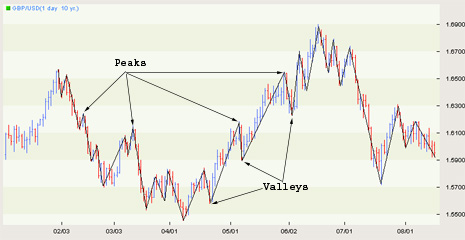
Lets first start with the basic concept. During the course of any trend, either up or down, the market will form little peaks and valleys. see the chart below:

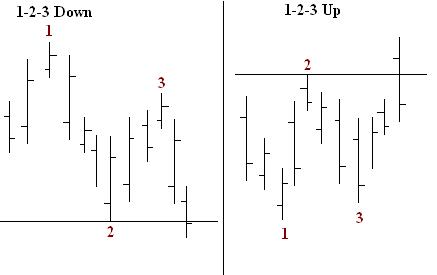
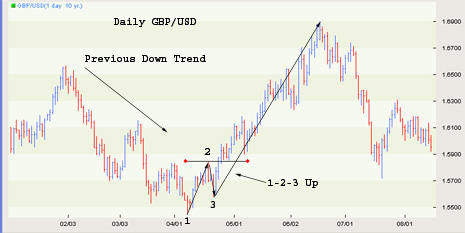
The problem is, how do you know when to enter the market and where do you get out. This is where the 1-2-3 method comes in. First let's look at a typical 1-2-3 set up:


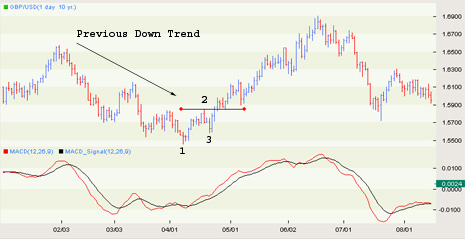
Nice and simple, but it still doesn't tell us if we should take the trade. For this we add an indictor. You could use just about any indicator with this method, but my preferred indicator is MACD with the standard settings of 12,26,9. With the indicator added, it now looks like this:

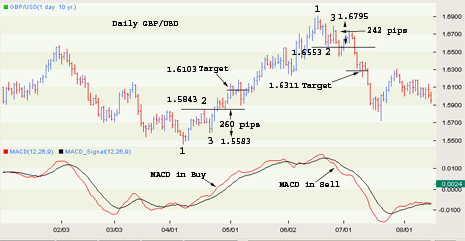
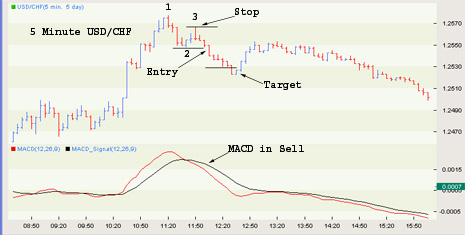
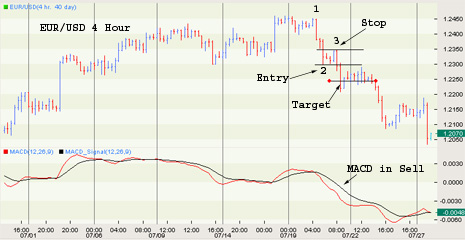
Now here is where it gets interesting. The rules for the trade are as follows:

Uptrend

  1. This works best as a reversal pattern, so identify a previous downtrend.
  2. Wait for the MACD to signal a buy and for the 1-2-3 set up tobe in place.
  3. As the market pulls back to point 3, the MACD should remain inbuy mode or just slightly dip into sell.
  4. Place a buy entry order 1 pip above point 2
  5. Place a stop loss order 1 pip below point 3
  6. Measure the distance between point 2 and 3 and project thatforward for your exit.
  7. Point 3, should not be lower than point 1

The reverse is true for short trades. As the market progresses you can trail your stop to 1 pip below the most recent low (Valley in an uptrend). You can also use a break in a trend line as an exit.

Some examples:


There are a lot of variations on the 1-2-3 setup but the basic concept is always the same. Try experimenting with it on your favorite time frame.

Good Trading

Best Regards
Mark McRae Forex Avenger

Bio - Mark McRae is a fulltime professional trader, author and coach. He has coached some of the top names in Forex trading. David Curran, Forex's latest rising star attributes his success in the Forex market to the teachings of Mark McRae. To read more about David, go HERE