 Crucial but often overlooked, money management practices can mean the difference between winning and losing in the market.
-Placing Stop Order- It's helpful to think of these by their more formal name, stop-loss orders, because that is what they are designed to do – stop the loss of money. Stop orders are offsetting orders placed away from the market to liquidate losing positions before they become unsustainable.
Placing stop orders is more of an art than a science, but adhering to money management rules can optimize their effectiveness. Stops can be placed using a number of different approaches; by determining the exact dollar amount a trader wishes to risk on a single trade; as a percentage of total equity; or by applying technical indicators.
Realistically, methods may overlap, and you'll have a certain amount of leeway in deciding where to put a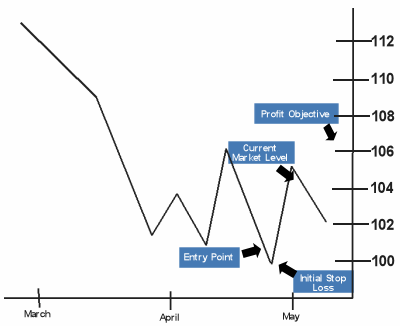 stop, but always be wary of straying too far from the basic asset allocation parameters established earlier. For example, if a trader is long one S&P 500 future at 450.00, a based on his total equity he has a $2,500 to risk on the position, he might place a sell stop at 445.00, which would take him out of the market with a $2,500 loss ($500 per full index point, per contract). Buss after consulting his charts, he discovers strong support at the 444.55, a level he believes if broken will trigger a major break. If this level is not broken, the trader believes, that rally will continue. So he might consider putting a stop at 444.55 to avoid being stopped out prematurely. Although he's risking an extra $225, he's staying close to his money allocation percentages and modifying his system to take advantage of additional market information.
Of course, the size of a position will affect the placement of stops. The larger the position, the loser the stop has to be to keep the loss within the established risk level. Also consider market volatility. You run a greater risk of getting stopped out in choppy, “noisy” markets, depending on how far away stops are placed. This can cause unwanted liquidation when the market is actually moving your direction.
Now suppose our hypothetical trader, who started with $50,000, is now looking at a $10,000 gain (which happened to be his goal for this trade) on a long position. What should he do? That depends entirely on his trading goals. He can take the $10,000 profit and, assuming he leaves the money in his trading account, turn to other trading opportunities. If he desires, he can increase the size of his trades proportionally to his increase in trading equity. This would give him the potential to earn greater profits, with the accompanying risk of greater losses.
He also could choose to keep the size of his trades identical to what they were before he made his initial profit, thus minimizing his risk (as he would be committing a smaller percentage of his total equity to his trades) but at the same time bypassing the chance for larger profits. If his winning positions had consisted of more than one contract and he believed the market was still in an uptrend, he could opt to take his profits immediately on some of the trades, while leaving the other positions open to gain even more. He then could limit his risk on these remaining trades by entering a stop order at a level that would keep him within his determined level of risk, as well as protect his profits. He does run the risk of giving back some of his money if he is stopped out, but counters that with the potential for even larger gains if the market continues in his direction.
Good money management practices dictate stop orders be placed at levels that minimize loss; they should never be moved farther away form the original position. You should accept small losses, understanding that preservation of capital will in the long run keep you in the market long enough to profit from the wining trades that make up for the losers.
Trading in the real world almost never seems to go as smoothly as it does on paper, mainly because paper trading typically never figures in such real world factors as commission, fees and slippage. “Slippage” refers to unanticipated loss of equity does to poor fills (especially on stops) that can result from extreme market conditions or human error. Factoring these elements into your overall money management program can help create a more realistic trading scenario, and reduce stress and disappointment when gains do not seem to be as large as they should be.
-One Final Note- Do your money management homework before you start trading. This helps you decide what to trade and how to trade it. On paper, money management sounds so obvious and based on common sense that its significantly overlooked. The challenge is to apply its principles in practice. Without money management, even the most astute market prognosticator may find himself caught in a downward trading spiral, right on the trend, but wrong on the money.

 It was there, in one of those sweaty, tumultuous, in your face trading pits, that I learned one of the most valuable trading secrets in the world.
 My new 8 minute educational trading video that remains true to core principles of the "The Book of Calculation." Show you step by step, exactly how you can benefit from using this trading secret.
 PDF Workbook
 Crucial but often overlooked, money management practices can mean the difference between winning and losing in the market.


