ETFs For A Negative Market Turn

Do you believe the current market rally is here to stay?

That belief would mean that despite two consecutive quarters of negative Gross Domestic Profit numbers and the Federal Reserve continuing to increase interest rates as a method to bring down inflation, which is at a level that we have not seen since the 1980s, we actually are not currently staring down the barrel of a recession.

There are economists and market participants currently on both sides of the argument of whether or not we are heading towards a recession.

I am not personally confident enough to invest based on where I think we are heading in the short term. But I still like to know what is available for me to buy if the tide seems to be turning one way or the other.

As I mentioned, I would like to give you a few ETFs that would make you money if the market turns negative. These ETFs are all inverse or leveraged funds, meaning they will experience contango if held for longer than one day. Lastly, I would also like to point out that these ETFs, if used correctly, could help investors hedge their portfolio’s against a market correction.

The first few I would like to mention are the basic inverse ETFs that track major indexes. The Direxion Daily S&P 500 Bear 1X Shares ETF (SPDN) tracks the S&P 500 and will increase in value daily if the S&P 500 goes lower.

For example, if the S&P 500 falls 1%, SPDN will increase by 1%. However, if the S&P 500 increases by 1%, SPDN will decrease by 1%. SPDN and every other ETF I mention today will only produce a near-exact correlation to its corresponding index on a one-day basis. Continue reading "ETFs For A Negative Market Turn"
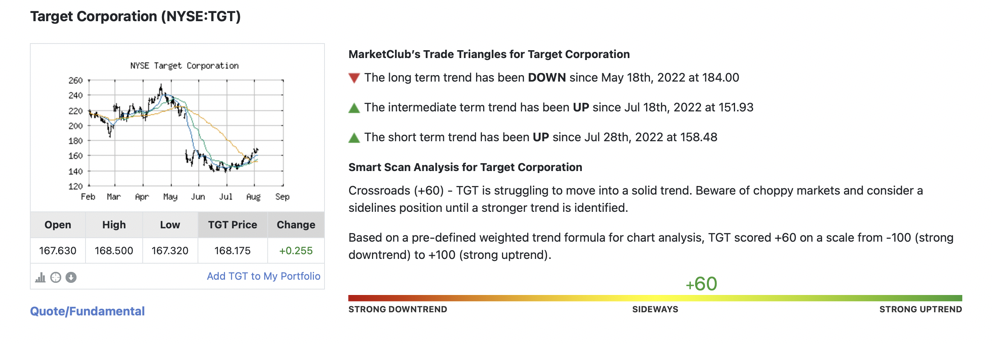
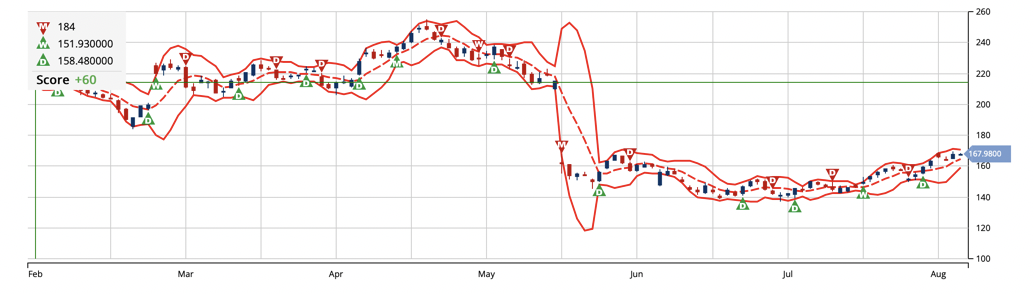
Chart Spotlight: Target Corp. (TGT)

With millions of kids heading back to school in just weeks, investors may want to keep an eye on oversold retailers like Target Corp. (TGT).

TGT Chart Analysis

Source: MarketClub

Granted, Target hasn’t been popular among investors.

After all, the stock collapsed on an earnings miss. EPS came at $2.19, which was short of expectations. Revenue came at $25.17 billion. Analysts were expecting sales to come in at around $24.49 billion.

“Throughout the quarter, we faced unexpectedly high costs, driven by several factors, resulting in profitability that came in well below our expectations, and where we expect to operate over time,” Target Chief Executive Brian Cornell added.

It’s why the TGT stock plummeted from about $207 to a low of $140.

But the pullback has become overkill, creating a solid opportunity.

TGT Chart With Trade Triangles

Source: MarketClub

For one, according to the MarketClub tools, the intermediate and short-term trends are moving in the right direction. MarketClub is showing green weekly and daily Trade Triangles, which is an indication of further short term upside in the beaten-down retail stock. Continue reading "Chart Spotlight: Target Corp. (TGT)"

Gold Stocks Trading At Deep Discounts

It’s been a mixed Q2 Earnings Season for the Gold Miners Index (GDX), with most producers posting solid operational results but revising cost guidance higher to reflect inflationary pressures. These pressures are related to fuel (diesel) and labor inflation, partially related to a tight labor market in prolific mining regions.

However, a few companies have bucked the trend, and others are in a position to claw back any margin declines experienced this year. These miners are the ones to own, and due to depressed sentiment in the sector, they’re trading at large discounts to their net asset value, with two being prime takeover targets.

Alamos Gold (AGI)

Alamos Gold (AGI) is a mid-cap gold producer operating in Mexico and Ontario, Canada, that has three mines and a development project in Manitoba.

The company was one of the few miners not to raise its cost guidance this year due to diesel hedges and operating high-grade underground mines. Notably, it’s also tracking nicely against production guidance, explaining the stock’s sharp rally following its Q2 results.

However, the real news for AGI was the release of its Island Gold Phase 3+ Study, which has outlined an operation capable of producing over 270,000 ounces per year at all-in sustaining costs below $600/oz.

This would make its Island Gold Mine (130,000 ounces per annum at ~$900/oz currently) one of the lowest-cost mines globally and a top-5 in Canada from a profitability standpoint. I believe this is a game-changer, but due to the poor sentiment sector-wide, the stock has not enjoyed the premium it should for this news.

Assuming the expansion is successful and the company can receive permits for its Lynn Lake Mine in Manitoba, Alamos has a path to become a 750,000-ounce producer at sub $850/oz costs by FY2027 a major upgrade from 460,000 ounces at $1,200/oz currently.

This should command a large premium to net asset value ($11.00 per share), yet it trades at a discount at a share price of $7.40, making this a rare opportunity to pick the stock up on sale. Continue reading "Gold Stocks Trading At Deep Discounts"

SPY Set To Lose Its Crown

Since 2017, the King of the Exchange Traded Fund world has slowly been losing ground to its closest competitors.

The SPDR S&P 500 ETF Trust (SPY), the undisputed ETF King since ETFs became popular, is set to lose its crown within the next few years. Well, perhaps it would be better to say that it will lose one of its crowns or maybe one of its world titles while still holding a few others. Let me explain...

The SPY ETF is and has been, with the exception of just a handful of months over the last 20-plus years, the largest Exchange Traded Fund in terms of assets under management. Currently, SPY has $365 billion under management.

In contrast, the next closest competitor, iShares Core S&P 500 ETF (IVV), has $298 billion, and then there is the Vanguard S&P 500 ETF (VOO) at $264 billion in assets.

The SPDR ETF has more than $65 billion in assets compared to the second largest ETF and more than $100 billion compared to the third largest ETF. So why are there predictions that its competitors will overtake it in the coming years?

First and foremost, since 2017, it has been losing ground to IVV and VOO, and based on results from the first half of 2022, the trend doesn't appear to be changing. VOO has added $29.2 billion in assets year-to-date, while IVV has added $15.7 billion. On the other hand, SPY has lost $22.7 billion. Continue reading "SPY Set To Lose Its Crown"

3 Stocks Trading Near 52-Week Highs

So far this year, the stock market has flashed more red signs than green due to various macroeconomic and geopolitical concerns. The immense volatility weighed heavily on equities and government bond yields.

The CBOE Volatility Index (VIX) gained 29.5% year-to-date.

However, the major stock indexes rose in the last trading session to end their best month since 2020, slashing some losses from a gloomy first half of the year. The S&P 500 gained 9.1% in July, while the Dow Jones Industrial Average rose 6.7%, reflecting their strongest month since November 2020. The Nasdaq Composite rose 12.4%, marking its best month since April 2020.

Chris Zaccarelli, chief investment officer for Independent Advisor Alliance, said, “We are seeing a relief rally in the stock market, as pessimism reached extreme levels, and as longer-term interest rates have been coming back down.”

Optimistic expectations from the upcoming earnings releases have also encouraged investors to take a breather from the idea of a slowing economy and further interest rate hikes.

Occidental Petroleum Corporation (OXY), Molina Healthcare, Inc. (MOH), and Greif, Inc. (GEF) are hovering near their 52-week highs and could be the ideal additions to your watchlist now given their strong fundamentals and momentum. Continue reading "3 Stocks Trading Near 52-Week Highs"