An Oil Stock to Ride Out the Looming Recession

At the moment, the oil market is much like the famous quote from the beginning of “A Tale of Two Cities.”

It is a tale of two markets: the futures market for oil (controlled by Wall Street) and the physical market, which reflects the real-world demand for oil. Both factor in many dynamics inputs, notably whether we’re actually heading into a recession.

Which Tale to Believe?

The price of oil dropped by about $15 a barrel in a few days in the futures market, thanks to recession worries. That pushed the global benchmark Brent crude oil price below $100 per barrel for the first time since April.

However, in the real world, there is no sign of a slowdown in demand for oil. In fact, it’s quite the opposite.

Premiums for the immediate delivery of oil are at record levels. For example, Nigerian Qua Iboe crude oil was offered at $11.50 a barrel above Brent, while North Sea Forties crude was bid at Brent-plus-$5.35—both all-time highs!

Here in the U.S., WTI-Midland and WTI at East Houston traded in June at a more than a $3 premium to U.S. crude futures, the highest in more than two years. And though both grades of oil have since edged off those highs, they are still trading more than 60% higher than at the start of June. Continue reading "An Oil Stock to Ride Out the Looming Recession"

Golden Opportunity for These 3 Mining Stocks

It’s been a tough year for investors in the Gold Miners Index (GDX), with the ETF shedding 38% of its value since its April highs.

It’s been a tough year for investors, with the ETF shedding more than 45% from its multi-year highs. A gold price decline exacerbated this tumble. For the weakest producers, this is a concern.

While this has led to many investors steering clear of the sector, some miners are now at their lowest multiples since the 2015 bear market bottom, when margins were half what they are today. Many miners were carrying considerable amounts of debt.

Today, this same group of producers will enter Q4 2022 in net cash positions, are paying out dividends double that of the S&P-500 (SPY), and are much more disciplined, learning from past mistakes. To summarize, I see this as a rare opportunity to buy a few high-quality businesses.

Let’s take a look at three stand-out names below: Continue reading "Golden Opportunity for These 3 Mining Stocks"

Here's Another Crisis the Fed Can Fix

Now that the geniuses at the Federal Reserve are on their way to engineering a soft landing — taming inflation while avoiding a recession — maybe their next task should be trying to fix the U.S. retirement system.

For the past year or so I have been bombarded with phone calls, emails and regular junk mail to sign up for Medicare, and this past weekend I finally reached the American Holy Grail: Medicare eligibility. It used to be Social Security, but with medical insurance so outrageously expensive Medicare has become the ultimate goal. 

Over this time I've found out the difficulties of trying to maneuver through this vast labyrinth of government benefits. Let me tell you, it ain't easy, so prepare yourself when it’s your time. 

How the government ever came up with this plan, I’ll never know, unless its intention was to deliberately confuse the heck out of its oldest citizens and to create a whole industry to help people navigate it. In that it has succeeded.

The first thing you need to know is that Social Security and Medicare are joined at the hip, but not exactly. While you’re eligible for Social Security starting at 62, you have to wait until 65 before you can sign up for Medicare, which again, is the more important of the two, unless you’re lucky enough to have your medical insurance covered by someone else, like your employer. For the vast majority of everyone else, however, Medicare is a critical benefit.

Maybe Bernie Sanders’ idea of Medicare-for-all isn’t such a great idea, but at least the two should start at the same time, just to avoid confusion.

First there’s the question of when to start taking Social Security. While you can start taking benefits as early as 62, you don’t reach your “full” payout until later, depending upon when you were born. For those born in 1957, you reach “full” retirement age at 66 and 6 months; add another six months if you were born in subsequent years.

Now, don’t confuse “full” retirement age with your “maximum” Social Security benefit, which occurs when you turn 70.

Confused yet? I’m just getting warmed up.

Most of the advice you hear about when to start taking Social Security is that you should wait until you reach your “full” benefit or, better yet, your “maximum” benefit. That’s because benefits rise by about 8% a year between 62, when you’re eligible to collect, and beyond. And the difference is indeed meaningful. For example, if you start collecting when you’re 62, rather than 66 ½, your monthly benefit will be reduced by $725, or 27.5%. Now that’s every month for the rest of your life.

While it may indeed be more financial advantageous to wait for the bigger payout, the fact is lots of people can’t – they need the money now. In fact, about a third of eligible recipients start collecting as soon as they can, at 62.

Waiting to collect isn’t always the best advice. If you believe you have a short life expectancy, either because of your lifestyle, family medical history, or both, it may be wise to start collecting early.

You also need to consider the amount of money you will forgo by waiting until “full” or “maximum” retirement age – that’s a lot of monthly payments you’ll be missing. In fact, the breakeven point between the two occurs around age 78, so if you don’t think you’ll live to see that, it may be wise not to wait to start collecting.

Now let’s get back to Medicare, whose rules are just as complicated.

There are several parts to Medicare. Part A, which covers hospitalization, is free. Yes, you heard that right - FREE.

The most expensive medical expense you can probably face is spending a night in the hospital, which Medicare estimates costs an average $13,600. And yet that coverage is free. I kid you not.

Part B covers your doctor visits, but there is a fee for that, which comes directly out of your Social Security payment. You are automatically enrolled in both Part A and B when you start collecting Social Security (I told you they were joined at the hip).

Part D covers your medicines, but not all the drugs you take are covered by Medicare (neither are dentistry, eyecare, and hearing aids, i.e., the stuff you really need when you’re old). There’s a fee for this, too.

Which brings us to Medicare “supplemental” insurance and “advantage” plans, which sound the same but are completely different. You’ve probably heard about them on TV.

As the name implies, supplemental insurance — which you also have to pay extra for - picks up some of what Medicare doesn’t cover (see above).

Advantage plans, by contrast, largely take the place of Medicare, but their premiums and coverages range all over the place. In case you were wondering, Advantage plans are also known as Medicare Part C.

I failed to mention that Social Security and Medicare make up the lion’s share of the federal budget and run out of money every few years, at which time Congress has to “fix” them to make them appear solvent for a while, which usually means making them even more complicated.

So maybe the Fed is the right place to seek a solution. It seems to solve just about all our other financial problems.

George Yacik
INO.com Contributor

Disclosure: This article is the opinion of the contributor themselves. The above is a matter of opinion provided for general information purposes only and is not intended as investment advice. This contributor is not receiving compensation (other than from INO.com) for their opinion.

4 Value Stocks for Times of Uncertainty

Ahead of the Fed’s July rate hike, markets seem volatile. Given the viability of value investing during such times, quality value stocks Intel (INTC), Micron Technology (MU), AbbVie (ABBV), and Cisco Systems (CSCO) could be solid picks to navigate a volatile environment.

The Fed is yet to announce its next rate hike for July. Since inflation soared to a record 9.1% in June, another 75 bps rate hike seems imminent. Consequently, market volatility is rife, as is evident from the CBOE Volatility Index’s 35.7% year-to-date gains.

Amid such circumstances, value investing has a history of outperforming its growth counterparts. Over the past 40 years, a significant portion of value returns has come during rate hike periods.

Furthermore, Bank of America Corp’s (BAC) chief quant Savita Subramanian prefers value over growth, and the bank expects value stocks to outperform growth in the coming years.

Therefore, fundamentally sound value stocks Intel Corporation (INTC), Micron Technology, Inc. (MU), AbbVie Inc. (ABBV), and Cisco Systems, Inc. (CSCO) could be profitable investments amid the ongoing uncertainty.

Intel Corporation (INTC)

An industry leader, INTC designs, manufactures, and sells computer products and technologies worldwide. It operates through CCG; DCG; IOTG; Mobileye; NSG; PSG; and All Other segments. INTC creates world-changing technology to enable global progress.

On July 12, 2022, INTC launched the first set of its open-source AI reference kits, which were built in collaboration with Accenture plc (ACN). These kits are designed to make AI more accessible to organizations in the on-prem, cloud, and edge environments and are available on GitHub. The company is expected to release a series of open-source AI reference kits over the next year, which should bolster its revenues.

INTC’s Datacenter and AI segment revenue increased 22.1% year-over-year to $6.03 billion for the first quarter ended April 2, 2022. Its net income came in at $8.11 billion, up 141.4% year-over-year, while its EPS came in at $1.98, up 141.5% year-over-year.

INTC’s forward EV/S of 2.18x is 22.1% lower than the industry average of 2.80x. Its forward P/S of 2.23x is 22.5% lower than the industry average of 2.87x.

Analysts expect INTC’s revenue to grow 2.6% year-over-year to $76.43 billion in 2023. Its EPS is expected to grow 2% year-over-year to $3.49 in 2023. It has surpassed EPS estimates in each of the trailing four quarters. Over the past month, INTC has gained 7.6% to close the last trading session at $40.61.

INTC’s strong fundamentals are reflected in its POWR Ratings. The stock has an overall B rating, which indicates a Buy in this proprietary rating system. The POWR Ratings assess stocks by 118 different factors, each with its own weighting.

INTC has an A grade for Value and a B grade for Quality. Within the B-rated Semiconductor & Wireless Chip industry, it is ranked #24 out of 94 stocks. Click here to learn more about POWR Ratings.

Micron Technology, Inc. (MU)

MU designs, manufactures, and sells memory and storage products worldwide. The company operates through four segments: Compute and Networking Business Unit; Mobile Business Unit; Storage Business Unit; and Embedded Business Unit.

On July 6, 2022, MU announced the commercial and industrial channel partner availability of Micron DDR5 server DRAM to support the industry qualification of next-generation Intel and AMD DDR5 server and workstation platforms. The product’s commercial availability should add to the company’s revenue stream.

On June 30, 2022, MU’s President and CEO Sanjay Mehrotra, said, “We are confident about the long-term secular demand for memory and storage and are well positioned to deliver strong cross-cycle financial performance.”

For the third quarter ended June 2, 2022, MU’s revenue increased 16.4% year-over-year to $8.64 billion. Its non-GAAP net income came in at $2.94 billion, up 35.3% year-over-year. Also, its non-GAAP EPS came in at $2.59, up 37.8% year-over-year.

In terms of its forward EV/S, MU’s 2.09x is 25.4% lower than the industry average of 2.80x. Its forward P/S of 2.22x is 22.6% lower than the industry average of 2.87x.

MU’s revenue is expected to come in at $31.38 billion in 2022, representing a 13.2% year-over-year rise. The company’s EPS is expected to increase 41.3% year-over-year to $8.56 in 2022. In addition, it surpassed EPS estimates in each of the trailing four quarters. Over the past month, the stock has gained 12% to close the last trading session at $63.64.

MU has an overall B grade equating to a Buy in the POWR Ratings system. It also has an A grade for Value and a B for Quality.

MU is ranked #39 in the Semiconductor & Wireless Chip industry. Click here to learn more about POWR Ratings.

AbbVie Inc. (ABBV)

ABBV discovers, develops, manufactures, and sells pharmaceuticals worldwide. The company functions across several key therapeutic areas like immunology, oncology, neuroscience, eye care, virology, and gastroenterology.

In July, ABBV announced Health Canada’s approval for its RINVOQ® (upadacitinib, 15 mg), an oral, once-daily selective and reversible JAK inhibitor for the treatment of adults with active ankylosing spondylitis (AS). This is expected to expand the company’s portfolio of treatment options for Canadians.

On July 20, 2022, ABBV and iSTAR Medical SA announced a strategic transaction to develop and commercialize iSTAR Medical’s MINIject® device, a minimally invasive glaucoma surgical device. The strategic alliance is expected to be a step forward in the company’s innovation in glaucoma treatment.

ABBV’s net revenues for the first quarter ended March 31, 2022, came in at $13.54 billion, up 4.1% year-over-year. Its net earnings came in at $4.49 billion, up 26.4% year-over-year. Moreover, its adjusted EPS came in at $3.16, up 9.3% year-over-year.

ABBV’s forward EV/EBITDA of 10.39x is 22.8% lower than the industry average of 13.46x. Its forward P/S of 4.38x is 5% lower than the industry average of 4.61x.

Analysts expect ABBV’s revenue to increase 6.2% year-over-year to $59.61 billion in 2022. Its EPS is expected to increase 9.8% year-over-year to $13.94 in 2022. It surpassed EPS estimates in each of the trailing four quarters. Over the past year, the stock has gained 26.3% to close the last trading session at $147.75.

It’s no surprise that ABBV has an overall A rating, equating to a Strong Buy in the POWR Ratings system. In addition, it has an A grade for Quality and a B for Growth and Value.

ABBV is ranked #9 out of the 167 stocks in the Medical – Pharmaceuticals industry. Click here to learn more about POWR Ratings.

Cisco Systems, Inc. (CSCO)

CSCO designs, manufactures, and sells Internet Protocol-based networking and other products related to the communications and information technology industry in the Americas, Europe, the Middle East, Africa, the Asia Pacific, Japan, and China.

On July 21, 2022, CSCO launched a new Webex Wholesale Route-to-Market for Service Provider partners to address the evolving needs of SMBs. This new model is expected to offer greater customer satisfaction for CSCO and its partners.

In June, CSCO launched AppDynamics Cloud, which delivers power and usability in a single, intuitive interface. AppDynamics Cloud supports cloud-native, managed Kubernetes environments on Amazon Web Services (AWS) and is expected to expand to Microsoft Azure, Google Cloud Platform, and other cloud providers in the future.

CSCO’s total revenue increased marginally year-over-year to $12.84 billion for the third quarter ended April 30, 2022. Its net income came in at $3.04 billion, up 6.3% year-over-year, while its EPS came in at $0.73, up 7.4% year-over-year.

CSCO’s forward EV/EBITDA of 8.96x is 28.7% lower than the industry average of 12.55x. Its forward EV/EBIT of 10.01x is 35.5% lower than the industry average of 15.54x.

CSCO’s revenue is expected to increase 3.3% year-over-year to $52.86 billion in 2023. Its EPS is expected to grow 5.4% year-over-year to $3.53 in 2023. Also, it surpassed EPS estimates in each of the trailing four quarters. The stock has gained marginally over the past month to close the last trading session at $44.58.

CSCO’s overall B rating equates to a Buy in the POWR Ratings system. Also, it has an A grade for Quality.

CSCO is ranked #8 out of 53 stocks in the Technology – Communication/Networking industry. Click here to learn more about POWR Ratings.


About the Author

Riddhima Chakraborty is a financial journalist with a passion for analyzing financial instruments. With a master's degree in economics, she helps investors make informed investment decisions through her insightful commentaries. Riddhima is a regular contributor for StockNews.com.

Gold Bug Survivors Prepare to Capitalize

It has been a classic washout in the gold stock sector, but if positioned correctly opportunity is setting up.

  • The ‘macro’ and sector fundamentals have been incomplete.
  • The technicals have advised a downtrend since mid-2020 with the exception of one head fake in March-April, 2022.
  • Sentiment, which was over-bullish in mid-2020 and April 2022 is now opposite, and very bullish on a contrarian basis.
  • The sector is deeply oversold as evidenced by an extreme in the Gold Miners Bullish Percent Index (BPGDM).
  • Commitments of Traders data for gold and silver are positive and very positive, respectively on a contrarian basis.
  • As has been proven by the facts of recent history, the view of cyclical (as opposed to ‘stag’) inflation being terrible for gold stocks was correct, even as this view was lost in the din of opposing – and tragically wrong – opinions by heavily followed Twitter ‘influencers’ and other dignitaries.

So here we are, intact.

What have you done for me lately, smart guy? Err, not much. There has been a lot of waiting, biding time, trading other areas and sitting on cash; a high percentage of it.

But as speculators, traders and/or investors are we not called upon to never set our views in stone? Are we not called upon to be ready to capitalize on extreme events within the markets? When the herds run one way we need to be ready to go the other. The herds are not prepared because they’re either already deployed or too busy running from losing positions.

Gold bug herds, AKA less experienced or analytically critical precious metals bulls, are currently running that way, over that cliff over there. They have been herding since August 2020, when we first noted the danger.

Such events climaxed in 2008 and 2020 too. In each of those instances a crash took place and it coincided with fundamentals slamming into place. Crashing gold stocks + ramping fundamentals = big time buy opportunity.

As noted in the first bullet point above, the fundamentals have not slammed into place on this cycle. They are grinding into place, slowly and outside the limits of the average market participant’s patience. But that is exactly why contrarian investing is so difficult. It is very hard to have patience when time takes what it takes for an opportunity to play out, especially when your viewpoint is not reinforced by a majority.

So that is the background. We have been more than prepared in managing risk. That is how markets often go… manage risk > manage risk some more > manage risk for so long you almost lose sight – in real time – of why you’re there and what your job is > and then PREPARE TO CAPITALIZE.

Intact players should now be considering the big sentiment event on tap for next week as the Fed, which was jerked kicking and screaming into hawk mode by the bond market, prepares to render its big decision (on July 27 they will either hike the Fed Funds by .75% per 71% of CME traders or 1% per 29% of CME traders).

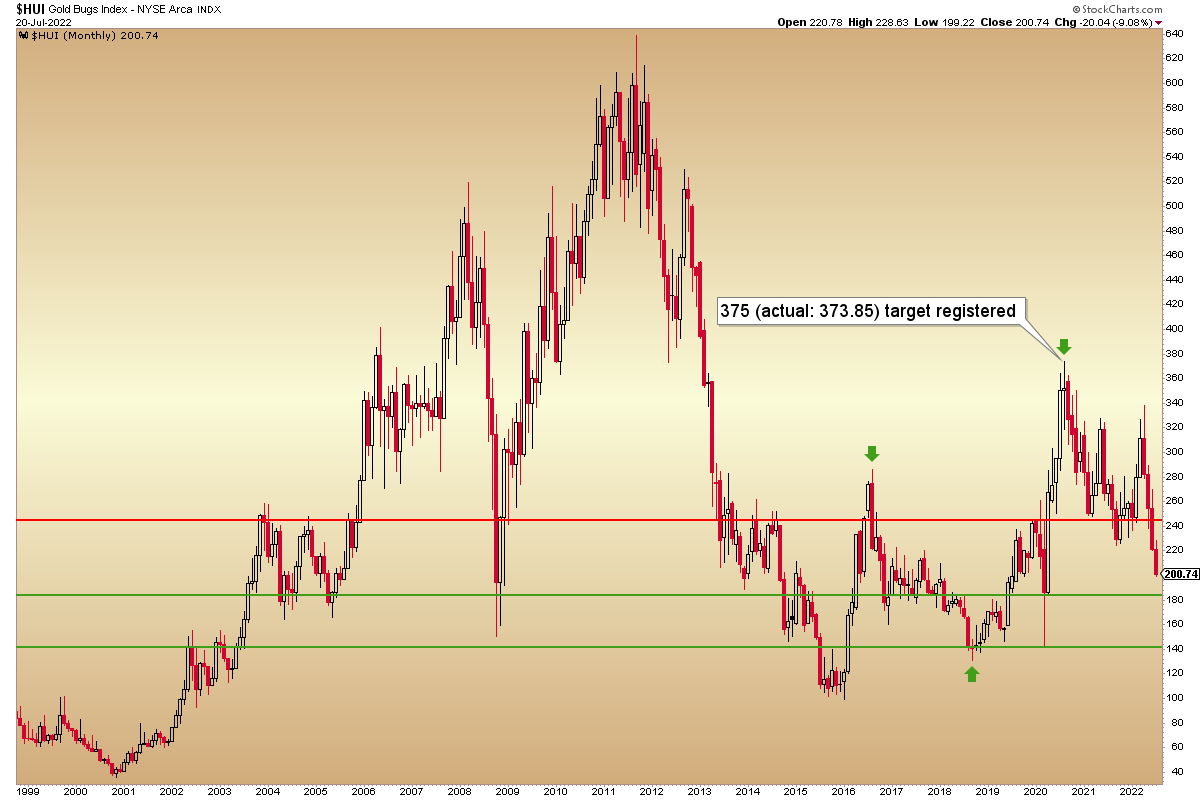
Meanwhile, the Gold Bugs index is tanking toward a higher low to the 2018 low, which is really all it needs to do to keep the volatile series of higher highs and higher lows (AKA a bull market) intact.

I use shorter-term charts and of course the ‘macro’ and sector fundamentals and sentiment to fine tune the situation, but this general monthly chart picture should not only cause no concern for would-be buyers who are well prepared; it should stimulate greed while a majority of bugs are gripped in fear.

Gold Bugs Index Chart

Source: StockCharts.com

Gary Tanashian

For “best of breed” top-down analysis of all major markets, subscribe to NFTRH Premium, which includes an in-depth weekly market report, detailed market updates, and NFTRH+ dynamic updates and chart/trade setup ideas. Follow via Twitter @NFTRHgt.