The 3T’s of Trading

Today I'd like you to welcome Geoffrey A. Smith, from Day Traders Institute. DTI has been a leading the way in trading education for years and I'm very excited to have Geoffrey, the lead instructor from DTI, join us today. Please take time and read the article below on "The 3T's of Trading", then visit the DTI to learn more about them as a company and how they can help you with your trading and investing.

==================================================================

As a trader and instructor, one of the most frequently asked questions I get is “where to take profit”? When I first was asked this, my initial response was “when you are making money”. But after pondering the question for some time, I came to realize that many traders struggle with taking profit hoping that the market would go further in their favor only to get stopped out for a loss. So to help traders with learning to take a profit, we came up with the 3T’s of trading:

Tick
Trade
Trend

Look to trade in thirds, taking 1/3 of your position down at a time. When using the 3T’s, the goal is to first finance the trade and let the last third pay as much as possible. Wouldn’t it be nice to trade with someone else’s money? Well, initially we have to put up the cash to get into the trade and take on the risk of losing money. But if we take enough of the trade off and adjust the protective stop to a point that the trade cannot lose, this eliminates our risk in the trade, relieves the fear of losing, and allows us the legal right to let greed set in.

The first T is the Tick part of the trade. Really it is a scalp, only looking for a small amount. If trading stock, take 1/3 of the position off at $0.30. If trading futures like the Emini S&P, look for 0.50 to 0.75 of a point. This accomplishes two things, it reduces your exposure to the market, and also allows you to pay commission.

The second T is the Trade. Look for twice as much as you got on the Tick part of the trade. Again, if trading stock, look for $0.60 or so. This will elevate 2/3 of the initial position and lock in $0.90. If you adjust your protective stop back $0.50 from current market, then you are on a “free ride”. At this point, you have no more risk in the trade and can concentrate on making money.

Finally is the third T, which is the Trend part of the trade. This is the last 1/3 of the position that we hope will pay the most. Sometimes you will get stopped out on the last 1/3, but other times the market will continue to trend in the direction you are trading and can end up making your whole day.

These price targets are not set in stone but examples of what you might look for. On a stock that is trading at 50, you can’t look for as much profit as one that is trading at 150 because of the price movement. You will need to adjust your profit targets accordingly. I will look at the ATR (average true range) of the stock and set my first target at 10 – 15%, second target at 30 – 40%, and look for the whole ATR on the last third. Some days the stock will get there, other days it will not, but at least the trade was financed on the way.

Give this technique a try and see how you like it. It helps in reducing the fear of losing and allows you to take some profits as the market trends in your direction. It has been my experience that the first target is hit 85% to 90% of the time, with the second target getting filled about 75% to 80% of the time. Not every trade goes in your direction, however, if 1/3 of the trade has been taken out of the market, then the loss has been reduced as well. Remember as traders, we want to make are losses small and our gains big. The 3T’s is one technique to help us get there.

Good Luck!

Geoffrey A. Smith
Chief Instructor – DTI

Bailout or bust... for the USA

Bailout or bust... for the USA.

Congress, can't live with them and we can't sue them. How about putting a few of them in jail, is that possible given the mess they have put us in?

Let's think about what can happen if they pass the bill for the "rescue" package. The first thing that will happen is that they will come up with a softer name that will not scare the general public. After that, confidence and fear will push and pull the markets.

Let's look at the market in the belief that they pass the bill. What will happen the next trading day? What happens is going to be very important as to which direction the market heads. If the market opens lower after they pass the bill, watch out. It won't be a pretty day and panic will be sure to set in. If the market opens sharply higher and sells off later in the day, it's not going to instill confidence in the system.
What I'm looking at is how the market closes this Friday. Does it close higher for the week, or does it close lower for the week? Another key will be what are traders comfortable going home with this weekend. You may want to watch the dollar index and gold and see where they are closing for the week as they typically foreshadow things to come for the economy as a whole.

If Congress and the Senate continues to play politics and do not pass this bill for the markets, we are going to see a pullback and a retest of the lows. Again, I can not stress enough the importance of how the indexes close this weekend. I doubt I am the only one who thinks that these guys are incapable of cleaning up this issue given that they made the mess to start with.

Our "Trade Triangle" technology continues to remain in a negative position and we see nothing in the short term that's going to change the trend of the US economy and the stock indexes that we are following.

For your information the Dow closed at 11,143.13 last week. NASDAQ closed at 2183.34 and the S&P closed at 1213.01.

Again, I stress that I want to see how these markets close for the week and not only how they close the day after the announcement is made.
Our blog poll for traders has always been very accurate over time. Many traders, in this case 67%, are negative on the stock market for the balance of the year. I would not dismiss this poll as it has been extremely accurate in the past in predicting gold, crude oil, and other markets.
We are living in tumultuous times and these times demand strict discipline in the one's trading.

Round three begins Thursday morning.

Good luck to everyone,

Adam Hewison
President, INO.com
Co-creator, MarketClub.com

Trader's Blog Contest For October

There is no one technical analysis indicator that will win 100% of the time. There is no holy grail of charting... and if there is, then someone is keeping one hell of a secret. However, technical analysis techniques can help you make educated decisions, putting the odds on your side that you are on the favorable direction of a move.

So the question is...

"Besides MarketClub's 'Trade Triangles', what is your favorite technical analysis indicator?"

Prize

Winner will receive 6 workshops on technical analysis from our authors in INO TV. These MP3s and digital PDF workbooks will be mailed to you courtesy of INO TV.

Construction & Application Of The MACD Indicator

The Theory of Momentum & Lane's Stochastic - George Lane

The Relative Strength Index Explained - Andrew Cardwell

Classic Technical Analysis as a Powerful Trading Methodology - John Tirone

Applying Fibonacci Analysis to Price Action 1 - Joe DiNapoli

Applying Fibonacci Analysis to Price Action 2 - Joe DiNapoli

How To Enter:

Comment on this post telling us what your favorite technical analysis study is and why. There are no wrong answers.

We want to you to share your thoughts and stories with our other visitors. Here are some responses from in the office to get you started:

Bob F. : I'm a fan of the MACD. I like to backtest various exponential moving average and signal settings for different markets.

Melissa P. : Average True Range is one of my favorites. I don't use this indicator for any other reason that to see activity. I can quickly see how much a stock has been moving throughout the day and leave the stagnant stocks alone.

Kenny S. : I have been trying to study up on the concepts regarding standard deviation. I'm still learning about Bollinger bands, but it's something that is very interesting thus far.

Lindsay T. : The MACD is one of my favorites too. I use the MACD crosses to confirm the "Trade Triangle" signals. When the market is moving sideways, I don't always follow each and every "Trade Triangle" unless I have a confirming back up.

---

Rules

1. This contest is open until 11:59 PM on October 31st.

2. No wrong answers, any participation counts as an entry.

3. One entry per email address.

4. Winner will be picked by random integer software.

5. Winner will be contacted on Monday, November 3rd via email.

--

Good luck!

Navigating the Q's

Today I'd like to welcome Allan Harris from AllAllan.com. Over the past few months Allan's blog has become a daily reader for myself, along with many others in the office. His analysis and ability to read the markets is uncanny. Allan decided to do an experiment, on his own, following the Q's...I think you'll find the results VERY interesting. But be sure and visit Allan's website for more details.

===================================================================

There is no greater feeling as a trader then the feeling you get having successfully navigated an options trade in the QQQQ. This is how I do it, using Market Club Triangles.

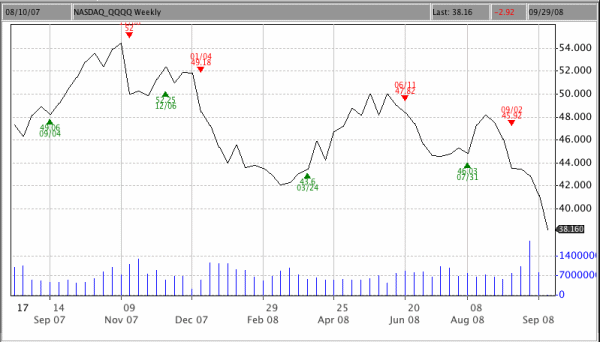
I consider Market Club triangles as serving to alert me to breakouts in the underlying tradable, a 3-day breakout for daily charts, a 3-week breakout on the weekly charts. I only use weekly charts because there are less whipsaws and signals generated on weekly charts also serve to confirm an intermediate term trend is in place. Market Club does a great job of monitoring my portfolio as well as market indexes, etf’s and individual stocks for these 3-week breakouts.

Here is a Market Club chart for the QQQQ with the weekly Triangles going back about one year. Notice that there are whipsaws, but more importantly, note how many tradable trends are caught using the automated triangles:

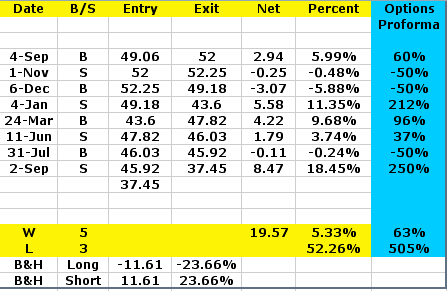
Below is my Excel worktable analyzing these signals. I stated with the Buy generated in September 2007 and finished with the Sell generated on September 2, 2008.

Note that there were a total of eight signals for this 12-month period, about one signal every six weeks. There were 5 net winners and 3 net losing signals.

A Buy & Hold strategy generated a loss of about 12 QQQQ points, or about 24%. A Sell & Hold strategy gained those 12 points, or 24%.

Using the Triangles returned about double the Sell & Hold strategy.

Using the Options made this whole exercise worthwhile, generating over 500% for those eight trades.

Winning 5 out of 8 trades is only a sampling error away from four out of eight wins, or a 50% win ratio. How does something so close to a 50% win/loss generate 500%?

This is an observation that a lot of wannabe traders miss: The magic here isn’t so much pinpoint market timing, it’s that age old trading rule of letting profits run and cutting losses combined with a decent market timing model.

In the case of the Q signals and returns, I’ve used a 50% stop loss rule, meaning all trades that fall 50% based on the underlying options are closed out. All trades that do not fall 50% are held until the next signal. That is why all of the losers are 50% (worst case basis) in the table of trades.

As for the winning trades, the returns above are based on a conservative assumption of losing one month of time premium for each trade and a beta of 60% for just-out-of-the-money calls and puts. Actual real money returns may be a little better or a little worse, but these assumptions capture a fair value for the strategy over the course of the past 12 months.

Finally, considering all of the angst in the market the past few months, look at how beautifully this strategy has bypassed all the fundamental and technical analysis out there and simply went short on September 2 and held short for the entire decline since then.

Consider the ease of trading like this, following the weekly triangles in and out of the Q’s and ask yourself, what other methodology would have navigated this market with as much success and as little sweat equity as the weekly Triangles?

Trading doesn’t have to be complicated, losing proposition. As I have shown, it can be both simple and rewarding.

Allan Harris

AllAllen.com

The rules have changed again!!!! Only this time it may be a good thing.

This from our business partner AP News

Government to clarify accounting rules for banks

AP Business Writer (AP:WASHINGTON) Federal regulators on Tuesday clarified accounting rules for banks in a way immediately embraced by the industry, which has been seeking relief that could boost its balance sheets in the financial crisis.46 minutes ago

By MARCY GORDON

The Securities and Exchange Commission and the Financial Accounting Standards Board issued clarifications to the current rules, and said more detailed guidance is coming later this week from the standard-setting FASB.

The banking industry, which has seen its mortgage-backed assets plummet in value, has been pressing the SEC to suspend the so-called "mark-to-market" accounting rules that require banks to value their holdings at current market prices, even if they plan to hold the assets for years. A possible addition to the $700 billion bailout bill being considered by Congress would reaffirm the authority of the SEC to suspend them.

But the head of a policy group backed by the biggest accounting firms warned lawmakers against such a suspension, saying it would hurt the interests of investors and the capital markets.

The principles of mark-to-market accounting "are rooted in the fundamental virtue of transparency and are central to informed market decisions and efficient allocation of capital," Cynthia Fornelli, executive director of the Center for Audit Quality, wrote in a letter to members of Congress.

The clarification issued Tuesday says that when an active market for a security doesn't exist, "the use of management estimates that incorporate current market participant expectations of future cash flows, and include appropriate risk premiums, is acceptable."

The guidance will apply to companies' financial statements for the just-completed third quarter. It is "intended to provide increased clarity related to the practices that may be used to determine an appropriate fair value in the light of current market conditions," said James Kroeker, the SEC's deputy chief accountant.

The arcane accounting rules even intruded into the battle for the White House, with Republican presidential contender John McCain's campaign lauding the SEC's release. Democrat Barack Obama's campaign did not immediately return requests for comment Tuesday evening.

The American Bankers Association also applauded the action, saying the new guidance "will help auditors more accurately price assets that are difficult to value under current market conditions."

McCain's campaign said he "is pleased to see that the SEC has finally decided to permit alternative accounting methods to mark-to-market accounting for securities where no active market exists. There is serious concern that these accounting rules are worsening the credit crunch, making it difficult for small businesses to stay afloat and squeezing family budgets."