Today I have the opportunity to introduce Brian Shannon from AlphaTrends.net. Brian is the author of "Technical Analysis: Using Multiple Time Frames." I had the chance to read this book on a flight form Maryland to California and I can tell you that I didn't put it down. The insights and strait forward analysis made me come home and rethink my positions and methodology. Brian takes what he's learned as a broker, hedge fund manager, speaker, and writer to really convey his knowledge. Enjoy his post below.
===
For the majority of market participants, the stage four bear market decline is a dark, scary period that they wish didn't exist. Whether you are a died-in-the-wool bull or someone who feels trapped by the long-only choice of your 401K, a bear market is most participants least favorite time to be involved in the markets. Unfortunately, it is a painful time for many market investors who try to catch a falling knife, rather than wait for it to drop and then pick it up.
For the perennial doomsayers of the world, a bear market is their time to say "I told you so" as they endlessly preach their pessimistic viewpoints.
The fact is declining equity prices bring about the strongest emotional response -- annoyance from longs to jubilance of shorts -- from the average participant. However, if you are an objective trader who understands the cyclical nature of the markets, a bear market can represent a terrific opportunity for your short-term profits.
There have been many attempts to classify exactly what constitutes a bear market, but it simply boils down to this: It is an environment where the path of least resistance is lower for the market being studied. The sellers are clearly in control and are able to create a condition where lower highs and lower lows prevail. The supply of stock offered to the market is greater than the demand can absorb at current prices, which forces a move lower in search of liquidity. That's it.
The stage three distributive action which precedes a downturn robs the market of further upside as sellers gradually wrestle control from buyers. When prices break below the lows of stage three and establish the first evidence of lower lows and lower highs a new downtrend has begun and ensuing rallies should be treated as "guilty until proven innocent."
Note that trend reversals can occur early on. However, as more long participants are trapped with losses, fear-driven liquidation is more likely and typically will play out in multiple waves. Not only is there an absence of buyers; there is also an increasingly aggressive source of supply from who short sellers apply further pressure to the market. The obvious resulting technical signs of bearish enviornment take the stage -- lower lows which form below declining longer-term moving averages.
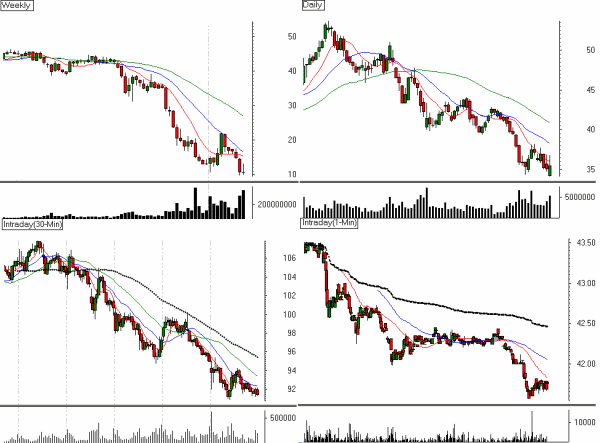
The stage four decline is market by lower lows and lower highs, regardless of time-frame. Notice the direction of the moving averages, they can be used to quickly identify "the path of least resistance."
It is easy and tempting to look at bounces in a primary downtrend and think there is an opportunity to make money form the long side, but simply math favors trading the short side. For example, when a stock drops three points, the only way it can remain in a downtrend is to rally less than three points as a counter trend rally ensues. On other words, the sum of the declines will always be greater than the sum of the rallies in a downtrend. Understanding the basis of trend trading (once a trend has been established, the more likely it is to continue than to reverse) increases the likelihood of further downside, and the declines will travel further than the corrective rallies within a downtrend. This creates a powerful reason to embrace short selling.
Picking bottoms is the hardest job on Wall Street, and frankly, nobody rings a bell at the market bottom. Yet for some reason there seems to be an attraction to declining prices among most participants. Natural human optimism and learned behavior of hunting for bargains in a retail environment provides a "slope of hope" along which stage four stocks, decline, crushing the dreams and finances of bewildered longs in its path.
We have all experienced the helpless feeling of searching every new source for a shred of bullishness to justify holding onto a stock in the face of declining prices. This fruitless action only delays the inevitable recognition of truth. It does not delay your losses. The is said that "it is better to be in cash wishing you were in a stock than it is be in a stock and wishing you were in cash." This is perhaps never truer than the point at which you are "foraging" for a reason to continue on a course that offers little promise.
For long participants, the stage four decline is market by two brands of fear:
- Fear that the stock's descent will continue to wipe out their equity (a good fear to have as it may portend a proper action into cash).
- Fear of feeling stupid for selling "the loser" at a point just before the stock turns higher (a bad fear to have). Do not fall prey to the short-term pauses in a primary downtrend; the short term action will typically be resolved in the direction of the larger, more powerful trend of the longer time-frame.
See the rest of this post by clicking HERE.

 Record high prices for crude. Did you miss the move to $147? Watch this 90 second video on trading crude it will enlighten you to the possibilities that this market offers.
  Adam Hewison
 interested in the idea of this experiment that I had to watch the whole thing.