Three Reasons Why Gold and Gold Stocks Will Rise

The Gold Report: Over two days, July 14 and 15, the price of gold fell over $40 per ounce ($40/oz), more than 3% of its value. To what do you attribute this drop?

Jeffrey Mosseri: I don't think it was a very extraordinary event. Gold has been trading around $1,300/oz. We see sharp upward and downward movements triggered by, for instance, something Federal Reserve Chair Janet Yellen said or a negative report by Goldman Sachs. It looks as if gold will stay in the $1,300/oz range for a little while. We'll see which way it breaks out. We believe it's going to break out on the upside.

Douglass Loud: Gold had been running up for a while, and every so often investors want to take some money off the table.

TGR: How high do you believe gold will go?

"We like North American Nickel Inc.'s Maniitsoq nickel sulfide project in Greenland."

JM: The average sustaining cost of production for gold is about $1,500/oz. If gold continues to trade below that level, at some point no new mines will be brought on. Supply and demand indicates higher prices for gold. At the same time, we're dealing with a seasonal trading pattern. Usually the position for those commodities tightens up around September/October. We think this will happen again this year. Higher prices? Yes. How much higher? We don't know.

TGR: Given that the financing for junior gold companies collapsed years ago, shouldn't the concomitant shortage of new supply have led already to higher prices? Continue reading "Three Reasons Why Gold and Gold Stocks Will Rise"

Have Natural Gas Prices Hit Bottom?

It's been a summer of open windows and dormant air conditioners in the Eastern U.S. as the mercury has failed to break 85 degrees on most days and night-time lows fall down to the mid-50s in much of New England.

And that partially explains why natural gas prices are plunging to seven-month lows. Gas-fueled power plants are operating at a low hum as electricity demand has been unusually tepid. When you consider that late July typically represents a turning point for summer temperatures, this may turn out to be a year without any major heat waves. Good news indeed for residents in the Eastern U.S. after enduring an unusually dispiriting frigid winter.

As demand for gas remains subpar, gas storage facilities are re-filling at a rapid rate, turning gas back into a buyer's market. That's a quick change from six months ago when gas was being consumed at a faster-than-normal rate. And the resulting price collapse has left many to wonder: Will gas prices keep plunging, or have they hit bottom?

The answer to that question: Gas prices are likely to keep falling. Continue reading "Have Natural Gas Prices Hit Bottom?"

I Know Where You Can Find Winning Stocks To Trade

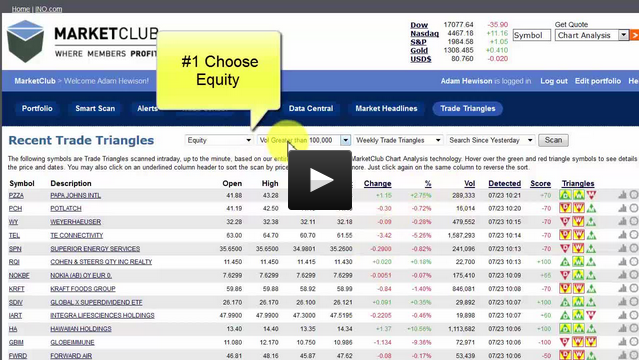
With thousands of symbols out there, the question that is perplexing many investors is, "How do I find winning stocks?" This has been a dilemma for investors since the dawn of modern trading.

With more and more stocks coming online every day, it has become a monumental challenge for most investors and traders to find winning stocks.

In this quick video, I show you how I find winning stocks using a simple set of tools that you can use just as effectively to find your own winning stocks.

Let's get started right away, it's a short video, and you'll get to see just how easy it can be.

Every Success,
Adam Hewison
President, INO.com
Co-Creator, MarketClub

If Other Countries Sneeze, Will The U.S. Catch A Cold?

Just as the U.S. economy is strengthening, other countries are threatening to drag it down.

Employers in the U.S. are creating jobs at the fastest pace since the late 1990s and the economy finally looks ready to expand at a healthy rate. But sluggish growth in France, Italy, Russia, Brazil and China suggests that the old truism, "When the U.S. sneezes, the rest of the world catches a cold," may need to be flipped.

Maybe the rest of the world will sneeze this time, and the U.S. will get sick.

That's the view of David Levy, who oversees the Levy Forecast, a newsletter analyzing the economy that his family started in 1949 and one with an enviable record. Nearly a decade ago, the now 59-year-old economist warned that U.S. housing was a bubble set to burst and that the damage would push the country into a recession so severe the Federal Reserve would have no choice but to slash short-term borrowing rates to their lowest levels ever to stimulate the economy. That's exactly what happened. Now, Levy says the United States is likely to fall into a recession next year triggered by downturns in other countries, the first time in modern history.

"The recession for the rest of the world ... will be worse than the last one," says Levy, whose grandfather called the 1929 stock crash and whose father won praise over decades for anticipating turns in the business cycle, often against conventional wisdom. Continue reading "If Other Countries Sneeze, Will The U.S. Catch A Cold?"

With The World Spinning Out Of Control, Have The Markets Got It Right?

It seems everywhere you turn there is bad news around the world. Whether it's the Ukraine and Russia shooting down a passenger plane, all the problems in Afghanistan and Iraq with ISIS, and let’s not forget, Hamas and Israel.

Despite having every known obstacle and block thrown in its path, the markets continue to march on and trend higher. How much longer this can go on is anyone's guess.

Somewhere along the line, the markets will make a turn to the downside and when that happens I certainly don't want to be left holding the bag based on what the pundits are saying. I trust in the Trade Triangle technology given its solid track record.

Today, I will be looking at the major indices and indicating where the "line in the sand" is drawn to exit positions should a downturn occur.

I'll also be looking at Netflix Inc. (NASDAQ:NFLX) with its big break down today. I'll share with you one indicator that could have helped predict today's move. Continue reading "With The World Spinning Out Of Control, Have The Markets Got It Right?"