Gold futures in the December contract hit a new all-time intraday high of $2,089.20 per ounce Friday morning as investors poured into the safe-haven asset ahead of the closely watched jobs report.
Gold is up about +1.8% this week, on pace for its ninth straight weekly gain for the first time since May of 2006. Gold futures, however, have since fallen about -2.2% to $2,031.10 per ounce. Spot gold dipped as well, falling about -2.1% to $2,028.70 per ounce on Friday. On a weekly level, it will still post a gain of +2.1%; it's the ninth straight week of gains.
The DOW just posted a "Golden Cross," joining the NASDAQ and S&P 500, when it's 50-day moving average broke above its 200-day moving average, which is traditionally a bullish signal for the first time since March. Continue reading "Gold Hits Record High"→
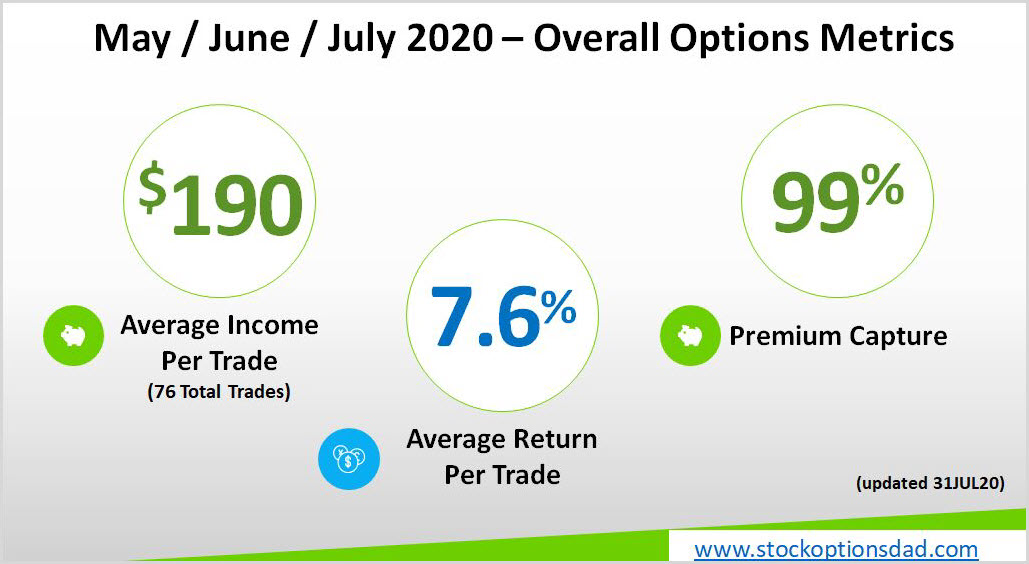
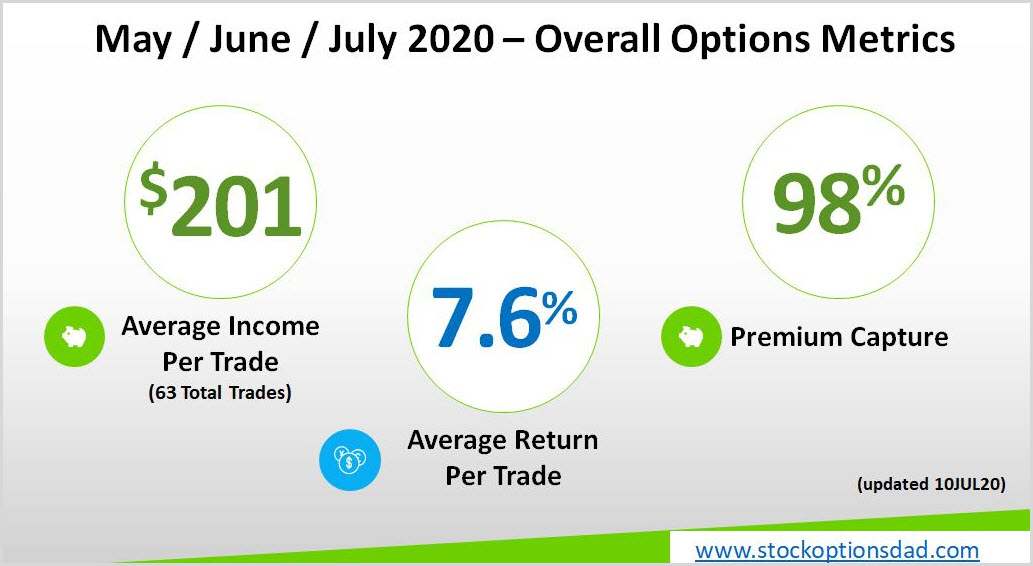
A total of 76 options trades were placed in May, June, and July as the market rebounded after the COVID-19 market lows. During this timeframe, all 76 trades were winning trades to lock-in a 100% option win rate with an average income per trade of $190 and an average return on investment (ROI) per trade of 7.6%. After the tumultuous market lows of March and into early April, leveraging a minimal amount of capital, mitigating risk and maximizing returns was paramount. The objective of an options-based portfolio can offer the optimal balance between risk and reward while providing a margin of downside protection with high probability win rates.
As the market continues to rebound, optimal risk management is essential when engaging in options trading as a means to drive portfolio performance. When engaging in options trading, risk mitigation needs to be built into each trade via risk-defining trades, staggering options expiration dates, trading across a wide array of uncorrelated tickers, maximizing the number of trades, appropriate position allocation and selling options to collect the premium income.
Getting creative and customizing your option trade structure is another element that can be layered into the overall strategy for long-term success in options trading. Maintaining disciple via continuing to risk-define trades, leveraging small amounts of capital while maximizing return on investment, is essential despite the impressive streak of 76 consecutive winning trades.
3 Months Post COVID-19 Results
After placing 76 trades throughout May, June, and July, a 100% win rate, 99% premium capture, and 7.6% ROI per trade was achieved. This was accomplished via leveraging a minimal amount of capital and maximizing return on investment with risk-defined trades. Deploying a combination of put spreads and custom put spreads was used to optimize the risk-reward profile for these 76 trades. Whether you have a small account or a large account, a defined risk (i.e., custom put spreads) strategy enables you to leverage a minimal amount of capital, which opens the door to trading virtually any stock on the market regardless of the share price. Risk-defined options can easily yield double-digit realized gains over the course of a typical one month contract (Figures 1, 2, and 3).
Facebook, Apple, and Amazon are leading the tech sector after announcing better than expected earnings. However, as we head into the close, all three major indexes have dipped into the red for the day.
As far as the weekly numbers go, the S&P 500 will likely eke out a weekly gain of roughly +.5%. The DOW, on the other hand, will suffer it's second straight weekly loss standing at -1.3% while the NASDAQ, on the back of the big earnings blowout by the big three, will post a weekly gain of +2.4%.
For the first time since 2011, spot gold has topped $1900, hitting an intra-day high of $1906.35. Gold futures in the December contract traded above $1900, starting on Wednesday, hitting an intra-day high of 1933.60 today. On a weekly level, gold will post its seventh consecutive week of gains with a weekly increase of +4.8%
The move higher has been attributed to a US new home sales beat with US new home sales rising 13.8% in June versus an expected 4% increase for the month.
The May numbers were also upwardly revised to 19.4% advance. New home sales were at a seasonally adjusted annualized rate of 776,000 homes in June, the US Commerce Department said on Friday. May's sales were revised up to a rate of 682,000 units.
The market consensus called for sales to advance to 700,000 units in June. On an annual basis, new home sales were up 6.9% from last year's estimate of 726,000 units. Looking at home prices, the report said that the median sales price for homes sold last month was $329,200, while the average price was $384,700. The inventory of houses for sale as of the end of June was at 307,000, representing a 4.7-month supply at the current sales rate.
The major indexes are struggling to make up ground at the end of the week with all three indexes posting weekly losses. The S&P 500 will lose roughly -.5%. The DOW stands to lose somewhere around -.7%, and as a weakness to continue to enter the tech sector, the NASDAQ will post a weekly loss standing near -1.6%.
The US dollar continues to be put under pressure losing -1.6% on the weekly extending its weekly loss streak to five weeks.
Bitcoin, on the other hand, like gold, has seen a recent increase in trading volume triggering a new green weekly Trade Triangle at 9479.57 with a weekly gain of +4.3%.
Leveraging a minimal amount of capital, mitigating risk, and maximizing returns is the objective of an options-based portfolio. Options trading can offer the optimal balance between risk and reward while providing a margin of downside protection with a high probability of success. Proper portfolio construction and optimal risk management are essential when engaging in options trading as a means to drive portfolio performance. Key pillars of risk mitigation are rooted in maintaining liquidity, risk-defining trades, staggering options expiration dates, trading across a wide array of uncorrelated tickers, maximizing the number of trades, appropriate position allocation, and selling options to collect premium income. Customizing your option trade structure is another element that can be layered into the overall strategy for long-term success in options trading. A risk-defined custom put spread offers layers of protection, thus optimizing the risk management aspect of an options trade while maximizing return on investment.
Custom Put Spreads: Results
Leveraging a minimal amount of capital and maximizing returns with risk-defined trades optimizes the risk-reward profile. Whether you have a small account or a large account, a defined risk (i.e., custom put spreads) strategy enables you to leverage a minimal amount of capital which opens the door to trading virtually any stock on the market regardless of share price such as Apple (AAPL), Amazon (AMZN), Chipotle (CMG), Facebook (FB), etc. Risk-defined options can easily yield double-digit realized gains over the course of a typical one month contract (Figures 1, 2, and 3).
You are now leaving a Magnifi Communities’ website and are going to a website
that is not operated by Magnifi Communities. This website is operated by Magnifi
LLC, an SEC registered investment adviser affiliated with Magnifi Communities.
Magnifi Communities does not endorse this website, its sponsor, or any of the
policies, activities, products, or services offered on the site. We are not
responsible for the content or availability of linked site.