Consumer Sentiment Falls Unexpectedly In July

U.S. consumer sentiment fell unexpectedly dipping in the early part of July amid a continuing rise in new coronavirus cases. The University of Michigan's consumer sentiment index came in at 73.2 for July, a decline from 78.1 in June, snapping a two-month uptrend. Economists who had been polled by the Dow Jones were expecting a small rise to 79.

Falling consumer sentiment shouldn't be a shock with coronavirus cases spiking in several states across the country, including massive spikes in the stares of Florida, Texas, Arizona, and California. The stock market seems to agree with today's muted moves to end the week. As we head into the Friday close, the major indexes are mixed on the day matching their theme for the week.

The DOW will end the week with a positive gain of roughly +2%, which is a bit higher than the S&P 500's gain of +1%. However, the NASDAQ will post a weekly loss of approximately -1% as the tech sector was hit hard to end the week, most notably with Netflix losing over -6% on the day and -10 for the week. Continue reading "Consumer Sentiment Falls Unexpectedly In July"
S&P 500 Sends Bullish Signal

The S&P 500 just sent what most traders view as a bullish signal, what is it you ask? A golden cross, which is often seen as a bullish indicator signaling that a significant move higher could follow.

So, precisely what is the golden cross. A golden cross is when the 50-day Simple Moving Average (SMA) crosses above the longer-term 200-day SMA.

When a short-term simple moving average crosses over a long-term one, it's often a signal that bullish momentum is ramping for the stock. Because long-term simple moving averages take a lot more time to influence, traders can use this to calculate a stock's relative strength. The higher the time period used, the stronger and longer-lasting the breakout tends to be.

All three major indexes will end the week in positive territory with the Continue reading "S&P 500 Sends Bullish Signal"

10 Options Trading Rules That Must Be Followed

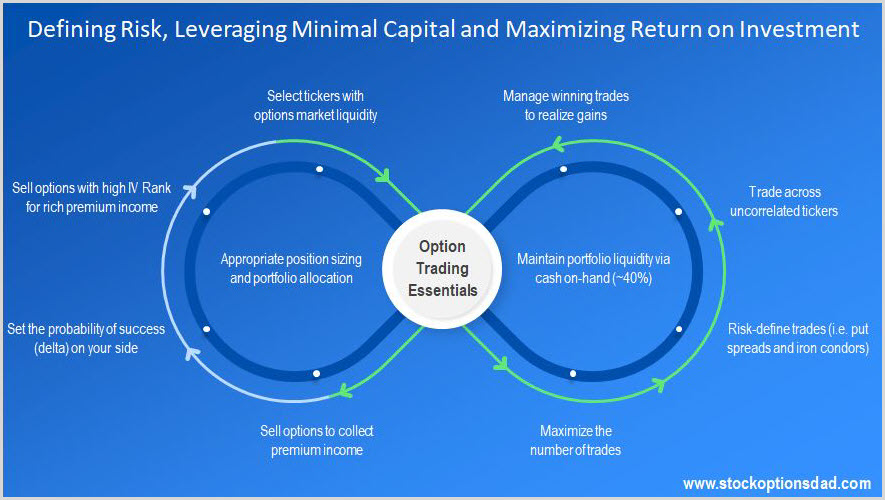
Despite the COVID-19 backdrop, some individual stocks and broader indices have exploded to new all-time highs and retraced previous all-time highs, respectively. Since the depths of the COVID-19 induced sell-off in late March, the markets have experienced an uninterrupted resurgence. It’s easy to become complacent when markets are roaring higher. However, one must remain disciplined when managing risk, especially as it relates to options trading. Mitigating risk and maximizing returns is paramount as the markets rotate out of the depths COVID-19 sell-off. Options trading offers the optimal balance between risk and reward while providing a margin of downside protection and a statistical edge. Proper portfolio construction and optimal risk management is essential when engaging in options trading as a means to drive portfolio performance. The Q4 2018 and the COVID-19 pandemic are prime examples of why maintaining liquidity, risk-defining trades, staggering options expiration dates, trading across a wide array of uncorrelated tickers, maximizing the number of trades, appropriate position allocation and selling options to collect premium income are keys to an effective long-term options strategy.

An Effective Long-Term Options Strategy

A slew of protective measures should be deployed if options are used as a means to drive portfolio results. One of the main pillars when building an options-based portfolio is maintaining a significant portion of cash-on-hand. This cash position provides the ability to rapidly adapt when faced with extreme market conditions such as COVID-19 and Q4 2018 sell-offs. When selling options and running an options-based portfolio, the following guidelines are essential (Figures 1 and 2):

      1. Trade across a wide array of uncorrelated tickers
      2. Maximize sector diversity
      3. Spread option contracts over various expiration dates
      4. Sell options in high implied volatility environment
      5. Manage winning trades
      6. Use defined-risk trades
      7. Maintains a ~50% cash level
      8. Maximize the number of trades, so the probabilities play out to the expected outcomes
      9. Continue to trade through all market environments
      10. Appropriate position sizing/trade allocation

10 Options Rules
Figure 1 – Defining the 10 rules that one must follow to appropriately manage risk and maximize returns when deploying options as a means to drive portfolio results
Continue reading "10 Options Trading Rules That Must Be Followed"

Market Selloff To End Volatile Week

As we head into the close for the week, stocks are at or near session lows in a market selloff ending what was a volatile week. The reason for the selloff, spiking cases for Coronanvirus in several states.

The U.S. hit a new record for daily coronavirus cases. That has caused the governors of Texas and Florida to pause their reopening plans, with both states effectively closing bars to limit the spread of coronavirus. Coronavirus cases are trending upward in about half of U.S. states, and several have reported record-breaking daily new case counts this week, according to Johns Hopkins University. The U.S. reported 39,972 daily cases of the coronavirus on Thursday, a new daily record, according to Johns Hopkins.

Both the S&P 500 and DOW have now gone negative for the month, but the NASDAQ continues to trade in positive territory on a monthly level. However, on a weekly level, all three indexes will post weekly losses with the S&P 500 losing over -2%, the DOW will drop over -2.9% closing in on -3%, and the NASDAQ is looking at a weekly loss over -1%. Continue reading "Market Selloff To End Volatile Week"

Stocks Mixed As Coronavirus Cases Spike

The stock market started the day with significant gains but quickly retreated as cases of coronavirus continue to spike in the states of Florida, Arizona, and California. On top of that, the WHO (World Health Organization) reported this afternoon that the pandemic has entered what WHO Director-General Tedros Adhanom Ghebreyesus termed "a new and dangerous phase" as daily Covid-19 cases hit record highs.

Despite the turn lower at the end of the week, all three major indexes will post weekly gains, their fourth straight week of gains. The S&P 500 will post a weekly increase of +2%, while the DOW will check-in at +1%. The NASDAQ has the largest weekly gain standings at +3%. Reason for the weekly gains, a record surge in U.S. retail sales, and the Federal Reserve announcing it will buy individual corporate bonds. Continue reading "Stocks Mixed As Coronavirus Cases Spike"