Stocks Peak One Year After Bonds (History Set to Repeat?)

Financial parallels between the 1920s and today

By Elliott Wave International

When the financial media mentions the late 1920s, they usually mean the 1929 stock market top. But today's investors can also learn from what happened in 1928. That was the year that the bond market topped, while commodities peaked even sooner.

You can see this for yourself in a chart published in the September 2013 issue of Robert Prechter's Elliott Wave Theorist.

In the deflationary collapse of 1929-32, commodities fell
from lower peaks, not higher peaks; stocks fell
from all-time highs down to the bottom; and bond
prices fell from an all-time high a year earlier.

The Elliott Wave Theorist, July-August,
2013

These markets could see a similar outcome in the near future: Commodities peaked in 2008, while Treasury bonds topped in 2012. The high in the Dow Industrials remains December 31, 2013. Continue reading "Stocks Peak One Year After Bonds (History Set to Repeat?)"
Options Traders: Watch Out For This Little-Known Income Killer

Using a covered call strategy can be a great way to generate steady returns in your portfolio. As a general rule, I expect my covered call trades to increase my capital by about 25% to 35% per year, depending on the market environment.

(If you're new to the covered call strategy, click here for an introduction to how this strategy works.)

Whenever I set up a new covered call trade, there are a number of different dynamics to be aware of.

I always want to start with an underlying stock that has a high probability of increasing in price. I typically look for stocks with strong fundamental growth and a chart pattern that indicates investors are steadily buying the stock.

Next, I want to make sure that the option contract we use has plenty of premium built into it. Since we make our income by selling attractively priced call options, we need to make sure we're getting a good value for the contracts we sell. Continue reading "Options Traders: Watch Out For This Little-Known Income Killer"

Chart of The Week - Canadian Dollar

Each Week Longleaftrading.com will be providing us a chart of the week as analyzed by a member of their team. We hope that you enjoy and learn from this new feature.

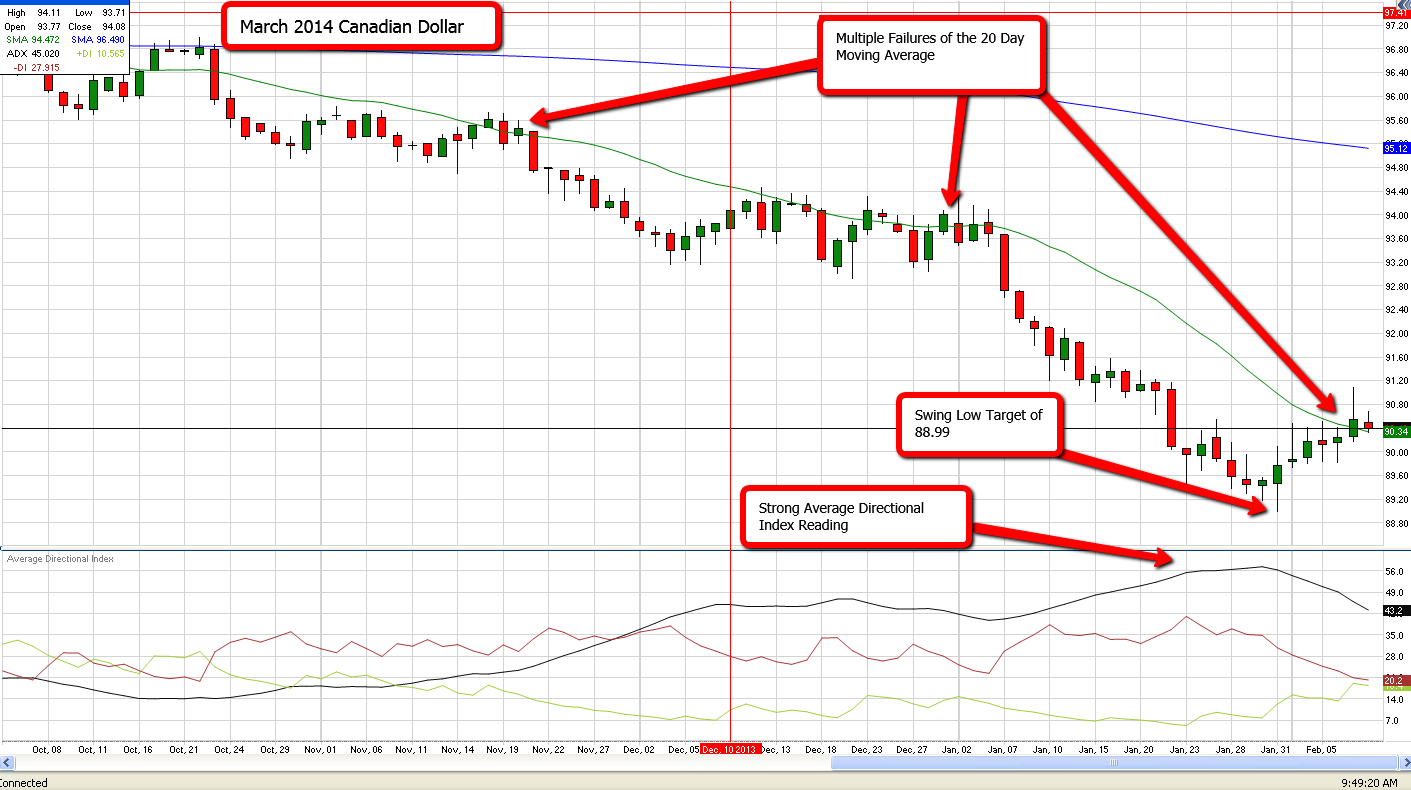
This week’s focus turns to the March Canadian Dollar futures, where recent down-trend market structure has given way to a possible continuation of the sell-off in coming days.  After posting a recent swing low of 88.99 on January 31st, the market has since experienced short covering off of the recent sell off.  Last week, we saw consolidation off of the recent short covering.  In weeks past, we have seen multiple tests, and failures, of the 20 day moving average, making this indicator a key resistance point.

As we open this week, if we see yet another failure of the 20 day moving average, traders will likely expect a sell off if the market breaches Friday’s low of 90.17.  Along with a strong average directional index reading, the March Canadian Dollar could have strong downside momentum in the near term.  If this scenario takes place, the likely target would be the March Canadian Dollar’s swing low of 88.99.  Continue reading "Chart of The Week - Canadian Dollar"

Chart to Watch - Corn Futures (CBOT:ZC.H14.E)

We've asked our friend Jim Robinson of profittrading.com to provide his expert analysis of charts to our readers. Each week he'll be analyzing a different chart using the Trade Triangles and his experience.

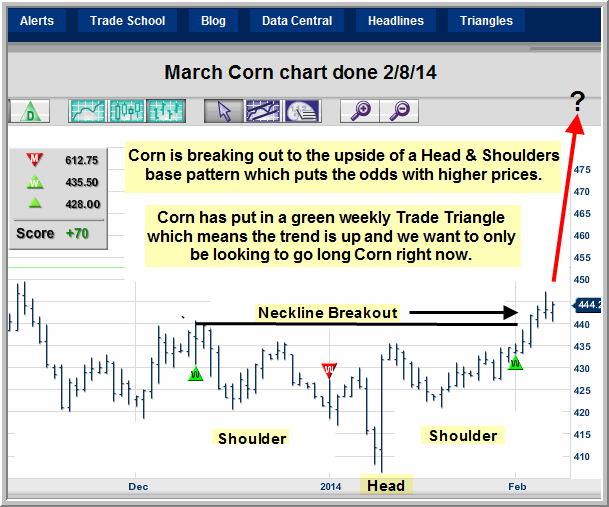
Today he is going to take a look at the technical picture of the March Corn Futures (CBOT:ZC.H14.E).

When trading futures with the MarketClub system you use the weekly Trade Triangles to tell trend and the daily Trade Triangles to time the trades.

With the trend up right now in Corn, you can buy on all new green daily Trade Triangles as long as the weekly Trade Triangle stays green.

With the growing season for March Corn Futures (CBOT:ZC.H14.E). just around the corner, there can be a number of weather scares, from too much rain, to not enough rain, any of which can drive the price of Corn higher.

Right now there looks to be great upside potential in Corn making this an excellent Chart to Watch!

Thanks,
Jim Robinson
Profit Trading.com

Many Are Betting on a Calm Market. We're Not.

Here's one good reason why: a historic market sentiment extreme

By Elliott Wave International

The DJIA, S&P and NASDAQ are struggling to bounce. Yet the bullish convictions remain high. Says a February 5 Investor's Business Daily headline:

"Why Mutual Fund Investors Need Not Panic After January Sell-Off"

When is the best time to get out of the stock market? When everyone else is invested and extremely optimistic. When is the best time to buy, then? Exactly: when you see the opposite sentiment.

Market sentiment is one indicator you don't hear much about on financial networks. Yet we've seen sentiment extremes repeat at every recent market top and bottom. What's more, as Robert Prechter, the president of Elliott Wave International, puts it, "the greater the degree of the advance that is ending, the greater the optimism at its peak."

This contrarian view of the market can be a financial lifesaver.

Below is an excerpt from Prechter's recent Elliott Wave Theorist, a monthly newsletter he has published since 1978. It shows you one way how Bob finds bearish and bullish extremes in the market. Continue reading "Many Are Betting on a Calm Market. We're Not."