
Trader's Whiteboard: Lesson 7

Do you know how to tell if a market has topped out? Has it hit the bottom? If you know how to look at your chart and pick out a flag or symmetrical triangle pattern, you may have your answer and be able to react accordingly.

In the seventh Trader’s Whiteboard Lesson, Adam illustrates two key continuation patterns that will tell you if the market has had a little hiccup or if it will be staying down for quite a while.

Watch today and add this tool to your “trading toolbox”.

Enjoy!

The MarketClub Team

Traders Toolbox: Learning Options Part 1 of 4 Revisited...

Trader's Toolbox

At MarketClub our mission is to help you become a better trader. Our passion is creating superior trading tools to help you achieve your goals -- no matter which way the markets move -- with objective and unbiased recommendations not available from brokers.

The Trader's Toolbox posts are just another free resource from MarketClub.

---
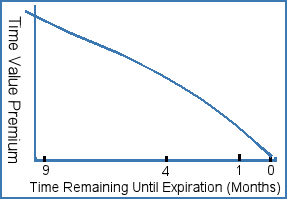
Options Part 1 of 4

"There are four components to an options price: underlying contract price, intrinsic value ( determined by strike price), time value (time remaining until expiration) and volatility. (A fifth element, interest rates, also can affect option prices, but for our purposes is unimportant.)Intrinsic value refers to the amount an option is in-the-money. With Eurodollar futures at 95.55, a 95.00 call has an intrinsic value of .55. The more an option is in the money, the greater its intrinsic value. At-the-money and out-of-the-money options have no intrinsic value.

Options are referred to as “wasting” assets because their value decreases over time until it reaches zero at expiration, a process called time decay. Time value refers to the part of an option’s price that reflects the time left until expiration. The more distance an option’s expiration date, the greater the premium because of the uncertainty of projecting prices further into the future..."

Revisit the Trader's Toolbox Post: "Learning Options Part 1 of 4" here.

Trader's Whiteboard: Lesson 6

How many times have you turned on your television or computer to see that Corporation XYZ is expected to make huge profits, but when you look at the chart it is telling you otherwise?

Who is right? How do you determine what to look at when you are preparing to enter a trade? Adam has put together this Trader’s Whiteboard video to explain the differences in information and to help you wade through the “noise”.

Click here to watch Lesson 6 in the series and tell us what you think about fundamentals, technicals, and market perception in the comments section.

Enjoy!

The MarketClub Team

Traders Toolbox: Money Management Part 4 of 4 Revisited...

Trader's Toolbox

At MarketClub our mission is to help you become a better trader. Our passion is creating superior trading tools to help you achieve your goals -- no matter which way the markets move -- with objective and unbiased recommendations not available from brokers.

The Trader's Toolbox posts are just another free resource from MarketClub.

---

"This is the final portion of the Trader’s Toolbox: Money Management series. This post will recap the 5 main rules discussed. If you missed our previous post please click here for : Part 1Part 2 or Part 3.

♦ Setting a goal - Decide what your trading objective is (quick profit and steady return) as well as your risk tolerance level

♦Diversification - If possible, allocate your finances between different products to avert the danger of getting wiped out in a single market. Don’t go overboard, though; think in terms of three to five unrelated instruments. Stick to markets you know, rather than risking the unknown for the sake of diversification...."

Revisit the Trader's Toolbox Post: "Money Management Part 4 of 4" here.

The MarketClub Minute - Lesson 8

What do all successful traders have in common? Today Adam shares what might be the most important facet in trading like the pros. This last minute in the MarketClub Minute series is a "can't miss"!

Click here to view Lesson 8 in the MarketClub minute series and find out what will keep you from avoiding a common downfall of new traders.

Best,

Adam and The MarketClub Team