Traders Toolbox: Gann Theory

MarketClub is known for our "Trade Triangle" technology. However, if you have used other technical analysis indicators previously, you can use a combination of the studies and other techniques in conjunction with the "Trade Triangles" to further confirm trends.

W.D. Gann was a trader in the early 1900s who devised a unique and complex trading method that parallels some of these other theories. His technique is sometimes referred to as geometric because of his use of the mathematical properties of certain geometric figures and angles to predict price behavior. Gann had a cyclic view of market behavior and placed enormous emphasis on proportional relationships between price and time. He believed market events occurred at intervals that could be determined mathematically. And like Elliott, he believed the relationships he “discovered” reflected the natural law of the universe.

Gann calculated price retracements on percentages derived from dividing price action into eights, i.e. 2/8 = 25%, 4/8 – 50%, etc. He also included the Dow and Fibonacci retracements of 1/3 (33%) and 2/3 (67%) in his list of key percentages. He constructed support and resistance lines (Gann lines) based on varying ratios of time units to price units. His most important trend line, plotted at 45 degrees (up from a market bottom or down from a market top) represents one unit of time movement per one unit of price movement.

He also placed lines with other time/price ratios, like 1:2, 2:1, 1:3. 3:1, etc. The angle of these lines corresponds to the strength and speed of a trend. As long as pries stay above (or below, depending on the direction of the trend) the 45-degree line, the trend will continue. Once prices break that line, they will theoretically proceed to the next line of resistance, 1:2 or 1:3, for example, as the trend is played out.

Gann determined “anniversary dates” for timing market events based on the degrees of a circle (30, 60, 90, 180, 360 days) as well as periods of 12 months and 144 days (144 is the only square Fibonacci number). For example, when a market made a high or low, Gann looked for another significant price milestone 144 days or a year in the future.

He also predicted future support and resistance points using “cardinal squares.” Starting with a low price for a contract, he spiraled prices clockwise around it on a grid until the prices reached the current trading range. Prices that fell on the “cardinal cross,” the perpendicular lines equivalent to the X and Y axes of a graph, represented probable levels of future support and resistance.

Gann techniques are most effective when used together. Instances in which a trend reversal corresponds to a previously calculated retracement ratio, a cardinal square price, an anniversary date and the breaking of a trend line would represent important market cycles.

---

You can learn more about the Gann Theory by visiting INO TV.

"Saturday Seminars" - Does A "Holy Grail" Really Exist ... And Should You Look For It?

In this workshop, John Hayden will examine if there were a "Holy Grail", what would be its characteristics and how would we know it was the "Holy Grail" if we did discover it? Before computers, men became great traders by studying human nature, history and acquiring all the relevant facts about a particular industry. The traders that read the "tape" were very aware of the psychology of other traders and the market.

Today we use the biographies and autobiographies of previous traders in conjunction with the study of what propels an individual to the top of his chosen profession. It is a fascinating study, one that strips away at many of the myths concerning what it really takes to become "one of the best."
The outcome of this talk is to empower everyone present so that they may take some of this new knowledge and immediately use it to increase their profitability. Every trader needs a way to perceive the marketplace; this "way" may be through technical analysis, fundamental analysis, or by trading in the "moment". However, before these techniques can be used the trader must master his own beliefs and thoughts. All traders look for certainty and desire courage and confidence. This is only possible by mastering one's beliefs, increasing ones virtues and decreasing ones vices.

Just a few of the topics that John will cover are:

-Confidence is required for success.

-Disciplined traders are consistently profitable.

-Doubt, hesitancy and indecision - a sure fire way to ruin.

-Developing a written strategy for trading your methodology.

John HaydenJohn Hayden is the Director of Risk Management for Directional Research & Trading Ltd. From 1998 to 1999, John worked for Lind-Waldock as a Managed Account Representative where he advised clients on Asset Allocation and Risk Control. Prior to that John Hayden was CEO of PGM Refining Ltd., a Colorado firm that specialized in the processing and refining of gold and platinum group metals where he hedged and traded inventories in the futures and cash markets. John was the founder and CEO of Continental Security Products Inc., a Colorado firm that imported high security equipment from England and other international sources. His clients included Fortune 500 companies, as well as many of the large jewelers in the United States.

In the spring of 1999, John Hayden wrote "The 21 Irrefutable Truths of Trading" which McGraw-Hill is publishing in May 2000. John started day trading stocks while in college in 1975, shifting his focus to commodities in 1992. He earned an A.A.S. degree in Business Administration from Dutchess College and studied Geo-politics at the University of Plano.

---

Saturday Seminars are just a taste of the power of INO TV. The web's only online video and audio library for trading education. So watch four videos in our free version of INO TV click here.

INO TV

Traders Toolbox: Elliott Wave Theory

MarketClub is known for our “Trade Triangle” technology. However, if you have used other technical analysis indicators previously, you can use a combination of the studies and other techniques in conjunction with the “Trade Triangles” to further confirm trends.

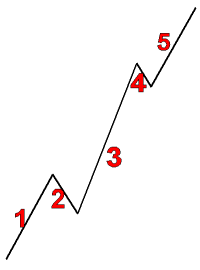
Elliott Wave Theory categorizes price movement in terms of predictable waves. Beginning in the late 1920s, R.N. Elliott developed his own concept of price waves and their predictive qualities. In Elliott theory, waves moving with the trend are called impulse waves, while waves moving against it are called corrective waves.

Impulse saves are broken down into five primary price movements, while correction waves are broken down into three. An impulse wave is always followed by a correction wave, so any complete wave cycle will contain eight distinct price movements. Breaking down the primary waves of the impulse/correction wave cycle into subwaves produces a wave count of 34 (21 from the impulse wave plus 13 from teh correction wave), producting more Fibonacci numbers.

Elliott analysis can be applied to time frames as short as 15 minutes or as long as decades, with smaller waves functioning as subwaves of larger waves, which are in turn subwaves of still larger formations. By analyzing price charts and maintaining wave counts, you can determine price objectives and reversal points.

A key element of Elliott analysis is defining the wave context you are in: Are you presently in an impulse wave uptrend, or is it just eh correction wave of a larger downtrend? The larger the time frame you analyze, the larger the trend or wave you find yourself in. Because waves are almost never straightforward, but are instead composed of numerous subwaves and minor aberrations, clearly defining waves (especially correction waves) is as much an art as any other kind of chart analysis.

Fibonacci ratios play a conspicuous role in establishing price objectives in Elliott theory. In an impulse wave, the three principal waves moving in the direction of a trend are separated by two smaller waves moving against the trend. Elliotticians often forecast the tops or bottoms of the upcoming waves by multiplying previous waves by a Fibonacci ratio. For example, to estimate a price objective for wave III, multiply wave I by the Fibonacci ratio of 1.618 and add it to the bottom of wave II for a price target. Fibonacci numbers are also evident in the time it takes for price patterns to develop and cycles to complete.

Never try and pick a bottom but look for the clues

Never try and pick a bottom but look for the clues

The action yesterday on the NASDAQ was particularly interesting as market movement resulted in a "gravestone doji," which is a Japanese Candlestick formation that often signals a turnaround.

What a "gravestone doji" means is that the buyers and sellers are in an evenly matched tug-of-war and potentially signals the first clues that the NASDAQ may be putting in an interim low.

Take a look at the chart and see what you think. If the NASDAQ market closes higher than yesterday's high point, which is 1,806, then there's a good chance that we'll see this market at least have what some traders call a dead cat bounce.

It is not profitable to try to pick the top or in this case a bottom. What you want to look for are clues that maybe, just maybe, the market is beginning to put in a low.

Japanese Candlestick charts are a fascinating form of charting as they represent both a visual and psychology view of the market.  If you're not familiar with this form of charting, INO.com will be happy to send you a e-book that explains most if not all of the major candlestick charting patterns. You can reach us at 1-800-538-7424, or email

se*****@in*.com


to ask for the candlestick e-book.

I know the e-book will help your trading as it did mine.

Every success in trading,

Adam Hewison
President, INO.com
Co-creator of MarketClub

General Motors plunges below $6 a share!!!

You might find this earlier post on GM very interesting given today's market activity.

First posted on June 27th.

"What is good for General Motors is good for America"

Back in 1955, Charlie Wilson, then chairman of General Motors Corp. made this somewhat pompous statement. Here we are, some 53 years later and look what is happening to the stock of General Motors (NYSE_GM). This stock is at a 53 year low and shows no signs of turning around.

So the question becomes, what happened to America and General Motors? How did this company lose its edge in the marketplace?

HOW DID GM GET IT SO WRONG?

Digging through the history of GM, I found one fascinating item. GM developed an electric car back in 1996 when gas was $1.28 a gallon! They named the battery powered car the EV1 and then basically scrapped it in 2002.

Today there is very little evidence that this car was ever in existence. I am sure you're thinking right about how we could sure use a car like that today with gas prices trading over $4.00 a gallon.

When you look at the stock of General Motors, you'll see that the high for the stock in the last eight years was around $68 in 2002. What's interesting is that high point in the stock was right around the time GM scrapped its EV1 car.

So what happened to GM's first electric car? GM claims there was not enough public demand. That could be, but I think the story is a lot more complicated than that.


You can see all the GM - Big Oil conspiracy theories in the movie

"Who Killed the Electric Car."

(Next Video)

WHY KILL THE GOLDEN GOOSE?

From a business standpoint, why would GM want to improve something that would kill the goose that lays the golden egg? General Motors tends to make most of its money on sales of replacement parts. Up to 40% of its profits come from selling replacement parts for existing GM automobiles, so why would they sabotage their own cash flow?

Unlike a gasoline driven car, which has many moving parts, an electrical car like the GM's EV1 has very few parts to go wrong, so therefore part sales and cash flow would go right into the tank for GM. The other perception problem GM has with an all electric car with zero emissions is this: if GM produces an all electric clean car with zero emissions, it's making an admission that all of their other cars are dirty, spew out harmful emissions and pollute the planet.

But look at how GM got it wrong. This may be one of the biggest blunders ever in American corporate history. GM took the lead in electric car technology (smart move), but was not convinced that they as a company could be profitable selling electric cars.

WHO OWNS THE MOST ADVANCE BATTERY TECHNOLOGY?

One fascinating piece of information is that GM acquired advanced battery technology from Ovonic's in the form of a NiMH battery. This battery produces a stronger, longer lasting charge, and was the ideal battery for their second generation of EV1 cars. What came out later was truly a shocker, GM sold this amazing battery technology along with the patent (dumb move) to Texaco who was later taken over by Chevron. Now Chevron owns the technology and the patent!

You have to ask yourself the question... why would an oil company be interested in purchasing advanced battery technology from a major car producer like GM?

I'll let you draw your own conclusions.

Fast forward to 2008 when everyone is mad as H#LL for having to pay over $4.00 for a gallon of gas. Back in 1996 when GM launched the EV1 with very little fanfare, the cost of gas was around $1.28 a gallon.

Why GM decided to scrap the EV1 and look for short-term profits in big cars as opposed to building and preparing to adopt a different business model is still a mystery and one that has decimated GM's stock price in the last five years.

The automobile business has not changed in almost a century and the industry appears reluctant to embrace change. It would now appear that GM's business model like many of its big cars is rapidly becoming outdated and destined for dinosaur land.

LET'S LOOK AT THE STOCK OF GM

Let's take a look at the GM stock chart and see how you would have fared had you purchased GM stock at $68 in 2003. Then let's look at the same stock using a MarketClub's proactive approach. As you can see the results of a buy and hold strategy have been a disaster losing 79% of its value for all share holders while the proactive results have been quite stellar.

If a major company like General Motors can fall to a 53 year low, so can any stock on the big board.

Readers of this blog know that MarketClub uses a proactive approach when taking positions in the marketplace. The world has changed, and it has changed not only for GM but for many other mature companies that are using business models and products that are rapidly becoming outdated and will prove to be noncompetitive in the long run.

Learn how to trade crude oil

Learn how to trade stocks

I'll finish by saying: "What is good for America in the long run, are smart businesses that embrace change." Maybe General Motors will get it, maybe they won't. The market will decide that one.

Adam Hewison

Co-Founder MarketClub.com