Jobs Report Dropped A Bombshell On The Markets

The non-farm payrolls report released last Friday dropped a bombshell on the market, revealing the US economy added 517K jobs in January 2023, surpassing expectations of 185K and the highest since July 2022.

Growth was seen in leisure and hospitality, professional and business services, health care, government, retail trade, construction, transportation and warehousing, and manufacturing. Despite tech layoffs and potential economic slowdown, the labor market remains tight, with November and December job numbers revised higher.

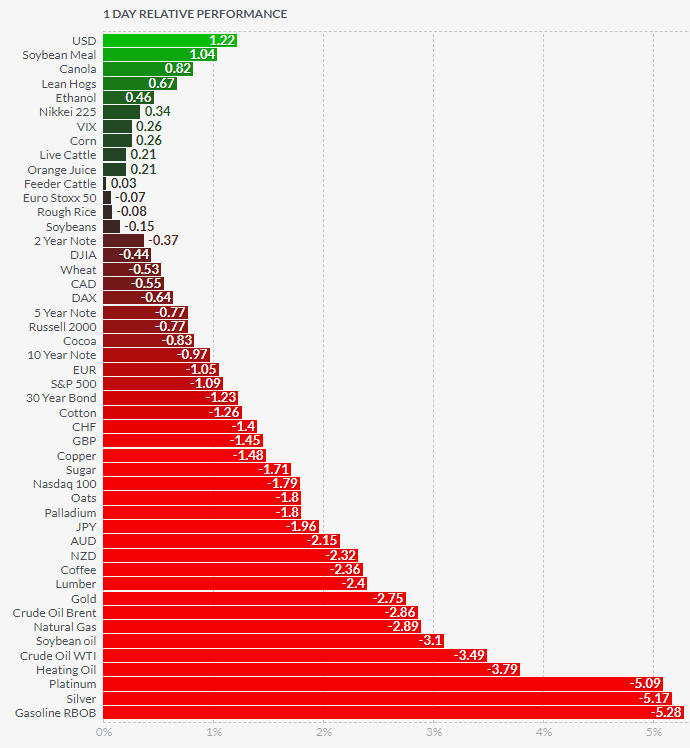
This was a real shocker that caused huge, unexpected waves of volatility in the markets. Let’s have a look at 1-day futures performance last Friday in the diagram below. It looks like a red sea with a small island covered in green grass.

1 Day Futures Performance

Chart courtesy: finviz.com

Gasoline, silver and platinum were the ultimate losers that day with massive losses of -5.3%, -5.2% and -5.1% respectively. Gold futures lost huge -2.8% as well. Palladium futures price plummeted -1.8%. Among metals, Copper futures were the most resilient at -1.5%. Continue reading "Jobs Report Dropped A Bombshell On The Markets"

Bullish or Bearish or BOTH???

Please enjoy this updated version of weekly commentary from the Reitmeister Total Return newsletter. Steve Reitmeister is the CEO of StockNews.com and Editor of the Reitmeister Total Return.

Click Here to learn more about Reitmeister Total Return


Why are so many investment experts still calling for a bear market?

And just as interesting…why are so many equally talented investors saying the new bull market is already here?

Because investing is an inexact science leading some to rely on economic data…while others prefer to read the charts…or the expression on Powell’s face… or astrology signs or….(fill in the blank with the nuttiest thing you can think of).

So what is an investor to do when there are so many well-reasoned opinions that are giving such contradictory conclusions?

That will be the focus of this week’s commentary.

Market Commentary

I believe the best way to tell this story is from a very personal place. That being where I have an Economics degree and most certainly diagnose the market from a fundamental point of view.

Early on in my career I used to make fun of chartist for playing the market like a video game instead of taking it more seriously with fundamentals. Yet that was quite foolish on my part as I have come to greatly respect many of the leading chartist like Kevin Matras of Zacks and JC Parets of AllStarCharts.com. There is simply no denying their keen insights on market direction.

Now let’s move the conversation forward to Wednesday’s Fed meeting. I was already bearish beforehand…as are the majority of market commentators at this time. And I became even more bearish after the announcement. Amazingly, others saw it differently as stocks 3% from the time of the speech into Thursday’s close.

I went to bad Wednesday night angry, confused, dejected, perplexed, and downright flummoxed.

But then something dawned on me in the early hours and could not get back to sleep. This led to the following trade alert that I sent out to Reitmeister Total Return members on Thursday morning. Continue reading "Bullish or Bearish or BOTH???"

AI - Do You Have It in Your Portfolio?

In late January, the world of artificial intelligence went mainstream when popular online media company BuzzFeed announced it was planning to use artificial intelligence software called API to help it generate content.

OpenAI, the company that created API, also made the more popular ChatGPT, released in November of 2022.

API and ChatGPT have been used to write emails and create quizzes and listicles. It has even been used to write reports on popular books and other essay-style assignments for high school and college students.

While we have all heard about the potential of artificial intelligence for years, BuzzFeed taking the plunge and using it to create content is a big deal.

For most of us, this is the first time we can say we are seeing the technology firsthand (well, at least that will be true when we see our first AI-created quiz or article).

Up until now, AI has to most people, just been a pie-in-the-sky idea that we weren't sure how it was going to affect our lives. Or how we would interact with AI technology on a day-to-day basis.

BuzzFeed using AI, makes it real now.

And now that it is real and not just a research project some technology company in California is spending money on, maybe now is a good time to put some real money into it.

Unfortunately, OpenAI, the creator of these AI chatboxes, is not publicly traded. But, a number of other companies are developing similar technology and are publicly traded.

However, since we are still very much in the infancy stages of AI technology, my suggestion is not to try and cherry-pick the AI winners today but bet on the idea that AI as a technology will prevail. The way to do that is with Exchange Traded Funds.

Exchange Traded Funds that buy companies developing artificial intelligence and robots will expose you to the whole industry but reduce your single stock risk. Let's take a look at a few ETFs that are focused on AI, and then you can decide which one is right for you. Continue reading "AI - Do You Have It in Your Portfolio?"

1 Tech Stock To Count On In 2023

Software giant Oracle Corporation’s (ORCL) second-quarter revenue and EPS exceeded Wall Street’s estimates. The company’s EPS was 3.2% above the consensus estimate, while its revenue beat analyst estimates by 2.1%.

The strength in cloud infrastructure and cloud-based applications drove a solid topline performance.

Its total cloud revenue, including infrastructure-as-a-service (IaaS) and software-as-a-service (SaaS), rose 48% year-over-year in constant currency to $3.80 billion.

IaaS revenue increased 59% year-over-year in constant currency to $1 billion.

Without the impact of the foreign-exchange rates, ORCL’s adjusted EPS would have been 9 cents higher.

ORCL’s CEO, Safra Catz, said, “In Q2, Oracle’s total revenue grew 25% in constant currency-exceeding the high end of our guidance by more than $200 million. That strong overall revenue growth was powered by our infrastructure and applications cloud businesses that grew 59% and 45%, respectively, in constant currency.”

“Fusion Cloud ERP grew 28% in constant currency, NetSuite Cloud ERP grew 29% in constant currency- each and every one of our strategic businesses delivered solid revenue growth in the quarter,” she added.

For fiscal 2023, the company expects its cloud revenue to grow more than 30% in constant currency compared to the 22% growth in fiscal 2022.

ORCL expects its revenue to rise 17% to 19% on a reported basis and 21% and 23% on a constant currency basis in the third quarter. Also, it expects adjusted EPS for the third quarter to be between $1.17 and $1.21, lower than the consensus estimate of $1.24.

ORCL’s stock has gained 13.3% in price over the past three months and 13.6% over the past six months to close the last trading session at $88.46.

The company paid a quarterly dividend of $0.32 on January 24, 2023. Its annual dividend of $1.28 yields 1.45% on the current share price. It has a four-year average yield of 1.59%.

Its dividend payouts have increased at a 10.1% CAGR over the past three years and an 11% CAGR over the past five years. The company has grown its dividend payments for eight consecutive years.

Here’s what could influence ORCL’s performance in the upcoming months:

Steady Topline Growth

ORCL’s total revenues increased 18.5% year-over-year to $12.27 billion for the second quarter that ended November 30, 2022.

The company’s non-GAAP operating income increased 4.8% year-over-year to $5.08 billion. Its non-GAAP net income declined 2% year-over-year to $3.31 billion. Continue reading "1 Tech Stock To Count On In 2023"

Two Dividend Payers In Low-Risk Buy Zones

It’s been a solid month for the market, with the S&P 500 (SPY) up 6% in January and another 1% to start February. However, the real winners have been growth stocks, with the Russell 1000 Growth Index Fund (IWF) up 10% year-to-date.

This broad-based rally has made it more difficult to find names trading at deep discounts to fair value, but there are still a few names that continue to look attractive, especially if one is looking to battle-harden and diversify their portfolio with high yields.

Given the violent pullback in natural gas prices and some disappointing company-specific news this week, TC Energy (TRP) and National Fuel Gas Company (NFG) have found themselves sitting near 52-week lows, placing them in a relatively low-risk buy zone to start new positions. Let’s take a closer look below:

TC Energy (TRP)

TC Energy is one of the largest North American energy companies. It is best known as the owner of the Keystone XL Pipeline (~2,900 miles) that transports Canadian/US crude oil supplies across North America and the ANR Pipeline, one of the largest interstate natural gas pipeline systems (~9,200 miles) in the US.

The company was founded in 1951 and continues to have one of the best dividend track records among its peers, consistently paying and growing its dividend over the past 22 years, from $0.80 in FY2022 to $3.60 in FY2022.

Unfortunately, while it is a steady dividend and earnings grower that has continued to diversify with a focus on adding renewables over the past few years, it has had a rough past year from an inflationary standpoint.

This is evidenced by the company having to raise the cost estimate for its Coastal GasLink Project in Western Canada to ~$11.0 billion, impacting its FY2023 capital spending outlook, which has come after already reporting a doubling of the initial cost estimate to ~$7.0+ billion six months ago.

The continued cost increases can be attributed to construction delays due to COVID-19 disruptions and protests, combined with higher costs for materials. Continue reading "Two Dividend Payers In Low-Risk Buy Zones"