Don't Let This Stock's Reputation Discourage You

Shares of investing app operator Robinhood Markets, Inc. (HOOD) have declined more than 70% since its blockbuster IPO in July 2021. Moreover, the stock has declined 42.5% year-to-date.

Pioneering zero-commission trading, Robinhood's mobile app garnered huge popularity among beginners during the height of the COVID-19 pandemic. The company was at the center of the never-seen-before frenzied trading activity in meme stocks.

However, the retail brokerage controversially restricted trading in GameStop (GME) early last year, allowing investors to only sell their positions and not open new ones. This led to significant outrage among its users.

Since the Fed’s aggressive interest rate hikes have kept the market under pressure this year, most retail investors have stayed away from trading, leading to revenue loss for HOOD.

However, this rise in interest rates is turning out to be beneficial for brokerage firms like HOOD as customers tend to be more moderate in seeking out yield from their brokers when compared to banks.

Although cash sorting is one of the reasons banks have not risen in tandem with the rise in treasury yields, brokerages, on the other hand, are relatively in a better place as the request for cash sweeps among their customers is comparatively lower.

According to Curinos’s CDA Wealth data, during the previous cycle of rising interest rates between late 2015 and mid-2019, yields on wealth accounts under $250,000 subject to cash sweeps rose only 10% as much as the Federal funds rate. On the other hand, online savings accounts and one-year certificate-of-deposit rates rose 58% and 80%, respectively.

In addition, as brokers do not indulge in longer-term lending like banks, their assets tend to be shorter-term. This is beneficial, especially in a rising interest rate environment when cash can be redeployed at higher yields. Continue reading "Don't Let This Stock's Reputation Discourage You"
Trade Like a Hedge Fund - 1 Stock They're All Buying

The much-talked-about acquisition saga of Twitter, Inc. (TWTR) is finally drawing to a close.

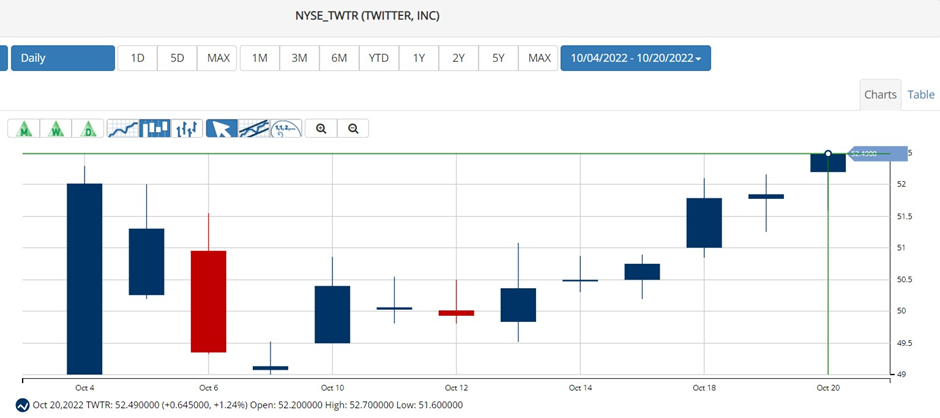
SpaceX founder Elon Musk finally agreed to buy the company for $54.20 a share. In a regulatory filing on October 4, Musk notified TWTR of his intent to go ahead with the initial agreed-upon deal to acquire the company and take it private. The stock jumped more than 22% on October 4, 2022, and has been on an uptrend since then.

TWTR Chart

Source: MarketClub

There has been no shortage of controversy as the two parties were scheduled to go to trial on October 17. TWTR had dragged the Tesla CEO to court after he informed the company of his intention to terminate the agreement in July.

Musk had backed out of the deal, stating that TWTR had failed to disclose the number of bots and spam accounts on its platform. He claimed that the company was misleading investors by misstating the number of bots on its platform by providing false numbers in its corporate filings with the SEC.

On July 12, 2022, TWTR filed a lawsuit against Musk, as his decision to back out of the deal had led to its investor sentiment tumbling. In the lawsuit, TWTR argued that having signed a binding agreement, he could not abandon it.

Just after Musk officially tried to terminate the deal in July, hedge funds Pentwater Capital and Greenlight Capital sensed an opportunity. They went long on the stock as there was a signed contract, and Musk could only pull out of the deal if there were fraud in TWTR’s financial statements or any material event that could change the company’s value. So, in the absence of these issues, Musk had no option but to honor the contract.

Greenlight Capital founder David Einhorn said, “Investing in something like Twitter, which I think will resolve this year, is good because I should get the cash out to redeploy into the next thing.” Continue reading "Trade Like a Hedge Fund - 1 Stock They're All Buying"

CDs Are Back In Style

For the past 20 years or so, old-fashioned saving has gone out of style. Back in the 1980s and 1990s, you could build a fairly respectable—and guaranteed—return on your retirement portfolio by buying bank certificates of deposit.

Since then, of course, we’ve encountered one seemingly endless economic crisis after another—the dot com bust, the 2001 terrorist attacks, the 2008 global financial crisis, and the 2020 Covid-19 pandemic—that have basically forced the Federal Reserve to lower interest rates to or near zero percent.

That policy, of course, largely destroyed the CD (certificate of deposit) market and forced savers, however reluctantly, to buy stocks instead, because There (Was) Is No Alternative, or TINA.

If you wanted to earn any kind of return on your portfolio, you really had no choice but to buy stocks, either directly or through mutual funds and ETFs.

And that strategy has paid off pretty nicely for most people over the past two decades, provided they could stomach the roller coaster ride that the stock market has put them through over that time.

Until now.

Now the Fed has suddenly re-discovered monetary restraint in the form of higher interest rates to slay the inflationary beast it helped to create.

Since the end of last year, when the Fed finally came around to the notion that inflation wasn’t transitory and signaled that the party was over, stocks and bonds have tanked. If your retirement portfolio is only down 15% or so since then, consider yourself lucky.

But there is a positive flipside to the Fed’s new hawkish interest rate policy, and that is that it is now fashionable—and financially savvy—again to start shopping in the CD market. (If you’re in the market to buy a house, however, with mortgage rates now at 7% and rising, I’m afraid you missed the boat.)

Instead of following the stock market’s gyrations, mostly southward, here’s something that might cheer you up a little. Visit the brokered CD page on Schwab or Fidelity or wherever your account is and take a look at the rates being offered. I think you’ll be both surprised and pleased. You’ll want to party like it’s 1999. Continue reading "CDs Are Back In Style"

Silver And Palladium Update: False Hope

The price action in the silver futures has given a false hope to bulls this month.

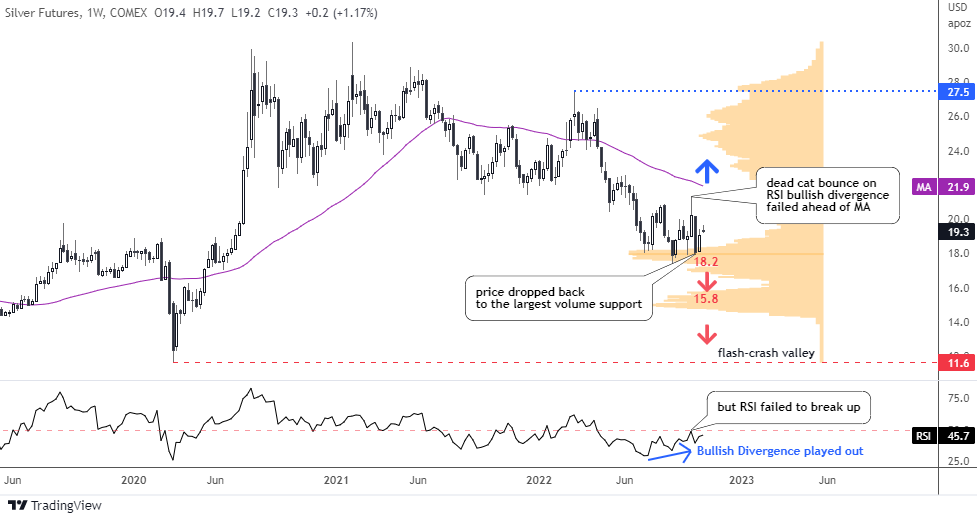
The largest volume support (orange) has offered a solid support for the silver futures price lately. It is located between $17.4 and $18.2. The price has tested it three times already and failed to break it down.

Silver Futures Weekly

Source: TradingView

The RSI has built a Bullish Divergence during the second touchdown at the end of the summer. The reaction was an imminent reversal to the upside. It was promising price action for the bulls as the futures price soared from $17.4 up to $21.3 by the start of this month to book the gain of almost four bucks (22% growth).

Afterwards, the same indicator has failed to break above the 50 barrier in spite of a strong impulse and so did the price rally. It stopped more than half dollar below the moving average (purple).

The price dropped back to the largest volume support after above mentioned failure but bounced then. It has managed to score more than one dollar from the latest valley of $18. This puts the silver futures between the hammer ($21.9, moving average resistance) and the anvil ($18, volume support).

The chart structure of the recent rally looks corrective. This means that the weakness of the price should resume. The next support is located at the following volume area of $15.8.

There are no other significant levels to catch the “falling knife” of silver except the “Flash-Crash” valley in $11.6. The drop to the latter could build a larger corrective structure visible on a bigger map.

The invalidation of the bearish outlook would come with the breakup of the moving average above $21.9.

Last time, your most popular answer was that silver futures would stop at $16. The next bid was bullish. None of the bets have played out as yet. Continue reading "Silver And Palladium Update: False Hope"

One Penny Stock Posting Extraordinary Gains

The Fed’s persistent hawkish stance to tame the stubborn inflation and the consequent increase in recession fears have led the widely-followed stock indices to witness massive sell-offs this year.

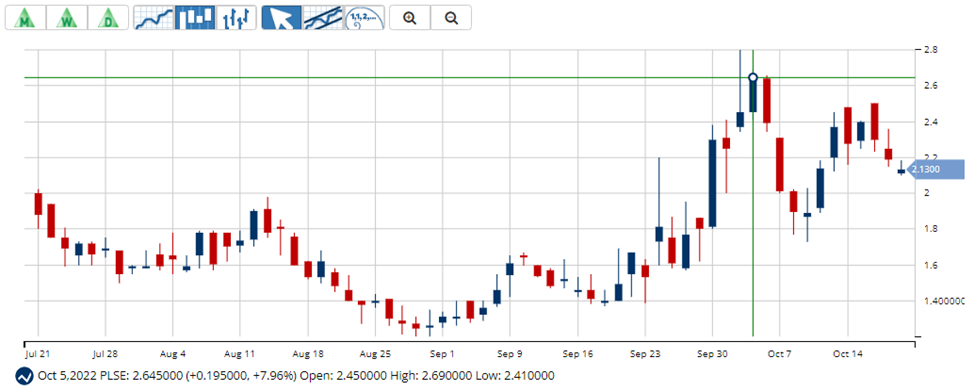
While most well-known names in the market got caught in the brutal sell-off, penny stock Pulse Biosciences (PLSE) witnessed a solid uptrend, gaining 54.3% over the past month and 11.9% over the past three months.

PLSE Chart

Source: MarketClub

PLSE operates as a novel bioelectric medicine company. It provides CellFX System, a tunable, software-enabled, and console-based platform used to treat various medical conditions using its Nano Pulse Stimulation technology.

The medical therapy company delivered impressive results for the second quarter that ended June 30, 2022. During the quarter, the company transitioned its commercial focus toward utilizing CellFX Systems in a select group of dermatology clinics. In addition, the company completed two commercial sales of CellFX Systems.

Furthermore, PLSE is expanding strategic opportunities within healthcare and anticipates a concentrated focus on the oncology, gastroenterology, and cardiac sectors.

PLSE is trading above its 50-day moving average of $1.73, indicating an uptrend. While the company is yet to turn profitable, Wall Street expects its loss to decline in the upcoming quarters, which could help the stock grab some more investor attention and maintain its momentum.

In terms of its forward EV/Sales, PLSE is trading at 73.74x compared to the industry average of 3.81x. The stock’s forward Price/Sales of 72.31x compares to the industry average of 4.25x.

Is it a good idea to buy shares of a loss-making company if it trades at a high premium to its peers but is trending upward?

View Results

Loading ... Loading ...

Here is what could influence PLSE’s performance in the upcoming months: Continue reading "One Penny Stock Posting Extraordinary Gains"