Best Performing ETF Group is Not What You Think

With just two months to go in 2022, the best-performing group of Exchange Traded Funds year-to-date may not be what you would have expected it to be when we started the year.

After a strong bull market rally coming off the march 2020 Covid-19 dip, most investors would have assumed stocks, mainly big technology stocks, would again be the market leaders in 2022.

However, the market never ceases to surprise, and as hindsight is always in 20-20 vision, it feels like we all should have seen the signs that 2022 wasn't going to be a good year for stocks and another asset class was going to dominate.

What asset class are we speaking of? Bonds! Well, to be more specific, shorting Treasury Bonds.

Shorting longer-dated Treasury bonds has been, hands down, the best trade of 2022. Whether you use leveraged and-or inverse products or not, shorting Treasury Bills has produced great results in 2022.

For example, the ProShares UltraPro Short 20+ Year Treasury ETF (TTT) is up 176% year-to-date and more than 50% over the last three months. Direxion's version of the same ETF, the Direxion Daily 20+ Year Treasury Bear 3X Shares ETF (TMV), is also up 176% year-to-date. The ProShares UltraShort 20+ Year Treasury ETF (TBT), which is a 2X leveraged inverse fund, is up more than 100% year-to-date.

Even the funds that short the shorter term Treasury bills, the 7-10 year term bills, like the Direxion Daily 7-10 Year Treasury Bear 3X Share ETF (TYO) and the ProShares UltraShort 7-10 Year Treasury ETF (PST) are up 66% and 42% respectively.

If you had run a screener at the beginning of the year for non-leveraged and non-inverse funds because the risk involved with those products are not necessarily in your comfort zone, you still could have bought the Simplify Interest Rate Hedge ETF (PFIX). PFIX holds over-the-counter interest rate options and US Treasury Inflation-Protected Securities or TIPS, and still produced a return of around 100% year-to-date.

So you may be asking how and why shorting longer-dated Treasury bills produce solid results when interest rates, Treasury bills, and bond yields are climbing higher. Well, it is a little complicated on the surface but pretty simple once you understand how it all works. Continue reading "Best Performing ETF Group is Not What You Think"
Two Growth Stocks to Buy on Dips

It’s been a volatile year for the major market averages, and the S&P-500 (SPY) has now corrected over 27% from its highs, suggesting we’ve seen the majority of the downside short-term.

This is based on the average recessionary bear market coming in at 34% and the S&P-500 now satisfying 80% of the average decline’s magnitude.

One of the most beaten-up areas of the market has been growth stocks, and with elevated pessimism finally increasing the likelihood of a short-term market bottom, this is the ideal time to be hunting for new ideas.

Unfortunately, not all stocks are created equal. While many growth stocks might be oversold, those still posting net losses per share and carrying high debt levels are extremely risky in a rising-rate environment.

However, for investors willing to dig through the rubble, two names stand out as extremely attractive, trading at significant discounts to fair value despite boasting strong earnings trends. In this update, we’ll look at two stocks that are solid buy-the-dip candidates:

Boot Barn (BOOT)

Boot Barn (BOOT) is a small-cap growth stock in the Retail/Apparel industry group that has enjoyed near triple-digit sales growth, increasing revenue from $180MM in fiscal Q1 2020 to $299MM in fiscal Q1 2023.

This has been accomplished by industry-leading same-store sales growth rates and continued unit growth (73 new stores opened), which is supported by the company’s continuously improving unit economics. For example, the company’s average sales per square foot have improved from a prior target of $170/square foot to over $400/square foot, increasing its payback period from three years to one year for new stores.

At the same time as sales have continued to increase at double-digit levels and it’s grown its store count to 330, the company has enjoyed growth in exclusive brand penetration, providing a significant boost to annual earnings per share.

This is because its private-label brands carry much higher margins, allowing BOOT to nearly quadruple annual EPS from FY2020 to FY2022 ($6.18 vs. $1.55). These are phenomenal growth rates, and with plans to grow its store count by over 12% this year, this growth story is still in its early innings.

Unfortunately, the stock has been crushed year-to-date (down 56%) due to the negative sentiment for the Retail Sector (XRT) and the company’s lukewarm comments in fiscal Q2 2023 guidance. Continue reading "Two Growth Stocks to Buy on Dips"

Health Care Stocks You'll Wish You Bought Sooner

The latest inflation data has further aggravated recession worries. With inflation still hovering near its multi-decade high, the odds of the Fed proceeding with its fourth consecutive 75-bps interest rate hike are pretty high. The consequent increase in recession fears has dampened the market sentiment significantly.

However, healthcare companies enjoy demand and margins resistant to inflation and recession. The inelastic demand for healthcare products helps these companies generate stable revenues regardless of inflationary pressures and consumers’ spending cuts amid a recession.

Moreover, the demand for healthcare products and services could rise further due to the increased need to serve aging Baby Boomers and the increasing frequency and severity of chronic conditions.

According to a report published by Health Affairs, national health spending is expected to reach $6.8 trillion by 2030.

Hence, given ongoing macroeconomic turbulence and uncertain outlook, one could make the most of the strong uptrend in healthcare stocks Eli Lilly and Company (LLY), Merck & Co., Inc. (MRK), and Biogen Inc. (BIIB) by investing in them.

Eli Lilly and Company (LLY)

LLY discovers, develops, and markets human pharmaceuticals worldwide. With a market capitalization of $314.88 billion, the company provides diabetes, oncology, neuroscience, and other products.

Over the last three years, LLY has grown its revenue at a 10.3% CAGR, while the company’s EBITDA has grown at a 13.3% CAGR.

For the second quarter of the fiscal year 2022 ended June 30, 2022, LLY’s worldwide revenue stood at $6.49 billion. Excluding revenue from Alimta, the sale of the company's rights to Cialis in China in Q2 2021, and COVID-19 antibodies, the company’s revenue grew 6% year-over-year. LLY’s operating income and net income came in at $1.21 billion and $952.50 million, respectively. Its non-GAAP EPS came in at $1.25.

The consensus revenue estimate of $30.30 billion for fiscal 2023, ending September 2023, represents a 5.2% improvement year-over-year. Also, Street expects LLY’s EPS to grow 16.3% year-over-year to $9.28 during the same period.

LLY’s stock is trading at a premium, indicating high expectations regarding the company’s performance in the upcoming quarters. Regarding forward P/E, LLY is trading at 41.69x, 122.7% higher than the industry average of 18.7x. Also, it is trading at a forward Price/Sales multiple of 10.98 compares to the industry average of 4.25. Continue reading "Health Care Stocks You'll Wish You Bought Sooner"

2 Overly Traded Stocks to Avoid This Fall

Stubborn inflation, rising interest rates, and consequent market volatility have kept many investors on edge. Inflation shows no signs of slowing, despite the Fed’s aggressive monetary policy tightening.

The consumer price index increased 0.4% sequentially in September, beating the Dow Jones estimate. The headline inflation was up 8.2% on a 12-month basis, hovering near the highest levels in decades.

The surging inflation and hot employment data for September strengthen the case for the Fed announcing a fourth 75-basis-point interest rate hike in next month’s meeting. Given these circumstances, the Conference Board sees a 96% chance of a recession in the United States over the coming 12 months, which might begin before the end of 2022. Moreover, the board projects 2022 real GDP to grow 1.5% year-over-year and 2023 growth to zero percent.

Since the economic headwinds are expected to keep the stock market under pressure, overly traded stock Pfizer Inc. (PFE) and Snap Inc. (SNAP) could be best avoided now, with their intermediate and long-term trends being down.

Pfizer Inc. (PFE)

Popular drugmaker PFE discovers, develops, manufactures, and distributes biopharmaceutical products worldwide. The pandemic made PFE one of the world’s most watched stocks, thanks to its COVID-19 drugs and vaccines. The stock has a market capitalization of $240.55 billion.

Although the company has recently announced some promising deals, acquisitions, and FDA approvals, the stock has declined 27.4% year-to-date, underperforming the S&P 500’s 23% decline. The stock has been underperforming the broader market, with investors pricing in the expected sales decline that the company might experience due to an anticipated slowdown in Covid vaccinations in the near term.

For the fiscal second quarter that ended June 30, 2022, PFE’s revenues increased 46.8% year-over-year to $27.74 billion. However, the company’s revenues largely leaned on sales of its Covid-19 vaccine Comirnaty and its antiviral treatment Paxlovid. The Covid-19 vaccine brought in $8.80 billion in revenue in the second quarter, while sales of Paxlovid totaled $8.10 billion.

Adjusted net income attributable to PFE common shareholders rose 93.5% from the year-ago value to $11.66 billion, while adjusted EPS grew 92.5% year-over-year to $2.04.

Wall Street analysts expect PFE’s revenues to decline in the about-to-be-reported quarter, which ended September 2022. The consensus revenue estimate of $21.33 billion for the fiscal third quarter indicates an 11.5% year-over-year decline. Continue reading "2 Overly Traded Stocks to Avoid This Fall"

Gold Update: The Breakdown

It’s all about persisting inflation at the end of the day. All markets watch how the Fed tries to fight it as aftershocks of rate decisions are observed in bonds, stock market, foreign exchange, precious metals and even crypto.

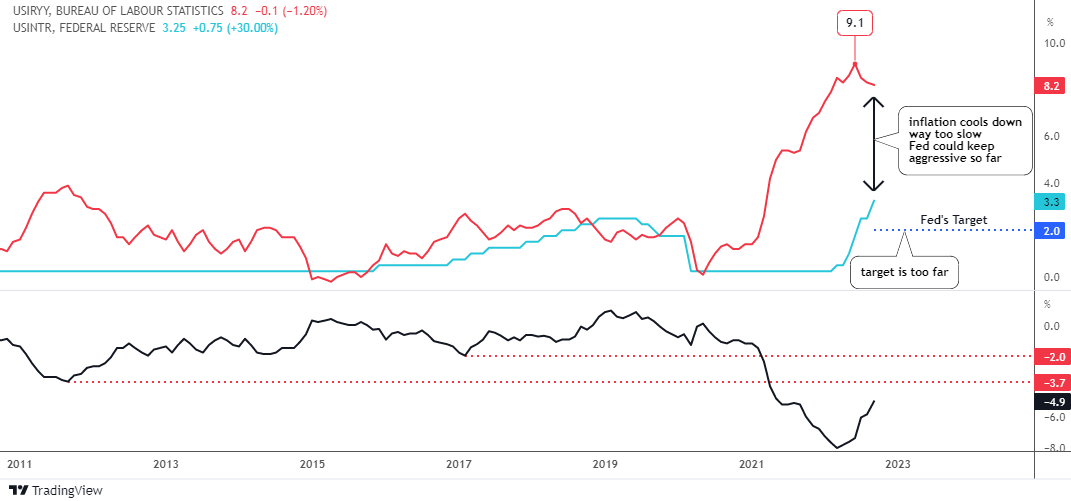
US Inflation vs Fed Rate vs Real IR

Source: TradingView

The graph above visualizes that “fight of the night”. Indeed, we witness some progress of the Fed’s efforts in the falling U.S. inflation (red line) numbers from the peak of 9.1% in the summer down to the latest data of September at 8.2%, which was still above the expected 8.1%.

The 3% increase of the Fed rate (blue line) brought inflation down only by 0.9%. It is way too slow, as the inflation target of 2% is still way too far, hence the Fed could keep their aggressive tightening mode.

Surely, there is a time lag between the Fed action and the inflation reaction. However, the time is ticking away as inflation is like a fire - the earlier it's extinguished the better.

The real interest rate (black line, down pane) crossed over the August top above the -5.1%. The next resistance is at -3.7% (valley of 2011) and it is highly likely to be hit soon as it is only 1.2% away. The valley of 2017 in -2% is almost 3% away, which means a huge Fed rate hike or a big drop of inflation. We can’t rule it out anyway.

Where do you see the yearly U.S. inflation by the end of the year?

View Results

Loading ... Loading ...

Indeed, these interest rate projections above could make precious metals life tough. Let's check the gold futures chart below. Continue reading "Gold Update: The Breakdown"