ETF Explores New Signals Behind Corporate Profitability

There are many factors in play when it comes to a company's ability to succeed and reward shareholders.

One of the most difficult factors to measure has been human capital.

Current accounting methods treat human capital as a current or future expense.

Real estate and production equipment add to the balance sheet. However, a highly-skilled (and well-paid) workforce just detracts from profit and value.

In short, measuring the value of human capital in a business has been downright impossible. How do you quantify who has the best employees or how driven the employees are to drive corporate success?

How do you know when employees feel engaged, feel empowered to innovate, and feel like both the management and the mission align with their values?

Famed author and behavioral economist Dan Ariely is a founding member of Irrational Capital. This investment research firm that has unlocked the connection between companies with a high level of human capital and success in the marketplace.

Irrational Capital's Human Capital Factor (HCF) Index has the potential to change how businesses are valued forever. Continue reading "ETF Explores New Signals Behind Corporate Profitability"

New ETFs Worth Knowing About

Over the last 25 years, Exchange Traded Funds have seen incredible growth in the number of offerings. The increase is due to the high demand from investors, and because of this, ETF issuers are constantly coming up with new products they feel investors will want.

For example, in September this year, we saw 53 brand-new Exchange Traded Funds offered to investors. As you can see, this seems like issuers are essentially throwing a lot at the wall to see what will stick and what will not.

For the individual investor, it can be hard to dig through all the new offerings and determine which are viable investments and which are unlikely to produce market-beating returns. Today I will point out a few recent ETFs that I think are worth digging deeper into and, at the very least worth knowing, are available for investors to buy.

The first is the Direxion Daily Electric and Autonomous Vehicles Bull 2X Shares ETF (EVAV). This ETF is a two-times leveraged investment focused on the electric vehicle and autonomous driving industry.

We recently saw New York state following California's lead, which will not allow new gas-burning vehicles to be sold in the state starting in 2035. With two of the largest states in the country moving towards banning sales of internal combustion engine-powered vehicles, the only option drivers will have in those states is to buy electric vehicles, pushing demand for EVs higher.

Furthermore, it is unlikely that all states in the US will make these laws with the same timeline, the year 2035, but it is hard to deny that other states won't follow along in some form or fashion.

It also should be noted that the mass adoption of EVs is still probably years away. So while you look at EVAV, investors need to remember that it is a leveraged product. Meaning contango will occur, and thus EVAV is not an investment that should be held for long periods of time.

If you are looking for an ETF that you can buy today and have for decades to come, something like the iShares Self-Driving EV and Tech ETF (IDRV) would be an excellent place to start looking.

Next, I would like to point out the Defiance Daily Short Digitizing the Economy ETF (IBIT). The IBIT is an actively managed fund-of-funds that will offer inverse exposure to the Amplify Transformational Data Sharing ETF (BLOK). BLOK is an ETF that owns companies focusing on blockchain technology. Continue reading "New ETFs Worth Knowing About"

Restaurant Stocks: "David vs Goliath"

It’s been a rough year thus far for the restaurant industry, with a pullback in traffic, higher costs due to commodity/wage inflation, and a challenging environment for some companies from a traffic standpoint.

The result is that much of the group has become un-investable, and some names are looking worse by the month, including Red Robin (RRGB), which will post its third straight year of heavy net losses in FY2022.

Given this backdrop, the best strategy is to focus on the industry leaders and those with proven business models enjoying unit growth and still enjoying strong restaurant-level margins.

However, in a sector where there are still several names with these attributes, it’s tough to decipher which are the best to own. In this update, we’ll compare newly public restaurant operator First Watch (FWRG) with long-time franchiser Dominos Pizza (DPZ) and see which is the better name to own in the current environment.

Scale & Business Model

Dominos and First Watch are akin to David and Goliath from a scale standpoint, with Dominos being the largest pizza company globally with ~19,300 restaurants and First Watch being an emerging breakfast chain with ~450 restaurants.

The differences in the business model are also night and day, with Dominos being a 98% franchised model with a significant international footprint and First Watch being a primarily company-owned company model, with just 22% of its restaurants being franchised currently.

While Dominos’ operators have seen some headwinds due to elevated cheese prices and difficulty securing drivers from a margin standpoint, Dominos is more inflation-resistant than First Watch, given its franchised model where operators bear the brunt of higher costs.

The good news is that First Watch still has very respectable restaurant-level margins, even if they dipped 440 basis points in the most recent quarter. Besides, this margin erosion was largely due to a conservative pricing approach to maintain its value proposition. Plus, as its alcohol mix grows and it’s rolled out to 100% of the system, we could see some additional benefit from a margin standpoint.

That said, Dominos is the clear winner from strictly a margin standpoint, with 30% plus gross margins and double-digit operating margins vs. First Watch at 21% and 4%, respectively, on a trailing-twelve-month basis.

Domino’s Pizza - 1 / First Watch - 0 Continue reading "Restaurant Stocks: "David vs Goliath""

An Auto Parts Winner in a Greener Future

The global auto industry is in an all-out drive toward a cleaner and greener future.However, for some suppliers to the auto industry, it has not been a pleasurable joyride.

Instead, current conditions are more like driving on a icy, treacherous mountain road in the middle of a blizzard. Only the most skilled drivers will make it to the bottom of the metaphorical mountain intact.

Tough Sledding for Auto Suppliers

Most auto suppliers are already feeling a squeeze due to rising energy prices and rampant inflation in other parts of the supply chain. They have little choice but to shoulder most of the extra costs of making their components sustainable to help the automakers meet their environmental targets.

And make no mistake: the carmakers are pushing their suppliers hard. For example, Reuters reports that BMW expects all of its battery and many of its steel and aluminum providers to produce materials made using renewable energy, while Volvo Car is targeting 25% recyclable plastic in its cars by 2025.

Consequently, many suppliers to the automobile industry are making large investments to “green” their companies, doing everything from developing recyclable parts to using renewable energy.

Simultaneously, many of these same firms have little leeway to raise the prices they’re charging automakers, which are themselves focused on reducing costs. Automakers are spending tens of billions of dollars to shift their focus to producing electric vehicles.

This difficult situation faced by the auto parts industry was summed up nicely by Joe McCabe, CEO of the research firm AutoForecast Solutions, who told Reuters: “We use the term disruptive all the time, but it’s much more than just disruptive. We’re going to see a real big shakeout the next five, 10 years in the auto supply chain.”

In other words, the auto industry’s move to a greener future, alongside the supply-chain problems that began during the pandemic and soaring costs, has killed the profit margins for auto parts suppliers and created a perfect storm for the industry.

It is likely that only the strongest and shrewdest companies will survive this extinction event in the sector. The rest will go the way of the dinosaur.

One company that I believe will survive is TE Connectivity (TEL). It is able to pass along price increases to its customers, and it pays a dividend, too. Continue reading "An Auto Parts Winner in a Greener Future"

Inflation Continues To Spiral Higher

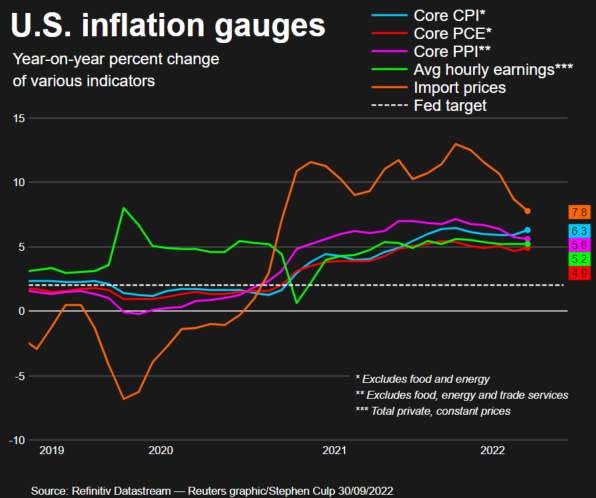
Key reports released last week in both the United States and the Eurozone revealed what global citizens have been acutely aware of. Inflation continues to spiral higher and at a staggering level.

This prompted Credit Suisse to issue a dire global economic outlook, saying that the “worst is yet to come”.

US Inflation Gauges

The Commerce Department released the latest inflation numbers vis-à-vis the PCE that revealed that the Core PCE jumped 0.6% in August. It shows that inflation is still intense and increasing.

The preferred gauge used by the Federal Reserve, the PCE (Personal Consumption Expenditures Price Index) revealed that inflation accelerated even more than expected in August. On a year-over-year basis, the core PCE which omits food and energy costs increased 4.9%, above projections of 4.7%. Continue reading "Inflation Continues To Spiral Higher"