Ride the Crypto Dip with this Bitcoin ETF

In late June, the ProShares Short Bitcoin Strategy ETF (BITI) began trading. BITI is the first inverse or ‘short’ Bitcoin exchange-traded fund in the US. The purpose of this ETF is to give investors a way to profit if the price of Bitcoin falls.

The fund didn’t seem to be well received the first day it was available to investors, but in just its first nine days of trading, it grew its assets enough to make it the second-largest Bitcoin-focused ETF listed in the US. The largest is ProShares Bitcoin Strategy ETF (BITO), which has over $680 million in assets while BITI has just around $59 million in assets under management.

There is really nothing super special about BITI other than the fact that it is the first time investors can short Bitcoin with an exchange-traded product specifically designed to do just that task. However, the timing of BITI being released on the market is interesting, to say the least.

First, Bitcoin just wrapped up its worst month in the 12 years that it has been traded on exchanges. Yes, you read that correctly. June 2022 was the worst month Bitcoin has had in 12 years. Bitcoin lost 38% of its value in June. Let that sink in.

Since Bitcoin peaked in November of 2021 at $69,000, the cryptocurrency is now down around 71%. (This is not the worst decline Bitcoin has had; in 2018 during the last ‘crypto winter’ Bitcoin lost more than 80% of its value.

Furthermore, a recent report about Bank of America’s internal customer data shows that the number of active crypto users has dropped by 50%, from 1 million in November 2021, to below 500,000 in May 2022.

The price of Bitcoin and other major cryptocurrencies has been crushed lately, but so has the number of active users. These two numbers are likely interconnected, but also show that the public's interest in Bitcoin, and perhaps even other cryptocurrencies, is waning.

And lastly, the SEC just denied the application to convert the Grayscale Bitcoin Trust (GBTC) into a spot bitcoin ETF. Many believe that if and when the SEC allows a spot Bitcoin ETF, new investors will flood the markets since many believe the structure of a spot ETF is much better than a futures-based ETF.

This leads us back to the idea that the timing for the Bitcoin Short ETF was interesting, or just even straight bad. Now granted, ProShares filed with the Securities and Exchange Commission to offer this Bitcoin short ETF back in February 2022, but that doesn’t help the fact that it didn’t hit the market until after a lot of bad news and low prices have hit Bitcoin and the rest of the cryptocurrency industry.

If ProShares had come to market with the Bitcoin short ETF just a few months or even weeks prior, investors could have caught a wave of bad industry-wide news, like the collapse of a stablecoin and a number of crypto firms falling into financial troubles, needing cash infusions or announcing layoffs.

With Bitcoin down 71% from its peak, or 38% in just June alone, investors have to be asking themselves if the world's largest cryptocurrency has fallen too fast and/or too far.

How much more room does Bitcoin have to go? From $20k a coin to $10k? Maybe even $5k? Or have we seen the bottom at $17k?

It is hard to say where Bitcoin goes from here, especially in the short term. But it isn’t very easy to get short or go long an investment after it has already made a big move in that direction, such as getting short after it's already down 38% in a month and 71% since November.

With that all said, beggars can’t be choosers. We didn’t have a short Bitcoin ETF before, and now we do. So, while the timing may not have been ideal, it is good to know that some investors are already taking advantage of this opportunity.

But, more importantly for me, I like knowing that I now have a viable option to short Bitcoin if and/or when I may find the opportunity to do so.

Matt Thalman
INO.com Contributor
Follow me on Twitter @mthalman5513

Disclosure: This contributor did not hold a position in any investment mentioned above at the time this blog post was published. This article is the opinion of the contributor themselves. The above is a matter of opinion provided for general information purposes only and is not intended as investment advice. This contributor is not receiving compensation (other than from INO.com) for their opinion.
'Anti' Markets

These daily charts are flipped over to a view that is ‘anti’ their normal selves.

I have often referred to the improbably bullish (to many; NFTRH has tracked and respected the bullish dollar for a year now) US dollar as an anti-market, the liquidity collector from the global liquidity-driven and speculative mess created by the Fed and its fellows.

But here is a look at some markets (ETFs & indexes) in their opposite or ‘anti’ suit. In other words, here are some charts flipped over. If the chart is bullish the underlying asset/market is technically not.

The major risk in my opinion is in the over-hyped inflation trades as inflation signals fade. That means commodities, mainly. But also Materials, Financials and other areas thought to be ‘reflation’ sensitive and highly cyclical.

While the environment that is developing should be positive for gold and especially its miners, reality is often a different matter in the short-term. As noted in the previous post and in the recent interview with the Daily Gold, that reality, if past is prologue, is that some significant number of gold mining investors are wrongheadedly in it for inflation. If the inflation trades do fail then gold stocks tend to be vulnerable at first.

The hope against the crash scenario would be that the post-2020 correction has mitigated the damage the inflation herds will do when they give up the inflated ship. But hope is not an investing strategy.

Personally, with all of this in motion I am staying balanced and open minded. No dogma or robot thinking. Just day to day, week to week and letting it play out (with the odd minor mental whipsaw here and there). Continue reading "'Anti' Markets"

Stocks are NOT Out of the Woods

I get the distinct feeling that a lot of investors are feeling like the action last week in the equity markets may be a harbinger of good things to come. In other words, we might be out of the woods.

As much as I’d like to believe that I can’t jump on board. I still feel there’s more downside pain to come for stocks, tech, and other risky assets like Bitcoin (BTC) and crypto. But before I tell you why, let’s take a win, no matter how ugly it is.

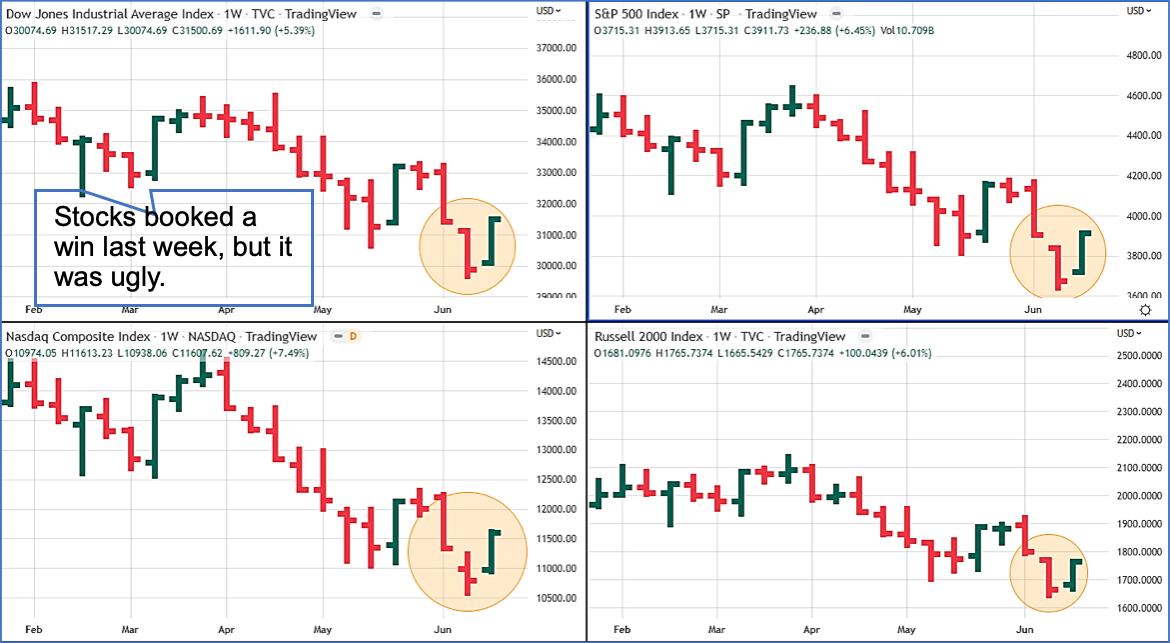
Fact is, across the board last week equity markets were up. See for yourself…

Weekly Charts

Source

As you can see from this collection of multiple weekly charts, stocks booked a win last week. The Dow was up 5.4% and the S&P 500 - a good proxy for the broader stock market - was up 6.4%. Meanwhile, the Russell 2000 - a good gauge of all stocks - was up 6%. And probably most surprising of all, the tech-heavy Nasdaq was up 7.5%.

In addition, last week’s action in all four the indexes reversed multi-week slides. It was the first positive week in four weeks for the Dow, the S&P, and the Nasdaq. For the Russell 2000 it was the first up week in the last three weeks.

But as you can see from the above charts, last week’s action was an anomaly compared to the action we’ve been seeing over the recent past. In fact, if you take the above charts and drill out to what’s been happening over the past year, it’s clear the overall trend in all these markets is bearish. No ifs, ands, or buts.

As I warned about in my article at the beginning of June, the scant positive weekly action in these markets is now confirmed as little more than a series of “dead cat bounces.”

If you remember, a dead cat bounce can masquerade as a reversal to the upside. But it’s only a temporary reprieve and quickly resumes its prior downtrend. Unfortunately, that’s what we’ve been seeing in all these stocks markets. And while I’d love to be wrong on this point, the numbers don’t lie.

Stubborn Inflation Means More Downside

But it’s not just these technical patterns that tell me the markets have more downside pain to come. The other huge factor pressuring stock prices: Inflation and what it will take to bring it under control. Here’s what I mean.

In general inflation can drive investors to sell stocks. And that because inflation wears away at the value of invested dollars. If your money is worth 8.6% less this year that it was last year, nobody is happy.

But the biggest reason inflation drives investors to sell stocks is that that the “medicine” that’s needed to bring inflation down - higher interest rates - can have unpleasant side effects.

Fact is if higher rates do their jobs and bring prices down, companies have less money to do the things that investors want, like sell more goods, expand operations, and develop new products. And if companies aren’t doing what investors want, those investors sell their shares.

Result: A bear market like we’re seeing right now.

But as unpleasant as that is, not bringing inflation down is much, much worse. In fact, inflation can decimate entire economies. The last thing we want is to look in the rear-view mirror and see the current inflation rate of 8.6% as “the good old days.”

That’s why as unpleasant as the side effects of higher interest rates can be, the Fed must do everything in its power to get inflation under control. But don’t take my word for it: Here’s what Fed chairman Jerome Powell told Congress last week in his testimony and semiannual monetary policy report:

I will begin with one overarching message. At the Fed, we understand the hardship high inflation is causing. We are strongly committed to bringing inflation back down, and we are moving expeditiously to do so. We have both the tools we need and the resolve it will take to restore price stability on behalf of American families and businesses. It is essential that we bring inflation down if we are to have a sustained period of strong labor market conditions that benefit all. Source

So far, so good. What exactly are they going to do about it?

Over coming months, we will be looking for compelling evidence that inflation is moving down, consistent with inflation returning to 2 percent. We anticipate that ongoing rate increases will be appropriate; the pace of those changes will continue to depend on the incoming data and the evolving outlook for the economy. We will make our decisions meeting by meeting, and we will continue to communicate our thinking as clearly as possible. Our overarching focus is using our tools to bring inflation back down to our 2 percent goal and to keep longer-term inflation expectations well anchored. Source

So, what does this tell me? With benchmark target fed funds rate now at a range of 1.5% to 1.75%, it’s clear that that’s just the beginning. More interest rate increases are coming. In fact, I think the Fed won’t slow down until it hits 3.5% and higher.

In addition, I now think the Fed is willing to take on a higher risk of recession in exchange for lower inflation. In fact, during his testimony Powell said that a recession could be in the cards: “It’s not our intended outcome at all, but it’s certainly a possibility … we are not trying to provoke and do not think we will need to provoke a recession, but we do think it’s absolutely essential” that prices come down. Source

Here's What to Do

There’s no doubt about it: Until inflation gets under control, rates will continue to go up. The Fed is making it clear that they’re going to do everything in their power to control rising prices.

And that means that there’s likely more downside to stocks as well as other risky assets like Bitcoin (BTC) and other cryptocurrencies. So, I wouldn’t be adding to any positions right now. And as always, don’t devote any more than 1% to 2% of your portfolio to crypto of any kind, including BTC.

Stay safe,
Wayne Burritt
INO.com Contributor

Disclosure: This contributor may own cryptocurrencies, stocks, or other assets mentioned in this article. This article is the opinion of the contributor themselves. The above is a matter of opinion provided for general information purposes only and is not intended as investment advice. This contributor is not receiving compensation (other than from INO.com) for their opinion.
Three Gold Miners on Sale

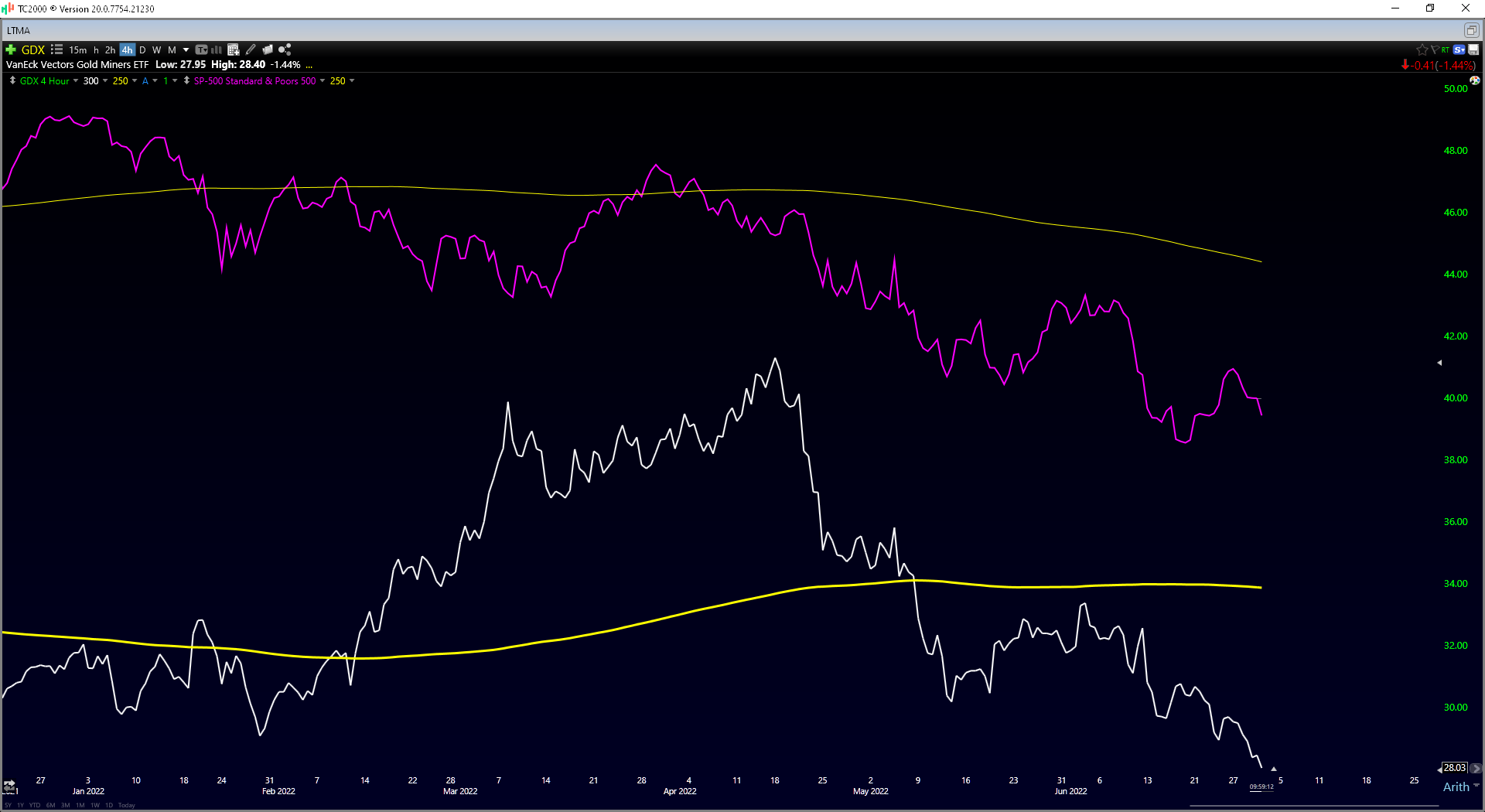
Disgust. Despair. Robbed. These are just a few of the emotions likely felt by investors in the Gold Miners Index (GDX), which are looking at the ETF trade at the same level it did over two years ago when the gold price (GLD) sat below $1,525/oz.

Worse, this pathetic performance has occurred in a period when the Federal Reserve has been its most dovish in years ahead of the past two meetings.

Now, staring down the possibility of two additional rate hikes, it's understandable that investors are on pins and needles, worried about the effect of additional rate hikes on gold and the miners. As the saying goes, though, it's always darkest before the dawn, and with sentiment arguably the worst in years, I believe this has presented some opportunities in the gold miners.

GDX Chart

Source: TC2000.com

With the Federal Reserve's mission being to stamp out multi-decade inflation readings, they've adopted one of their most hawkish stances in years, planning to raise rates four times this year.

Conventional wisdom would suggest that does not make owning gold very attractive with an alternative (higher interest rates) suddenly available.

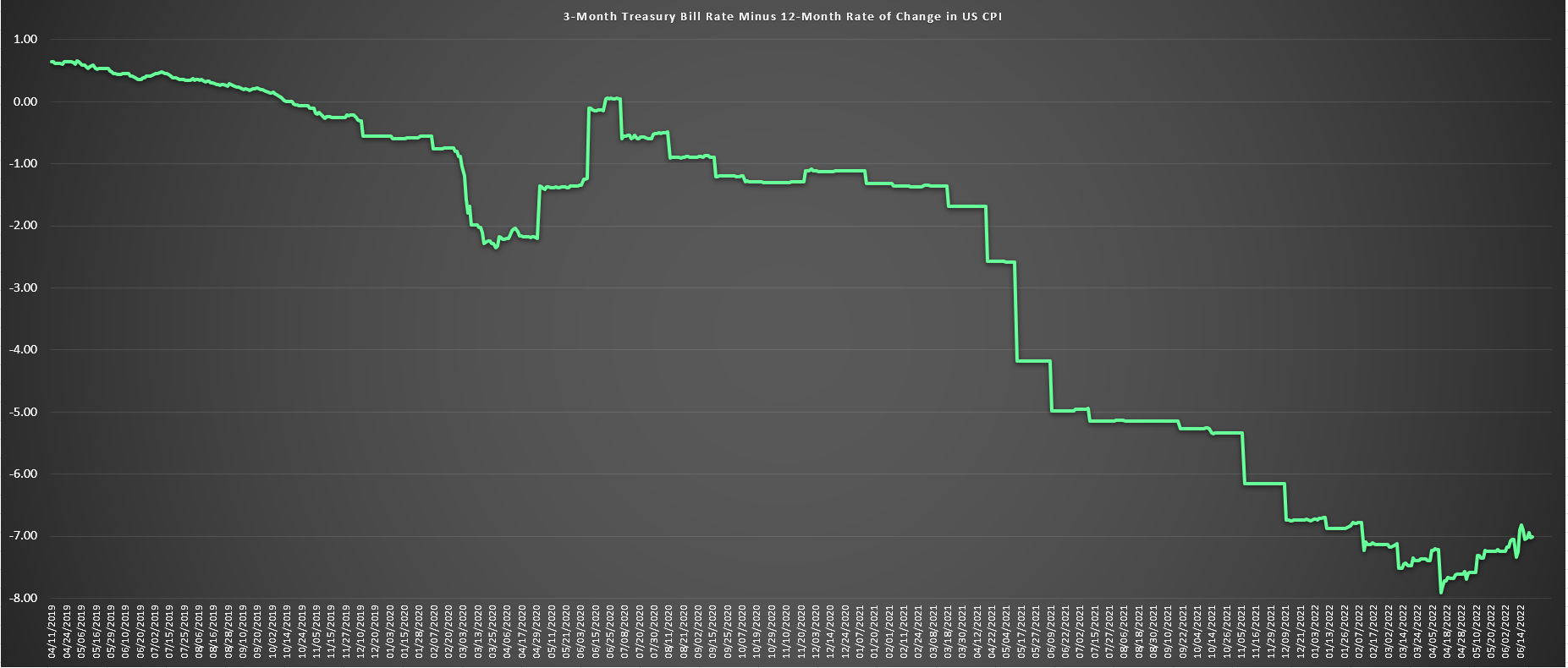
However, the more important metric to watch is real rates, defined as the three-month treasury bill minus the current inflation rate. When real rates are in negative territory, gold tends to perform its best, given that there is a cost to not owning gold.

Real Rates

Source: Real Rates, YCharts.com, Author's Chart

Despite the recent rate hikes, this key indicator continues to sit deep in negative territory, hovering near (-) 7.00%. This means that even if investors are getting a better interest rate, it's being eaten away by inflation, it's which is likely to remain above 5.0%.

So, why gold miners? Gold producers mine and process gold for those unfamiliar, and they provide significant leverage to the gold price. Historically, owning them over the metal hasn't made much sense, given that they didn't pay dividends and had much higher beta to the gold price, and lacked growth.

However, for once in a decade, many of the best producers have low debt, are paying 3.5% plus dividend yields, and have growth. This makes them far more attractive than the gold price, getting leverage on the metal while being paid to wait.

Let's look at three names that stand out from a quality standpoint.

Agnico Eagle (AEM)

Agnico Eagle (AEM) is the third-largest gold producer globally, on track to produce 3.3 million ounces of gold in 2022 at all-in sustaining costs [AISC] below $1,030/oz. This makes it one of the highest-margin producers and the lowest-risk, given that it operates in the safest jurisdictions globally with 11+ mines.

Notably, AEM recently added two ultra-high-grade mines to its portfolio and the largest gold mine in Canada: Detour Lake. The company did this by merging with one of the best growth stories in the sector, Kirkland Lake Gold.

In most circumstances, I would avoid a large producer like Agnico Eagle, but the company has one key differentiator from its peers after its recent merger, which is growth.

To date, the company has not given any firm targets or long-term production guidance, but given the company's solid pipeline, which leverages existing infrastructure, I see a path to annual production of 4.3 million ounces of gold by 2029. This would represent 30% growth from current levels, 2500 basis points higher than its peer group of multi-million-ounce producers.

While most gold producers will rely on the gold price to increase earnings and free cash flow looking out over the next six years, AEM will not. Despite this growth, the company trades at its largest discount to net asset value in years, with
what I believe to be a fair value of $78.00 per share.

So, with the stock hovering below the $48.00 level, AEM is my favorite way to get gold exposure currently, especially with a 3.4% dividend yield.

Royal Gold (RGLD)

Another name that recently moved onto the sale rack is Royal Gold (RGLD), the third-largest precious metals gold/streaming and royalty company.

Unlike Agnico Eagle, Royal Gold makes an upfront payment to gold developers and producers, and in exchange, it receives a portion of the production over the project's life. This protects the company from inflationary pressures, which is essential at a time of rising costs like we're seeing currently.

Royal Gold reported attributable production volume of 88,500 gold-equivalent ounces [GEOs] in Q1 and is on track for up to 340,000 GEOs this year.

However, with a solid organic growth pipeline, there is a meaningful upside to this outlook over the next few years, with the potential for 410,000+ GEOs per annum, which is a change from the past few years when the company was in its investment phase and lacked growth.

Despite this attractive growth outlook and 80% plus margins, Royal Gold currently trades at just 25x FY2023 earnings estimates vs. its historical earnings multiple of 50x earnings (20-year average). Even using a more conservative multiple of 38x earnings, which is easily justifiable for a company with 80% margins and recurring revenue, I see a fair value of $162.20. So, with the stock currently sitting below $108.00, this looks like an attractive buying opportunity.

Karora Resources (KRRGF)

Karora Resources (KRRGF) is the riskiest name on the list, sporting a market cap of barely $400 million and being a sub-150,000-ounce gold producer in Australia. However, it also has the most upside by a wide margin and looks very attractive for a small bet.

The reason is that it boasts one of the most impressive organic growth profiles, on track to increase production from 120,000 ounces in 2022 to 220,000 ounces by 2026. The company expects to achieve this by adding a second decline at its Beta Hunt Mine and using additional processing capacity from a recent mill purchase north of the mine.

Like AEM, this will allow Karora to grow earnings and free cash flow meaningfully regardless of the gold price, with any gold price upside being a bonus. So, with the stock trading at less than 1.3x FY2025 revenue estimates, this pullback below US$2.60 looks like a gift.

Final Thoughts

The gold producers are a high-risk area of the market, but once every couple of years, there's a fat pitch, and they get sold down to levels where they trade at massive discounts to fair value.

After the most recent decline in the GDX, we have reached this period, and I see the potential for a 25% plus upside over the next 9 months in the sector while collecting a 3.0%+ dividend yield in names like AEM. Hence, I see AEM, RGLD, and KRRGF as attractive ways to diversify one's portfolio.

Disclosure: I am long AEM

Taylor Dart
INO.com Contributor

Disclaimer: This article is the opinion of the contributor themselves. Taylor Dart is not a Registered Investment Advisor or Financial Planner. This writing is for informational purposes only. It does not constitute an offer to sell, a solicitation to buy, or a recommendation regarding any securities transaction. The information contained in this writing should not be construed as financial or investment advice on any subject matter. Taylor Dart expressly disclaims all liability in respect to actions taken based on any or all of the information in this writing. Given the volatility in the precious metals sector, position sizing is critical, so when buying small-cap precious metals stocks, position sizes should be limited to 5% or less of one's portfolio.

Consumers Are in a State of Shock

As the Fed continues to posture future rate increases to battle inflation, recent economic data shows consumers are in a state of shock as price factors continue to skyrocket. Food, gas, materials, etc have shot up in price over the past 24 months – with no end in sight.

Consumers Are Recoiling Away From Traditional Spending Habits

The natural reactions of consumers fall into two categories: Grow or Survive. This is similar to how plants and trees operate. In healthy environments, plants and trees enter a growth phase – flowering and prospering. In an unhealthy environment, plants and trees enter a survival phase – directing resources toward anything essential for survival.

Global inflation is putting pressure on central banks to thwart excesses in the markets after 8+ years of easy money policies and nearly 2+ years of COVID stimulus. Consumers thus seemed to have switched into Survival mode very quickly over the last 6+ months. This reaction could have very telling outcomes for global GDP and regional economies over the next 24+ months.

In August 2021, we published an article highlighting the shift in consumer activity. It brings attention to how important Consumers are to the overall health of the global economy.

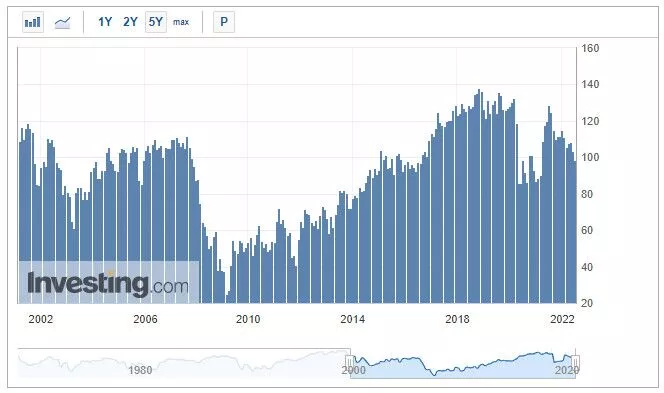
Consumer Confidence Dips Below 100

After the 2008-09 GFC, Consumer Confidence took more than 5 years to rally back above the 100 level (in 2015). The 2015-16 range was a US Presidential election year cycle – which usually disrupts US economic activities a bit.

In early 2017, Consumer Confidence started to rally higher – eventually reaching a peak in October 2018 near 137.90. Historically, the only other time Consumer Confidence reached higher levels was in 1998-99 (DOT COM Peak).

U.S. CB Consumer Confidence

Source

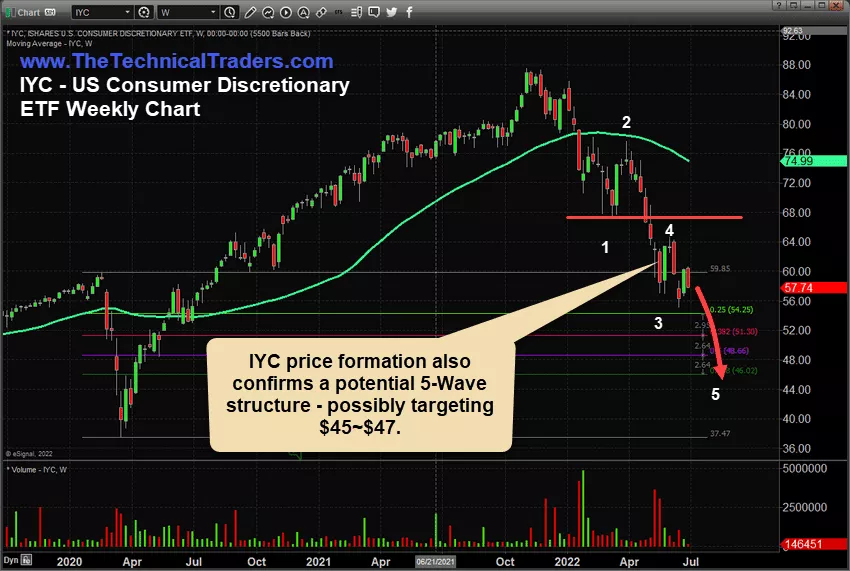
IYC May Start A Wave-5 Downtrend – Targeting $45-47 As A Base

Traders should consider the broader scope of the market trends while attempting to understand the opportunities that will come by waiting out the risks of trying to buy into a falling market. The Fed has clearly stated they intend to continue raising rates to break the inflationary cycle. Consumers will reflect these new risks by moving further away from traditional spending habits (Survival Mode) while attempting to wait out the risks to the environment.

It appears IYC has formed a moderate Wave-4 peak, which is below the Wave-1 bottom. From a technical perspective, it appears IYC will attempt to move below the $47 level over the next few weeks – attempting to establish a new base/bottom.

IYC Weekly Chart

US Real Estate Showing Signs Of A Top

No matter how you slice the data, more homes are flooding the US markets right now. Sellers are trying to “cash-out” at sky-high prices. Yet, buyers are staying very cautious because of rising interest rates and borrowing costs. Price Reductions on listed homes have risen to the highest levels over the past 8+ years. Sellers with homes on the market longer are aiming to tempt buyers with a discount. The race to the bottom has started. The Fed is going to add more fuel to the declines with another rate increase.

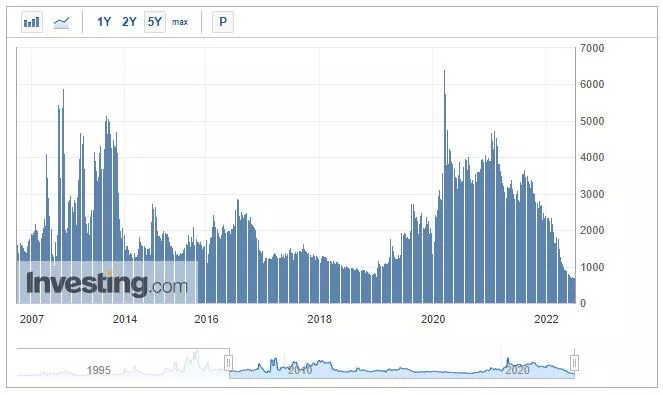
Recent Mortgage Refinance Index data shows the current 726.1 print is the lowest level since July 2000. This means the purchase and refinance are the most unfavorable for buyers over the past 22+ years (not since the peak of the DOT COM bubble).

Mortgage Refinance Index

Source

A reversion of home prices is almost a certainty at this point. I suspect a surge of new foreclosures and slowing sales will compound with layoffs and other economic contraction trends to present a “perfect storm” type of reversion event.

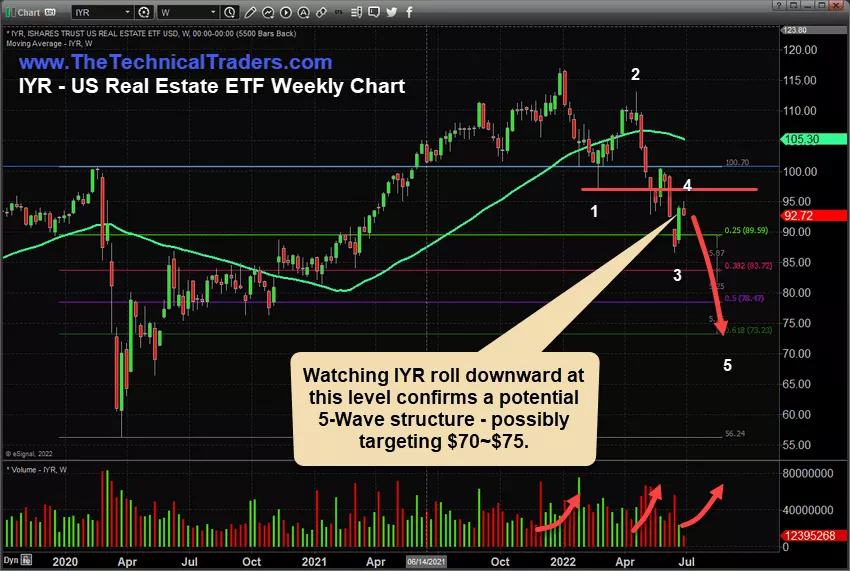
IYR Targeting $70 to $75 As Assets Unwind

IYR is likely to continue trending lower, targeting $70 to $75, before finding any real support. The reversion of asset valuation levels is still very early in the process of the Fed attempting to battle inflation. Depending on how the global markets react to the overall economic environmental change, we could see an extended contraction in assets lasting well into 2023 – possibly into 2024.

Traders should stay cautious of trying to chase the falling market trends. Real opportunity for profits exits when the reversion event is complete and when opportunities for less volatile extended trends resume.

IYR Weekly Chart

Protective Patience May Be The Best Trader/Investor Attitude Right Now

The US markets are already down by more than -25% overall. Any extended decline from current levels could push many traders/investors into a crisis. When the bottom sets up and is confirmed, we’ll begin to allocate capital back into sector trends. In the meantime, we avoid this massive drawdown event by waiting on the sidelines and being ready to deploy capital.

My strategies pulled capital out of the markets very early in 2022. Since then we have been sitting in CASH as a protective market stance while the global markets continued to decline. Protecting capital is the first rule for any trader/investor. Learning when to trade and when to be patient should be rule #2.

As Consumer Confidence continues to decline, Consumers have moved into a protective/patient (Survival) mode. Traders and Investors should consider the longer-term risks of not adopting a similar stance right now.

Learn more by visiting The Technical Traders!

Chris Vermeulen
Technical Traders Ltd.

Disclosure: This article is the opinion of the contributor themselves. The above is a matter of opinion provided for general information purposes only and is not intended as investment advice. This contributor is not receiving compensation for their opinion.