How To Spot The End Of An Excess Phase - Part 2

In Part I of this research article, my research team and I highlighted the five unique components of an Excess Phase peak and breakdown process. We are sharing this data with you because we believe the US stock market has already meandered 2.5 years past the end of a US Stock Market Appreciation phase and is well into an Excess Phase Peaking process. This becomes very important for traders because risks are much higher in these late Excess Phase stages because volatility is usually 4x to 6x higher than previous phases. Additionally, psychologically, many traders want the rally to continue and deeply believe the end of this phase is “just a pullback in a bigger trend”. This can be very dangerous as traders sometimes continue to buy into deeper price corrections – leveraging their accounts to the hilt thinking “they are going to make a killing when the rally resumes”.

Exploring Past Excess Phase Peak/Breakdown Events

Excess Phases and Blow-Off Peaks/Bottoms can become very addictive for certain people – especially those that have gotten into the trend before the Excess Phase began. These people are often “die-hard” believers that the trend will never stop rallying and can sometimes leverage themselves into very dangerous positions.

If you recall from the first part of this research article, there are five phases to the Excess Phase price decline and we believe each of these five phases is fairly common for all excess phase breakdowns: Continue reading "How To Spot The End Of An Excess Phase - Part 2"

Disney Becoming A Streaming Juggernaut

Disney continues to exceed all expectations in the streaming space accelerated by the stay-at-home COVID-19 environment. The Walt Disney Company (DIS) has been posting phenomenal streaming numbers that have thus far negated the COVID-19 impact on its other business segments, specifically its theme parks. Disney has had to shutter all its worldwide Parks and Resorts, and ESPN has been hit with the cancellation of virtually all sports worldwide. There’s been ebbs and flows with reopening efforts across the globe with mixed results followed by rolling lockdown measures. Despite the COVID-19 headwinds, Disney’s streaming initiatives have been major growth catalysts for the company. Disney+’ growth in its subscriber base has shifted the conversation from COVID-19 impact on its theme parks to a durable and sustainable recurring revenue model. This streaming bright spot, in conjunction with the optimism of its Park and Resorts coming back online, has been a perfect combination as of late. Disney+ has racked up 73.7 million paid subscribers, Hulu has 36.6 million paid subscribers, and ESPN+ has 10.3 million paid subscribers. Disney now has over 120 million paid streaming subscribers across its platforms. Disney+ has been wildly successful via unleashing all of its content (Marvel, Star Wars, Disney, and Pixar) in what has become a formidable competitor in the ever-expanding streaming wars domestically and internationally. Hence the tug-of-war on Wall Street between COVID-19 impacts versus the success of its streaming initiatives, with the latter winning out. Thus far, its streaming success has changed the narrative as its stock is approaching highs not seen since February. Disney is a compelling buy for long-term investors as its legacy business segments get back on track in 2021 in conjunction with these successful streaming initiatives.

Seeing Though COVID-19

Disney’s business segments will inevitably come back online as COVID-19 subsides worldwide, and widespread vaccination programs are rolled out. Disney’s theme parks will reopen over time, as seen with phased reopening efforts. Inevitably, movie productions will resume, movie theaters and theme parks will reopen to full capacity, and sports will return to pre-COVID formats. The resumption of all of these activities will feed into Disney’s legacy businesses in conjunction with its streaming successes. Disney continues to dominate the box office year after year with a long pipeline of blockbusters in the queue. Its Parks and Resorts continue to be a growth avenue with tremendous pricing power outside regardless of COVID-19. Disney is going all-in on the streaming front and acquired full ownership of Hulu. The company has launched its Disney branded streaming service with tremendous success with kudos from Netflix’s (NFLX) CEO Reed Hastings himself. I feel that the company offers a compelling long-term investment opportunity given its growth catalysts that will continue to bear fruit over the coming years despite the current headwinds. Continue reading "Disney Becoming A Streaming Juggernaut"

How To Spot The End Of An Excess Phase - Part 1

If you have been following my team’s research posts recently, we have highlighted some interesting new research related to Appreciation/Depreciation phases in the US stock market and how that relates to Gold. Today we will explore another method of identifying the different phases of market trends that appears to show very clear Appreciation/Depreciation phases and extended end-phase blow-off tops and bottoms.

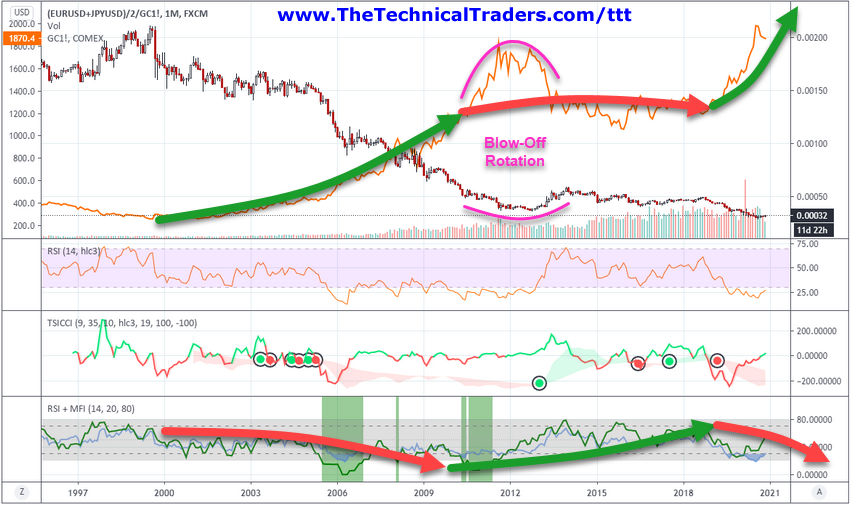
My research team and I believe the current rally in the US stock markets represents an end-phase blow-off top after a 9.5-year Appreciation phase that began in mid-2009. We believe it is very important for traders to understand these larger Appreciation/Depreciation cycles and how the Blow-Off end phases often create extreme volatility and price rotation.

Below, we are using a custom EURUSD/JPYUSD index divided by GOLD as the base Candlestick chart and have applied the real Gold price levels on the chart for visual reference. Near the bottom of the chart, we are showing the RSI indicator, the TSICCI indicator, and the RSI + MFI Indicator that helps to highlight the broad market trends and cycle phases. We want you to pay attention to the GREEN and RED arrows we’ve drawn on this chart showing the Appreciation/Depreciation phases of Gold and the broader US stock markets in EUR/JPY currency form. This method of charting these phases takes a bit of patience and understanding. We are looking for correlations to US stock market trends in relation to precious metals, and we must consider the end-phase process.

Excess Phase

The end-phase process, after any appreciation or depreciation phase, often includes a very volatile “blow-off” period where trends continue beyond the end of the actual price phase. This happens because the momentum of the previous price move has yet to realize the transitional shift in underlying appreciation/depreciation factors. Traders still want the rally in the stock market or metals to continue, so they chase after the excess phase rally until the momentum of the move fails. Continue reading "How To Spot The End Of An Excess Phase - Part 1"

Facebook's Moat Undeniable

Facebook (FB) is fresh off a strong earnings report, which underscores its massive moat in the social media space. Facebook has faced several public relations challenges over the past couple of years (i.e., Cambridge Analytica, coordinated boycotts, government inquiries into privacy, jumbled earnings calls, and anti-competitive testimonies). Exacerbating these public relation issues has been the COVID-19 backdrop, both domestically and abroad. As companies scale back advertising spending amid the COVID-19 pandemic, Facebook continues to grow across all business segments, with its user base continuing to expand slowly. Facebook’s moat is undeniable, and any meaningful sell-off could provide an entry point for the long-term investor.

Recent Advertising Boycotts

Facebook faced a very public onslaught of companies joining an advertising boycott across its social media platforms. However, its latest earnings suggest that this effort may have been largely symbolic and virtually inconsequential to its revenue and growth numbers. The advertising boycott had grown to roughly a thousand groups and multinational companies. This presented a unique challenge that still has the potential to weigh heavier on the company since this boycott will directly impact revenue as overall compliance/security expenses swell. The magnitude of this boycott may inevitably influence the stock price if this movement expands in sheer numbers and duration. However, as advertising spending is abandoned indefinitely until further notice due to this boycott and overall spend slows due to COVID-19, this culmination could cast uncertainty around its stock valuation. Continue reading "Facebook's Moat Undeniable"