March Was A Month Of Ups And Downs

Hello traders everywhere. March was a month of weekly ups and downs with two weeks to the positive and two weeks to the negative, but at the end of the month, the stock market will end in positive territory with the exception of the DOW. In fact, it will close out a strong first quarter to start the year.

Both the NASDAQ and S&P 500 will post monthly gains for +2.4% and +1.54% respectively, meanwhile, the Dow will post a monthly loss of -.3%. On a quarterly level, all the indexes will post gains for the first quarter of 2019. The S&P 500 checks in with a gain of +12%, the Dow +10%, and the NASDAQ will post the biggest quarterly gain of +16%. Quite a start to the year.
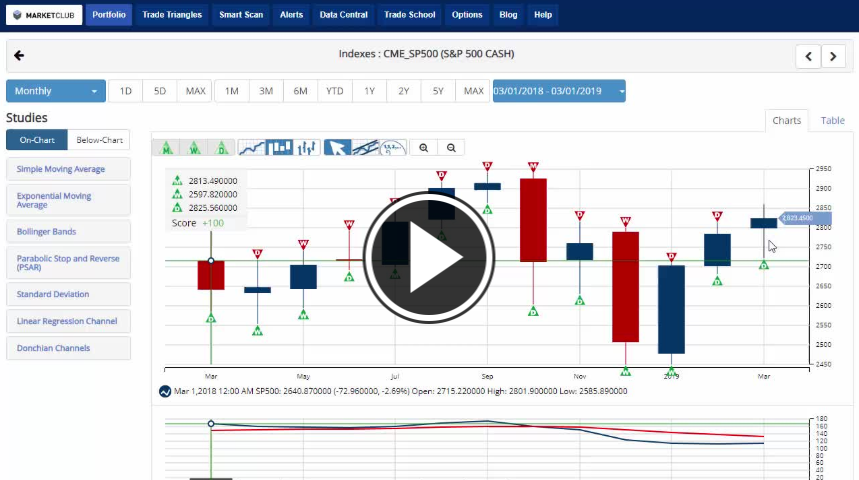
quarterly gain

After starting off the year slowly losing -.49% in January the U.S. dollar bounced back with consecutive monthly wins gaining +.90% in March. The two winning months pushed the dollar to +1.1% gains for the first quarter of 2019. Continue reading "March Was A Month Of Ups And Downs"
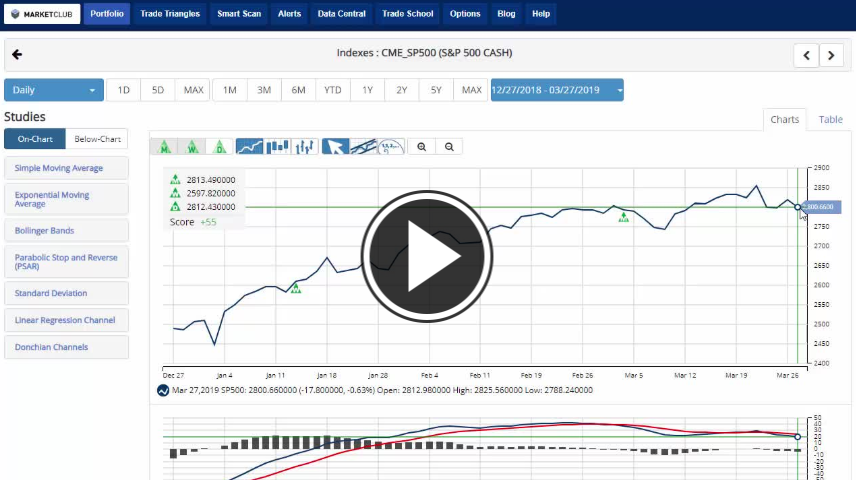
Falling Treasury Yield Pressures Market

Hello traders everywhere. The benchmark 10-year rate traded at 2.36% and hit its lowest level since late 2017. Investors are keeping an eye on rates after the 10-year fell below the 3-month rate last week for the first time since 2007. It is a development that investors call an inverted yield curve and is seen as an early indicator of a recession.

The U.S. Treasury yield curve has inverted before each recession in the past 50 years and has only offered a false signal just once in that time, according to data from Reuters.

10-year rate

Yields fell on Wednesday after Stephen Moore, who is expected to be nominated to the Federal Reserve Board of Governors, called for the central bank to cut rates by half a percentage point. Moore made his remarks in an interview with The New York Times, noting he is not a "dove" or a "sycophant" for President Donald Trump.

Key Levels To Watch This Week:

Continue reading "Falling Treasury Yield Pressures Market"

Treasury Inversion And Political Fed Cycles

With so much news hitting the wires regarding the Treasury Inversion level and the "potential pending recession", we wanted to shed a little insight into this phenomenon and what we believe the most likely outcome to be going forward. Our researchers, at Technical Traders Ltd., believe the Treasure inversion is a reactionary process to overly tight US Fed monetary policies, consumer demand factors and outside cycle forces. There is very little correlation to inverted Treasury levels and causation factors other than the US Fed and global central banks. We believe consumers and consumer sentiment also play a role in setting up the conditions that prompt yield inversion. The one aspect we believe everyone fails to consider is the uncertainty that is associated with major US election cycles.

The US Fed is obviously a driving force with regards to yields and consumer expectations. In the past, the US Fed has rotated FFR levels up and down by enormous amounts (in some cases 200 to 500%+ over very short spans of time. Consumers, you know those people, the ones that are the actual driving force of the local and state level economies, have been the the ones having to deal with wildly rotating FFR levels and the consequences of their debt rotating from 4~7% average interest rates to 8~25%+ average interest rates over the span of just a few years.

Take a look at this chart that highlights the current and previous US Federal Reserve FFR rate changes. It is quite easy to see that consumers and business, on the receiving end of these changes, often swing from one extreme to another as the US fed makes these dramatic moves. And, yes, that last 2400% number is correct. The FFR went from 0.06% to 2.4% over the past 3+ years – do the math yourself if you don't believe us. Continue reading "Treasury Inversion And Political Fed Cycles"

Sweet Surrender

Janet Yellen had a pretty easy job when she was the Federal Reserve chair. By keeping interest rates at or near zero for years on end, she never heard any criticism from the president, government officials or the financial markets. Since he became Fed chair a little over a year ago, Jerome Powell has gotten nothing but flack, from President Trump – who was at it again last week – to a whole swarm of people on Wall Street complaining that the Fed was ruining their returns.

Powell got the message several months ago, and last week he handed in his formal surrender. Not only did the Fed leave interest rates alone at its monetary policy meeting, but it indicated that there would likely be no more rate hikes the rest of this year, and maybe next year, too. “It may be some time before the outlook for jobs and inflation calls clearly for a change in policy,” Powell said.

The Fed also called a halt to the runoff in its still humungous Treasury securities portfolio. Beginning in May, the Fed will slow to $15 billion – from the current $30 billion -- the monthly redemptions of its Treasury holdings, with the runoff to end in October, meaning its balance sheet will start growing again.

So now Powell and his Fed mates can sit back blissfully and listen to the silence, at least for now. Continue reading "Sweet Surrender"

Yield Curves, 2-Year Yield, SPX (and a crack up boom?)

While the 30-5 year yield curve does this, implying some inflationary issues…

30yr yield minus 5yr yield

The more commonly watched 10-2 year does this, implying ongoing Goldilocks…

yield curve

While the nominal 2-year yield does this, implying “ruh roh!”Continue reading "Yield Curves, 2-Year Yield, SPX (and a crack up boom?)"