Weekly Futures Recap With Mike Seery

We've asked Michael Seery of SEERYFUTURES.COM to give our INO readers a weekly recap of the Futures market. He has been Senior Analyst for close to 15 years and has extensive knowledge of all of the commodity and option markets.

Michael frequently appears on multiple business networks including Bloomberg news, Fox Business, CNBC Worldwide, CNN Business, and Bloomberg TV. He is also a guest on First Business, which is a national and internationally syndicated business show.

Gold Futures

Gold futures in the February contract are down $16 this Friday afternoon in New York currently trading at 1,192 an ounce after settling last Friday at 1,175 with huge volatile this trading week with Monday’s trade going as low as 1,140 before rallying sharply hitting a 4 week high as the volatility is as high as I’ve ever seen it due to the fact that crude oil prices have plummeted coupled with a strong U.S dollar as I’m neutral this market and I’m advising traders to sit on the sidelines and look for another market with better chart structure with less risk. Gold futures are trading above their 20 but below their 100 day moving average telling you that the trend is mixed and I do believe that gold prices will continue to head lower as money flows will continue to head into the S&P 500 which is hitting another record high today but the volatility is too high and the risk/reward at the current time is not in your favor in my opinion. The month of December in recent years has been bearish as ETF selling in the gold has put pressure on prices as investors want to take a tax break on losing trades before the end of the year and I think that will continue this year as well as I still see no reason to own gold at the current time.
TREND: MIXED
CHART STRUCTURE: AWFUL
Continue reading "Weekly Futures Recap With Mike Seery"

Are Investors Pulling The Plug On Tesla (NASDAQ:TSLA)?

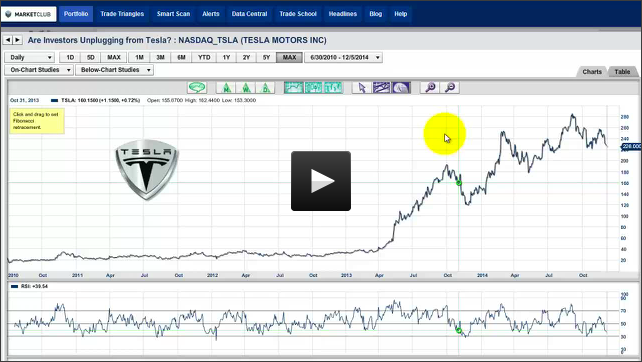
Hello investors and MarketClub members everywhere! Today I'm going to be looking at automobile stocks to find out just how positive the drop in gas prices has been for GM (NYSE:GM) and Ford (NYSE:F), but perhaps not so for Tesla (NASDAQ:TSLA). High gas price were a big selling point for Tesla and with gas prices recently falling to five year lows, it may be a harder sell to move Elon Musk's iconic Tesla "S" electric car.

Technically, Tesla is very close to giving a major exit signal which I will be sharing with you in today’s video. I will also be looking at some downside target zones for Tesla should this happen.

In today's video, I will also be looking at Ford and General Motors to see if cheap gas prices are having a positive or negative effect on either of those two stocks.

Gold will be discussed, which seems to be reawakening from its multi-year decline. You may remember that I indicated that 2015 could well be the start of a bull market in gold.

This being Friday, I will also look at stocks that are making 52-week highs and some that are making 52-week lows and decide which markets represent the best opportunities for a weekend trade.

Traders! Don't miss out on MarketClub's Special Holiday Promotion! Try the tools for 30 days for only $8.95, then take advantage of a Special Holiday Rate for 90 additional days of access (Save 40%!).

Enjoy today's video and have a great weekend everyone.

Adam Hewison
President, INO.com
Co-Creator, MarketClub

The Carry Trade That’s Set To Unravel

Lior Alkalay - INO.com Contributor - Forex


Carry trade... if that’s the first time you’ve come across that term you should know that "carry trade" is one of the oldest tricks in the books when it comes to foreign exchange trading. It is based on a very basic gap, specifically, the interest rate gap. The way investors use it to create alpha is by borrowing one currency with a lower interest rate and buying with the borrowed cash a currency with a higher one. The investor's gain is created then by the gap between what the borrower pays on the low yielding currency and what he earns on the high yielding currency. Of course, if the currency you buy appreciates in the process that would be even better.

Investors have been making good (i.e. profitable) use of this technique for years using various currencies. For instance, back in the 1990s and 2000s, investors would borrow the Japanese Yen, then buy the U.S. Dollar or Euro. Or as in the 2009-2010 period, they’d borrow the U.S. Dollar and buy the Euro (of course, back then rates were much higher). Usually, this would create inflows for the higher yielding currencies and as such lead to the currency’s appreciation. But what happens when this rate gap is threatened? As Euro bulls discovered just recently, it can create a meltdown of the trade rather quickly and the trend can reverse course just as fast. So, why am I telling you this? Why the sudden dive into the mechanics of the carry trade? Because just as you are reading those very words, a big carry trade is set to unravel and as it does, the trend it created is set up to reverse as well.

The Aussie Kiwi Carry Trade

One of most prominent carry trades of the past two years has revolved around the currencies of two neighboring countries, Australia and New Zealand. Ever since China’s economy began slowing and the commodity space began its bearish cycle, the Australian economy has likewise been slowing and, of course, as a result interest rates were cut to prevent the Aussie economy from further deterioration. However, while Australia suffered a slowdown, New Zealand, its smaller neighbor, has been faring well and growing above trend, thanks in large part to a prosperous dairy industry. Naturally, this created an interest rate deferential which is illustrated below and, as you might have guessed, a big carry trade that led the AUD/NZD to an utter collapse of 20.9% until it reached a multi-year low of 1.049. Yet, now as the pair is trading close to its record low, there are tentative signs emerging which suggest a turnaround could be in the making. This could lead the trend to reverse and allow investors to potentially bank on a big rebound of the AUD/NZD. Image courtesy of TradingEconomics.com.

New Zealand Interest Rate - Dec 2014

The Trend Unravels

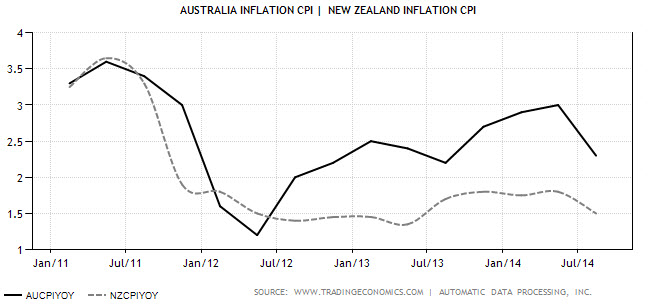
So, why is the trend on the verge of unraveling? In one word: inflation. If Australia had lower interest rates along with a rate of inflation lower than New Zealand’s own, the trend would have no reason to reverse. Australian interest rates would remain low (or else be at risk of dropping lower), while New Zealand would have rising inflationary pressures that would justify higher rates. But that is not the case at all. In fact, Australia’s annual inflation rate is more than double New Zealand’s. Aussie inflation was reported at 2.3% YoY while New Zealand’s inflation stands at a mere 1%, and that is in spite of the one-off effect of a reduction in Australia’s electricity tax that lowered inflation. In other words, while interest rates in Australia are much lower, the inflation rate is much higher, shaking the fundamentals of the trend. This means that while the Reserve Bank of Australia (RBA) has neither the space nor the rationale for easing, the Reserve Bank of New Zealand (RBNZ) has at least one reason to cut rates and none to raise them, leaving the fundamentals of the short AUD/NZD to crumble and open the space for a rebound. Image courtesy of TradingEconomics.com.
Australia Inflation CPI

Price and Projections

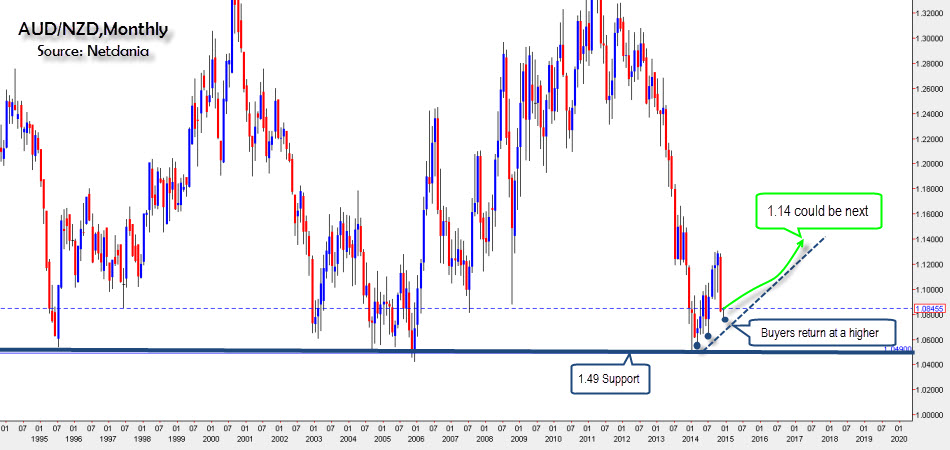
But now, there’s one final question, does the market show signs of a trend reversal in the AUD/NZD? The answer is yes. As seen below, each and every time the pair moved nearer to its record low of 1.049, buyers emerged. In fact, since the beginning of the year, buyers for AUD/NZD seem to reemerge, each time at a higher point, signaling a clear, albeit slow, sentiment shift. However, given that the RBNZ rate decision is set to take place next week and considering that the RBA took a decidedly neutral turn this week, the likelihood of an AUD/NZD trend reversal is on the rise, especially as the RBNZ governor continues, time and again, to point out that the Kiwi Dollar is "unjustifiably high." If that winds up being the case next week as well, that trend reversal could quickly accelerate. And as far as projections go? Looking at the chart, logically, we could be looking at a reversal toward at least 1.14 as this Aussie Kiwi carry trade unravels over the next couple of months.
AUD/NZD Monthly

Look for my post next week.

Best,

Lior Alkalay
INO.com Contributor - Forex

Disclosure: This article is the opinion of the contributor themselves. The above is a matter of opinion provided for general information purposes only and is not intended as investment advice. This contributor is not receiving compensation (other than from INO.com) for their opinion.

5 Stocks Ready To Rock

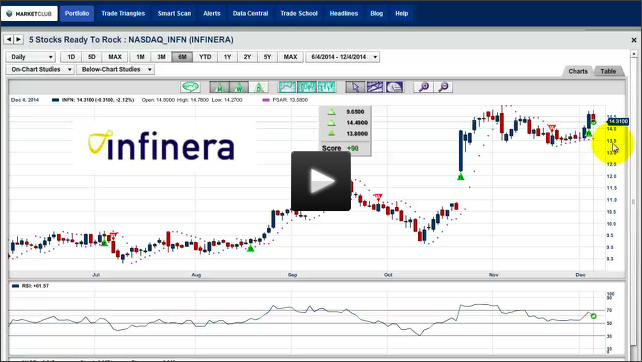
Hello traders and MarketClub members everywhere! It’s Thursday and I have five stocks for you that are ready to rock. Each of these stocks flashed a weekly Trade Triangle buy signal yesterday and all of them are sporting good technical chart formations.

Here are the five stocks I will be looking at and providing upside guidance for in today's video.

Infinera (NASDAQ:INFN)
Infinera Corporation provides optical transport networking (OTN) equipment, software, and services to communications service providers.

American Electrical Power (NASDAQ:AEP)
A public utility holding company, engaged in the generation, transmission, and distribution of electricity for sale to retail and wholesale customers.

Ameritrade Holdings (NYSE:AMTD)
Provides securities brokerage services and related technology-based financial services to retail and institutional investors.

HCA Holdings (NYSE:HCA)
Provides health care services. The company owns, operates and manages hospitals.

Morgan Stanley (NYSE:MS)
A financial holding company that provides various financial products and services to corporations, governments, financial institutions, and individuals worldwide.

I will be looking into each of these stocks in detail and providing guidance as to what I think is going to happen to each of them in the coming weeks and months.

Traders! Don't miss out on MarketClub's Special Holiday Promotion! Try the tools for 30 days for only $8.95, then take advantage of a Special Holiday Rate for 90 additional days of access (Save 40%!).

Have a great trading day,

Adam Hewison

President, INO.com

Co-Creator, MarketClub

Leveraged 3X ETFs Are Much More Dangerous Than You May Think!

Matt Thalman - INO.com Contributor - ETFs


Due to market demand, over the past few years we have begun to see another increase in investors' use of leverage. Just ten years ago all the rage was using leverage to buy more home than one could really afford. Before that, it was the increased use of credit cards and way back in the late 1920's it was trading stocks on margin. The use of leverage has time and again blown up in the faces of those who use it at an abusive level.

So today I would like to point out some of the dangers of Leveraged ETFs or better known as 3X ETFs. But first, let's talk about why it's hard to see the danger in these investments. I believe the most glaring reason is because we have been told that ETFs, or any group of investments bundled together in order to provide diversity, is safer than buying individual stocks or investments. And that is completely true, but what makes the leveraged ETFs dangerous is the leverage itself.

Deterioration Risk

The first item to consider is what it costs the ETF to gain 3X leverage. That price is often referred to as deterioration risk. The deterioration of invest-able capital is due to the price the ETF must pay other financial institutions to buy and sell investment instruments in order to gain the 3X price movement of the underlying ETF asset. If the ETF is invested in the oil industry for example, the industry itself will have a limited number of financial instruments to invest in, and often times those instruments will have very little liquidity. The lack of supply and lack of demand for the investment therefore pushes the price of the investment higher for the ETF to purchase. In turn, and over time, that increased cost will deteriorate part of the capital being used to invest.

Daily Trading Only

The next issue is the use of leverage and how it makes returns very unpredictable, especially over long periods of time. Direxion Investments is one company who offers leveraged ETFs. On their website, as well as in the profile summary of each of their leveraged ETFs, you can find a warning to investors which reads:

"These leveraged ETFs seek a return that is +300% or -300% of the return of their benchmark index for a single day. The funds should not be expected to provide three times or negative three times the return of the benchmark’s cumulative return for periods greater than a day."

Continue reading "Leveraged 3X ETFs Are Much More Dangerous Than You May Think!"