Deepwater Service Stocks Are Tapping the Supercycle Sweet Spot: Elliott Gue

The Energy Report: A lot has happened in the energy markets since your last interview. What are the most significant changes in the space?

Elliott Gue: The Gulf oil spill in May 2010 and the Fukushima event in March 2011 were the two most pivotal events of the past two years. The repercussions of the Gulf spill extended for over a year. Fukushima dramatically changed the policy toward nuclear energy in Japan and in Germany and caused a surge in global natural gas prices due to increased Japanese demand, Japan having suddenly lost about 30% of its power. Japan has since built new natural gas plants, which are the only plants that can be brought onstream very quickly to generate large amounts of power. Continue reading "Deepwater Service Stocks Are Tapping the Supercycle Sweet Spot: Elliott Gue"
The Solar Silver Thrust

By Jeff Clark, BIG GOLD

In early July, Japan set a premium price for solar energy that was three times the rate of conventional power. This meant utility companies would be paid three times more for electricity sourced from solar. It's widely expected that the premium will ignite the use of solar power – and solar uses a lot of silver.

Silver Demand from PV Panels

As you may know, silver is used in photovoltaic (PV) technology to generate solar power. A typical solar panel uses a fair amount of the metal – roughly two-thirds of an ounce (20 grams). To put that in perspective, a cellphone contains around 200 to 300 milligrams (a milligram weighs about as much as a grain of sand). A laptop contains 750 milligrams to 1.25 grams. Continue reading "The Solar Silver Thrust"

Systemic Stress is Building, and it’s Bullish (for now)

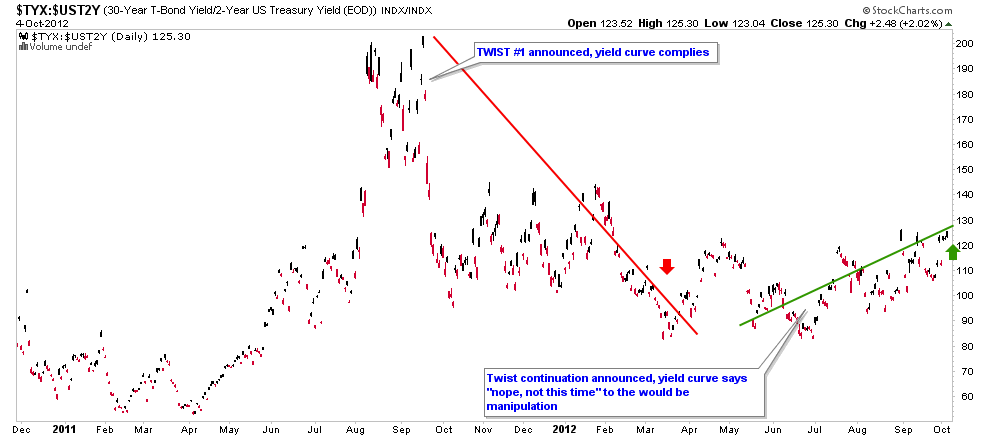
Using the spread between 30 year and 2 year US Treasury yields, we can gauge when policy makers are in control of market participants’ perceptions and when they are losing control to the free market’s will.

Operation Twist was announced in September of 2011 in the aftermath of the first phase of the Euro crisis as the yield curve had exploded higher, taking the monetary stress barometer, gold, with it.  Over bought on unbridled momentum, gold entered an extended correction in line with the yield curve, which complied with policy makers’ goal of calming down the system.  As shown many times in the past, gold and the 30-2 yield curve generally travel together. Continue reading "Systemic Stress is Building, and it’s Bullish (for now)"

Chart to Watch

We've asked our friend Jim Robinson of profittrading.com to provide his expert analysis of charts to our readers. Each week he'll be be analyzing a different chart using the Trade Triangles and his experience.

Today he is going to take a look at the technical picture of November Orange Juice (OJ.X12.E). I hope you had a GREAT week !

November Orange Juice made a double bottom, a breakout of the double bottom, and now looks to be making a higher low which is a probably a test of the breakout.

If the higher low holds and Orange Juice trades up from here that would paint a very bullish picture as the move after a higher low can often be a strong one.

The monthly MarketClub Trade Triangle is currently green which means the longer term monthly time frame is pointing up. Continue reading "Chart to Watch"

Canada – The New Evolution in Financial Security

By Greg McNally, International Man

With the OECD, EU and US continuing to put pressure on traditional financial centres, clients from emerging markets such as Russia, China and Brazil are now looking to new jurisdictions to plan for their financial security. One of those jurisdictions may be Canada.

In the case of Fundy Settlement v. Canada, 2012 SCC 14 [April, 2012], the Supreme Court of Canada ruled that a trust should be taxed where its "mind and management" is located, not where the trustee is resident. Although these locations could be the same, tax residency for Canadian purposes is now determined to be where the principal place of business of the trust is conducted.

Therefore, a company can be incorporated in Canada. That company can enter into a trust indenture as trustee (either on declaration, or settlement) on behalf of a client and, if the trustee engages a co-trustee or a trust administrator from outside of Canada to perform the day to day management of the trust, no tax consequences will arise in Canada. As a trust not subject to tax in Canada, there is also no requirement to file any sort of information or tax return. Continue reading "Canada – The New Evolution in Financial Security"