My last visit to New York proved to be a very fruitful one as I had the opportunity to attend the Trader's Expo, and more importantly, I got a chance to sit down with Bo Yoder from BoYoder.com. I've known of Bo when I first started here at INO, but he took time out and refocused on some top projects that meant a lot to him. He's back now and I'm excited to introduce you to him, his site, and the article below. Please enjoy the article and comment below so you can make Bo feel welcome!
As the markets fight for a bottom, there is a new wave of interest in the world of active trading and self-directed investing. These new traders have so many wonderful tools available to help guide them and accelerate their learning curve. Archives such as those offered by INO.com have all the information needed to build a solid background as a technically focused trader.
However, many beginning traders fail to understand that technical analysis at its root is the science of interpreting order flow. Let's look at one of the most fundamental technical analysis price patterns... the double bottom.
Born of a marriage between technical analysis, physics and pattern recognition, the pH-Indicators are elastic and focused on the future, like today’s broadband electronic markets. Static terms such as ‘overbought’ or ‘oversold’ force traders to make decisions with two-dimensional road maps in three-dimensional real time. These new indicators provide equity and forward market traders with tools that accurately reflect the market environment. The indicators help traders construct the appropriate three-dimensional map, showing first where the market itself wants to go and second, how to build a position ahead of and within the trend of those markets. As CAT-SCANs are to X-rays, these indicators offer a brand-new view of market internals. Boundaries imposed upon traditional concepts of momentum are no longer applicable.
In this session, Richard explains his unique outlook on pH-Indicators and how he uses them to achieve financial success. Richard uses these indicators to successfully manage money and he carefully considered the time and place to present them to the public. He chose TAG 20 as the appropriate forum because he felt it is where real traders come together in search of new methods to make real money. Workshop attendees were the very first traders ever to have access to Richard’s unique work; now you can share his insights, as well.
Richard Lees is president of Richard Lees Capital Management, a registered investment advisory in Los Angeles’ Studio City area, where his clients include members of the entertainment industry and other high net-worth individuals. He edits and publishes 21 Forward, a monthly investment newsletter and journal that offers uniquely detailed and unusual discussion of markets. The newsletter also gives specific recommendations for implementation of his proprietary pH-Indicators to profit from those markets. Richard was educated at Stanford, the University of Michigan, and Yale, and he has written about financial analysis for industry publications such as Barron’s, always exhibiting his trademark style of sharp wit and truly contrarian commentary. With a degree in psychology and a career as a professional writer, trading—or turning perception into money—came naturally to him. An active trader since 1982, Richard was one of the first to use sophisticated trading analysis software. His methods have shown consistency and sometimes startling accuracy in the stocks, options, and the forward markets." alt="null" />Richard Lees is president of Richard Lees Capital Management, a registered investment advisory in Los Angeles’ Studio City area, where his clients include members of the entertainment industry and other high net-worth individuals. He edits and publishes 21 Forward, a monthly investment newsletter and journal that offers uniquely detailed and unusual discussion of markets. The newsletter also gives specific recommendations for implementation of his proprietary pH-Indicators to profit from those markets. Richard was educated at Stanford, the University of Michigan, and Yale, and he has written about financial analysis for industry publications such as Barron’s, always exhibiting his trademark style of sharp wit and truly contrarian commentary. With a degree in psychology and a career as a professional writer, trading—or turning perception into money—came naturally to him. An active trader since 1982, Richard was one of the first to use sophisticated trading analysis software. His methods have shown consistency and sometimes startling accuracy in the stocks, options, and the forward markets.
---
Saturday Seminars are just a taste of the power of INO TV. The web's only online video and audio library for trading education. So watch four videos in our free version of INO TV click here.
MarketClub is known for our "Trade Triangle" technology. However, if you have used other technical analysis indicators previously, you can use a combination of the studies and other techniques in conjunction with the "Trade Triangles" to further confirm trends.
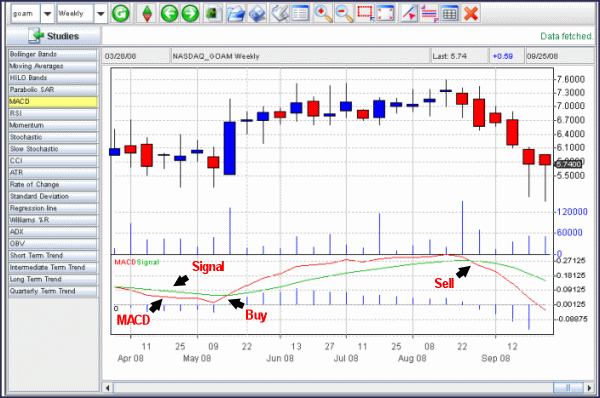
Developed by Gerald Appel, this indicator consists of two lines: a solid line called the MACD line and a solid line called the signal line. The MACD line consists of two exponential moving averages, while the signal line is composed of the MACD line smoothed by another exponential moving average.
To complete the standard calculation of the two lines, you must:
Calculate a 12-period exponential moving average of closing prices
Calculate a 26-period exponential moving average of closing prices
Plot the difference between the two calculations above as a solid line. This is your MACD line.
Calculate a nine-period exponential moving average of the MACD line and plot these results as a dashed line. This is your signal line.
MarketClub will do the above calculations for you. The MACD line is represented by a red solid line and the Signal line is represented by a green solid line. The default values for this study are set to the suggest values listed above.
The most useful signals generated from this system occur when the solid red (MACD) line crosses below the green solid line (Signal) and a sell signal occurs when it crosses above the signal line.
MarketClub is known for our "Trade Triangle" technology. However, if you have used other technical analysis indicators previously, you can use a combination of the studies and other techniques in conjunction with the "Trade Triangles" to further confirm trends.
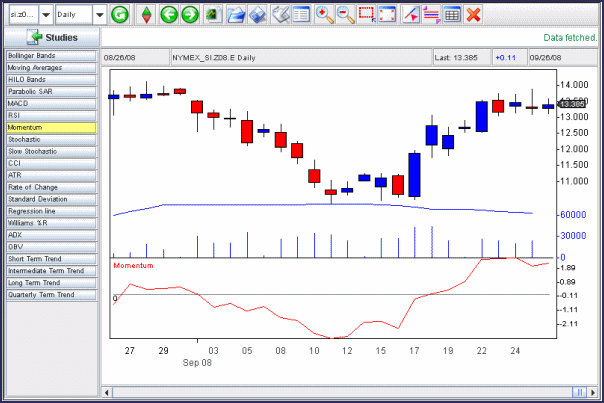
Momentum measures the change in a commodity's price with time. M = Pc-Pn where M = momentum, Pc = current period's price and Pn = price n periods ago.
The length of time used for the prior period is a matter of personal preference and time horizon of the trader. A narrow window of less than five periods back would be short-term in nature while six to nine periods would be considered intermediate; 10 or more would be a longer time perspective.
The most common value is 10 periods prior. Momentum is positive if today's price is higher than your past period's price and negative if not.
Momentum indicators give their best trading signals when they diverge (go in the opposite direction from prices). There are two types of divergences – bullish and bearish.
Bullish divergence occurs as price falls to a new low while the oscillator refuses to set a new low. This often signals the end of a downtrend.
Conversely, a bearish divergence occurs when price reaches new highs and the indicator doesn't confirm it by also reaching new highs.
You are now leaving a Magnifi Communities’ website and are going to a website
that is not operated by Magnifi Communities. This website is operated by Magnifi
LLC, an SEC registered investment adviser affiliated with Magnifi Communities.
Magnifi Communities does not endorse this website, its sponsor, or any of the
policies, activities, products, or services offered on the site. We are not
responsible for the content or availability of linked site.


 PDF Workbook
 Richard Lees is president of Richard Lees Capital Management, a registered investment advisory in Los Angeles’ Studio City area, where his clients include members of the entertainment industry and other high net-worth individuals. He edits and publishes 21 Forward, a monthly investment newsletter and journal that offers uniquely detailed and unusual discussion of markets. The newsletter also gives specific recommendations for implementation of his proprietary pH-Indicators to profit from those markets. Richard was educated at Stanford, the University of Michigan, and Yale, and he has written about financial analysis for industry publications such as Barron’s, always exhibiting his trademark style of sharp wit and truly contrarian commentary. With a degree in psychology and a career as a professional writer, trading—or turning perception into money—came naturally to him. An active trader since 1982, Richard was one of the first to use sophisticated trading analysis software. His methods have shown consistency and sometimes startling accuracy in the stocks, options, and the forward markets." alt="null" />Richard Lees is president of Richard Lees Capital Management, a registered investment advisory in Los Angeles’ Studio City area, where his clients include members of the entertainment industry and other high net-worth individuals. He edits and publishes 21 Forward, a monthly investment newsletter and journal that offers uniquely detailed and unusual discussion of markets. The newsletter also gives specific recommendations for implementation of his proprietary pH-Indicators to profit from those markets. Richard was educated at Stanford, the University of Michigan, and Yale, and he has written about financial analysis for industry publications such as Barron’s, always exhibiting his trademark style of sharp wit and truly contrarian commentary. With a degree in psychology and a career as a professional writer, trading—or turning perception into money—came naturally to him. An active trader since 1982, Richard was one of the first to use sophisticated trading analysis software. His methods have shown consistency and sometimes startling accuracy in the stocks, options, and the forward markets.